


 (916) 313-3030
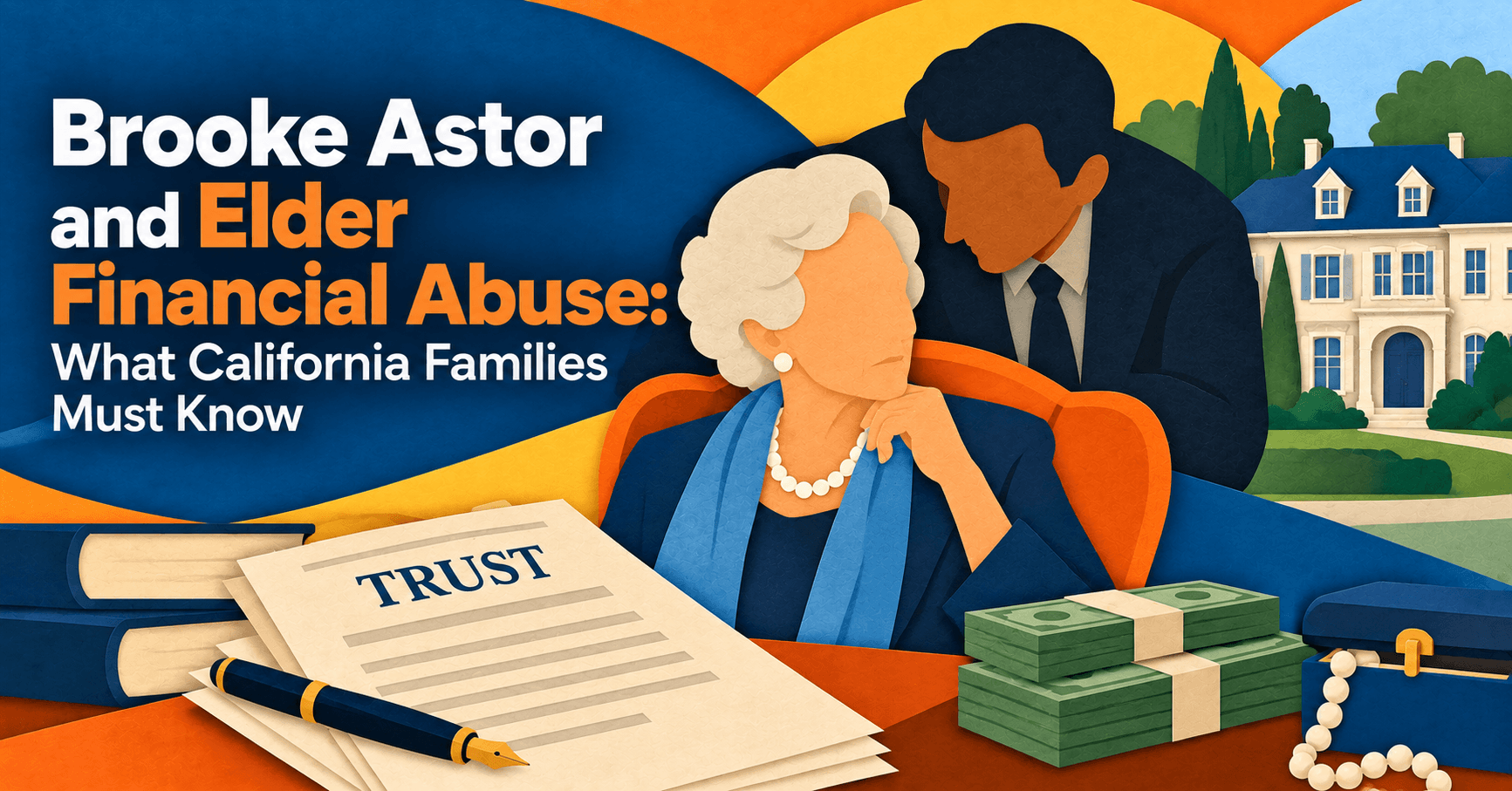
Brooke Astor and Elder Financial Abuse: What California Families Must Know

The Brooke Astor Story: A Warning Every Family Should Hear
I am Michael Hackard, founder of Hackard Law. Over five decades of practicing law, I have represented heirs, beneficiaries, and elder abuse victims across California – from Sacramento and the San Francisco Bay Area to Los Angeles. I have written four books on inheritance protection and produced more than 1,000 educational videos that have reached over seven million viewers. I tell those stories because the patterns they reveal are not isolated. They repeat themselves in families across this state, often with devastating results.
The story of Brooke Astor is one of the most instructive elder financial abuse cases in American history. She was a celebrated philanthropist, one of New York’s most admired public figures, and the last heir to one of the country’s great fortunes. Yet in her final years, the person entrusted with her care – her own son – systematically stripped her of her assets, her dignity, and her ability to make her own decisions. Her story is a window into how elder financial abuse operates, how it is enabled, and how it can be stopped.
Hackard Law provides contingency fee representation for qualified cases – no upfront costs to you. If you believe a loved one’s estate has been exploited, call us at (916) 313-3030.
Quick Summary
Brooke Astor was a famous philanthropist who died in 2007 at age 105, leaving behind a legacy of generosity – and a cautionary tale about elder financial abuse by a trusted family member. Her son Tony Marshall was convicted on 14 counts including grand larceny after exploiting her diminished capacity for years.
- Tony Marshall paid himself $1 million annually from his mother’s funds while cutting her medical care
- He transferred assets, sold artwork, and manipulated her will to redirect charitable bequests to himself
- His own son, Philip Marshall, filed the petition that exposed the abuse and triggered criminal charges
- Tony was sentenced to 1 to 3 years in prison; his conviction stands as a landmark elder abuse case
- Philip Marshall later founded Beyond Brooke, an organization dedicated to advancing elder justice
How the Abuse Unfolded
Brooke Astor’s only child, Anthony “Tony” Marshall, began managing her finances in the 1970s. For years, the arrangement appeared unremarkable. But as Brooke’s dementia progressed and her capacity diminished, Tony’s conduct shifted from management to exploitation.
He paid himself an annual salary of $1 million from her accounts. He transferred funds to his personal accounts. He removed priceless artworks from her Park Avenue apartment and sold them. He told his mother she was running out of money – a lie designed to justify selling her properties. And he allegedly cut her medications, reduced her nursing care, and curtailed her medical visits to redirect those resources to himself.
This is the architecture of elder financial abuse: isolate, deceive, diminish, and extract. It rarely happens all at once. It builds gradually, taking advantage of cognitive decline, emotional dependency, and the near-total trust that elderly parents often place in their children. For a deeper look at how these patterns develop, the complete elder exploitation guide at Hackard Law walks through the legal and factual markers attorneys look for.
The Will Manipulation That Changed Everything
Perhaps the most legally significant element of Tony Marshall’s conduct was his alleged manipulation of Brooke’s will. Tony and his attorney were accused of persuading Brooke – a woman with advancing dementia – to change her testamentary documents so that her remaining assets would pass to her son rather than to the charitable institutions she had spent a lifetime supporting.
This is a classic case of undue influence. Vulnerable person. Trusted confidant. Change in estate documents that benefits the influencer at the expense of the intended beneficiaries. Courts in California and New York take this conduct seriously, and rightly so. When someone rewrites a person’s last wishes because they have something to gain, that’s when the whole estate planning process falls apart..
Real estate and personal property are frequently at the center of these disputes. The removal and sale of Brooke’s artwork illustrates how real estate and property battles in trust litigation often extend well beyond the family home to include any high-value asset a manipulative party can convert to cash.
Case Pattern: A family member managing an elderly parent’s finances begins making transfers to personal accounts after the parent’s dementia diagnosis. Over several years, artworks, investment accounts, and real property are liquidated or retitled. When other family members finally gain access to financial records, the estate has been substantially depleted. Litigation to recover those assets – and to void the altered estate documents – becomes the only path forward.
The Whistleblower: Philip Marshall’s Courage
What makes the Brooke Astor case unusual is that the person who exposed the abuse was Tony Marshall’s own son – Philip Marshall, then a university professor. In 2006, Philip filed a petition in New York State Supreme Court accusing his father of neglecting Brooke’s care and exploiting her financially.
That was a choice Philip made at enormous personal cost. Tony was the one who had Brooke’s will tampered with. Philip only got $1 million from his grandmother’s estate instead of the $10 million she left him. The court threw out the amended will but the damage to Philip’s inheritance was not wholly undone. Asked if he would do it again, Philip said simply: “We saved my grandmother and that was my goal.
That kind of moral clarity is rare. It is also a reminder that the people best positioned to detect elder financial abuse are often those closest to the situation – and that coming forward carries real consequences. California law provides legal tools to protect those who act to stop exploitation, and early legal intervention can make a significant difference in what assets are ultimately recovered.
Case Pattern: An adult grandchild observes that an elderly relative is not receiving regular medical care and that a sibling or parent who controls the estate has begun making unexplained purchases. After consulting with counsel, the grandchild petitions to compel an accounting and requests the appointment of a professional fiduciary. The petition leads to a thorough investigation, and the disputed estate documents are contested in court.
The Criminal Conviction and Its Limits
Tony Marshall was indicted on 16 counts – including conspiracy, grand larceny, and possession of stolen property. His attorney and co-conspirator faced separate charges, including forgery. Tony was convicted on 14 of 16 counts and sentenced to 1 to 3 years in New York State Prison. He reported to prison in June 2013 at age 89, was granted medical parole after eight weeks, and died the following year.
The criminal outcome was significant, but it did not undo all the harm. Tony received $14.5 million from Brooke’s estate – an amount reduced by half due to the elder financial abuse lawsuit – and he left that entire sum to his widow and her children, disinheriting Philip entirely. The financial toll on the estate, and on Philip’s inheritance, was real and lasting.
Criminal prosecution is one avenue of accountability. In California, civil remedies are often more powerful for families seeking to recover stolen assets. The civil remedies available under California’s elder abuse statutes – including double damages and attorney fee recovery – exist precisely because the legislature recognized that financial exploitation of the elderly demands more than ordinary civil liability.
What California Law Offers Families Facing Elder Financial Abuse
California has some of the strongest elder financial abuse protections in the country. When a person in a position of trust – a family member, caregiver, attorney-in-fact, or financial advisor – takes, hides, or misappropriates an elder’s assets, California law authorizes courts to award enhanced remedies beyond simple restitution.
Those remedies include recovery of stolen assets, disgorgement of profits, double damages in certain circumstances, and attorney fee awards that shift the cost of litigation to the abuser. These tools matter because elder financial abuse victims and their families often lack the resources to fund extended litigation – and abusers count on that. Understanding what elder financial exploitation looks like in practice is the first step toward using those legal tools effectively.
For decades, I have stood with families who discovered – sometimes too late – that a trusted person had been quietly dismantling an elder’s estate. The fracture that abuse creates often runs too deep for any judgment to fully mend. But a steadfast commitment to truth restores what dishonesty tried to steal, and the law gives us real tools to pursue that restoration. Discovery, forensic accounting, and the civil remedies California provides are not just legal strategies – they are safeguards for families threatened by the very people who were supposed to protect their loved ones.
Key Definitions
- Elder financial abuse: The wrongful taking, concealment, or appropriation of an elder’s money, property, or assets by a person in a position of trust or confidence.
- Undue influence: Excessive persuasion that overcomes an elder’s free will, typically exercised by someone in a position of authority or trust, resulting in a change to estate documents or financial accounts.
- Testamentary capacity: The legal and mental ability to understand the nature and effect of making a will, including who one’s heirs are and what property one owns.
- Will contest: A legal challenge to the validity of a will, often based on lack of capacity, undue influence, fraud, or forgery.
- Conservatorship: A court-supervised arrangement in which a person is appointed to manage the personal affairs or finances of an adult who can no longer do so independently.
- Fiduciary: A person legally obligated to act in the best interests of another – such as a trustee, executor, or attorney-in-fact – and who can be held liable for self-dealing or misappropriation.
- Grand larceny: The theft of property exceeding a statutory dollar threshold, charged as a felony; in the Astor case, Tony Marshall was convicted of first-degree grand larceny.
- Double damages: A civil remedy available under California’s elder abuse statutes allowing courts to award twice the amount of financial harm in cases of egregious exploitation.
- Petition to compel accounting: A legal filing that requires a fiduciary to produce a formal record of all financial transactions involving an elder’s assets or estate.
- Beyond Brooke: A nonprofit organization founded by Philip Marshall to advance elder justice and combat elder abuse, inspired by the experience of his grandmother, Brooke Astor.
What to Do Next
- Find the sudden changes in an elder’s financial documents, including new wills, trust amendments, or power of attorney designations that favor a caregiver or family member.
- If you have legal standing, get copies of recent bank statements and financial records, and look for unexplained transfers or withdrawals.
- Try to avoid delay – elder financial abuse tends to escalate as the victim’s cognitive capacity declines and the abuser grows bolder.
- Look for signs of neglect alongside financial misconduct, as Tony Marshall’s case shows that physical and financial abuse often occur together.
- Consult an attorney who handles elder financial abuse cases in California before confronting the suspected abuser directly.
- Try to avoid disposing of any documents or communications that may serve as evidence of manipulation or coercion.
- Look into whether California’s civil remedies – including double damages – apply to your situation, as they can significantly affect what your family is able to recover.
- Get copies of any estate planning documents the elder signed in the period after cognitive decline began, as those are most vulnerable to challenge.
- Learn about the contingency fee options available to California families, which allow litigation to proceed without upfront legal costs.
- Call Hackard Law at (916) 313-3030 to share your story and find out whether your family’s situation qualifies for representation. You can also reach us through our contact page.
CALL THE SAGE | When Experience Matters, Families Listen
🏛️ We practice California trust & estate & elder financial abuse litigation
⚖️ We represent heirs, beneficiaries, and elder abuse victims
🎥 1,000+ educational videos | 7 million+ views | 6 published books
🎯 “After thousands of cases, I see the pattern others miss.”
CONTINGENCY REPRESENTATION – No Win, No Fee
Throughout California: Sacramento | Los Angeles | Bay Area
📞 CALL THE SAGE: (916) 313-3030
Subscribe for weekly insights on:
- Elder financial abuse warning signs and prevention
- Trust and estate litigation strategies
- Inheritance protection for California families
- Family protection strategies
When your inheritance is under attack, Call The Sage.
Hackard Law | 10640 Mather Blvd, Mather CA 95655
Attorney Advertisement | Michael Hackard, State Bar #71067
RELATED VIDEOS
Elder Financial Abuse in California | A Growing Threat to Seniors
Explains how elder financial abuse affects California seniors and what families can do.
How Families Stop Elder Financial Abuse | Communication & Trust
Explores how open family communication can prevent exploitation of vulnerable elders.
The Case of Stan Lee | Elder Financial Abuse?
Examines allegations that a celebrity was financially exploited in his final years.
POA Vultures | Power of Attorney Abuse
Looks at how trusted agents misuse power of attorney to steal from elders.
Financial Elder Abuse | The Decedent Had Capacity – So What?
Addresses why claimed mental capacity doesn’t always shield financial abuse from legal challenge.
The Cost of Elder Financial Abuse | California Estate & Trust Litigation
Breaks down the financial and emotional toll elder abuse takes on California families.
 Michael Hackard is the founder of Hackard Law, a California trust and estate litigation firm with more than five decades of experience protecting the inheritance rights of families across Sacramento, the San Francisco Bay Area, and Los Angeles. He is the author of six published books and has produced more than 1,000 educational videos with over seven million views.