


 (916) 313-3030
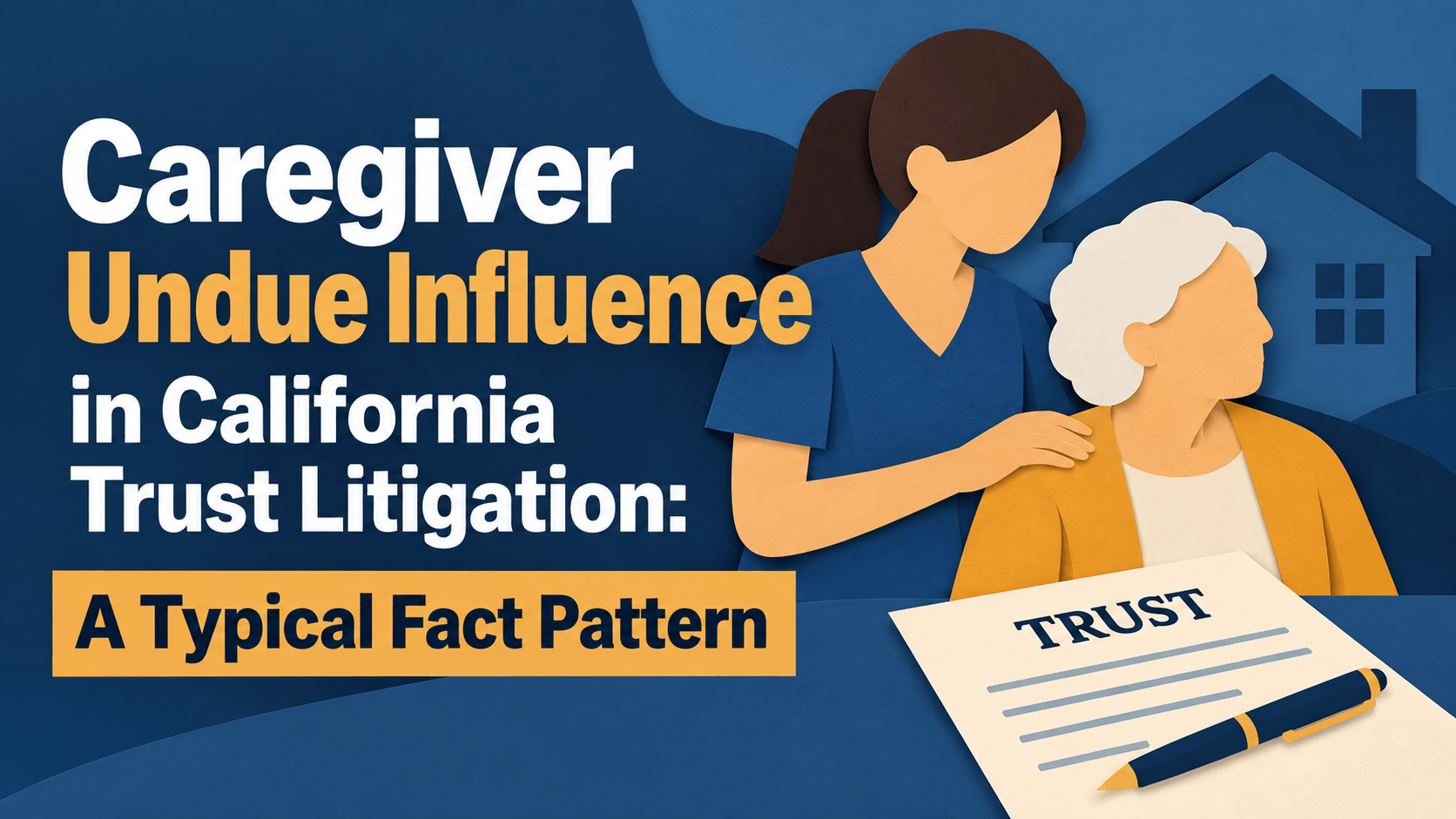
Caregiver Undue Influence in California Trust Litigation: A Typical Fact Pattern

What This Case Pattern Reveals
I am Michael Hackard, founder of Hackard Law. Over five decades of practice, I have fought for heirs, beneficiaries, and elder abuse victims across California – from Sacramento and the San Francisco Bay Area to Los Angeles. I have authored four books on inheritance protection and produced more than 1,000 educational videos that have reached over seven million viewers. In that time, I have seen one pattern emerge with troubling regularity: a vulnerable elder, a caregiver who moves in, and an estate that quietly changes hands before the family realizes what happened.
The scenario I walk through below is a composite teaching case – a distillation of the fact patterns that appear again and again in California trust litigation. It is not the story of any single client, but it reflects the real dynamics that drive these disputes. If any part of it sounds familiar, your family may be facing the same threat.
Hackard Law provides contingency fee representation for qualified trust and estate litigation cases – no upfront costs to get started. Call us at (916) 313-3030 to discuss your situation.
Quick Summary
Caregiver undue influence cases follow a recognizable arc: isolation, dependence, and last-minute trust amendments that cut out the rightful heirs. California law provides tools to fight back, but the deadlines are strict.
- A trust amendment obtained through undue influence can be challenged in California court
- Cognitive decline is a key factor courts consider when evaluating testamentary capacity
- Isolation of the elder from family is one of the strongest indicators of undue influence
- California’s no-contest statute deadlines – typically 120 days – are hard cutoffs that must be respected
- Hackard Law litigates these cases on contingency throughout California
The Setup: A Well-Structured Estate Plan
Delta was born in 1928 and spent her life building something worth protecting. She married Beau in 1950, raised two daughters – Ava and Becky – and after Beau’s death in 2000, she worked with an attorney to create a revocable living trust. The trust was straightforward: Delta controlled everything during her lifetime, and at her death, her Moraga home, bank accounts, and securities would pass in equal shares to her daughters. Ava was named first successor trustee, Becky second.
This is exactly how a thoughtful estate plan is supposed to work. The trust reflected Delta’s genuine wishes, made during a period when she had full capacity and no outside pressure. That clarity matters later – because what followed was a direct assault on everything she intended.
Cognitive Decline and the Opening for Manipulation
By 2010, Delta was being treated for high blood pressure. Ava and Becky began noticing something more troubling: Delta could not hold a meaningful conversation, could not remember what had been discussed, and by Christmas 2013, could no longer recall her grandchildren’s names. Bills went unopened. Bank statements piled up. Her physician documented dementia and noted that Delta could no longer drive or shop without help.
This is the window that predatory caregivers look for. A person with diminishing cognitive capacity is not just vulnerable to physical harm – she is vulnerable to legal manipulation. Courts in California examine this period closely. Medical records, physician notes, and family observations all become evidence of whether a person had the mental capacity to execute a valid trust amendment. Understanding what California beneficiaries can do when a trustee delays or acts improperly begins with understanding how trust control is obtained in the first place.
Case Pattern: Cognitive Decline as a Gateway to Control
In cases following this pattern, a caregiver enters the home during a period of documented medical decline. Within months, family members report being unable to reach their loved one by phone. Shortly before death, a new trust amendment surfaces naming the caregiver as sole beneficiary. The medical records from that period – often showing dementia, anxiety, or recurrent falls – become central to the litigation.
Isolation, Transfers, and the Trust Amendment
Ava and Becky hired Sheila as a live-in caretaker for Delta. What they did not anticipate was that Sheila would use that position to sever Delta’s connection to her family. Sheila cut off Delta’s phone communications with both daughters. With Delta isolated and dependent, Sheila convinced her to transfer the Moraga house and add Sheila to her bank accounts. Then Sheila accompanied Delta to an attorney’s office – an attorney Sheila had selected – where a trust amendment was signed making Sheila the trustee and sole beneficiary.
Delta died two months later.
This sequence is not accidental. Isolation is the mechanism. Dependence is the leverage. The trust amendment is the result. California courts recognize this pattern, and the 8 stages of trust and estate litigation often begin precisely here – with a family discovering, after death, that the estate plan they knew has been replaced by one they never saw.
Case Pattern: The Caregiver as Sole Beneficiary
In cases like Delta’s, the caregiver-turned-beneficiary often argues that the elder made a free and voluntary choice. But the record tells a different story: isolation from family, documented cognitive decline, a new attorney selected by the caregiver, and a trust amendment signed weeks before death. Courts look at the totality of these circumstances, not just the signature on the page.
The Notice and the Deadline
After Delta’s death, Fletcher – the attorney Sheila had hired – sent Ava and Becky a formal notice. The language was precise and intentional: you have 120 days from this notice, or 60 days from receiving a copy of the trust terms, whichever is later, to bring a contest. Miss that window, and the right to challenge is gone.
This is not a technicality. It is a hard legal cutoff under California Probate Code. Families who delay – waiting to see if things resolve on their own, or hoping for more information – can lose their right to contest entirely. The top probate and trust battles in California almost always involve a race against these deadlines.
Ava and Becky did not wait. They came to Hackard Law, and we got to work.
What California Law Provides
California has strong statutory tools for challenging trust amendments obtained through undue influence. A successful contest can void the amendment entirely, restoring the trust to its prior terms – in Delta’s case, equal shares for Ava and Becky. Beyond the trust contest, California’s elder financial abuse statutes provide additional remedies, including the recovery of assets transferred under undue influence and, in appropriate cases, attorney’s fees.
The contingency fee model exists precisely for cases like this one. Heirs and beneficiaries who have been cut out of an estate often have no liquid assets to fund litigation – because those assets were taken. A contingency arrangement levels the playing field. For families in Sacramento, the Bay Area, Los Angeles, and across California, this access to representation can make the difference between recovery and loss.
For decades, I have stood with families in exactly this position – arriving after the damage was done, working to undo what manipulation tried to make permanent. Discovery, forensic analysis, and the pursuit of justice are not just legal strategies. They are safeguards for families threatened by undue influence and fraud. The financial toll grows with every month of delay, and the fracture within a family often runs too deep for any judgment to fully mend. A steadfast commitment to truth, backed by experienced litigation, restores what dishonesty tried to steal.
Key Definitions
- Undue influence: Pressure or manipulation that overcomes a person’s free will and substitutes another person’s intent for their own in a legal document.
- Testamentary capacity: The mental ability required to execute a valid will or trust amendment – understanding the nature of the act, the extent of assets, and the identity of natural heirs.
- Revocable living trust: A trust created during the grantor’s lifetime that can be amended or revoked, and that passes assets outside of probate at death.
- Trust amendment: A formal change to the terms of an existing trust, which must meet the same capacity and voluntariness standards as the original document.
- No-contest clause: A provision in a trust that threatens to disinherit a beneficiary who challenges the trust – but in California, such clauses are narrowly enforced.
- Contest deadline: Under California Probate Code, a trust contest must typically be filed within 120 days of trustee notice or 60 days of receiving trust terms, whichever is later.
- Isolation: A recognized indicator of undue influence – cutting off an elder’s contact with family members to increase dependence on a caregiver or other third party.
- Successor trustee: The person named to take over trust administration after the original trustee dies or becomes incapacitated.
- Elder financial abuse: Under California law, the taking of an elder’s property through undue influence, fraud, or other wrongful means – subject to civil remedies including double damages.
- Contingency fee: A fee arrangement in which the attorney is paid only if the case is won or settled, with no upfront cost to the client.
What to Do Next
- Look for medical records documenting cognitive decline – physician notes, hospital records, and prescription histories are critical evidence.
- Get copies of all trust documents, including any amendments, as soon as possible after a loved one’s death.
- Try to avoid waiting to see if the situation resolves – the 120-day contest deadline begins running from the trustee’s notice.
- Document any evidence of isolation: unanswered calls, blocked visits, or reports from neighbors and other family members.
- Look for financial records showing transfers of property or account changes that occurred after a caregiver moved in.
- Try to identify who selected and paid the attorney who drafted the amendment – that relationship matters in court.
- Get an independent assessment of the elder’s cognitive state during the period the amendment was signed.
- Look for any prior estate planning documents that reflect the elder’s true, uninfluenced intent.
- Call Hackard Law at (916) 313-3030 to discuss your case before the contest deadline passes.
- Reach out through our contact page to schedule a confidential consultation with our litigation team.
CALL THE SAGE | When Experience Matters, Families Listen
🏛️ We practice California trust & estate & elder financial abuse litigation
⚖️ We represent heirs, beneficiaries, and elder abuse victims
🎥 1,000+ educational videos | 7 million+ views | 6 published books
🎯 “After thousands of cases, I see the pattern others miss.”
CONTINGENCY REPRESENTATION – No Win, No Fee
Throughout California: Sacramento | Los Angeles | Bay Area
📞 CALL THE SAGE: (916) 313-3030
Subscribe for weekly insights on:
- Elder financial abuse warning signs and prevention
- Trust and estate litigation strategies
- Inheritance protection for California families
- Family protection strategies
When your inheritance is under attack, Call The Sage.
Hackard Law | 10640 Mather Blvd, Mather CA 95655
Attorney Advertisement | Michael Hackard, State Bar #71067
RELATED VIDEOS
Anatomy of Trust Litigation | Protecting Beneficiaries
Walks through how trust litigation works and what beneficiaries can do to protect themselves.
California Trust & Estate Litigation | Delay Is Not Your Friend
Explains why acting quickly on trust disputes is critical given California’s strict deadlines.
The 3 Biggest Risks to Family Wealth | CA Estate & Trust Litigation
Covers the most common threats that put family inheritances and estates at risk in California.
Unfair Trust Distributions | California Trust Litigation
Addresses what heirs can do when trust distributions seem manipulated or deeply unfair.
What Are Common Acts of Fraud in Trust or Probate? | California Estate Litigation Attorney
Describes the most frequent forms of fraud that arise in California trust and probate cases.
Trust Litigation Scenarios | Part 3
Presents real-world trust dispute scenarios and how they typically play out in litigation.
 Michael Hackard is the founder of Hackard Law, a California trust and estate litigation firm with more than five decades of experience protecting the inheritance rights of families across Sacramento, the San Francisco Bay Area, and Los Angeles. He is the author of six published books and has produced more than 1,000 educational videos with over seven million views.