I am Michael Hackard, founder of Hackard Law. Over my five decades of practice, I have fought for heirs, beneficiaries, and elder abuse victims across California – from Sacramento and the San Francisco Bay Area to Los Angeles. I have authored six books on inheritance protection and produced more than 1,000 educational videos with over seven million views. The story of Peter Max is one I return to often, because it captures every element of what happens when a brilliant mind begins to fade and the people surrounding that mind have competing interests – and competing claims to a fortune.
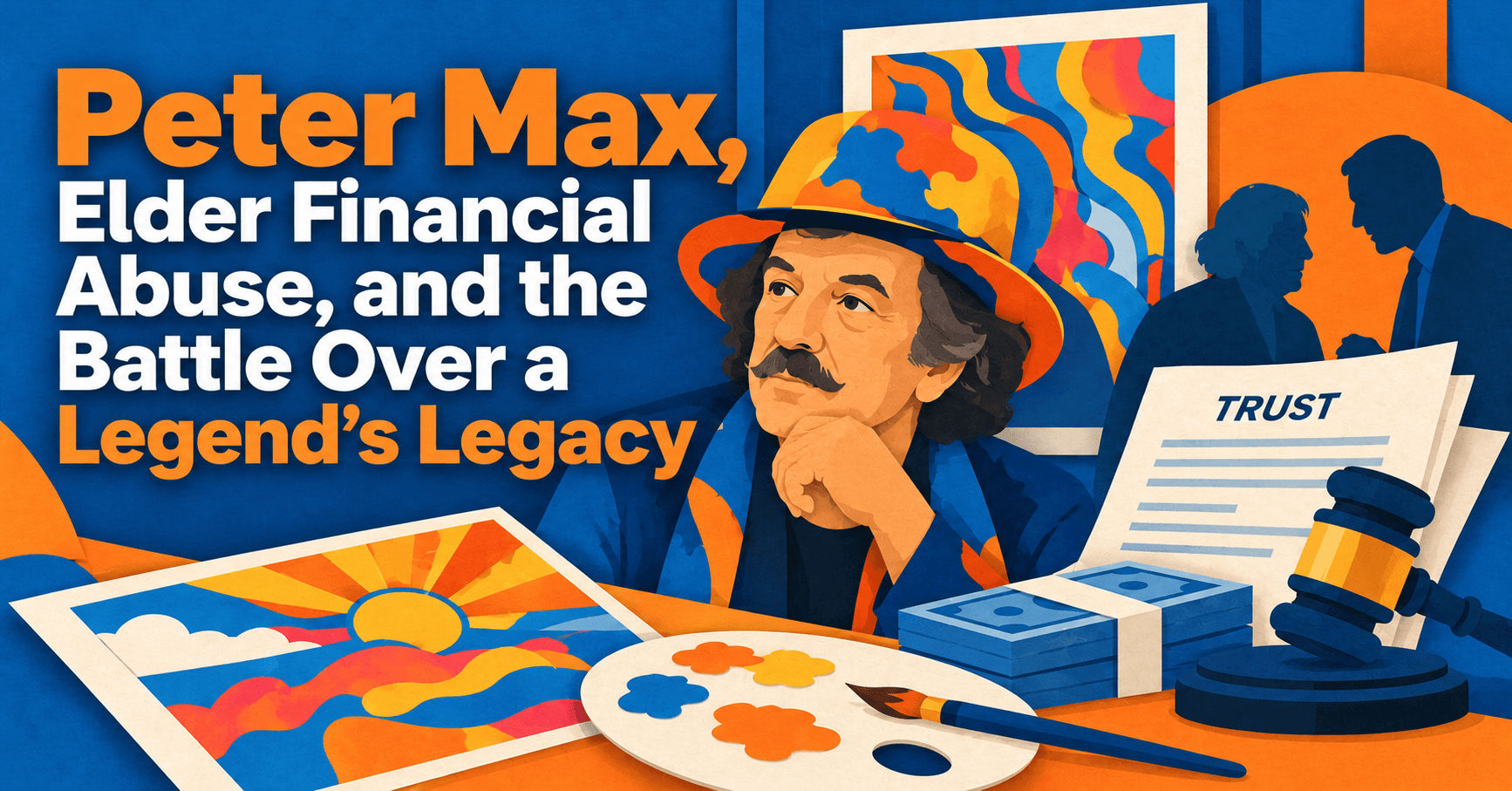
Peter Max was a countercultural icon. His psychedelic paintings defined an era, appeared on cereal boxes and cruise ships, and earned him comparisons to Andy Warhol and Jeff Koons. After financial troubles in the late 1990s, he rebuilt his career through a partnership with Park West Gallery, selling art at cruise ship auctions that generated over $93 million between 2012 and 2018. But by 2012, at age 75, Max had begun showing signs of Alzheimer’s disease and dementia. What followed was a legal and family battle that illustrates the devastating intersection of cognitive decline, family conflict, and financial exploitation.
Hackard Law provides contingency fee representation – no upfront costs for qualified cases. If you believe a loved one has been financially exploited, call us at (916) 313-3030.
Quick Summary
The Peter Max case is a cautionary tale about what can happen when a wealthy artist with dementia becomes the center of a family and business power struggle.
Peter Max’s son Adam took financial control of the studio as his father’s dementia worsened, allegedly ramping up production using 18 assistant painters while Max signed the work.
Max’s wife Mary sought court-appointed guardianship; Adam responded by relocating his father to an undisclosed location.
His daughter Libra eventually took over, filing lawsuits against her brother and against Park West Gallery, claiming 23,000 works were sold far below their true value.
The case raises unresolved questions about elder financial abuse, guardianship, and the exploitation of a person with diminished mental capacity.
Courts have yet to fully resolve the competing claims, and Max himself reportedly remains unaware of the legal storm surrounding his legacy.
When Dementia Opens the Door to Exploitation
Alzheimer’s disease and dementia do not arrive all at once. They erode judgment gradually, creating a window during which a person may still appear functional while becoming increasingly vulnerable to manipulation. In Peter Max’s case, that window coincided with the peak commercial value of his art. The timing was not coincidental – it rarely is.
As Max’s capacity declined, the people around him made financial decisions that generated tens of millions of dollars. His son Adam took over studio finances in 2012, the same year the business defaulted on $5.4 million in bank loans and Hurricane Sandy flooded Max’s New Jersey warehouse. A $300 million flood insurance claim followed. Rather than scaling back, Adam and two business associates chose to scale up – hiring 18 assistant painters to produce work that Max would then sign. The New York Times documented this arrangement through sworn affidavits.
This pattern – using a cognitively impaired person’s name, signature, and reputation to generate income without their meaningful consent – sits at the heart of what California law recognizes as elder financial exploitation. For families watching a parent or spouse decline, understanding this pattern early can be the difference between protecting an estate and losing it entirely. Early legal intervention in elder financial abuse casesis often the most important step a family can take.
Case Pattern: A Signature Used Without True Consent
A relative with moderate dementia is still signing documents and artwork at the direction of a business associate. “The signings were voluntary and legally binding,” the associate later says. Judges who have considered these arrangements have often found that the cognitive impairment was such that there was no meaningful consent, allowing claims of fraud and elder abuse.
Guardianship, Kidnapping Claims, and Family Conflict
When Peter Max’s wife Mary petitioned the New York Supreme Court to appoint a guardian for her husband, she was doing what many spouses do when they see a loved one being financially controlled by others. Adam Max’s response – relocating his father to an undisclosed location – escalated the conflict dramatically. Mary called it kidnapping. Adam called it protection from an abusive stepmother.
Mary was described in several sworn affidavits as neglectful and punitive to her husband. Even the protector she had wanted to set up grew worried about her behavior. This is a pattern that we see in many high-conflict elder cases: the person making abuse allegations may himself be a source of harm, and the courts are left to sort through competing narratives with an incapacitated person at the center.
Guardianship proceedings are not administrative. They decide who runs a person’s life, finances and legacy. But where those proceedings are contested, the stakes increase considerably for heirs and beneficiaries. Understanding the civil remedies available for elder financial abuse– including double damages and attorney fee recovery – can help families respond with the full force of the law.
Case Pattern: Competing Claims Between a Spouse and Adult Children
A surviving spouse and adult children from a prior marriage each accuse the other of exploiting an incapacitated parent. Courts must evaluate credibility, financial records, and the timeline of the person’s cognitive decline. In many cases, both sides have engaged in conduct that harmed the elder – and the estate pays the price.
The Business of Art and the Fraud Allegations
By 2018, Park West Gallery’s cruise ship auctions were generating $30 million in net profit annually from Peter Max’s work. Libra Max, after being named president and CEO following her brother’s removal, filed suit against Park West alleging that the gallery had taken 23,000 works of her father’s art – paying only $14.7 million for inventory she claimed was worth at least $100 million. Park West countersued for breach of contract.
It’s more than a family feud. It raises the question of whether a business partner knowingly profited from a relationship with a cognitively impaired artist who could not meaningfully evaluate the terms of any transaction. California’s elder financial abuse laws apply not only to family members, but also to business associates, agents, and anyone who financially exploits a dependent adult.
Families dealing with similar situations – where a business or professional relationship has extracted value from a person who lacked capacity – should understand that the law provides meaningful remedies. California’s elder financial exploitation framework is designed precisely for situations where the harm was systematic rather than opportunistic.
What California Law Says About Cognitive Decline and Financial Exploitation
California’s Elder Abuse and Dependent Adult Civil Protection Act provides some of the strongest statutory protections in the country. A person who takes, secretes, appropriates, or retains property belonging to an elder through undue influence, fraud, or the abuse of a confidential relationship can face liability for the full value of the assets taken, plus double damages and attorney fees in appropriate cases.
Cognitive decline does not have to be total for exploitation to occur. Courts examine the person’s capacity at the time of specific transactions, not their general condition. A person with moderate dementia may retain capacity for some decisions while lacking it for others. When business associates or family members exploit that ambiguity – pushing through transactions during moments of apparent lucidity – courts have the tools to unwind those transactions.
Hackard Law litigates these cases across California, drawing on decades of experience with the financial and evidentiary patterns that define elder exploitation. Guarding against elder financial abuse in trust and estate casesrequires both legal knowledge and the willingness to pursue accountability.
Key Definitions
Elder financial abuse: The taking, secreting, or appropriation of an elder’s property through fraud, undue influence, or breach of a confidential relationship.
Dependent adult: Under California law, a person aged 18-64 with physical or mental limitations that restrict their ability to carry out normal activities or protect their own rights.
Guardianship: A court-supervised arrangement in which a designated person manages the personal and/or financial affairs of someone who lacks capacity.
Undue influence: Excessive pressure that overcomes a person’s free will, particularly in the context of financial or estate decisions.
Cognitive incapacity: A mental condition that impairs a person’s ability to understand the nature and consequences of their decisions.
Confidential relationship: A relationship in which one party places trust and confidence in another, creating a duty not to exploit that trust for financial gain.
Double damages: A statutory remedy under California elder abuse law that allows courts to award twice the actual damages in proven exploitation cases.
Conservatorship: A court-ordered arrangement giving a designated person authority over an incapacitated adult’s finances, property, or personal care.
Breach of fiduciary duty: A violation of the legal obligation owed by a trustee, agent, or other fiduciary to act in the best interests of the person they represent.
Fraudulent transfer: The movement of assets to avoid creditors or deprive rightful heirs and beneficiaries of their inheritance.
What to Do Next
Watch for signs of cognitive decline in a parent or loved one and write down what you see, including dates and specific incidents.
Get copies of all recent financial documents, including bank statements, contracts and any changes to estate planning made after the decline began.
Do not directly approach suspected exploiters before speaking with an attorney — they may make evidence disappear.
Look for changes in estate documents, beneficiary designations, or business agreements that occurred after the person’s capacity began to diminish.
Get a professional assessment of your loved one’s cognitive status if you believe financial decisions were made without true understanding.
Try to avoid delays – California’s statutes of limitations on elder abuse claims are strict, and early action preserves options.
Look for patterns rather than isolated incidents: exploitation is rarely a single act but a course of conduct over time.
Call Hackard Law at (916) 313-3030 to discuss your situation with an attorney who has spent decades protecting heirs, beneficiaries, and elder abuse victims.
Visit our contact pageto reach us online and schedule a consultation.
CALL THE SAGE | When Experience Matters, Families Listen
🏛️ We practice California trust & estate & elder financial abuse litigation
⚖️ We represent heirs, beneficiaries, and elder abuse victims
Outlines why acting quickly is critical when elder financial abuse is suspected.
Frequently Asked Questions
California’s elder abuse statutes apply to anyone who takes financial advantage of an elder or dependent adult – including business associates, gallery owners, agents, and professional advisors. The key question is whether the person knew or should have known that the elder lacked capacity to consent to the transaction.
Contracts signed by a person who lacked mental capacity at the time of signing can be voided or rescinded under California law. Courts look at the person’s condition at the moment of the specific transaction, not their general diagnosis, so detailed documentation of cognitive decline is critical to these cases.
Courts evaluate the best interests of the incapacitated person, including the fitness, availability, and conduct of each proposed guardian. Evidence of financial exploitation, neglect, or abuse by any candidate weighs heavily against their appointment, and courts may appoint a neutral professional guardian when family conflict is severe.
Not necessarily. California’s elder abuse statutes have specific limitations periods, but courts may extend them when the exploitation was concealed or when the victim lacked capacity to recognize the harm. Speaking with an attorney promptly gives you the best chance of preserving your claims and recovering assets.
Financial records showing the timing and volume of transactions relative to the person’s cognitive decline are central. Witness accounts, medical records, sworn affidavits, and business agreements entered during the period of impairment all contribute to building a compelling case for the court.
About the Author
Michael Hackard is the founder of Hackard Law, a California trust and estate litigation firm with more than five decades of experience protecting the inheritance rights of families across Sacramento, the San Francisco Bay Area, and Los Angeles. He is the author of six published books and has produced more than 1,000 educational videos with over seven million views.


 (916) 313-3030

 Michael Hackard is the founder of Hackard Law, a California trust and estate litigation firm with more than five decades of experience protecting the inheritance rights of families across Sacramento, the San Francisco Bay Area, and Los Angeles. He is the author of six published books and has produced more than 1,000 educational videos with over seven million views.