


 (916) 313-3030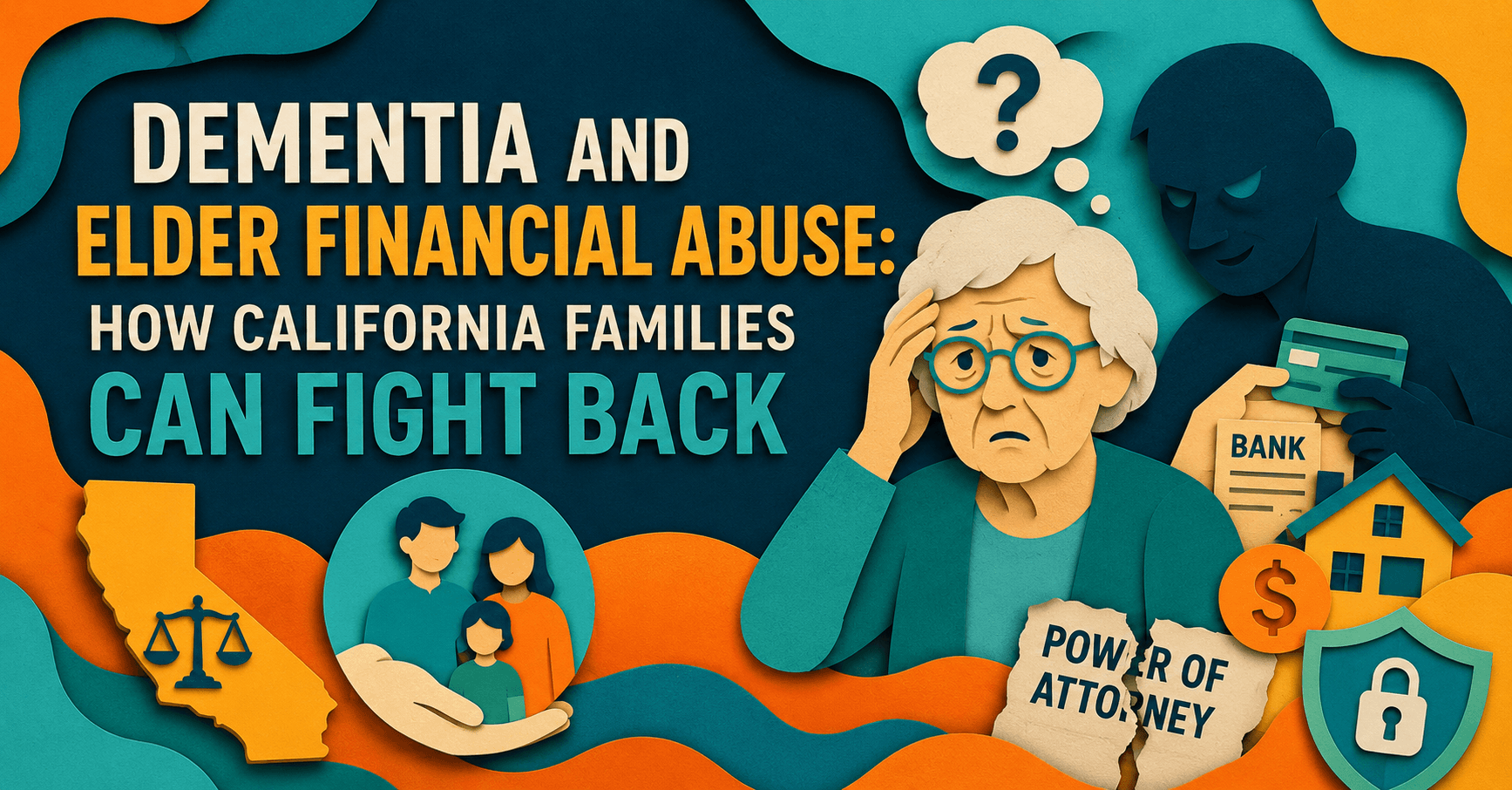
Dementia and Elder Financial Abuse: How California Families Can Fight Back

Why Dementia Makes Elders a Target
I am Michael Hackard, founder of Hackard Law, and over five decades of practice I have fought for heirs, beneficiaries, and elder abuse victims across California – from Sacramento to the San Francisco Bay Area and Los Angeles. I have written four books on inheritance protection, and my firm has produced more than 1,000 educational videos that have reached over seven million viewers. I bring that depth of experience to every family that calls us.
Approximately 5.8 million Americans are living with Alzheimer’s disease, and roughly 670,000 of them live in California. Financial transactions today happen at speeds that would have been unimaginable twenty years ago. For an elder whose judgment, memory, and self-awareness are compromised by dementia, that speed creates a dangerous gap – one that financial predators are eager to fill. The warning signs are consistent: declining ability to judge risk, isolation, reluctance to discuss money matters, and limited awareness of their own vulnerability. Families in the Bay Area and across California need to understand this landscape before a crisis arrives.
Hackard Law provides contingency fee representation for qualified elder financial abuse cases – no upfront costs to you. If you believe a loved one has been exploited, call us today at (916) 313-3030.
Quick Summary
The victims of such predatory activity are older people who suffer from dementia, and include family members, caretakers, attorneys, and others. There are legal remedies in place in the state of California, and our firm handles such litigation on a contingency basis.
- Dementia reduces an elder’s ability to detect fraud, making them prime targets for scams and exploitation.
- Perpetrators range from anonymous phone scammers to trusted professionals and family insiders.
- California’s elder abuse statutes allow victims to pursue double damages and attorney fee recovery in qualifying cases.
- Early legal intervention often determines whether assets can be traced and recovered.
- Families should document suspicious financial activity and consult an attorney without delay.
Real Cases, Real Harm: California Examples
The pattern of elder financial abuse is not abstract. In August 2019, a Santa Clara County resident suffering from Alzheimer’s disease received approximately forty phone calls from someone posing as an FBI agent claiming she had won $8.5 million, a new Mercedes, and a house. The caller demanded $1,950 in delivery fees, and the victim wired the money through a Walmart-to-Walmart transfer. Before police could intervene, the same caller attempted to reach her thirty-four more times, demanding $10,000 in supposed taxes on the winnings.
In May 2019, the former business manager of Marvel Comics legend Stan Lee was charged with theft, embezzlement, forgery, fraud against an elder adult, and false imprisonment of an elder adult. Prosecutors alleged he pocketed more than $262,000 from autograph sessions Lee conducted in 2018. The same month, a San Mateo attorney was sentenced to four years in state prison after embezzling more than $460,000 from a 92-year-old woman with dementia and her disabled son. And in San Diego, a life insurance agent sold a $1.2 million annuity to a man with dementia and helped the victim’s relatives steal $700,000 in early withdrawals – resulting in sixteen counts of grand theft, caretaker theft, and forgery.
These are not isolated incidents. They represent a pattern that Hackard Law confronts across California, including in Santa Clara, Alameda, and the broader Bay Area. For families navigating these situations, understanding elder financial exploitation is a critical first step.
Case Pattern: A Trusted Professional Turns Predator
This was an older lady of her nineties suffering from moderate dementia. Over the years she had depended on one particular lawyer for all her legal matters. Once her mental faculties started deteriorating, her lawyer started transferring money from her accounts to meet his own financial needs. It was only when family members noted the inconsistencies in her account statements that over $400,000 had already been transferred. This case dealt with financial statements, legal invoices, and the medical records of the elderly person’s disability.
Why Dementia Creates Legal Vulnerability
Dementia does not arrive all at once. In the early stages, an elder may appear functional in conversation while losing the capacity to evaluate complex financial decisions. Predators – whether strangers on the phone or trusted insiders – learn to exploit this window. They move quickly, often before family members realize anything is wrong.
Undue influence is a central legal concept in these cases. When a person in a position of trust uses that position to override an elder’s free will – pressuring them to sign documents, change beneficiaries, or transfer assets – California law treats that as a form of abuse. The connection between undue influence and elder financial abuse is well established in California courts, and Hackard Law litigates these claims regularly in the Bay Area and statewide.
Caregivers present a particular risk. The relationship is intimate, the access is constant, and the opportunity for financial control is significant. What begins as help with grocery shopping can quietly evolve into control over bank accounts, credit cards, and estate documents. Families should understand how caregiving can become financial control and watch for the warning signs.
Case Pattern: The Phone Scam That Drained a Retirement Account
An ex-engineer in his eighties and recently diagnosed with early-stage Alzheimer’s disease received calls from an individual who claimed to be a government officer. Over several months, he made several payments, thinking he was getting a big award. However, his daughter found out about these payments only when she reviewed the bank statement. At that moment, almost $80,000 had been withdrawn from the account. Even though the complete restitution could not be achieved, legal proceedings against a bank resulted in substantial compensation.
What California Law Allows
California’s elder abuse statutes are among the strongest in the country. When financial abuse is proven, victims may be entitled to double damages and attorney fee recovery – remedies that go beyond simple restitution. This matters because it shifts the financial calculus for predators and creates real incentives for accountability.
For estate-related exploitation – where an elder’s trust, will, or beneficiary designations have been manipulated – early legal intervention in estate transfers can make the difference between recovering assets and losing them permanently. Courts can freeze accounts, void fraudulent transfers, and appoint conservators when the situation demands it. Time is not on the victim’s side, which is why families should act quickly.
Hackard Law litigates these cases across California’s major urban areas, including Santa Clara, Alameda, and Contra Costa counties. Whether the matter involves a Santa Clara estate dispute or an Oakland inheritance conflict, the firm brings the same depth of preparation and commitment to accountability.
Resources for Families and Caregivers
Families do not have to navigate this alone. The Financial Industry Regulatory Authority (FINRA) and AARP both maintain resources to help seniors and their loved ones recognize fraud schemes – including IRS impersonation scams, lottery fraud, and investment manipulation. These tools are valuable, but they are most effective when combined with legal counsel that understands how to build a case.
I have written two books directly relevant to this issue: The Wolf at the Door and Alzheimer’s, Widowed Stepmothers and Estate Crimes. Both address how seniors are targeted and what families can do. Families who want to understand the broader landscape of elder financial abuse in California trust litigation will find these resources useful alongside qualified legal advice.
For decades, I have stood beside those families that found out – too late in many cases – that an individual they trusted was exploiting their vulnerable parent or relative. The financial losses mount as each month passes, but the family breakdown caused is often too serious for any judgment to repair completely. These steps are not simply part of a legal process – they are the means of protection for families under threat of fraud and exploitation.
Key Definitions
- Elder financial abuse: The wrongful taking, concealment, or appropriation of an elder’s money or property by any person, including caregivers, family members, or strangers.
- Undue influence: Excessive pressure exerted on a vulnerable person that overrides their free will, often used to obtain changes to wills, trusts, or account beneficiaries.
- Dementia: A group of conditions, including Alzheimer’s disease, that progressively impair memory, judgment, and decision-making capacity.
- Conservatorship: A court-supervised arrangement in which a person is appointed to manage the financial or personal affairs of an incapacitated adult.
- Fraudulent transfer: The movement of assets out of an estate or account with the intent to defraud heirs, beneficiaries, and elder abuse victims.
- Double damages: A remedy available under California elder abuse law that allows courts to award twice the actual damages proven in qualifying cases.
- Fiduciary duty: A legal obligation of loyalty and care owed by trustees, attorneys, and other professionals to the people they serve.
- Contingency fee: A fee arrangement in which the attorney is paid only if the case results in a recovery – no upfront cost to the client.
- Capacity: The legal and cognitive ability to understand and make informed decisions about financial or legal matters.
- Caretaker theft: A specific criminal charge in California that applies when a person entrusted with an elder’s care steals from them.
What to Do Next
- Watch out for unexpected alterations in your family member’s financial records, beneficiaries, or wills and trusts.
- Obtain copies of his or her latest financial reports, bank wires, and any newly signed papers.
- Look for new individuals who have gained unusual access to or influence over the elder’s finances.
- Try to avoid confronting a suspected abuser directly before speaking with an attorney – doing so can cause assets to disappear faster.
- Document everything: dates, amounts, names of people involved, and any statements made by the elder.
- Try to reach the elder privately and ask open-ended questions about recent financial decisions.
- Contact Adult Protective Services if you believe the elder is in immediate danger of continued exploitation.
- Consult an attorney as early as possible – early intervention significantly improves the likelihood of recovery.
- Call Hackard Law at (916) 313-3030 to discuss your situation with our team.
- Visit our contact page to reach us online and schedule a confidential consultation.
CALL THE SAGE | When Experience Matters, Families Listen
🏛️ We practice California trust & estate & elder financial abuse litigation
⚖️ We represent heirs, beneficiaries, and elder abuse victims
🎥 1,000+ educational videos | 7 million+ views | 4 published books
🎯 “After thousands of cases, I see the pattern others miss.”
CONTINGENCY REPRESENTATION – No Win, No Fee
Throughout California: Sacramento | Los Angeles | Bay Area
📞 CALL THE SAGE: (916) 313-3030
Subscribe for weekly insights on:
- Elder financial abuse warning signs and prevention
- Trust and estate litigation strategies
- Inheritance protection for California families
- Family protection strategies
When your inheritance is under attack, Call The Sage.
Hackard Law | 10640 Mather Blvd, Mather CA 95655
Attorney Advertisement | Michael Hackard, State Bar #71067
RELATED VIDEOS
The Sick and Dying | Targets of Elder Financial Abuse
Explores how illness and vulnerability make elders prime targets for financial predators.
Elder Financial Abuse | Dr. Stacey Wood
A psychologist discusses the cognitive factors that make elders susceptible to financial exploitation.
How Families Stop Elder Financial Abuse | Communication & Trust
Practical steps families can take to protect aging loved ones from financial exploitation.
Changes in California Estate Litigation: Elder Financial Abuse & Undue Influence
Covers how California law addresses elder financial abuse and undue influence in estate cases.
LA Elder Financial Abuse | Know Vulnerabilities
Examines the specific vulnerabilities that put Los Angeles area elders at risk of financial abuse.
How to Protect Families from Elder Financial Abuse | CA Trust Litigation
Explains California legal options families can pursue when elder financial abuse has occurred.
 Michael Hackard is the founder of Hackard Law, a California trust and estate litigation firm with more than five decades of experience protecting the inheritance rights of families across Sacramento, the San Francisco Bay Area, and Los Angeles. He is the author of six published books on inheritance protection and has produced more than 1,000 educational videos with over seven million views.