


 (916) 313-3030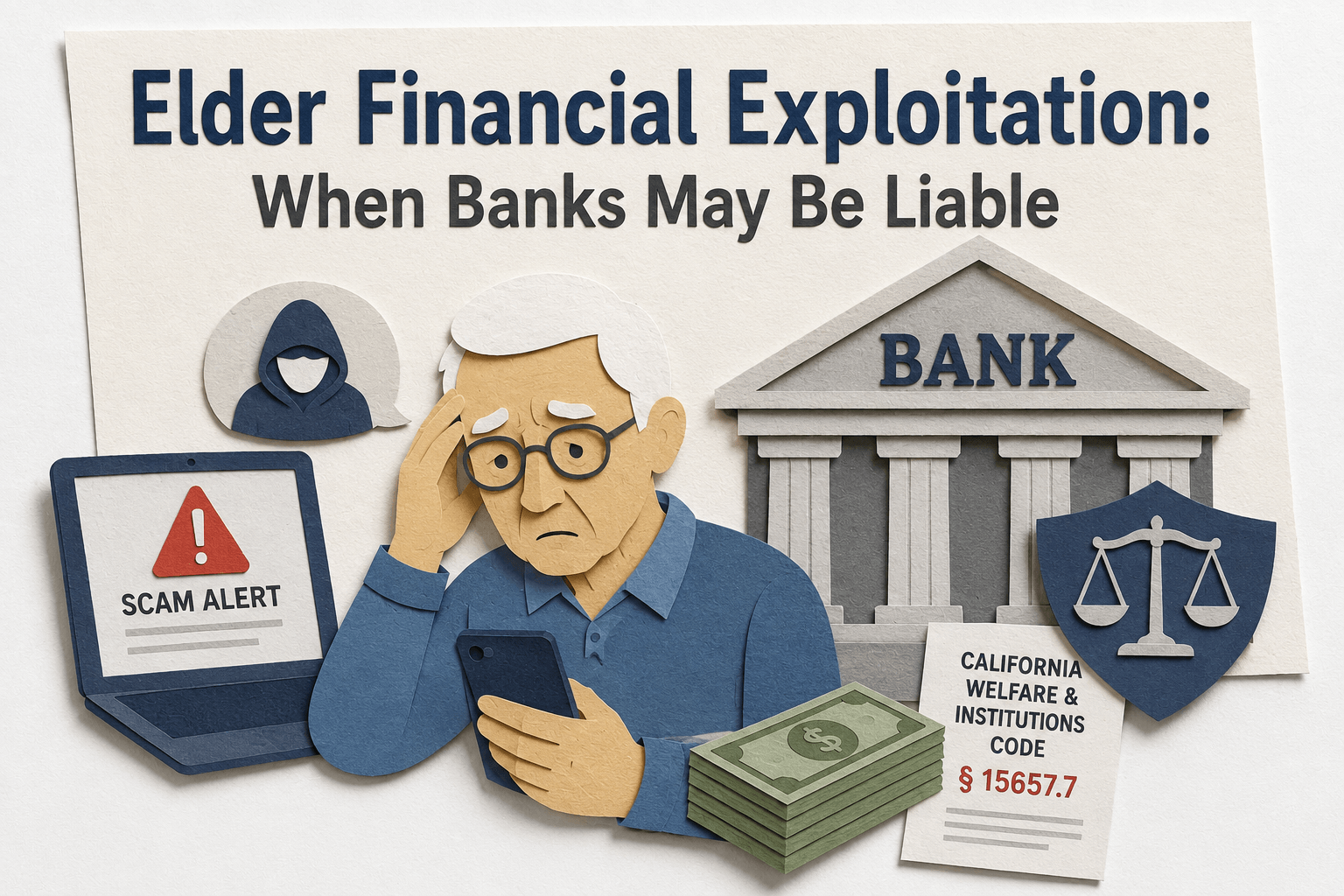
When the Bank Saw the Warning Signs: Online Elder Financial Exploitation and Institutional Liability in the Bay Area

I am Michael Hackard, founder of Hackard Law. With over five decades of California trust and estate litigation, I have fought for heirs, beneficiaries, and elder abuse victims whose families watched inheritances disappear through fraud, manipulation, and exploitation. I have written four books on inheritance protection and produced more than 1,000 educational videos that have reached over seven million viewers. My practice serves families across Sacramento, the San Francisco Bay Area, and Los Angeles.
For most of my career, elder financial exploitation arrived through the front door. A caregiver moved in. A new friend drove the elder to the attorney. The pattern required physical proximity. That is no longer the case. Today I regularly hear from Bay Area families whose elderly parent lost hundreds of thousands of dollars – sometimes more than a million – to someone they never met in person. The perpetrator lived on a screen. And the financial institution that processed every wire was right there the whole time.
Hackard Law provides contingency fee representation for qualified elder financial exploitation cases – no upfront costs to you. To speak with our team, call (916) 313-3030.
Quick Summary
Online scams targeting elderly Californians have grown in sophistication and scale. When a bank or financial advisor processed transfers despite clear warning signs of exploitation, California law may allow a civil claim directly against that institution.
- California Welfare and Institutions Code section 15657.7 reaches financial institutions that assisted in a wrongful taking
- Banks and investment advisors have regulatory duties to flag and pause suspicious transfers involving senior clients
- Recovery from the scammer is rare; recovery from the institution – where the facts support it – is a different case
- FINRA rules authorize broker-dealers to place temporary holds on disbursements when exploitation is suspected
- Mandatory fee-shifting and doubled-damages provisions under California law reshape the economics of these claims
Three Patterns, Three Institutions, Three Sets of Questions
The first call came from a daughter in the Bay Area. Her father was eighty-one, a retired engineer who had never sent a foreign wire in his life. A pop-up appeared on his computer warning that his system had been compromised. He called the number on the screen. What followed was a methodical fraud – a fake Microsoft technician, fabricated infections, requests for bank access, and a series of wires to a so-called secure holding account. Over two weeks, he sent three hundred and forty thousand dollars. He believed every wire would be returned.
When his daughter found the statements, I asked one question beyond the obvious: what did the bank do when those wires flagged? That father had never sent a foreign wire. His bank’s compliance system flags foreign wires. Someone reviewed them. Someone made a decision. What that person did – and what they documented – is what the file answers.
The second case involved a man in his seventies who sent eight hundred and twenty thousand dollars over eleven months to a woman he met on a dating site. His financial advisor of twenty years processed the wires. What the advisor asked him, if anything, and what the advisor documented, are the questions that matter. For families navigating these situations, understanding elder financial exploitation and the legal tools available is the essential first step.
The third case was a pig-butchering scheme. A husband and wife in their late seventies lost two million dollars to a fabricated cryptocurrency trading platform. A woman approached the husband on a messaging app, introduced him to the platform, and showed him a balance growing to eleven million dollars – then asked for a three-hundred-thousand-dollar tax clearance fee before he could withdraw. The portfolio their advisor had built over four decades was liquidated wire by wire. What the advisor said, and when, and to whom, are the questions the record answers.
Case Pattern: Tech Support Impersonation
An elderly man with no history of foreign wire transfers sent more than $300,000 abroad over two weeks after a fake technician convinced him the transfers would be returned. His bank flagged the wires. The compliance review that followed – and what it documented – became the foundation of a civil claim against the institution.
What California Law Requires of Financial Institutions
California’s elder financial exploitation statute – Welfare and Institutions Code section 15657.7 – does not stop at the person who ran the scheme. It reaches any financial institution that assisted in the wrongful taking by processing transfers it knew, or reasonably should have known, were the product of exploitation. This is not a peripheral theory. It is written into the statute.
FINRA rules reinforce this framework in two ways. First, broker-dealers are authorized to place temporary holds on disbursements when the firm reasonably believes financial exploitation is occurring. Second, separate FINRA rules require firms to collect the name of a trusted contact for every senior client account. These rules exist precisely because the industry recognized that seniors are targeted at a rate that demands a structural response – not just a policy statement.
When a registered investment advisor of twenty years processes wire after wire to a foreign account for a client in his seventies, the question is not only whether the advisor knew. The question is whether the advisor should have known, and what the firm’s own procedures required the advisor to do. Those are answerable questions. For Bay Area families dealing with these situations,early legal intervention in estate transfers can make a critical difference in what is recoverable.
Case Pattern: Romance Fraud and Advisor Inaction
A man in his seventies transferred nearly $1 million over eleven months to a woman he had never met in person. His long-term financial advisor processed every wire. A review of the advisor’s documentation – what questions were asked, what disclosures were made, and what the firm’s own senior client protocols required – shaped a civil claim against the institution.
The Economics of Institutional Claims
Recovery from the scammer is rare. The perpetrator is often overseas, operating under a false identity, and long gone by the time a family understands what happened. That reality is not a reason to stop. It is a reason to look at who else was in the room.
California’s mandatory fee-shifting and doubled-damages provisions in elder financial exploitation cases reshape the economic calculation in a way that reaches institutional defendants directly. When the facts show that a bank or advisor saw the pattern and failed to act, the claim is not speculative – it is grounded in what the institution’s own records reveal. For a detailed look at how these provisions work,California’s civil remedies for elder financial abuse explain the doubled damages and fee-shifting framework that applies to qualified cases.
Hackard Law litigates these claims on a contingency basis for qualified cases. The firm’s ability to take on institutional defendants – banks, broker-dealers, registered investment advisors – depends on the facts in the record, not on the family’s ability to fund litigation. That is the contingency model applied to the cases where it matters most.
How These Schemes Actually Work
Understanding the mechanics helps families recognize what happened and what evidence to preserve. Tech support scams follow a consistent structure: a pop-up or phone call, a fake technician, fabricated evidence of compromise, a request for remote access, and then a sequence of wire transfers framed as protective measures. The elder believes the money will be returned. Each wire builds on the last.
Romance fraud operates on a longer timeline. The relationship develops over weeks or months. The requests begin small and escalate. By the time the family discovers what is happening, the transfers may span a year or more. The pig-butchering variant adds a fabricated investment platform – the elder watches a fake balance grow, becomes emotionally invested in the return, and liquidates real assets to pay fees that never unlock the fictional portfolio.
In every pattern, the financial institution processed the transfers. In every pattern, the institution had access to the client’s history. And in every pattern, the question of what the institution knew – and what it was required to do – is a question the record can answer. Families in the Bay Area and across Northern California who want to understand these patterns more fully can reviewguarding against elder financial abuse in California trust litigation.
Key Definitions
- Welfare and Institutions Code section 15657.7: California statute that imposes civil liability on financial institutions that knowingly or negligently assist in elder financial exploitation.
- Pig-butchering scheme: A fraud pattern in which a perpetrator builds a relationship with the victim, introduces a fabricated investment platform, and eventually extracts large sums through fake fees or withdrawal requirements.
- Tech support scam: A fraud in which a perpetrator impersonates a technology company, convinces the elder their device is compromised, and uses that access to initiate financial transfers.
- Romance fraud: A pattern in which a perpetrator develops an online romantic relationship with an elder and makes repeated financial requests over an extended period.
- FINRA temporary hold: A regulatory authorization allowing broker-dealers to pause disbursements when the firm has a reasonable belief that financial exploitation of a senior client is occurring.
- Trusted contact rule: A FINRA requirement that broker-dealers collect the name of a trusted contact person for every senior client account, to be reached when exploitation is suspected.
- Doubled damages: A remedy available under California elder financial exploitation law that allows a court to award twice the amount of actual financial loss in qualifying cases.
- Fee-shifting: A statutory provision requiring the losing party to pay the prevailing party’s attorney fees, which applies in California elder financial exploitation claims and affects institutional defendants.
- Compliance review: An internal bank or brokerage process triggered by flagged transactions, such as foreign wire transfers, in which a staff member evaluates whether the transfer should proceed.
- Foreign wire flag: An automated alert generated by a financial institution’s compliance system when a client initiates an international wire transfer, particularly one inconsistent with the client’s prior history.
What to Do Next
- Look for bank statements, wire transfer confirmations, and any communications your parent received from the perpetrator – preserve everything before accounts are closed or records are purged.
- Get copies of any documentation the financial institution provided at the time of the transfers, including disclosures and confirmations.
- Look for evidence of what the bank or advisor knew about your parent’s transaction history and whether any internal review was triggered.
- Try to avoid confronting the financial institution directly before speaking with an attorney – what you say and when can affect the claim.
- Look for the name of a trusted contact listed on your parent’s brokerage account – that record may reveal whether the firm followed its own FINRA obligations.
- Get copies of your parent’s account agreements and any senior client protection policies the institution had in place.
- Look for any communications between your parent and the institution during the period the transfers were made – emails, letters, or call logs.
- Try to document the timeline of the scheme as clearly as possible, including when your parent first made contact with the perpetrator and when each transfer occurred.
- Reach out to an attorney who handles elder financial exploitation claims against institutional defendants before the statute of limitations runs.
- Call Hackard Law at (916) 313-3030, or visit our contact page to tell us what happened.
CALL THE SAGE | When Experience Matters, Families Listen
🏛️ We practice California trust & estate & elder financial abuse litigation
⚖️ We represent heirs, beneficiaries, and elder abuse victims
🎥 1,000+ educational videos | 7 million+ views | 4 published books
🎯 “After thousands of cases, I see the pattern others miss.”
CONTINGENCY REPRESENTATION – No Win, No Fee
Throughout California: Sacramento | Los Angeles | Bay Area
📞 CALL THE SAGE: (916) 313-3030
Subscribe for weekly insights on:
- Elder financial abuse warning signs and prevention
- Trust and estate litigation strategies
- Inheritance protection for California families
- Family protection strategies
When your inheritance is under attack, Call The Sage.
Hackard Law | 10640 Mather Blvd, Mather CA 95655
Attorney Advertisement | Michael Hackard, State Bar #71071067
RELATED VIDEOS
Silicon Valley Elder Financial Abuse_ When Tech Wealth Becomes a Target
Explores how tech-savvy Bay Area seniors become targets of sophisticated financial exploitation schemes.
Elder Financial Abuse | Warning Signs | CA Trust Litigation
Walks through the red flags of elder financial abuse and California trust litigation options.
The Wolf at the Door: Ep. 3 | How Elder Financial Abuse Happens
Breaks down the tactics and patterns abusers use to financially exploit elderly victims.
Common Signs of Elder Financial Abuse | Estate & Trust Lawsuits
Identifies warning signs families should watch for and explains how estate lawsuits can help.
Elder Financial Abuse | Alameda, Contra Costa & San Francisco
Covers elder financial abuse cases across key Bay Area counties and available legal remedies.
Fighting Elder Financial Abuse | San Mateo’s EDAPT
Highlights a Bay Area program dedicated to detecting and stopping elder financial exploitation.
 Michael Hackard is the founder of Hackard Law, a California trust and estate litigation firm with more than five decades of experience protecting the inheritance rights of families across Sacramento, the San Francisco Bay Area, and Los Angeles. He is the author of six published books on inheritance protection and has produced more than 1,000 educational videos with over seven million views.