


 (916) 313-3030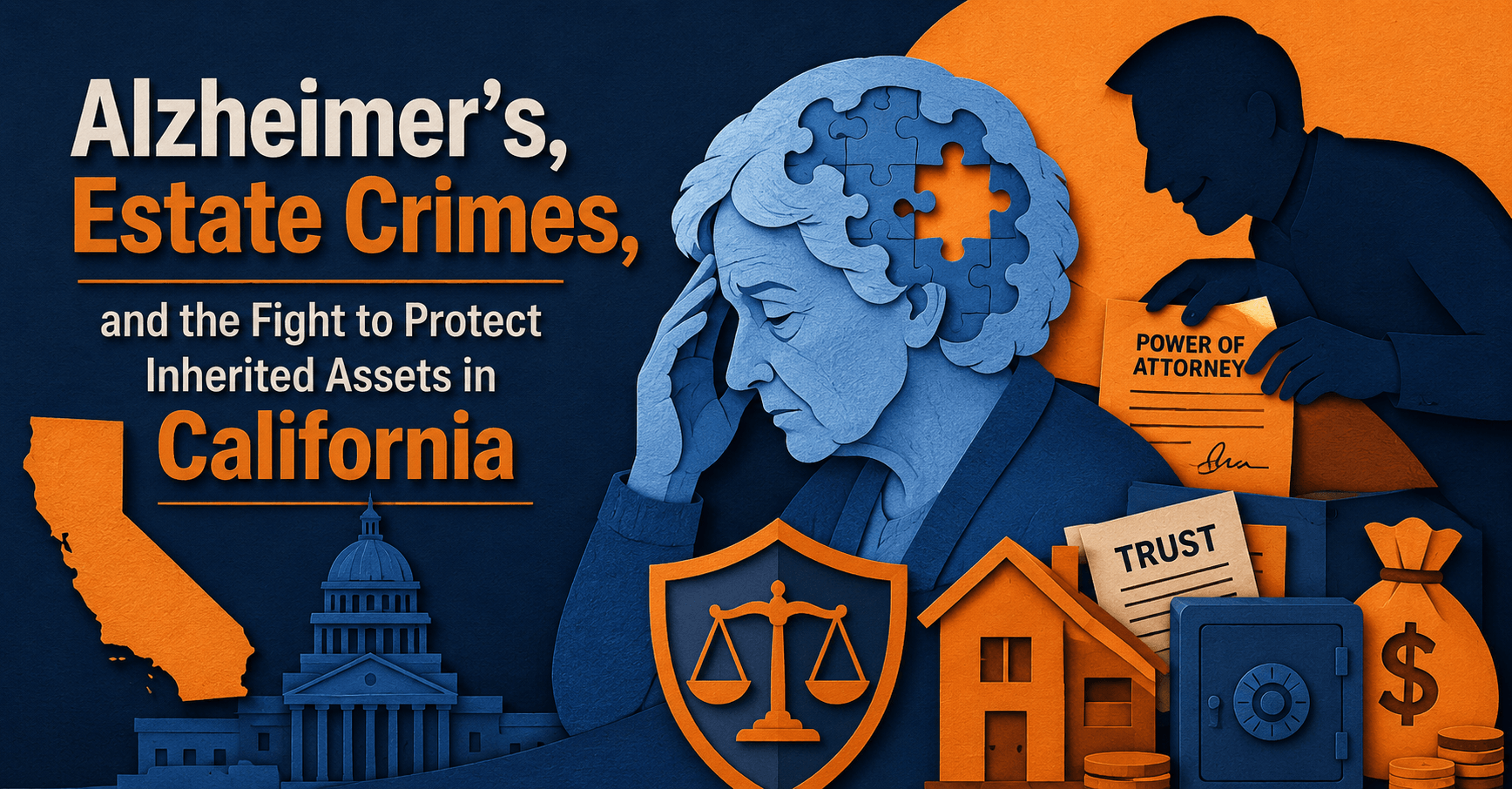
Alzheimer’s, Estate Crimes, and the Fight to Protect Inherited Assets in California

When Families Least Expect It
I am Michael Hackard, founder of Hackard Law, and over five decades of practice, I have fought for heirs, beneficiaries, and elder abuse victims whose inheritances were stolen, fractured, or simply erased. I have written four books on inheritance protection – including Alzheimer’s, Widowed Stepmothers, and Estate Crimes – and produced more than 1,000 educational videos that have reached over seven million viewers. My practice serves families throughout California, from Sacramento and the San Francisco Bay Area to Los Angeles and every community in between.
The families I meet almost never saw this coming. A parent receives an Alzheimer’s diagnosis. A stepparent moves in. A sibling gets power of attorney. And somewhere in that chain of events, the inheritance that was supposed to pass to the next generation quietly disappears. These are not rare tragedies. They happen in ordinary families, in every income bracket, in every corner of California.
Hackard Law provides contingency fee representation for qualified cases – no upfront costs to you. If your family is facing inheritance loss, elder financial abuse, or estate fraud, call us today at (916) 313-3030.
Quick Summary
Alzheimer’s and cognitive decline create serious legal vulnerabilities that dishonest family members, caregivers, and scammers are quick to exploit. California law provides real remedies, but families must act before assets disappear.
- A diagnosis does not automatically mean a person lacks legal capacity to sign a will or trust
- Power of attorney can become a tool for financial exploitation if left unsupervised
- Scams targeting isolated seniors drain assets that were meant for heirs
- Transparency over bank accounts is one of the most effective early defenses
- California law allows recovery of stolen assets, and in elder abuse cases, double damages and attorney fees may be available
Capacity: What It Means and Why It Matters
Whether a parent can still legally sign a will or trust after receiving an Alzheimer’s diagnosis is one of the most frequent questions families ask me. The answer is complicated and causes confusion for both families and lawyers.
Capacity is not all-or-nothing. A person can have good days and bad days. In many cases, even someone with a moderate diagnosis retains sufficient capacity to execute a valid estate planning document. The key is timing and documentation. Reaching out to the person’s treating physician is a reasonable first step – physicians can offer an opinion on whether their patient has the cognitive ability to understand what they are signing and its consequences.
In high-value estates, I have recommended that families arrange an evaluation with a geriatric psychiatrist. That specialist will typically record the meeting, creating a contemporaneous record of the person’s mental state. That recording becomes powerful evidence if a will or trust is later challenged. When capacity is genuinely absent, the family must pursue other legal options – guardianship, conservatorship, or litigation to unwind transactions that should never have happened.
Case Pattern: A family in Northern California discovered that their elderly mother had signed a new trust amendment just weeks after a formal Alzheimer’s diagnosis. A geriatric psychiatrist’s evaluation, conducted close in time to the signing, documented that she could not recall her own assets or identify her children by name. That evidence anchored a successful challenge to the amendment.
Trust Basics That Protect – or Fail – Your Family
Even families who do the right things often make one critical mistake: they create a trust but never fully fund it. A trust that exists on paper but does not actually hold the family home, the bank accounts, or the investment portfolio offers very little protection. After death, heirs discover that the real property was never retitled, the accounts were never transferred, and the trust is essentially an empty vessel.
The foundation of any solid plan is a will – and for estates that include real property or significant assets, a pour-over will that directs everything into the trust at death. But the follow-up work matters just as much. Every asset that should be inside the trust must be formally retitled. That process takes time and attention, and it is where many families fall short.
For families dealing with real estate disputes within a trust, understanding real estate battles in trust litigation can help clarify what is at stake when property was never properly transferred.
When Power of Attorney Becomes a Weapon
Granting someone power of attorney feels like a responsible act. You are naming a trusted person to manage your affairs if you cannot. But without oversight, that authority can become the mechanism for serious financial exploitation.
I have handled cases where the person holding power of attorney transferred real property into their own name, liquidated bank accounts, and redirected investment assets – all while the elder believed their affairs were being managed properly. By the time the family discovered what had happened, hundreds of thousands of dollars were gone.
California law treats this kind of abuse seriously. When a power of attorney is used to exploit an elder, the conduct can constitute both a breach of fiduciary duty and elder financial abuse under California’s Welfare and Institutions Code. The legal consequences for those who misuse this authority can be severe – and California allows recovery of double damages and attorney fees in proven elder financial abuse cases. You can read more about how a power of attorney can become a weapon and what California families can do to fight back.
Case Pattern: An adult son held power of attorney for his father, who had been diagnosed with vascular dementia. Over eighteen months, the son transferred the family home and drained three bank accounts. When a sibling finally gained access to account statements, the pattern of transfers was unmistakable. The case settled with significant asset recovery after litigation commenced.
Understanding undue influence in California estate law is essential context for any family confronting this kind of manipulation.
Scams That Target Seniors – and Drain Estates
Not every threat comes from inside the family. Isolated seniors – particularly those living alone and managing their own finances – are prime targets for telephone and computer scams designed to frighten them into sending money.
The IRS impersonation scam is one of the most common. A caller claims to be from a government agency and threatens immediate arrest unless payment is made. To someone living alone who cannot easily verify the claim, the threat feels real. The grandparent scam works differently: a caller claims to be a grandchild in trouble – needing bail money, a replacement passport, or emergency funds. The senior, wanting to help, sends money before anyone else in the family knows what happened.
Computer scams add another layer of danger. A pop-up warning appears on screen claiming the device is infected. The senior calls the number displayed, and the person on the other end walks them through steps that grant remote access to the computer – and to every financial account stored on it. These scams are not just embarrassing. They are financially devastating, and the money is rarely recovered.
For families navigating the aftermath of exploitation, the Sacramento elder financial abuse lawyer page outlines how Hackard Law approaches asset recovery across California.
The First Lines of Defense
For decades, I have stood with families who wished they had acted sooner. The financial toll grows with every month that exploitation continues unchecked. The fracture it causes often runs too deep for any judgment to fully mend. But early action – even simple steps – can change the outcome.
The single most effective early defense is financial transparency. A trusted family member should have read-only access to the elder’s bank accounts. They do not need the ability to transfer funds – they simply need to see what is happening. Unusual withdrawals, large ATM cash transactions, and wire transfers to unfamiliar accounts are warning signs that something is wrong. Catching those patterns early can prevent months or years of exploitation.
Beyond account monitoring, families should maintain regular contact with elderly relatives, particularly those living alone. Isolation is the condition that makes exploitation possible. Discovery, forensic accounting, and the pursuit of justice through California’s elder abuse statutes are not just legal strategies – they are safeguards for families threatened by the kind of quiet, calculated theft that too often goes undetected until it is too late.
For situations where a trustee has failed to account for assets, knowing your rights to compel a trust accounting is an important step toward recovery.
Key Definitions
- Testamentary capacity: The legal standard a person must meet to validly sign a will – they must understand the nature of the document, know their assets, and recognize who their natural heirs are.
- Power of attorney: A legal document authorizing one person to act on another’s behalf in financial or legal matters, which can be limited or broad in scope.
- Pour-over will: A will that directs any assets outside a trust at death to be transferred into the trust, ensuring the trust terms govern distribution.
- Trust funding: The process of retitling assets – real property, bank accounts, investments – into the name of a trust so they are governed by its terms.
- Elder financial abuse: Under California law, the taking, concealing, or appropriating of an elder’s property for a wrongful use or with intent to defraud.
- Undue influence: Pressure or manipulation that overcomes a person’s free will and causes them to make estate planning decisions they would not otherwise have made.
- Geriatric psychiatrist: A physician who evaluates cognitive function and can provide experienced attorney testimony on a person’s mental capacity at a specific point in time.
- Double damages: A civil remedy available in California elder financial abuse cases that allows courts to award twice the amount of financial harm proven.
- Fiduciary duty: The legal obligation of a trustee, executor, or agent under a power of attorney to act in the best interest of the person they serve.
- Contingency fee: A fee arrangement in which the attorney is paid only if the case is successfully resolved, with no upfront cost to the client.
What to Do Next
- Look for early warning signs: unusual bank withdrawals, large cash transactions, or wire transfers to unfamiliar accounts.
- Get copies of any existing wills, trusts, and power of attorney documents and review them with an attorney.
- Try to avoid waiting to consult a lawyer – California has strict deadlines for contesting trusts and pursuing elder abuse claims.
- Look into arranging a geriatric psychiatrist evaluation if a loved one’s capacity is in question and estate documents need to be updated.
- Try to avoid leaving a senior isolated – regular contact from family members is one of the most effective deterrents against exploitation.
- Get copies of bank and investment account statements going back at least two to three years if you suspect financial abuse has occurred.
- Look for a California attorney who handles elder financial abuse and trust litigation on a contingency fee basis, so cost is not a barrier to justice.
- Learn about civil remedies for elder financial abuse including double damages and attorney fee recovery under California law.
- Call Hackard Law at (916) 313-3030 to discuss your situation with an attorney who handles these cases throughout California.
- Visit our contact page to request a free consultation and take the first step toward protecting your family’s inheritance.
CALL THE SAGE | When Experience Matters, Families Listen
🏛️ We practice California trust & estate & elder financial abuse litigation
⚖️ We represent heirs, beneficiaries, and elder abuse victims
🎥 1,000+ educational videos | 7 million+ views | 4 published books
🎯 “After thousands of cases, I see the pattern others miss.”
CONTINGENCY REPRESENTATION – No Win, No Fee
Throughout California: Sacramento | Los Angeles | Bay Area
📞 CALL THE SAGE: (916) 313-3030
Subscribe for weekly insights on:
- Elder financial abuse warning signs and prevention
- Trust and estate litigation strategies
- Inheritance protection for California families
- Family protection strategies
When your inheritance is under attack, Call The Sage.
Hackard Law | 10640 Mather Blvd, Mather CA 95655
Attorney Advertisement | Michael Hackard, State Bar #71067
RELATED VIDEOS
Alzheimer’s, Dementia & Estate Crimes | A Disastrous Mix
Explores how cognitive decline opens the door to estate crimes and financial exploitation.
Diagnosing Alzheimers | Protecting Estate Assets
Explains what an Alzheimer’s diagnosis means for protecting a loved one’s estate assets.
POA Vultures | Power of Attorney Abuse
Examines how dishonest agents exploit power of attorney to steal from vulnerable seniors.
Alzheimer’s Estate Abuse | Reaching Out for Help
Guides families on recognizing estate abuse tied to Alzheimer’s and finding legal help.
Interview with Bob Brooks | Alzheimer’s, Widowed Stepmothers & Estate Crimes
Michael Hackard discusses his book on Alzheimer’s, blended families, and inheritance theft.
Estate Planning Challenges with Alzheimer’s: Early Steps Matter
Covers why acting early on estate planning is critical after an Alzheimer’s diagnosis.
 Michael Hackard is the founder of Hackard Law, a California trust and estate litigation firm with more than five decades of experience protecting the inheritance rights of families across Sacramento, the San Francisco Bay Area, and Los Angeles. He is the author of six published books on inheritance protection and has produced more than 1,000 educational videos with over seven million views.