


 (916) 313-3030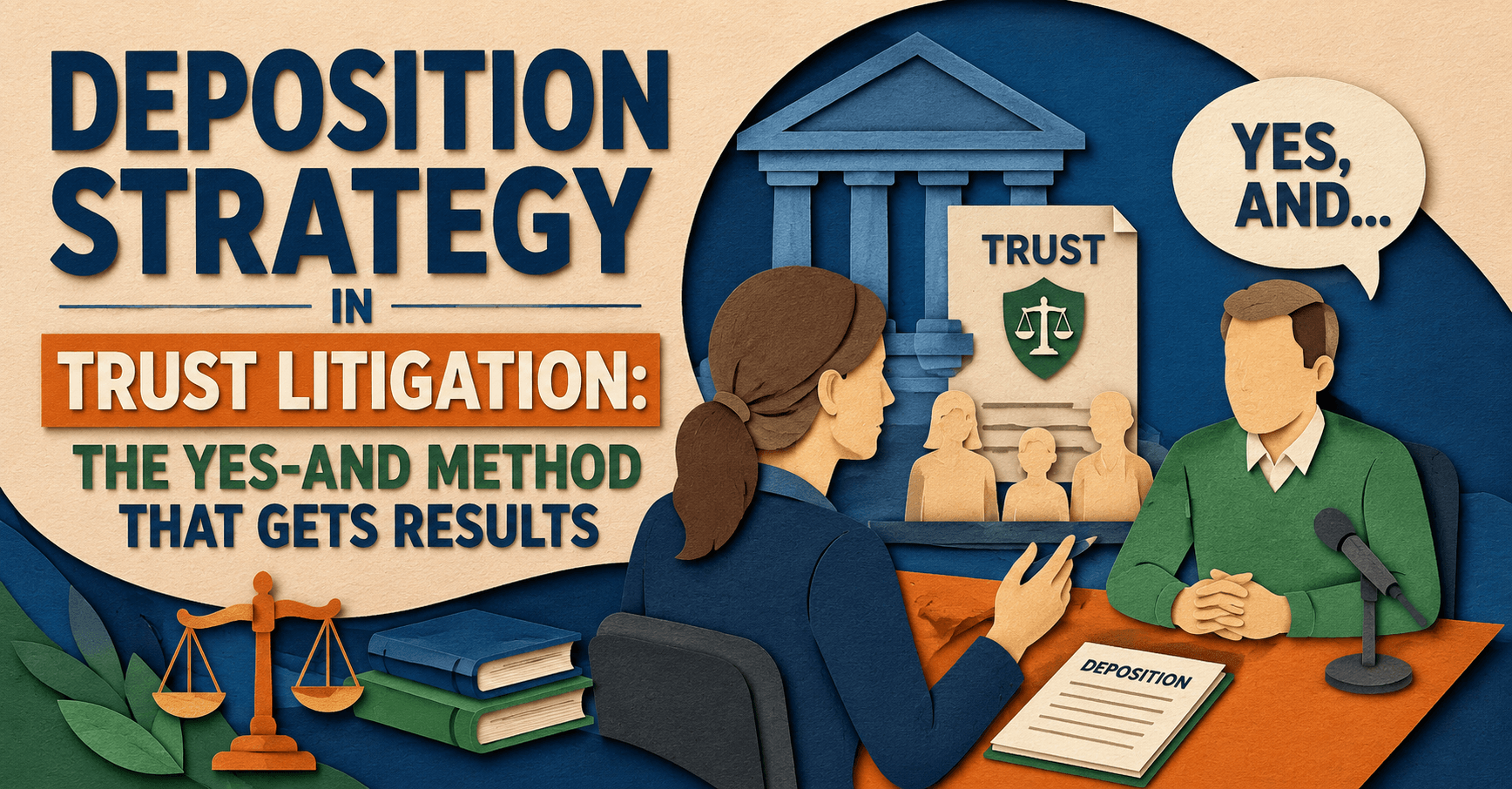
Deposition Strategy in Trust Litigation: The Yes-And Method That Gets Results
Why Deposition Preparation Defines Trust Cases
I am Michael Hackard, founder of Hackard Law, and over nearly five decades of fighting for heirs, beneficiaries, and elder abuse victims, I have learned that cases are rarely won at trial – they are won, or lost, long before a courtroom ever enters the picture. I serve clients throughout California, from Sacramento and the San Francisco Bay Area to Los Angeles, and in trust and estate disputes across this state, the deposition is often the single most consequential event in the entire case. I have written four books on inheritance protection and produced more than 1,000 educational videos with over seven million views, and this topic – how to take a deposition that actually moves a case toward justice – is one I return to again and again.
Roughly 99% of estate and trust lawsuits in California are settled out of court. This means your deposition is more than trial preparation. For most clients, the deposition serves as the trial. Whether a family gets what was taken from them or leaves empty-handed depends on how well that work is done.
Hackard Law provides contingency fee representation – no upfront costs for qualified cases. If you believe a trustee has mismanaged or misappropriated trust assets, call us at (916) 313-3030.
Quick Summary
The “yes-and” deposition method, developed by trial theater professionals Steve Holman and Olivia Espinosa, combines improv storytelling techniques with constructive cross-examination to build narrative momentum and expose trustee misconduct through contrast rather than confrontation.
- The method opens by boosting the witness, lowering defenses and locking in agreed facts
- Defining every term and concept closes the doors a witness might otherwise use to escape
- Writing questions in natural, conversational language keeps the attorney in control without telegraphing aggression
- Factual contrast – not emotional pressure – does the heaviest lifting in a well-crafted deposition
- In California trust litigation, a strong deposition often drives a favorable settlement without trial
The Yes-And Method: Building a Yes Train
The yes-and framework comes directly from improvisational theater. In improv, performers accept whatever their scene partner offers – they say “yes” to it – and then build on it with “and.” Applied to depositions, this means the attorney begins by affirming the witness, drawing out agreements on every foundational fact before ever approaching the disputed conduct.
It’s as simple as getting the witness on a yes train, according to Steve Holman, a fifteen-year improv skills instructor who has been cross-examined more than 1,500 times while acting as a witness at trial skills clinics. Their defenses come down once they nod along and answer questions about their values, roles, responsibilities, and stated intentions. They cease preparing for an assault. They begin talking.
That opening phase serves two purposes simultaneously. It lowers the witness’s guard, and it locks in every element of the appropriate standard of conduct – the benchmark against which their actual behavior will later be measured. Every yes they give in the opening chapters becomes a door that closes behind them.
For California trust litigation, this is particularly powerful when deposing a trustee. The 8 stages of trust and estate litigation make clear that the deposition phase is where the factual record is built. A trustee who has agreed, on the record, that a trustee must put beneficiaries’ interests first, cannot easily walk that back when the facts show they did the opposite.
Writing Questions the Way You Actually Talk
One of the most practical lessons from working with Steve and Olivia is deceptively simple: write your deposition questions the way you speak. Most attorneys draft questions in formal legal prose. That formality creates friction. When you are in the middle of a deposition, you do not want to be working to decode your own script.
Questions written in contractions, plain words, and short sentences flow naturally. They create rhythm. And rhythm matters – a witness who feels the conversation moving at a comfortable pace is less likely to dig in and fight. They answer. They keep answering. The momentum builds.
Olivia Espinosa adds a second rule that works alongside the first: define everything. Do not assume the witness shares your understanding of a term. In a HEMS dispute, for example, you define HEMS before you ever ask whether the trustee followed it. You define what a reasonable distribution looks like before you present the numbers that show the actual distributions fell below the poverty line. Each definition is also a door closing. There is no room left to say “I didn’t understand what that meant.”
Case Pattern: A trustee serving as both fiduciary and beneficiary repeatedly declined distributions to the other beneficiaries while approving substantial property renovations. Because the deposition had locked in the trustee’s own stated understanding of the duty of loyalty early in the questioning, the contrast between that stated duty and the actual conduct was impossible to explain away. The case resolved in favor of the beneficiaries before any trial date was set.
The Power of Contrast: Ending the Witness
The second phase of the yes-and method is what Steve and Olivia call “ending” the witness. This does not mean attacking them. It means using everything they agreed to in the opening phase as a measuring stick against what they actually did.
In the demonstration deposition in this presentation, the trustee had agreed – question by question – that family takes care of family, that a trustee must put beneficiaries’ interests above their own, that she wanted to do right by her step-siblings, and that she understood the consequences of failing in her duties. She had agreed to all of it. Then came the facts.
David, a 19-year-old college student working as a restaurant server, received $502 per month from a trust generating roughly $10,000 per month per beneficiary share. He lived in his car for eight months. In a Taco Bell parking lot. The trustee, meanwhile, spent over $1.5 million on property renovations and $190,000 on household furnishings – as an interior designer using trust funds on trust properties she also benefited from. When David’s car needed $4,100 in repairs so he could drive to work and school, she said no.
The facts did all the work. The attorney did not need to editorialize. He simply brought her back to what she had already agreed to, and let the contrast speak.
This is the heart of what makes the method effective in trust and estate disputes across California. The attorney is not the one making the argument. The witness makes it for you.
Case Pattern: In a HEMS dispute, a trustee who had received a one-hour legal orientation before assuming her role had agreed on the record that she understood her duties and had asked all necessary questions. When distributions to beneficiaries were shown to fall hundreds of dollars below the federal poverty line while trust renovation expenditures exceeded seven figures, that one-hour consultation became a liability rather than a defense. The record she built in the yes phase made her position untenable.
Stripping Trigger Words and Staying Factual
One of the most important filters Steve and Olivia apply when crafting deposition questions is removing trigger words – language that signals aggression, invites defensiveness, or gives the witness something to fight. Adjectives that editorialize. Phrasing that implies the answer. Anything that makes the witness feel cornered before the facts have done their work.
When a witness feels attacked, they fight. When they fight, they give long, evasive answers. Those answers muddy the record and slow the momentum. A clean, factual question – “You distributed $502 per month to David” – is harder to evade than “You only gave David a measly $502 a month, didn’t you?” The first version is a fact. The second version is an argument, and witnesses argue back.
This discipline also protects the attorney’s credibility with the judge or jury who will eventually review the transcript or the video. An attorney who is calm, methodical, and factual looks in control. An attorney who is pressing and emotional looks like they are trying to manufacture outrage rather than reveal truth.
For California beneficiaries navigating disputes like these, understanding what the contingency fee representation process looks like can make the difference between pursuing justice and walking away from a valid claim.
Why Deposition Is Trial in California Trust Cases
I have said this to attorneys and clients alike for years: in California trust and estate litigation, deposition is trial. With 99% of cases resolving before a courtroom verdict, the deposition record is the primary vehicle through which cases settle. A well-built deposition does not just preserve testimony – it shows the other side exactly what the evidence looks like when presented with skill and structure. It shows them what a jury would hear.
For decades, I have stood with families whose inheritances were taken, whose trust rights were ignored, and whose loved ones’ final wishes were undermined by trustees who served themselves. Discovery, forensic analysis, and the pursuit of justice through careful deposition work – these are not just legal strategies, but safeguards for families who have already lost too much. The financial toll grows with every month a trustee delays or diverts. The fracture within a family often runs too deep for any judgment to mend. A steadfast commitment to truth, built question by question through a well-prepared deposition, restores what dishonesty tried to steal.
If you are a beneficiary in California who believes a trustee has breached their duty, the time to act is now. Hackard Law handles these cases across the state, including through our Sacramento estate litigation practice, Santa Clara estate litigation, Oakland estate litigation, and Alameda County estate litigation.
Key Definitions
- Yes-and method: A deposition framework borrowed from improvisational theater that opens by affirming the witness to lower defenses, then uses those affirmations to contrast actual conduct.
- HEMS standard: Health, Education, Maintenance, and Support – the distribution standard commonly used in trust agreements to guide trustee decisions about beneficiary payments.
- Duty of loyalty: The trustee’s legal obligation to place the beneficiaries’ interests above their own and to avoid self-dealing transactions.
- Breach of fiduciary duty: A trustee’s failure to act in accordance with the legal duties owed to the trust and its beneficiaries, which can result in removal, surcharge, and personal liability.
- Self-dealing: When a trustee uses trust assets to benefit themselves rather than the beneficiaries, including transactions that create a conflict of interest.
- Abuse of discretion: A trustee’s failure to exercise reasonable judgment in making distribution decisions, including distributions so inadequate they fall outside the bounds of reason.
- Looping: A deposition technique in which the attorney incorporates the witness’s own words into the next question, creating a conversational rhythm and reinforcing the record.
- Trigger words: Language in deposition questions that signals aggression or editorializes, prompting the witness to become defensive and give evasive answers.
- Federal poverty guidelines: Annual thresholds set by the Department of Health and Human Services below which an individual is considered unable to meet basic needs – a useful benchmark in HEMS distribution disputes.
- Contingency fee representation: A fee arrangement in which the attorney is paid only upon a successful outcome, with no upfront cost to the client.
What to Do Next
- Look for signs that a trustee is making distributions to beneficiaries that fall far below what the trust income would reasonably support.
- Get copies of all trust accountings, distribution records, and correspondence between the trustee and beneficiaries as early as possible.
- Try to avoid confronting the trustee directly before speaking with an attorney – premature disputes can complicate the legal record.
- Look for evidence of trustee self-dealing, including renovations, purchases, or transactions that benefit the trustee personally.
- Get a written record of any requests for distributions that were denied, including the dates and the trustee’s stated reasons.
- Try to avoid signing any releases or settlement agreements with a trustee without independent legal review.
- Look for patterns over time – a single low distribution may be explainable, but a sustained pattern below the poverty line tells a very different story.
- Get copies of any communications where the trustee acknowledged beneficiary needs but declined to act.
- Reach out to an attorney who handles trust litigation on contingency – you should not have to pay out of pocket to enforce rights your loved one intended you to have.
- Call Hackard Law at (916) 313-3030, and visit our contact page to schedule a confidential consultation about your case.
CALL THE SAGE | When Experience Matters, Families Listen
🏛️ We practice California trust & estate & elder financial abuse litigation
⚖️ We represent heirs, beneficiaries, and elder abuse victims
🎥 1,000+ educational videos | 7 million+ views | 4 published books
🎯 “After thousands of cases, I see the pattern others miss.”
CONTINGENCY REPRESENTATION – No Win, No Fee
Throughout California: Sacramento | Los Angeles | Bay Area
📞 CALL THE SAGE: (916) 313-3030
Subscribe for weekly insights on:
- Elder financial abuse warning signs and prevention
- Trust and estate litigation strategies
- Inheritance protection for California families
- Family protection strategies
When your inheritance is under attack, Call The Sage.
Hackard Law | 10640 Mather Blvd, Mather CA 95655
Attorney Advertisement | Michael Hackard, State Bar #71067
RELATED VIDEOS
When a Trustee Turns Against You: Litigating a Family Member’s Breach of Trust | Michael Hackard
Explores what beneficiaries can do when a family trustee breaches their duties.
Trust Beneficiary Litigation | The Power of Stories
Explains how compelling narratives shape outcomes in trust beneficiary disputes.
When the Numbers Don’t Add Up Using Accounting Disputes to Expose Trustee Mismanagement | Michael H
Shows how financial discrepancies can reveal a trustee’s mismanagement of assets.
Estate & Trust Battles | Litigation is War
Discusses the high-stakes, combative nature of estate and trust litigation.
The Value of Experience | Trust and Estate Litigation
Covers why seasoned legal experience makes a decisive difference in trust cases.
Character Counts | Trust Beneficiary Litigation
Looks at how a witness’s credibility and character influence trust litigation outcomes.
 Michael Hackard is the founder of Hackard Law, a California trust and estate litigation firm with more than five decades of experience protecting the inheritance rights of families across Sacramento, the San Francisco Bay Area, and Los Angeles. He is the author of six published books on inheritance protection and has produced more than 1,000 educational videos with over seven million views.