


 (916) 313-3030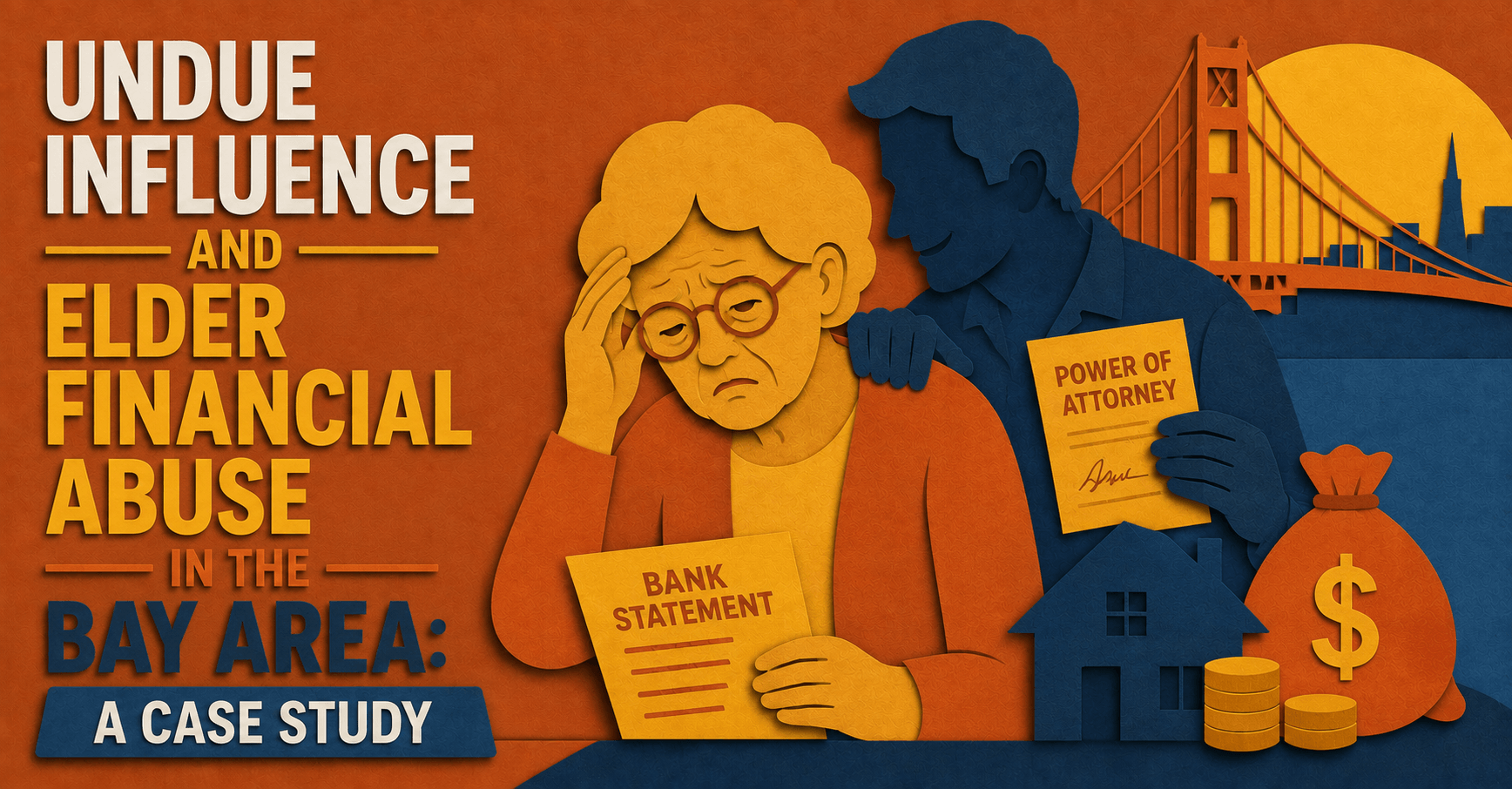
Undue Influence and Elder Financial Abuse in the Bay Area: A Case Study

When a Child Becomes a Predator: Understanding Elder Financial Abuse
I’m Michael Hackard, founder of Hackard Law. Over five decades of practice, I have fought for heirs, beneficiaries, and elder abuse victims across California – from Sacramento and the San Francisco Bay Area to Los Angeles. I have written four published books on inheritance protection and produced more than 1,000 educational videos that have reached over seven million viewers. Elder financial abuse is one of the most urgent issues I address in my practice, and it is growing more common as California’s senior population expands.
In this post, I want to walk through a realistic case pattern – a fictional but legally accurate scenario – that illustrates how undue influence unfolds inside a family and how the civil law responds. This is the kind of case Hackard Law litigates every business day.
Hackard Law provides contingency fee representation for qualified elder financial abuse and trust litigation cases – no upfront costs. If you believe a family member has been manipulated out of their inheritance, call us at (916) 313-3030.
Quick Summary
Undue influence is a recognized form of elder financial abuse under California law, and it can be used to invalidate a trust that was changed under pressure or manipulation.
- Isolation, control, and secrecy are hallmarks of undue influence in trust disputes
- California law allows heirs and beneficiaries to bring civil elder abuse claims even when the victim has died
- A successful case can result in recovery of stolen assets and disinheritance of the abuser under Probate Code Section 259
- Cases are filed in the Superior Court of the county where the elder lived – such as Alameda County for Oakland-area families
- Hackard Law handles these cases on contingency in the Bay Area and throughout California
The Anatomy of an Elder Financial Abuse Case
Let me describe a pattern that mirrors real cases Hackard Law handles. An elderly widow – call her Dorothy – was born in 1931 in San Francisco and settled in Oakland after marrying. She and her husband had two children, a son and a daughter. After her husband’s death, Dorothy created a revocable living trust through an East Bay attorney that left equal shares to both children. That was her clear, documented intent.
Years later, her son moved into her home. He was unemployed, had a history of substance abuse, and paid no rent. Dorothy had developed cognitive difficulties and could no longer manage her own financial affairs. Her son recognized the opening. He began isolating her from her daughter, her grandchildren, and her neighbors. He took control of her finances. He made false and disparaging remarks about his sister. He made it difficult for anyone outside the household to reach Dorothy at all.
This is not an unusual pattern. Elder financial exploitation often begins with a caregiver relationship – someone who provides genuine help at first, then gradually tightens control until the elder has no independent access to information, relationships, or decision-making.
How the Trust Was Changed – and Why It Matters
In this pattern, the son took his mother to a new attorney – one who had never met Dorothy and did not know her history. He sat beside her in the meeting. He told the lawyer that his mother wanted to remove his sister entirely from the trust and leave everything to him. The new attorney drafted a restatement of the trust that appointed the son as successor trustee and directed the entire estate to him.
This is where undue influence in California estate law becomes legally actionable. The son’s conduct – the isolation, the control, the secrecy, the haste, the presence at the attorney meeting – satisfies multiple factors California courts use to evaluate whether a person’s free will was overcome.
When Dorothy died, her estate included a residence worth over one million dollars and a bank account with $500,000. Her daughter learned of her mother’s death from a neighbor. The son refused to take her calls and would not share a copy of the trust.
Case Pattern: Isolation and Restatement
In situations that fit this pattern, a surviving child learns after the parent’s passing that a trust was discreetly reaffirmed when the parent was physically and cognitively dependent on a sibling. The surviving child is completely eliminated by the restated trust. In order to recover the disinherited share and possibly disinherit the abuser, Hackard Law pursues both a civil elder abuse claim and a probate action to set aside the restatement.
What California Law Provides: The Civil Elder Abuse Claim
Heirs, beneficiaries, and victims of elder abuse may file a civil lawsuit in California even after the elder has passed away due to the Elder Abuse and Dependent Adult Civil Protection Act, which is contained in the Welfare and Institutions Code. If the restatement is overturned, the daughter in this pattern would have inherited under the original trust, giving her standing to sue.
To win, she must show that her brother obtained Dorothy’s property through undue influence, that Dorothy was 65 or older at the time, that Dorothy was harmed, and that the brother’s conduct was a substantial factor in causing that harm. For Alameda County estate litigation like this, the case is filed in Alameda County Superior Court.
The jury instruction on undue influence defines it as excessive persuasion that overcomes another person’s free will and causes an unfair result. The jury considers Dorothy’s vulnerability – her age, cognitive decline, isolation, and dependency – alongside the son’s apparent authority as a live-in caregiver and family member, and the tactics he used: controlling her access to others, using secrecy and haste, initiating changes at a time when she could not resist.
The civil remedies available in a successful case can be significant. California law provides for recovery of the stolen assets and, in appropriate cases, double damages and attorney fee awards against those found liable for elder financial abuse.
Case Pattern: Probate Code Section 259 – Disinheritance of the Abuser
In cases where the court finds that a beneficiary committed financial abuse of the decedent, Probate Code Section 259 allows the court to treat that person as having predeceased the elder. This means the abuser is disinherited entirely – not just ordered to pay damages, but stripped of any inheritance. Hackard Law pursues this remedy alongside the civil elder abuse claim whenever the facts support it.
The Role of Early Intervention
One of the most important things I can tell families is this: do not wait. Early legal intervention in elder financial abuse cases can preserve evidence, protect assets, and in some cases stop the abuse before the elder dies. Once the elder is gone, the options narrow and the evidentiary challenges grow.
If you suspect a parent or grandparent is being isolated, controlled, or manipulated into changing estate documents, reach out to an attorney immediately. Hackard Law can assess whether emergency legal action is appropriate. We also regularly pursue cases after the elder’s death, as in the pattern described here, but earlier action is almost always better for the family and for the outcome.
For Bay Area families dealing with these situations, Hackard Law litigates in Alameda, Contra Costa, Santa Clara, and San Mateo counties, as well as throughout California. You can also learn more about how undue influence and elder financial abuse intersect in a broader educational context.
For decades, I have stood with families who discovered – too late or just in time – that someone they trusted had turned a vulnerable elder into a financial target. The financial toll grows with every month of delay. The fracture between siblings often runs too deep for any judgment to mend. But a steadfast commitment to truth restores what dishonesty tried to steal. Discovery, forensic analysis, and the pursuit of justice are not just legal strategies – they are safeguards for families threatened by undue influence and fraud.
Key Definitions
- Undue influence: Excessive persuasion that overcomes another person’s free will, causing them to act in a way that produces an unfair result, as defined under California law.
- Elder financial abuse: The wrongful taking, concealment, or appropriation of an elder’s property through fraud, undue influence, or other means, prohibited under California’s Welfare and Institutions Code.
- Revocable living trust: A legal document that holds assets during a person’s lifetime and distributes them at death, which can be changed or revoked by the creator while they have legal capacity.
- Trust restatement: A complete revision of a trust document that replaces the original terms, often used when significant changes to beneficiaries or distribution are intended.
- Successor trustee: The person designated to manage and distribute trust assets after the original trustee dies or becomes incapacitated.
- Probate Code Section 259: A California statute that allows a court to treat a person who committed elder financial abuse as having predeceased the victim, effectively disinheriting them.
- Standing: The legal right to bring a lawsuit; in elder abuse trust cases, a disinherited heir may have standing if they would have inherited under the prior valid trust.
- Substantial factor: A legal standard used in elder abuse cases requiring that the defendant’s conduct meaningfully contributed to the harm suffered by the elder.
- Isolation: A recognized tactic in undue influence cases in which the abuser limits the elder’s contact with family, friends, and advisors to increase dependence and control.
- Cognitive vulnerability: Diminished mental capacity due to age, illness, or impairment that makes an elder susceptible to manipulation and a key factor in undue influence analysis.
What to Do Next
- Look for signs of isolation – if a parent or grandparent has become suddenly difficult to reach, that is a warning sign worth investigating.
- Get copies of any trust documents you are entitled to receive, including prior versions and any amendments or restatements.
- Try to avoid confronting the suspected abuser directly before speaking with an attorney, as this can complicate the legal case.
- Look for evidence of cognitive decline during the period when any trust changes were made, including medical records, bank records, and witness accounts.
- Try to identify the attorney who drafted the new trust documents and whether the elder met with them independently or with the suspected abuser present.
- Document any instances of restricted access – dates when calls were not returned, visits that were blocked, or communications that were intercepted.
- Look into whether any assets were transferred out of the trust or estate before or after the elder’s death.
- Get legal advice before the statute of limitations expires – California imposes time limits on elder abuse and trust contest claims.
- Call Hackard Law at (916) 313-3030 to discuss your situation with an attorney who handles these cases across the Bay Area and California.
- You can also reach us through our contact page to request a free consultation.
CALL THE SAGE | When Experience Matters, Families Listen
🏛️ We practice California trust & estate & elder financial abuse litigation
⚖️ We represent heirs, beneficiaries, and elder abuse victims
🎥 1,000+ educational videos | 7 million+ views | 4 published books
🎯 “After thousands of cases, I see the pattern others miss.”
CONTINGENCY REPRESENTATION – No Win, No Fee
Throughout California: Sacramento | Los Angeles | Bay Area
📞 CALL THE SAGE: (916) 313-3030
Subscribe for weekly insights on:
- Elder financial abuse warning signs and prevention
- Trust and estate litigation strategies
- Inheritance protection for California families
- Family protection strategies
When your inheritance is under attack, Call The Sage.
Hackard Law | 10640 Mather Blvd, Mather CA 95655
Attorney Advertisement | Michael Hackard, State Bar #71067
RELATED VIDEOS
Establishing Undue Influence & Elder Financial Abuse | CA Trust Litigation
Explains how to build a legal case proving undue influence in California trust disputes.
Elder Financial Abuse | Alameda, Contra Costa & San Francisco
Covers elder financial abuse cases across the Bay Area’s core counties.
The Wolf at the Door: Undue Influence and Elder Financial Abuse | KUSI San Diego
Michael Hackard discusses how predators use undue influence to exploit vulnerable elders.
Elder Financial Abuse in Piedmont, Berkeley Hills & Oakland Hills | Hackard Law
Addresses elder financial abuse patterns in Oakland-area hillside communities.
Estate Theft & Fraud | Alameda County
Examines how estate theft and fraud play out in Alameda County cases.
 Michael Hackard is the founder of Hackard Law, a California trust and estate litigation firm with more than five decades of experience protecting the inheritance rights of families across Sacramento, the San Francisco Bay Area, and Los Angeles. He is the author of six published books on inheritance protection and has produced more than 1,000 educational videos with over seven million views.