


 (916) 313-3030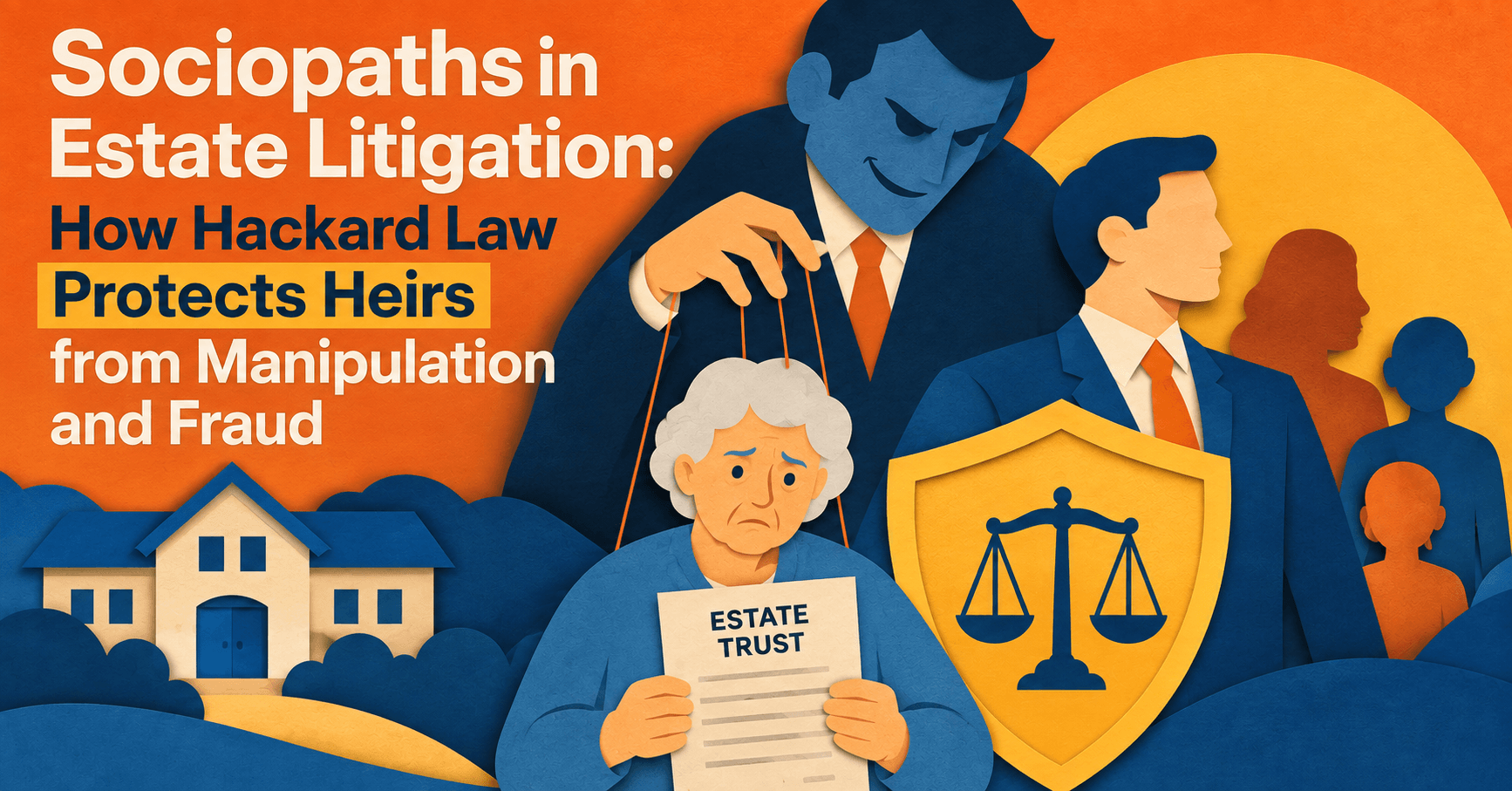
Sociopaths in Estate Litigation: How Hackard Law Protects Heirs from Manipulation and Fraud

Who Is Behind Estate Fraud?
I am Michael Hackard, founder of Hackard Law. Over five decades of practicing law, I have come to recognize a troubling pattern at the center of many estate and trust disputes: the presence of individuals who habitually violate the rights of others without remorse. In clinical terms, this is antisocial personality disorder. In plain language, these are sociopaths – and they show up in probate courts with alarming frequency.
I have written four books on inheritance protection and produced more than 1,000 educational videos that have reached over seven million viewers. Through that work, and through decades of litigation in Sacramento, the San Francisco Bay Area, and Los Angeles, I have seen firsthand how lying, manipulation, and deception become tools of estate destruction. If someone in your family has used fraud or undue influence to redirect an inheritance, you are not alone – and you are not without options.
Hackard Law provides contingency fee representation for qualified cases, meaning there are no upfront costs to you. Call us today at (916) 313-3030 to tell us your story.
Quick Summary
Sociopaths in estate disputes use deception and manipulation to steal inheritances from heirs and beneficiaries. Hackard Law litigates these cases throughout California on a contingency fee basis.
- Sociopathic behavior in estate cases includes denying the existence of wills, trusts, and assets
- Manipulation of one group of beneficiaries against another is a common tactic
- Deathbed changes to estate plans are frequently driven by undue influence or elder financial abuse
- Victims often experience disbelief before anger – and anger is usually when they call us
- Hackard Law holds these bad actors accountable and pursues recovery for heirs, beneficiaries, and elder abuse victims
How Sociopaths Operate in Estate Disputes
Antisocial personality disorder is defined by a persistent pattern of violating the rights of others – and nowhere is that more destructive than in the administration of an estate. The sociopath does not simply lie once. Lying is a strategy, deployed in layers. It may begin with a denial that a will or trust even exists. When the document surfaces, the next lie concerns the assets. When the assets are traced, the manipulation shifts to the family itself.
Pitting one set of beneficiaries against another is a particularly effective tactic. Sociopaths thrive on division. A family already grieving a loss becomes vulnerable to planted suspicions, distorted narratives, and manufactured grievances. By the time the truth emerges, the damage to family relationships can run deep – sometimes deeper than any court judgment can repair.
Hackard Law litigates these disputes across California, including in Sacramento County probate court and throughout the state. Understanding the pattern is the first step toward stopping it.
Deathbed Changes and Undue Influence
One of the most damaging tactics a sociopath uses is engineering last-minute changes to a decedent’s long-established estate plan. These changes – new wills, amended trusts, revised beneficiary designations – are rarely made freely. They are extracted through pressure, isolation, and manipulation of a vulnerable person.
California law recognizes undue influence as a ground for challenging estate documents, and Hackard Law has pursued these challenges in cases across the state. The legal standard focuses on whether the influencer used their position of trust or authority to overcome the free will of the person making the change. When a sociopath is involved, the evidence of that pressure is often hiding in plain sight – in the timing of the change, in who was present, and in the sudden departure from a lifetime of expressed wishes.
Case Pattern: A family member with a history of financial manipulation isolates an elderly parent during a serious illness, then surfaces with a revised trust that redirects the estate to themselves. After the parent passes, the remaining heirs discover the change and retain Hackard Law. Through discovery and forensic review of the decedent’s medical records and financial accounts, the pattern of isolation and control becomes clear, supporting a claim for undue influence.
Why Victims Feel Disbelief First
When estate wrongdoing comes to light, the first reaction from heirs and beneficiaries is almost never anger. It is disbelief. The idea that a sibling, a caregiver, or a trusted family friend could orchestrate a deliberate theft from a dying person is genuinely difficult to absorb. Logical people with strong values struggle to understand how someone could act this way without remorse.
That disbelief is understandable – but it costs time. Statutes of limitations run. Assets move. Evidence disappears. By the time the disbelief gives way to anger, the window for action may already be narrowing. At Hackard Law, we are typically engaged at the anger stage, when a client has processed enough of what happened to be ready to fight back. We meet clients where they are, and we move quickly once retained.
For an overview of how these disputes unfold from start to finish, the top 10 most common probate, trust, and estate battles is a useful starting point.
Operating in the Shadows – and Fighting Back
Sociopaths do not conduct their schemes in the open. They operate in the shadows – in private conversations with a vulnerable elder, in documents signed without witnesses, in financial transfers that look routine until someone examines them closely. And when they are discovered, they do not fold. They fight. They lie in depositions. They manufacture counter-narratives. They have no shame and no sense of responsibility, and they will maintain their story right up to the moment a court rules against them.
This is why litigation against a sociopathic bad actor requires more than legal knowledge. It requires a willingness to go the distance – to conduct thorough discovery, retain forensic accountants when needed, and build a case that can withstand a determined opponent who will not cooperate voluntarily.
Case Pattern: An estate administrator repeatedly denies that certain accounts existed, producing incomplete records during discovery. Hackard Law pursues third-party subpoenas to financial institutions, uncovering transfers made in the months before the decedent’s death. The pattern of concealment itself becomes evidence of the administrator’s bad faith, strengthening the claims for breach of fiduciary duty and financial elder abuse.
Discovery, forensic analysis, and the pursuit of justice – these are not just legal strategies, but safeguards for families threatened by manipulation and fraud. A steadfast commitment to truth restores what dishonesty tried to steal.
For those facing these battles in Sacramento, our Sacramento estate lawyer and Sacramento contested will and trust pages provide more detail on how we approach these cases locally.
Key Definitions
- Antisocial personality disorder: A clinical diagnosis describing a persistent pattern of disregarding and violating the rights of others, often without guilt or remorse.
- Sociopath: A common term for someone exhibiting antisocial personality disorder, particularly in the context of manipulative or exploitative behavior.
- Undue influence: Pressure or manipulation that overcomes a person’s free will, causing them to make estate decisions they would not otherwise have made.
- Elder financial abuse: The illegal or improper use of an elder’s funds, property, or assets, often by someone in a position of trust or authority.
- Deathbed change: A modification to a will, trust, or beneficiary designation made shortly before death, which may be challenged if procured through undue influence or fraud.
- Probate litigation: Court proceedings to resolve disputes about the validity of a will, the conduct of an executor, or the distribution of a decedent’s estate.
- Discovery: The pre-trial process in litigation through which parties obtain evidence from each other and from third parties, including financial records and communications.
- Fiduciary duty: The legal obligation of a trustee, executor, or other representative to act in the best interests of the beneficiaries they serve.
- Contingency fee: A fee arrangement in which the attorney is paid only if the case is won or settled, with no upfront cost to the client.
- Bad faith: Conduct that is dishonest, deceptive, or designed to obstruct the legitimate rights of another party.
What to Do Next
- Look for sudden or unexplained changes to a will, trust, or beneficiary designation made close to the time of death.
- Get copies of all estate planning documents as soon as you are able, including older versions if available.
- Look for signs of isolation – whether the decedent was cut off from family or friends in the period before their death.
- Try to avoid confronting the suspected bad actor directly before speaking with an attorney, as this can tip them off and accelerate asset movement.
- Gather financial records, bank statements, and any communications that seem relevant to the suspected misconduct.
- Look for patterns across time – a single suspicious act may be part of a longer scheme.
- Try to avoid delay; statutes of limitations in California estate disputes can be as short as 120 days from notice of a trust.
- Learn more about how contingency fee representation works so you understand your options before your first call.
- Call Hackard Law at (916) 313-3030 to speak with our team about what you have observed.
- Visit our contact page to reach us online and schedule a consultation.
CALL THE SAGE | When Experience Matters, Families Listen
🏛️ We practice California trust & estate & elder financial abuse litigation
⚖️ We represent heirs, beneficiaries, and elder abuse victims
🎥 1,000+ educational videos | 7 million+ views | 4 published books
🎯 “After thousands of cases, I see the pattern others miss.”
CONTINGENCY REPRESENTATION – No Win, No Fee
Throughout California: Sacramento | Los Angeles | Bay Area
📞 CALL THE SAGE: (916) 313-3030
Subscribe for weekly insights on:
- Elder financial abuse warning signs and prevention
- Trust and estate litigation strategies
- Inheritance protection for California families
- Family protection strategies
When your inheritance is under attack, Call The Sage.
Hackard Law | 10640 Mather Blvd, Mather CA 95655
Attorney Advertisement | Michael Hackard, State Bar #71067
RELATED VIDEOS
What Are Common Acts of Fraud in Trust or Probate? | California Estate Litigation Attorney
Explores the most frequent fraudulent acts that arise in California trust and probate cases.
Brain Tumors, Strokes & Estate Cheats Lying in Wait | Estate Litigation
Examines how bad actors exploit vulnerable people facing serious illness to steal inheritances.
Untold Stories of Family Estate Disputes | CA Probate Litigation
Real stories of family members fighting over estates gone wrong in California probate court.
Top 10 Types of Estate Battles | CA Probate & Trust Litigation
Breaks down the ten most common disputes that send families into probate and trust litigation.
Our Job is to Protect Your Family | Estate & Trust Litigation Attorneys
Michael Hackard explains how his firm fights to safeguard heirs and beneficiaries from wrongdoing.
Disputed Trusts & Family Estrangement | CA Estate Litigation
Looks at how trust disputes tear families apart and what legal options estranged heirs have.
 Michael Hackard is the founder of Hackard Law, a California trust and estate litigation firm with more than five decades of experience protecting the inheritance rights of families across Sacramento, the San Francisco Bay Area, and Los Angeles. He is the author of six published books on inheritance protection and has produced more than 1,000 educational videos with over seven million views.