


 (916) 313-3030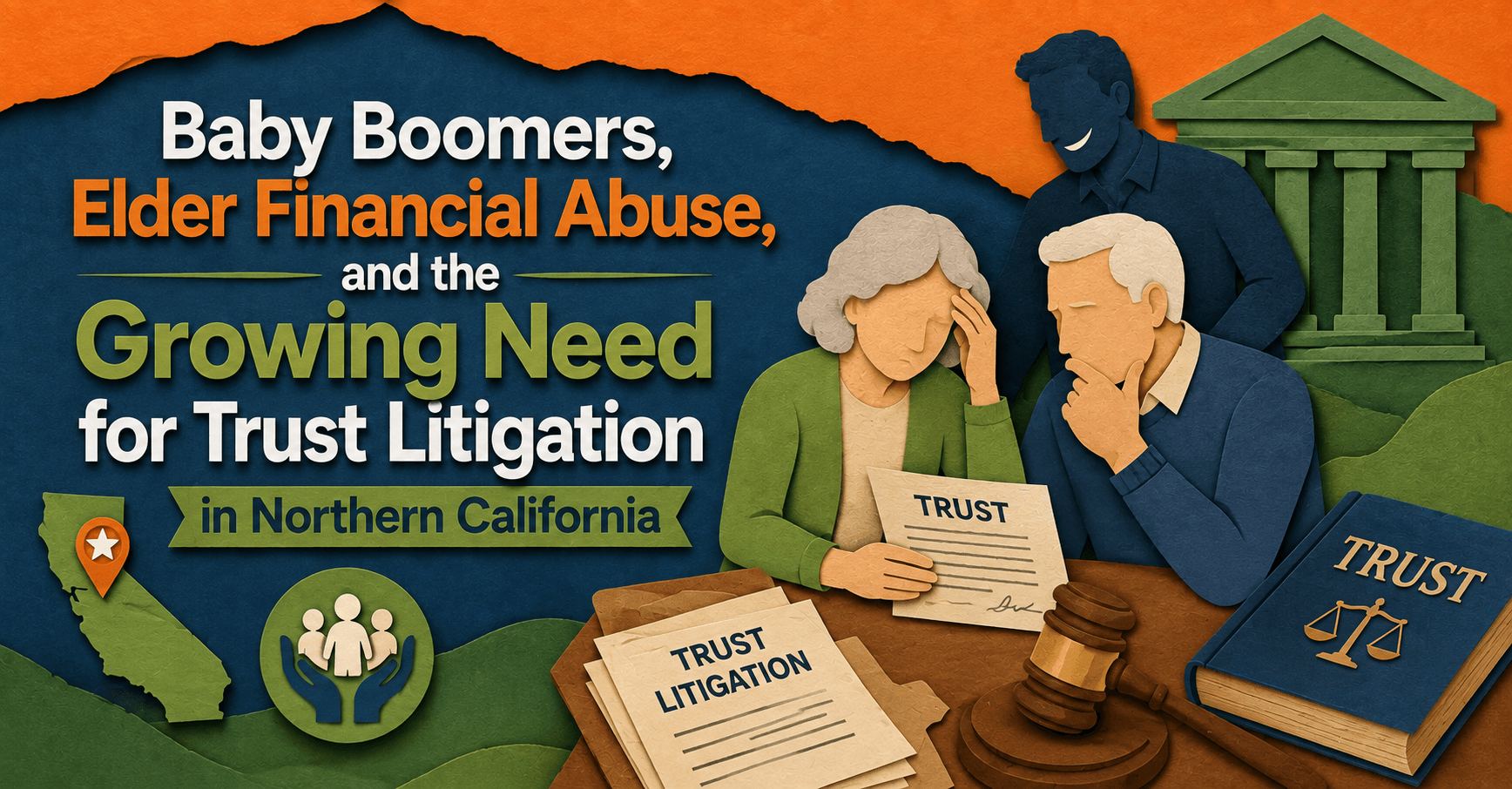
Baby Boomers, Elder Financial Abuse, and the Growing Need for Trust Litigation in Northern California

Who Is at Risk as Northern California’s Boomer Population Ages?
I am Michael Hackard, founder of Hackard Law, and over my five decades of practice, I have fought for heirs, beneficiaries, and elder abuse victims across California. I have written four books on inheritance protection – including titles that go directly to the heart of elder financial abuse – and I have produced more than 1,000 educational videos that have reached over seven million viewers. My practice serves families throughout Sacramento, the San Francisco Bay Area, and Los Angeles, and I have watched the aging of the baby boomer generation transform the landscape of trust and estate litigation in ways that demand serious attention.
Recent data from a nationwide apartment search platform identified the top Northern California ZIP codes by baby boomer population. San Francisco, Daly City, Hayward, Vallejo – these communities are home to tens of thousands of boomers, and the numbers are only growing. Projected population increases for residents aged 60 and over between 2010 and 2060 are staggering: San Joaquin County at 220%, Merced County at 211%, Santa Clara County at 203%, Alameda County at 195%, and Contra Costa County at 191%. The conclusion is clear – the influence and vulnerability of this generation will deepen over the next two decades.
Hackard Law provides contingency fee representation, meaning qualified clients pay no upfront costs to pursue their case. If your family has been affected by elder financial abuse or an inheritance dispute, call us at (916) 313-3030.
Quick Summary
The baby boomer population in Northern California is growing quickly, and with it comes an increasing number of elder financial abuse and estate disputes that families need to be ready to deal with.
- Baby boomers now occupy the highest-density ZIP codes in San Francisco, Daly City, Hayward, and Vallejo.
- Northern California counties project elder population growth of 191% to 220% by 2060.
- Elder financial abuse frequently targets seniors who wish to age in place rather than enter care facilities.
- Trust litigation is often the only effective remedy when undue influence or exploitation compromises estates.
- Early legal intervention is critical to recovering assets and protecting a family’s inheritance.
The Aging-in-Place Trend and Why It Creates Legal Risk
Many boomers have made clear they want to age in place – to remain in their homes and communities rather than transition into assisted living or nursing facilities. That preference is understandable and deeply human. But it also creates conditions that bad actors exploit. When a senior lives alone or relies on a single caregiver, the opportunity for financial manipulation grows.
Isolation is one of the most effective tools available to an abuser. A trusted caregiver, a new romantic partner, or even a family member can gradually reduce an elderly person’s contact with others. While positioning themselves as the sole source of support and information. Over time, this reliance can be used to divert assets, alter estate records, or empty accounts, often without the elder’s knowledge.
For families watching a loved one age at home, the warning signs are not always obvious. By the time the damage becomes obvious, significant assets may already be gone. That is why early legal intervention in elder financial abuse cases can make the difference between recovery and permanent loss.
What the Data Tells Us About Future Demand for Elder Protection
The projected growth figures are not abstract statistics. They represent hundreds of thousands of California families who will face decisions about estate planning, caregiving, and asset protection in the years ahead. Retailers, service providers, and government agencies are already beginning to adapt to this demographic shift – but the legal system must also be ready.
Hackard Law regularly handles cases filed in LA, Orange, Santa Clara, San Mateo, Alameda, Contra Costa, and Sacramento counties. The volume and complexity of elder financial abuse cases have grown alongside the boomer population, and that trend shows no sign of slowing.
Case Pattern: Following a health setback, a senior in a densely populated Bay Area community began relying on a live-in caregiver. Over the course of two years, the caregiver was added to financial accounts and ultimately named the primary beneficiary of a revised trust. When the senior died, the adult children discovered the changes and filed suit. In cases similar to this one, courts found evidence of undue influence and ordered the original estate plan to be restored.
Families navigating similar situations can learn more about their options from Hackard Law’s elder financial exploitation resources and by consulting a Sacramento elder financial abuse lawyer.
Undue Influence and the Estate Documents That Get Changed
Undue influence is the legal concept at the center of most elder financial abuse cases involving estate transfers. California law recognizes that when a person in a position of trust and confidence uses that position to override a senior’s free will, any resulting transfer of property or change to an estate document can be challenged in court.
The most frequently changed documents are revocable living trusts, wills, and beneficiary designations along with powers of attorney on financial accounts and life insurance policies. A change made under undue influence may appear perfectly legal on its face – properly signed, notarized, and witnessed. The problem lies in what happened before the pen touched the paper.
I have written about this at length in my book The Wolf at the Door: Undue Influence and Elder Financial Abuse, which explores how abusers operate and what families can do to respond. You can find that book and my other titles through the Hackard Law books page. The patterns described in that work appear in courtrooms across California with troubling regularity.
Case Pattern: An elderly widow in Sacramento County revised her trust three times in the final eighteen months of her life, each revision reducing her children’s share and increasing the share of a neighbor who had become her primary companion. After her death, the children challenged the final trust amendment. Evidence of isolation, the neighbor’s control over medical appointments, and inconsistencies in the widow’s stated wishes supported a finding of undue influence in cases following this fact pattern.
California’s Legal Remedies for Elder Financial Abuse
California has some of the strongest elder financial abuse statutes in the country. Under the Elder Abuse and Dependent Adult Civil Protection Act, victims – and their heirs after death – can pursue remedies that go well beyond what ordinary civil litigation provides. These include recovery of stolen assets, attorney fee awards, and in cases of recklessness or malice, enhanced damages.
The availability of double damages and attorney fee recovery under California law is a powerful tool. It means that abusers face consequences that exceed the amount they took, and it means that victims and their families can often pursue justice without carrying the complete financial burden of litigation themselves.
For those concerned about a trustee’s conduct, California law also gives beneficiaries the right to demand a full accounting. When trustees stonewall or delay, courts can compel disclosure. Families dealing with an unresponsive trustee should understand what happens when requests for an accounting are ignored.
For decades, I have stood with families who discovered – often too late – that someone they trusted had been systematically dismantling a lifetime of careful planning. The financial toll grows with every passing month that abuse goes unchallenged. The fracture it causes in families often runs too deep for any judgment to mend. But a steadfast commitment to truth restores what dishonesty tried to steal, and that is why this work matters.
Key Definitions
- Undue influence: A legal doctrine that voids transfers or estate changes made when a person in a position of trust overrides a senior’s free will.
- Elder financial abuse: The wrongful taking, concealment, or appropriation of an elder’s property or assets through fraud, duress, or undue influence.
- Contingency fee: A fee arrangement in which the attorney is paid only if the case results in a recovery, with no upfront cost to the client.
- Revocable living trust: A legal document that holds assets during a person’s lifetime and distributes them at death, which can be amended or revoked while the person has capacity.
- Trustee: The person or institution responsible for managing trust assets according to the trust’s terms and California fiduciary law.
- Beneficiary: A person entitled to receive assets or income from a trust or estate.
- Power of attorney: A legal document authorizing one person to act on behalf of another in financial or legal matters, which can be misused to exploit a vulnerable elder.
- Probate court: The California court with jurisdiction over the administration of estates, trusts, and related disputes.
- Enhanced damages: Additional financial penalties available under California elder abuse law when abuse is proven to be reckless, oppressive, or malicious.
- Aging in place: The choice by a senior to remain in their own home rather than move to a care facility, a preference that can increase exposure to financial exploitation.
What to Do Next
- Look for warning signs of isolation – a senior who was previously social becoming increasingly cut off from family and longtime friends.
- Get copies of any recent trust amendments, powers of attorney, or beneficiary designation changes as early as possible.
- Try to avoid confronting a suspected abuser directly before speaking with an attorney, as this can complicate future litigation.
- Document your observations with dates, names, and descriptions of behavior that seemed unusual or controlling.
- Look for unexplained financial transactions, new account signatories, or sudden changes in a senior’s stated wishes.
- Reach out to a caregiver financial exploitation attorney in Sacramento if a paid or informal caregiver has unusual access to finances.
- Consult with a Sacramento estate lawyer to understand your rights before an estate is fully distributed.
- Try to avoid delay – California statutes of limitations on elder financial abuse claims can bar recovery if action is not taken promptly.
- Call Hackard Law at (916) 313-3030 to speak with a California attorney who specializes in these types of cases.
- To arrange a private consultation at no cost up front, visit our contact page.
CALL THE SAGE | When Experience Matters, Families Listen
🏛️ We practice California trust & estate & elder financial abuse litigation
⚖️ We represent heirs, beneficiaries, and elder abuse victims
🎥 1,000+ educational videos | 7 million+ views | 4 published books
🎯 “After thousands of cases, I see the pattern others miss.”
CONTINGENCY REPRESENTATION – No Win, No Fee
Throughout California: Sacramento | Los Angeles | Bay Area
📞 CALL THE SAGE: (916) 313-3030
Subscribe for weekly insights on:
- Elder financial abuse warning signs and prevention
- Trust and estate litigation strategies
- Inheritance protection for California families
- Family protection strategies
When your inheritance is under attack, Call The Sage.
Hackard Law | 10640 Mather Blvd, Mather CA 95655
Attorney Advertisement | Michael Hackard, State Bar #71071067
RELATED VIDEOS
Elder Financial Abuse | Warning Signs | CA Trust Litigation
Learn to recognize the early warning signs of elder financial abuse in California.
Establishing Undue Influence & Elder Financial Abuse | CA Trust Litigation
Explains how attorneys prove undue influence and financial exploitation in trust cases.
How to Protect Families from Elder Financial Abuse | CA Trust Litigation
Practical steps families can take to shield elderly loved ones from financial predators.
Guarding Against Elder Financial Abuse | CA Trust Litigation
Covers strategies seniors and families can use to prevent financial exploitation.
The Cost of Elder Financial Abuse | California Estate & Trust Litigation
Examines the financial and emotional toll elder abuse takes on victims and their families.
When to Hire a Trust & Estate Litigator After Abuse or Disinheritance | ASAP
Discusses why acting quickly to hire a litigator matters after suspected abuse or disinheritance.
 Michael Hackard is the founder of Hackard Law, a California trust and estate litigation firm with more than five decades of experience protecting the inheritance rights of families across Sacramento, the San Francisco Bay Area, and Los Angeles. He is the author of six published books on inheritance protection and has produced more than 1,000 educational videos with over seven million views.