


 (916) 313-3030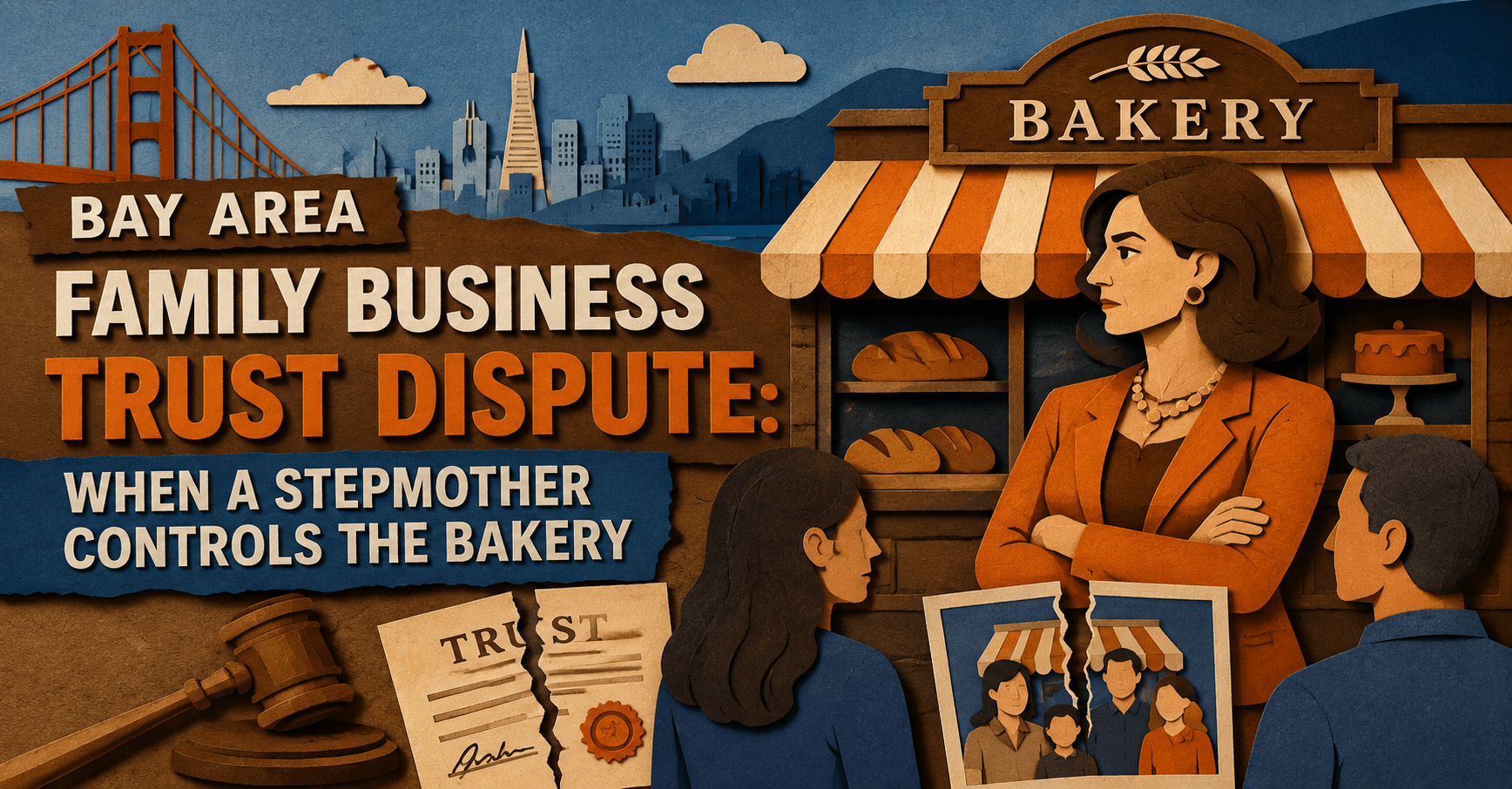
Bay Area Family Business Trust Dispute: When a Stepmother Controls the Bakery

A Story From San Francisco That Hits Close to Home
I am Michael Hackard, founder of Hackard Law, and a story out of San Francisco recently caught my attention. Not because the legal mechanics were unusual, but because the human elements were so familiar. A successful immigrant patriarch. Children from a prior marriage. A second wife. A thriving family business built over decades. And a trust that quietly handed control to the wrong person at the worst possible moment.
In my fifty years of practice, I have represented beneficiaries, heirs, and victims of elder abuse in Sacramento, the San Francisco Bay Area, and Los Angeles. In addition to producing over 1,000 instructional videos that have been viewed by over seven million people, I have authored four books on inheritance protection. This Bay Area bakery case, in my opinion, is not an anomaly. In California, this pattern can be seen in family boardrooms, corner stores, and kitchens.
Hackard Law provides contingency fee representation – no upfront costs for qualified cases. If your family is facing a trust dispute, call us today at (916) 313-3030.
Quick Summary
A San Francisco family bakery founded in 1951 became the center of a trust dispute when the aging patriarch’s trust gave his second wife controlling interest, allowing her to sell the property over his son’s objections.
- A blended family structure – children from a prior marriage plus a stepmother – created competing interests in a valuable estate
- The patriarch’s trust gave the stepmother a majority beneficiary share, including control over a $3 million corner property
- The stepmother moved to sell the building, which would force the bakery to close
- The son, who managed the bakery for years, had no legal mechanism to stop the sale without litigation
- This scenario repeats across California, from Alameda County to Santa Clara and beyond
The Bakery on the Corner: How It All Started
In 1951, a young immigrant arrived in San Francisco with his wife and founded a corner bakery. The neighborhood embraced it. Decades passed. The business grew into a community institution. The patriarch eventually handed day-to-day operations to his son, and the family continued building something worth protecting.
The building itself became a significant asset. The patriarch owned not just the bakery space but the entire corner complex, with apartment tenants on the upper floor generating rental income. By any measure, this was a successful estate built through hard work across generations.
Then came the shifts that frequently precede conflict. In the 1990s, the patriarch and his first wife got divorced. He got married again. The stepmother and his son seemed to get along. Life went on. However, the patriarch’s quiet building of trust prepared the ground for a collision that wouldn’t happen until he was 96 years old and his health was deteriorating.
When the Trust Becomes a Problem
At some point, the patriarch structured his trust to give the stepmother a majority beneficiary share – enough to give her controlling interest in the bakery property. On paper, this may have reflected his wishes at the time. In practice, it handed one person the power to unwind everything the family had built.
With the patriarch’s health in decline, the stepmother decided to sell the property. The building was worth approximately $3 million. Selling it meant closing the bakery. The son who had spent years running the business had no clear path to stop her under the trust’s terms.
This is where estate planning decisions made in private become public legal battles. The trust document did not just divide assets – it determined power. And power, when held by one party in a blended family, rarely goes unchallenged for long.
Case Pattern: A patriarch in a blended family restructures his trust late in life, granting his second spouse majority control over a family-run business property. After his health declines, the spouse moves to liquidate the asset over the objections of the children from his prior marriage. The children pursue litigation to challenge the transfer and protect the business their father built.
Blended Families and the Architecture of Conflict
Blended families are not inherently contentious. Many stepparents and stepchildren maintain warm, functional relationships for decades. But when a significant estate is involved, and trust documents concentrate power in one person, the conditions for conflict are already in place – whether anyone intends it or not.
Michael Hackard has handled cases across the Bay Area where the core dispute was not about greed but about competing legitimate claims. A child who devoted years to a family business has a real stake in its future. A surviving spouse who was promised security also has a real stake. When the trust does not account for both, litigation often fills the gap.
In many of these cases, the structural issue is that the trust was written to reflect the patriarch’s desires at one point in time, without taking into account how relationships, family dynamics, and health would change over the ensuing decades. An ordinary estate can become a battlefield due to poor drafting or antiquated planning. Hackard Law litigates these cases throughout the Bay Area, including in Oakland estate litigation and Santa Clara estate litigation.
Elder Financial Abuse and Undue Influence in Estate Transfers
Not every case involving a stepparent and a changed trust rises to the level of elder financial abuse. But when a vulnerable, aging patriarch’s trust is structured in ways that benefit one party at the expense of his children – particularly when that structuring occurs as his health declines – the question of undue influence deserves serious examination.
California law recognizes that seniors with cognitive decline or serious illness are at heightened risk of manipulation. The legal standard for undue influence looks at whether someone in a position of trust and confidence used that position to override the free will of the person making estate decisions. When a family member controls access to an aging parent, manages their finances, and stands to gain substantially from changes to a trust, those facts warrant scrutiny.
Hackard Law pursues these claims on behalf of heirs, beneficiaries, and elder abuse victims. California’s elder financial abuse statutes provide powerful remedies, including double damages and attorney fee recovery in proven cases. Early legal intervention can make the difference between recovering assets and watching them disappear into a completed sale. Learn more about early intervention in estate transfers involving elder abuse.
Case Pattern: Shortly after the parent started exhibiting symptoms of cognitive decline, an adult child discovers that a parent’s trust was significantly altered to favor a new spouse. Hackard Law is contacted by the child. An investigation shows that the spouse has a pattern of financial control and seclusion. The amendment is challenged in court on the grounds of undue influence.
Why the Bay Area Produces These Disputes
Because of the Bay Area’s high real estate values, trust disputes are especially risky. A $3 million corner property in San Francisco is by no means a modest asset. The dispute’s emotional and financial impact increases when that property serves as the foundation for a multigenerational company.
Hackard Law handles trust and will contests in Santa Clara and throughout the Bay Area. Due to the high property values, blended family households, and concentration of family-owned businesses in the area, inheritance disputes are common and call for knowledgeable, experienced litigation counsel.
For beneficiaries who feel shut out of an estate or threatened by a trustee’s decisions, understanding your rights is the first step. A trustee – even one who is also a beneficiary – owes fiduciary duties to all beneficiaries. Selling trust property in a way that destroys a family business may breach those duties, depending on the trust’s terms and the circumstances of the sale. You can read more about elder financial exploitation and how California law responds to it.
What the San Francisco Bakery Case Teaches Us
For decades, I have stood with families who discovered too late that a trust document had quietly transferred power away from them. The bakery story from San Francisco is a reminder that estate planning is not just paperwork – it is a map of who controls what when the founder is no longer able to speak for himself.
When disputes are postponed, the financial cost increases. Legal costs mount up. Real estate is sold. Companies shut down. It is frequently impossible for any judgment to completely heal the rift between siblings and stepparents. It is nearly always best to act early, before a sale closes, before assets are transferred, or before the window for a legal challenge closes.
The pursuit of justice, forensic analysis, and discovery are not merely legal tactics. They serve as protections for families under threat from improper influence and the subtle rewriting of a lifetime’s work. What dishonesty attempted to steal is restored by an unwavering dedication to the truth. I would like to know if your family is going through something similar.
For more on how California courts approach these disputes, read our guide on guarding against elder financial abuse in trust litigation.
Key Definitions
- Trustee: The person or institution named in a trust document to manage and distribute trust assets according to the trust’s terms.
- Beneficiary: A person entitled to receive assets or income from a trust.
- Undue influence: Pressure or manipulation that overrides a person’s free will in making estate planning decisions, recognized under California law as grounds to void a trust amendment.
- Fiduciary duty: The legal obligation of a trustee to act in the best interests of all beneficiaries, not just themselves.
- Controlling interest: A beneficiary share large enough to give one person decision-making authority over trust assets, including the power to sell property.
- Elder financial abuse: The wrongful taking, concealment, or misappropriation of an elder’s assets, often through manipulation of estate documents.
- Trust amendment: A formal change to the terms of an existing trust, which can shift beneficiary shares or trustee powers.
- Fraudulent transfer: A transfer of assets made to defeat the legitimate claims of creditors or other beneficiaries.
- Probate litigation: Court proceedings to resolve disputes over wills, trusts, and estate assets.
- Contingency fee: A legal fee arrangement where the attorney is paid only if the case results in a recovery, with no upfront cost to the client.
What to Do Next
- Look for signs that a trust was amended during a period when the creator was ill, isolated, or cognitively impaired.
- Get copies of the current trust document and any amendments as soon as possible.
- Try to avoid delaying action if a trustee has announced plans to sell property – court intervention may require time.
- Look for records of communications between the trustee and the original trust creator in the months before any amendments were made.
- Try to avoid confronting a trustee directly without legal guidance, as statements made without counsel can affect your case.
- Document your own contributions to any family business or property that is part of the trust estate.
- Look for financial records that show changes in account activity or asset transfers around the time of any trust amendments.
- Get a consultation with a trust litigation attorney before the statute of limitations on your claims expires.
- Call Hackard Law at (916) 313-3030 to discuss your situation with an attorney who handles Bay Area trust and estate disputes.
- Visit our contact page to schedule a free consultation and learn whether your case qualifies for contingency fee representation.
CALL THE SAGE | When Experience Matters, Families Listen
🏛️ We practice California trust & estate & elder financial abuse litigation
⚖️ We represent heirs, beneficiaries, and elder abuse victims
🎥 1,000+ educational videos | 7 million+ views | 6 published books
🎯 “After thousands of cases, I see the pattern others miss.”
CONTINGENCY REPRESENTATION – No Win, No Fee
Throughout California: Sacramento | Los Angeles | Bay Area
📞 CALL THE SAGE: (916) 313-3030
Subscribe for weekly insights on:
• Elder financial abuse warning signs and prevention
• Trust and estate litigation strategies
• Inheritance protection for California families
• Family protection strategies
When your inheritance is under attack, Call The Sage.
Hackard Law | 10640 Mather Blvd, Mather CA 95655
Attorney Advertisement | Michael Hackard, State Bar #71067
RELATED VIDEOS
The Widowed Stepmother | Trust Inheritance Disputes
Explores how a widowed stepmother can affect trust inheritance for stepchildren.
Inheritance Heists Ch. 12: Stepmother Estate Battles Over Estate and Trust Assets
Examines conflicts between stepmothers and biological children over estate and trust assets.
Inheritance Heists Ch. 11: Blended Family Estate Fights – Litigation or Mediation?
Weighs litigation versus mediation when blended families clash over inheritance.
Bay Area Estate & Trust Litigation Battles | Disinherited House Beneficiaries
Covers Bay Area trust disputes where beneficiaries are cut out of property they expected to inherit.
Blended Families & Elder Financial Abuse | Prudent Money
Discusses how blended family dynamics can open the door to elder financial abuse.
Elder Financial Abuse | Alameda, Contra Costa & San Francisco
Addresses elder financial abuse cases across the San Francisco Bay Area counties.
 Michael Hackard is the founder of Hackard Law, a California trust and estate litigation firm with more than five decades of experience protecting the inheritance rights of families across Sacramento, the San Francisco Bay Area, and Los Angeles. He is the author of six published books and has produced more than 1,000 educational videos with over seven million views.