


 (916) 313-3030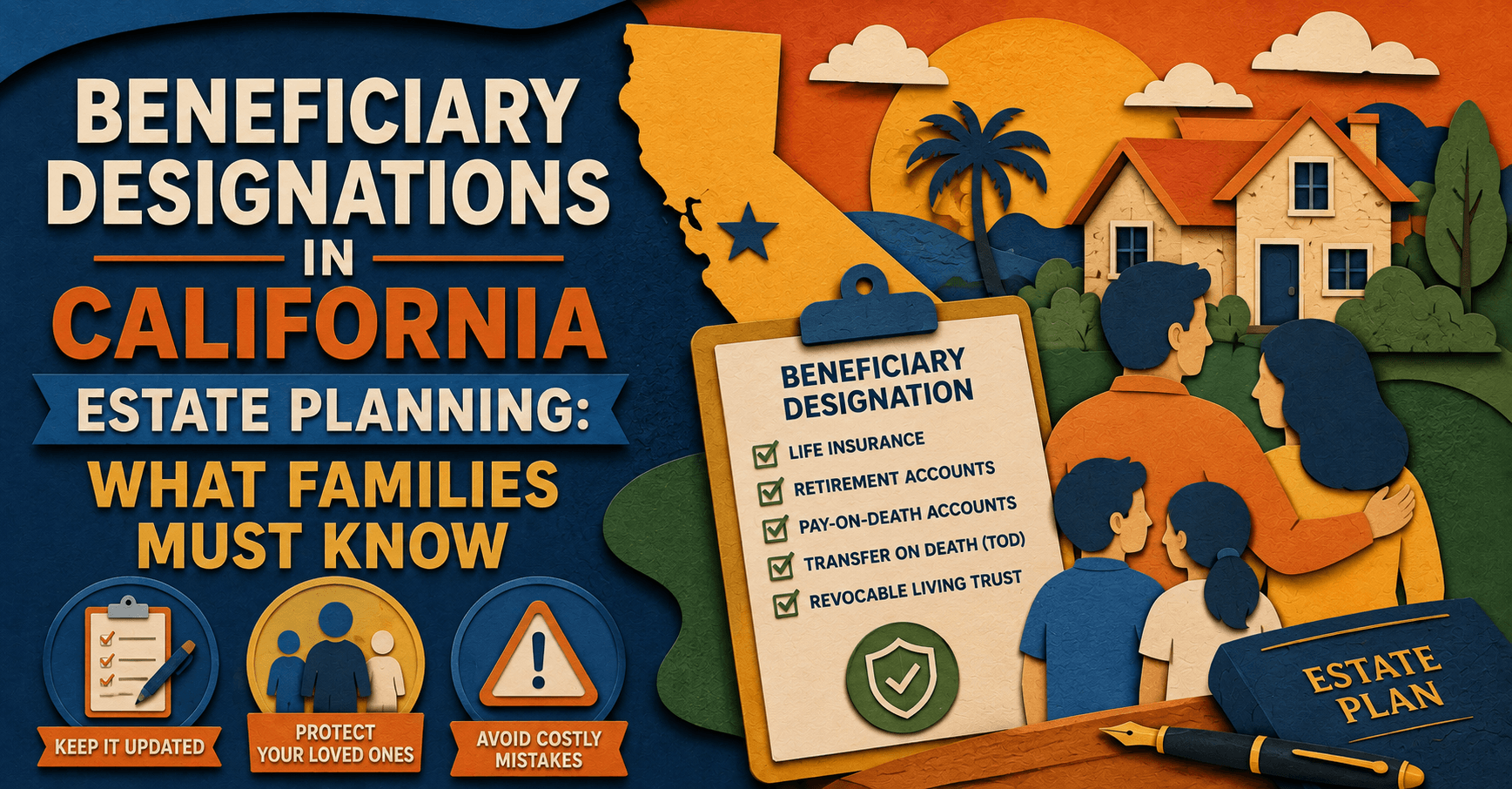
Beneficiary Designations in California Estate Planning: What Families Must Know

Why Beneficiary Designations Deserve Your Attention
I’m Michael Hackard, founder of Hackard Law. Over five decades of practice, I have fought for heirs, beneficiaries, and elder abuse victims across California – from Sacramento to the San Francisco Bay Area to Los Angeles. I have written four published books on inheritance protection and produced more than 1,000 educational videos that have reached over seven million viewers. In all that time, one estate planning mistake stands out for how quietly it causes harm: neglected beneficiary designations.
Wills, trusts, and court documents come to mind when families consider estate planning. These are vital tools. However, beneficiary designations, the straightforward documents sent to banks, insurance providers, and retirement plan administrators, have a degree of legal power that even a well-written will cannot supersede. Because the forms were up to date and well-coordinated, I have seen families receive just what a loved one had wanted. Additionally, I have seen families waste months on the probate process or see assets go to the incorrect person completely because no one remembered to update paperwork following a death or divorce.
Understanding how these designations work is one of the most practical steps any California family can take to protect their future.
Hackard Law provides contingency fee representation for qualified estate and trust disputes – no upfront costs. To discuss your situation, call us at (916) 313-3030.
Quick Summary
By transferring assets directly to designated individuals, beneficiary designations are legally binding directives that totally avoid probate. Outdated or missing designations are one of the most common and preventable causes of estate disputes in California.
- Beneficiary designations override your will – the form controls the asset
- Accounts covered include life insurance, IRAs, 401(k)s, annuities, and payable-on-death bank accounts
- Outdated forms, blank forms, and missing contingent beneficiaries all create serious problems
- Naming a minor directly as beneficiary can trigger court-supervised guardianship of the funds
- Regular review after major life events keeps designations aligned with your actual wishes
How Beneficiary Designations Actually Work
A beneficiary designation is a legally binding directive that is sent directly to a financial institution. When you pass away, the institution transfers the asset to the chosen individual without consulting the court. Because the transfer entirely avoids probate, there are no delays, no public documents, and no doubt.
This is crucial since probate is a public process in California that may take several months. A properly named beneficiary on a life insurance policy or retirement account may receive funds within weeks of a death, providing instant financial security at a time when families are already struggling.
The accounts covered by these designations are often among the most substantial assets a person owns. Life insurance policies, IRAs, 401(k)s, annuities, and bank or brokerage accounts with payable-on-death or transfer-on-death instructions all pass this way. For many California families, these accounts represent decades of savings. That makes the beneficiary form – not the will – the controlling document.
For a deeper look at how life insurance designations can be challenged when fraud or manipulation is involved, the article on life insurance fraud and undue influence covers the legal environment in detail.
The Most Common Mistakes – and Why They Happen
The errors I see most often are not the result of bad intentions. They happen because people assume their will controls everything, or because they simply forget to revisit forms after life changes.
Outdated designations are the most frequent problem. Marriages, divorces, births, and deaths all change the picture. A form completed twenty years ago may name someone who is no longer part of your life – or no longer living. The financial institution is legally required to follow what the form says, regardless of what happened afterward.
Another frequent mistake is to leave a form blank. The asset usually ends up in the probate estate when no beneficiary is chosen, removing the quickness and anonymity that initially made the designation advantageous. Families who anticipated a speedy move must instead endure a legal proceeding.
Naming a minor child directly as beneficiary creates a different set of complications. Children under 18 cannot legally manage inherited funds. A court will appoint a guardian to oversee the money until the child turns 18 – at which point the entire amount transfers to them outright, whether or not they are ready to handle it. A trust, named as beneficiary, can solve this problem cleanly.
Finally, forgetting to name a contingent beneficiary leaves no backup plan. If the primary beneficiary dies before you do, the asset may again be routed through probate.
Case Pattern: A family discovered after a father’s death that his retirement account still named his ex-wife as beneficiary – a designation made before their divorce fifteen years earlier. Because the form was never updated, the ex-spouse received the account by law. The outcome was legally correct but entirely contrary to what the father had intended and told his children.
Beneficiary Designations and Your Broader Estate Plan
Beneficiary designations are handled as a planned layer of the overall strategy rather than as an afterthought in the best estate planning. Assets outside of beneficiary designations and the probate process are handled by a will. Funds for recipients with special needs, couples in blended families, and minors are managed by trusts. For the accounts they cover, beneficiary designations enable quick, direct transactions.
When all three align, the estate plan works effectively. Assets reach the right people at the right time, with minimal court involvement and minimal delay. When they conflict – when a will says one thing and a beneficiary form says another – the form wins. That outcome surprises families who assumed the will was the final word.
For families dealing with disputes that arise from these conflicts, understanding undue influence in California estate law is often relevant, particularly when a designation was changed late in life under questionable circumstances.
For California families dealing with the extensive question of how assets move at death, the Sacramento estate lawyer page at Hackard Law covers the full range of estate and trust matters handled across the state.
Case Pattern: A widow in California synchronized her beneficiary selections with a living trust she had established for her adult children from a prior marriage. The life insurance proceeds were sent directly to the trust within weeks of her tragic demise. Her children received assistance without going through probate, just as she had planned years previously.
What Happens When Designations Are Challenged
Not every beneficiary designation goes unchallenged. Heirs, beneficiaries, and elder abuse victims sometimes have grounds to contest a designation – particularly when the change was made while the account holder lacked mental capacity, or when someone in a position of trust exercised pressure to alter the form.
California law provides remedies in these situations. Courts can set aside designations obtained through fraud, undue influence, or lack of capacity. The legal process requires evidence – medical records, witness accounts, financial history – and the timeline matters. Delay can complicate a claim.
For families who believe a beneficiary designation was changed improperly, the resource on contesting a life insurance beneficiary designation outlines the statutory standards courts apply. Similarly, the article on challenging a life insurance claim addresses the procedural steps involved.
For many years, I have supported families who found out too late that a form had been altered without their knowledge. A family’s division is frequently too deep for any judgment to heal, and the financial cost increases swiftly. What dishonesty attempted to steal is restored through discovery, forensic investigation, and a steadfast dedication to the truth; yet, prompt action is always preferable to delayed action.
Key Definitions
- Beneficiary designation: A legally binding instruction filed with a financial institution directing who receives an asset upon the account holder’s death.
- Primary beneficiary: The first person named to receive an asset under a beneficiary designation.
- Contingent beneficiary: A backup beneficiary who receives the asset if the primary beneficiary has already died.
- Payable-on-death (POD): A designation on a bank account that transfers the balance directly to the named person at death, bypassing probate.
- Transfer-on-death (TOD): Similar to POD, but applied to brokerage or investment accounts.
- Probate: The court-supervised process of administering a deceased person’s estate; bypassed when a valid beneficiary designation exists.
- Undue influence: Pressure or manipulation that overcomes a person’s free will, sometimes used to alter beneficiary designations improperly.
- Testamentary trust: A trust created by a will that takes effect at death; can be named as a beneficiary to manage inherited funds for minors or others.
- Capacity: The legal and mental ability to make binding decisions; required at the time a beneficiary designation is made or changed.
- Contingency fee: A fee arrangement where an attorney is paid only if the case results in a recovery; no upfront cost to the client.
What to Do Next
- Search for all current beneficiary designation forms in bank accounts, retirement accounts, annuities, and life insurance policies.
- Get copies of current designations from each financial institution to confirm who is actually named.
- Review your designations after any major life event – marriage, divorce, birth of a child, or death of a named beneficiary.
- Try to avoid naming a minor child directly; look into naming a trust as beneficiary instead.
- Make sure contingent beneficiaries are named on every account so there is always a backup plan.
- Coordinate your beneficiary forms with your will as well as any existing trusts to make sure everything points in the same direction.
- If you suspect a designation was changed through fraud or undue influence, try to act quickly – statutes of limitations apply.
- Look into the contingency fee representation options available for qualified estate disputes.
- Call Hackard Law at (916) 313-3030 to discuss your situation with an attorney who handles estate and beneficiary disputes across California.
CALL THE SAGE | When Experience Matters, Families Listen
🏛️ We practice California trust & estate & elder financial abuse litigation
⚖️ We represent heirs, beneficiaries, and elder abuse victims
🎥 1,000+ educational videos | 7 million+ views | 4 published books
🎯 “After thousands of cases, I see the pattern others miss.”
CONTINGENCY REPRESENTATION – No Win, No Fee
Throughout California: Sacramento | Los Angeles | Bay Area
📞 CALL THE SAGE: (916) 313-3030
Subscribe for weekly insights on:
- Elder financial abuse warning signs and prevention
- Trust and estate litigation strategies
- Inheritance protection for California families
- Family protection strategies
When your inheritance is under attack, Call The Sage.
Hackard Law | 10640 Mather Blvd, Mather CA 95655
Attorney Advertisement | Michael Hackard, State Bar #71067
RELATED VIDEOS
How Smart Beneficiary Planning Protects Your Family from Surprises
Explains how thoughtful beneficiary planning keeps assets out of the wrong hands.
Beneficiary of a California Trust? | What You Need to Know
Walks California trust beneficiaries through their key rights and responsibilities.
Estate Planning Pitfalls: Avoid Costly Mistakes
Highlights common estate planning errors that can cost families time and money.
Estate Planning Myths That Could Cost Your Family Everything
Debunks widespread misconceptions about wills, trusts, and inheritance planning.
Why Living Trusts Still End Up in Court | Avoid These Common Estate Planning Gaps
Reveals the planning gaps that send even well-drafted living trusts into litigation.
Were You Unfairly Cut Out of a Trust? | Know Your Rights as a Disadvantaged Beneficiary
Covers the legal options available when a beneficiary is wrongfully excluded from a trust.
 Michael Hackard is the founder of Hackard Law, a California trust and estate litigation firm with more than five decades of experience protecting the inheritance rights of families across Sacramento, the San Francisco Bay Area, and Los Angeles. He is the author of six published books on inheritance protection and has produced more than 1,000 educational videos with over seven million views.