


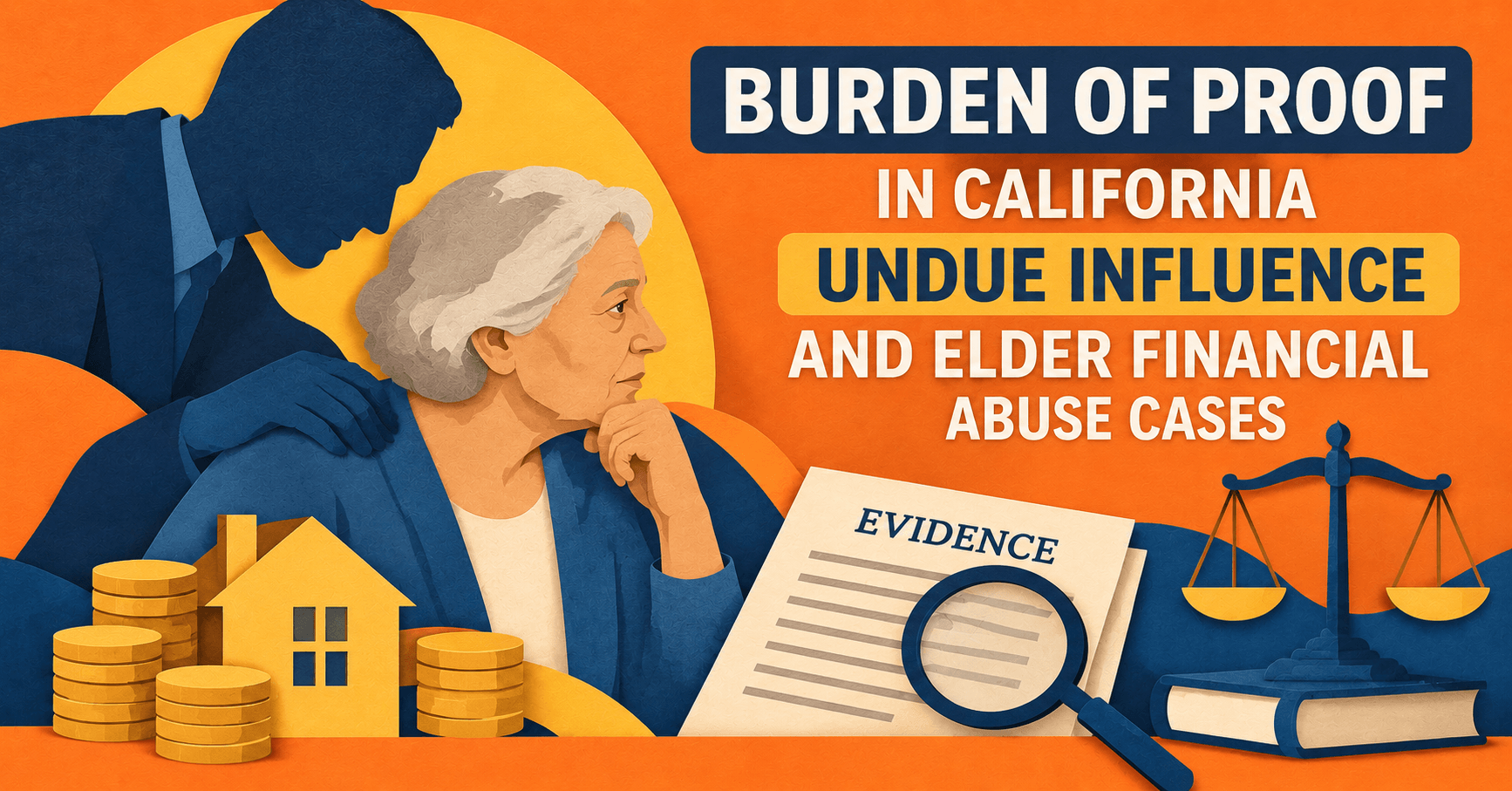
Burden of Proof in California Undue Influence and Elder Financial Abuse Cases

Who Bears the Burden – and Why It Changes Everything
I am Michael Hackard, founder of Hackard Law. Over five decades of practice, I have fought for heirs, beneficiaries, and elder abuse victims whose inheritances were taken through manipulation, outright theft, or a combination of both. I have published four books on inheritance protection and produced more than 1,000 educational videos that have reached over seven million viewers. Hackard Law handles trust and estate litigation across California’s largest urban centers – Sacramento, the San Francisco Bay Area, and Los Angeles – and we respond to dozens of inquiries every month from families trying to understand what happened to a loved one’s estate.
Many of those inquiries circle back to a single question: do we have enough to win? That question is really a question about the burden of proof. Understanding how that burden works – who carries it, what it requires, and how courts measure it – is essential before any family decides whether to pursue a claim.
Hackard Law provides contingency fee representation for qualified cases, meaning there are no upfront costs to you. To discuss your situation, call us at (916) 313-3030.
Quick Summary
In California undue influence and elder financial abuse cases, the party bringing the claim generally bears the burden of proving that the alleged wrongdoing more likely occurred than not. The timing of estate planning changes, the vulnerability of the elder, and the opportunity for manipulation all shape how courts evaluate that proof.
- The legal standard in most civil cases is a preponderance of the evidence – more likely true than not.
- California courts use the phrase “burden of going forward with the evidence” to describe a party’s obligation to introduce sufficient proof.
- A prima facie case means enough evidence exists to proceed to trial or judgment.
- The closer in time an estate planning change occurs to death or a period of cognitive decline, the more probative that timing becomes.
- Circumstantial evidence, financial records, and witness testimony all contribute to meeting the burden.
What the Burden of Proof Actually Means in These Cases
California civil courts do not require certainty. The standard in most trust and estate disputes – including undue influence and elder financial abuse claims – is a preponderance of the evidence. Put simply, the fact-finder must conclude that the disputed fact is more likely true than not. Think of it as tipping a scale past the halfway point.
For the party bringing the case, that means gathering enough convincing evidence for a judge or jury to say, “Yes, this is probably what happened.” That evidence can be direct – a witness who saw the manipulation – or circumstantial, built from patterns, timing, financial records and the elder’s documented condition. Courts have long held that undue influence is rarely practiced openly, so circumstantial evidence is given real weight.
In jury trials, the judge instructs jurors on which party bears the burden for each element of the claim. That allocation is not arbitrary – it is determined by statute and case law. Knowing who carries the burden, and for which facts, shapes litigation strategy from the first day of investigation.
Timing and the Weight of Estate Planning Changes
Not all suspicious estate planning changes have the same evidentiary weight. When a change was made years before death, under circumstances suggesting the elder was lucid, independent, and free of pressure, it becomes harder to attribute the change to undue influence. Distance in time dilutes the inference.
Contrast this with changes made in the last few weeks or months of life, especially when the elderly person was cognitively impaired, isolated from family, or reliant on the person most likely to benefit. The courts take great care when determining proximity. The reorientation of a lifetime’s work and relationships at the moment of death raises questions that must be answered. The timing does not establish the case on its own, but it does improve the perspective from which all other evidence is viewed.
For a deeper look at how California courts analyze these patterns, the page on undue influence in California estate law covers the statutory framework and evidentiary considerations in detail.
Case Pattern: A family member contacts Hackard Law after learning that an elderly parent with moderate dementia had signed a new trust amendment just three weeks before death. The amendment eliminated three adult children and designated a paid caregiver as the sole beneficiary. The proximity of the change to death, combined with medical records indicating cognitive decline, forms the basis for a compelling undue influence claim.
Building a Prima Facie Case for Undue Influence
A prima facie case is the threshold showing that a claim deserves to proceed. It does not mean the case is won – it means enough evidence exists that a reasonable fact-finder could rule in the claimant’s favor. Falling short of that threshold means the claim may be dismissed before trial.
For undue influence, California law identifies several factors courts consider: the vulnerability of the elder, the apparent authority of the influencer, the actions used to apply pressure, and the inequity of the resulting estate plan. Hackard Law builds cases by documenting each of these elements – medical records establishing vulnerability, financial records tracing asset movements, communications showing isolation tactics, and estate documents revealing the sudden shift in distribution.
The civil remedies available for elder financial abuse in California include double damages and attorney fee recovery in qualifying cases. This reflects how seriously the legislature treats this conduct.
Case Pattern: An adult son learns that his mother’s bank accounts were depleted over an eighteen-month period by a neighbor who acquired control of her finances through a power of attorney after his mother’s death. The prima facie standard for elder financial abuse is met by a pattern of financial control that is established by bank records, ATM withdrawal patterns, and testimony from a home health aide.
Where Smoke Alone Is Not Enough
Families sometimes come to us convinced that something went wrong, and they are often right. But suspicion, however reasonable, is not evidence. “Where there’s smoke, there’s fire” is a saying – not a legal standard. Courts require proof, and the obligation to produce that proof rests on the party making the claim.
This is why early investigation matters. Financial records, medical records, communications, and witness accounts need to be gathered and preserved before memories fade and documents disappear. The resources on trust traps and inheritance manipulation outline how these schemes are structured and what evidence tends to surface them.
For families concerned about financial abuse tied to life insurance beneficiary designations, the analysis of fraud and undue influence in life insurance claims addresses the parallel burden issues in that context.
The Human Stakes Behind the Legal Standard
For decades, I have stood with families who watched a loved one’s legacy disappear – not through accident, but through deliberate manipulation. The burden of proof is a legal concept, but what it protects is deeply human: an elder’s right to have their true wishes honored, and their family’s right to inherit what was genuinely meant for them.
Discovery, forensic analysis, and the careful marshaling of evidence are not just litigation tactics – they are the tools that restore what dishonesty tried to steal. When the financial toll grows, and the fracture in a family runs too deep for any judgment to fully mend, the pursuit of accountability still matters. It matters because it tells the truth about what happened.
If your family is dealing with a suspicious estate planning change, unexplained asset transfers, or signs of elder financial abuse, I encourage you to reach out. The earlier we can assess the evidence, the stronger the foundation for any claim.
Key Definitions
- Burden of proof: The obligation of a party to prove the facts supporting their claim to the degree required by law.
- Preponderance of the evidence: The civil standard requiring that a fact be more likely true than not – a greater than fifty percent probability.
- Prima facie case: A showing of sufficient evidence that, if unrebutted, would allow a fact-finder to rule in the claimant’s favor.
- Undue influence: Excessive pressure that overcomes the free will of a vulnerable person, causing them to act against their own interests in estate planning.
- Elder financial abuse: The wrongful taking, concealment, or appropriation of an elder’s property or assets, as defined under California Welfare and Institutions Code section 15610.30.
- Burden of going forward: The California courts’ phrase for a party’s duty to introduce evidence sufficient to raise a triable issue of fact.
- Circumstantial evidence: Indirect evidence from which a fact-finder can infer the existence of a disputed fact.
- Cognitive vulnerability: A documented mental or physical condition that reduces an elder’s capacity to resist manipulation or make independent decisions.
- Testamentary capacity: The legal standard for whether a person had sufficient mental ability to execute a valid will or trust amendment.
- Proximate timing: The closeness in time between an estate planning change and an elder’s death or period of incapacity, which courts treat as relevant to undue influence claims.
What to Do Next
- Look for any estate planning documents executed in the final months of your loved one’s life and note when they were signed relative to any diagnosis or health decline.
- Get copies of bank and financial account statements covering at least the last two to three years of the elder’s life.
- Try to avoid discarding any communications – emails, texts, or letters – involving the person suspected of exerting influence.
- Look for medical records that document cognitive decline, hospitalization, or dependency during the period when changes were made.
- Try to identify witnesses – neighbors, caregivers, or healthcare providers – who had contact with the elder during the relevant period.
- Consider whether a power of attorney was involved, and if so, review how powers of attorney can be misused to facilitate financial control.
- Get a timeline in writing before your first consultation – courts care about sequence and proximity.
- Try to avoid waiting, because evidence fades, witnesses become unavailable, and statutes of limitations apply.
- Call Hackard Law at (916) 313-3030 to discuss your case with an attorney who handles California trust and estate litigation on a contingency fee basis.
- Reach out through our contact page to schedule a free consultation.
CALL THE SAGE | When Experience Matters, Families Listen
🏛️ We practice California trust & estate & elder financial abuse litigation
⚖️ We represent heirs, beneficiaries, and elder abuse victims
🎥 1,000+ educational videos | 7 million+ views | 6 published books
🎯 “After thousands of cases, I see the pattern others miss.”
CONTINGENCY REPRESENTATION – No Win, No Fee
Throughout California: Sacramento | Los Angeles | Bay Area
📞 CALL THE SAGE: (916) 313-3030
Subscribe for weekly insights on:
- Elder financial abuse warning signs and prevention
- Trust and estate litigation strategies
- Inheritance protection for California families
- Family protection strategies
When your inheritance is under attack, Call The Sage.
Hackard Law | 10640 Mather Blvd, Mather CA 95655
Attorney Advertisement | Michael Hackard, State Bar #71071
RELATED VIDEOS
Establishing Undue Influence & Elder Financial Abuse | CA Trust Litigation
Explains what it takes to prove undue influence and elder financial abuse in California court.
Changes in California Estate Litigation: Elder Financial Abuse & Undue Influence
Covers how California law has evolved in handling elder financial abuse and undue influence claims.
Undue Influence | The Danger of Deathbed Transfers
Examines why last-minute estate transfers near death raise serious undue influence concerns.
Capacity & Undue Influence | CA Estate Litigation
Explores how mental capacity and undue influence intersect in California estate disputes.
Jury Trial vs. Bench Trial | CA Trust Litigation & Elder Financial Abuse
Breaks down the differences between jury and bench trials in elder financial abuse cases.
Countering Undue Influence | CA Estate Litigation
Discusses strategies families can use to challenge undue influence in California estate litigation.
 Michael Hackard is the founder of Hackard Law, a California trust and estate litigation firm with more than five decades of experience protecting the inheritance rights of families across Sacramento, the San Francisco Bay Area, and Los Angeles. He is the author of six published books and has produced more than 1,000 educational videos with over seven million views.