


 (916) 313-3030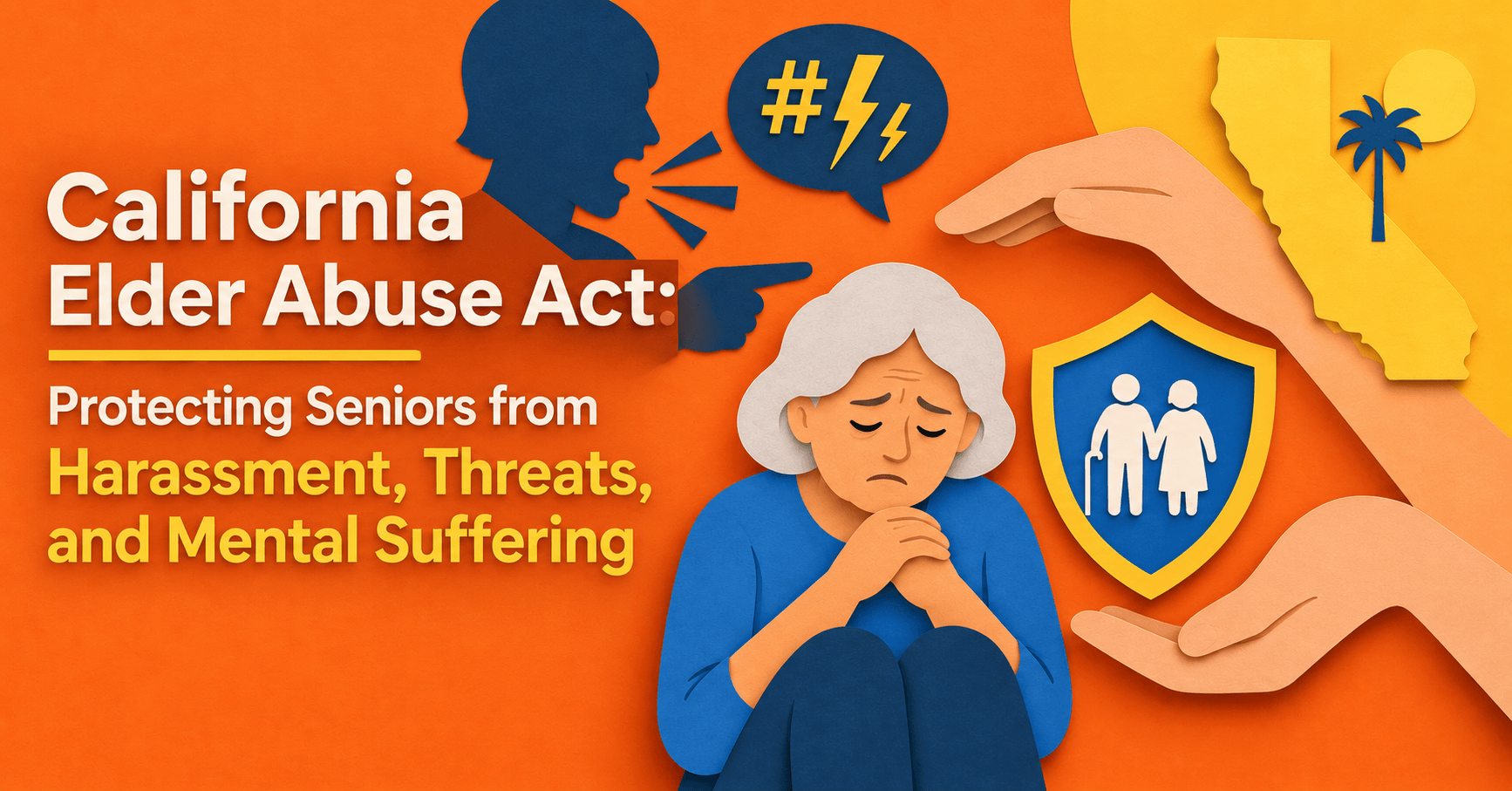
California Elder Abuse Act: Protecting Seniors from Harassment, Threats, and Mental Suffering

Who the California Elder Abuse Act Protects
I am Michael Hackard, founder of Hackard Law. Over five decades of practice, I have fought for heirs, beneficiaries, and elder abuse victims across California – from Sacramento and the San Francisco Bay Area to Los Angeles. I have authored four books on inheritance protection and produced more than 1,000 educational videos that have reached over seven million viewers. The subject of elder abuse is one I return to often, because the stakes are never abstract. Behind every case is a real person – a parent, a grandparent, a neighbor – who deserves to be treated with dignity and protected by the law.
The California Elder Abuse Act exists for exactly that purpose. It protects California residents who are 65 years of age or older from a wide range of harmful conduct. Understanding what the law covers, and how to use it, can make a profound difference for families watching someone they love suffer at the hands of an abuser.
Hackard Law provides contingency fee representation for qualified elder abuse cases – no upfront costs. If you believe a senior in your life is being abused, call us at (916) 313-3030.
Quick Summary
California’s Elder Abuse Act gives courts the power to stop abusive conduct against seniors and provides legal remedies even when the abuser has no formal caregiving role or control over the elder’s property.
- The Act protects California residents age 65 and older from physical abuse, neglect, abandonment, isolation, abduction, and conduct causing mental suffering.
- Mental suffering includes fear, agitation, confusion, severe depression, and serious emotional distress caused by threats, harassment, or deceptive acts.
- Elders or their advocates can petition a California Superior Court for a protective order.
- The burden of proof is preponderance of the evidence – more likely than not.
- A 2019 California court decision confirmed that even neighbors with no caregiving role can be held liable for elder abuse.
What the Law Covers: More Than Physical Harm
Many people assume elder abuse laws apply only to nursing home neglect or physical violence. California’s Elder Abuse Act reaches much further. The law explicitly protects elders from conduct that causes mental suffering – and it defines that term broadly.
Fear, agitation, confusion, severe depression, and other types of severe emotional distress are all considered mental suffering under the Act. Crucially, intimidation, threats, harassment, or dishonest acts carried out with malevolent intent must be the cause of this suffering. Physical harm is not the only objective of the abuser. The behavior is acceptable if it is intended to agitate, perplex, frighten, or induce severe depression in an elderly person.
This is an important distinction. This means that even without physically touching the victim, a neighbor who yells threats, a family member who consistently misleads an elderly person, or anyone who purposefully keeps a senior away from assistance may be subject to legal repercussions under the Act.
The 2019 Court Decision That Expanded Elder Protections
A 2019 California appellate decision clarified and strengthened the reach of the Elder Abuse Act in an important way. The case involved a neighbor who waged a sustained campaign of harassment and intimidation against an 81-year-old woman. The offending neighbor and her boyfriend threatened the elder, destroyed her property, trespassed, and, in one particularly disturbing incident, the boyfriend directed his dogs to attack her with the command to “kill her.”
Despite the neighbor’s lack of responsibility for the elder’s care and control over her property, the court determined that this behavior qualified as elder abuse under California law. The decision demonstrates that the victim’s relationship with the abuser does not restrict the application of the law. The behavior and how it affects the elderly are important.
Families and advocates will find great significance in this decision. It affirms that formal caregiving relationships are not the only context in which the law applies. Anyone who intentionally harasses, intimidates, or targets an elderly person may face consequences.
Case Pattern: A neighbor’s sustained harassment campaign
In a pattern Hackard Law has followed closely, an elderly woman living alone faced months of escalating threats and property destruction from a neighboring household. After the elder’s family petitioned the court under the Elder Abuse Act, the court issued a protective order, bringing the harassment to a halt. The elder’s mental suffering – documented through medical records and testimony – was central to the legal outcome.
How to Seek Protection Under the Act
An elder who has suffered abuse, or someone acting on their behalf, can petition a California Superior Court for a restraining order. The order can prohibit the abuser from contacting, approaching, or disturbing the peace of the elder. Courts can act quickly when the threat is serious.
The legal standard is preponderance of the evidence – meaning the petitioner must show it is more likely than not that a past act of elder abuse occurred. This is a lower bar than criminal proof beyond a reasonable doubt, which makes civil court an accessible path for many families.
For cases involving elder financial exploitation alongside harassment or intimidation, the remedies available can include double damages and recovery of attorney fees. California law provides some of the strongest civil remedies in the country for elder abuse victims – you can read more about those civil remedies for elder financial abuse on our site.
Early action matters. The longer abuse continues, the greater the toll on the elder’s health and wellbeing. Early legal intervention in elder abuse cases can stop harm before it compounds.
Case Pattern: Financial abuse paired with emotional intimidation
In a recurring pattern, an elder’s new companion gradually isolated her from family members, then used intimidation and false statements to pressure changes to her estate documents. When family members contacted an attorney and sought court intervention, the isolation tactics were documented as elder abuse under California law – opening the door to both protective orders and financial recovery claims.
Who Can Advocate for an Elder
One of the most important features of California’s Elder Abuse Act is that elders do not have to act alone. Family members, friends, neighbors, attorneys, and other professionals can all step in to contend for the rights of a senior who cannot defend themselves.
I have seen firsthand what happens when no one acts. The financial toll grows. The elder’s health deteriorates. The fracture in family relationships often runs too deep for any judgment to mend. Advocacy – whether through a court petition, a call to Adult Protective Services, or retaining an attorney – can change the trajectory entirely.
For those dealing with abuse situations that also involve trust or estate manipulation, our team handles these cases across California. Families in Sacramento can reach our Sacramento elder financial abuse practice directly. Those navigating disputes in Southern California can explore LA trust contingency options as part of a broader strategy.
For decades, I have stood with families in these moments. Discovery, documentation, and the pursuit of justice are not just legal strategies – they are safeguards for people who have been deliberately targeted because someone believed they were too old, too isolated, or too frightened to fight back. A steadfast commitment to truth restores what dishonesty tried to steal.
Key Definitions
- Elder: A California resident who is 65 years of age or older.
- Elder Abuse Act: California’s statutory framework protecting elders from physical, emotional, and financial abuse, with civil and criminal remedies.
- Mental suffering: Fear, agitation, confusion, severe depression, or other serious emotional distress caused by threats, harassment, intimidation, or deceptive acts with malicious intent.
- Physical abuse: Assault, battery, unreasonable physical constraint, or deprivation of food or water.
- Neglect: Failure to provide basic care, supervision, or services necessary to maintain an elder’s physical and mental health.
- Abandonment: Desertion of an elder by someone who has assumed care or custody.
- Isolation: Preventing an elder from receiving mail, telephone calls, or visits from family, friends, or other support.
- Abduction: Taking an elder out of California against their will or without legal authority.
- Preponderance of evidence: The legal standard requiring proof that abuse is more likely than not to have occurred – the standard used in civil elder abuse petitions.
- Protective order: A court order prohibiting an abuser from contacting, approaching, or disturbing the peace of the elder victim.
- Malicious intent: A deliberate purpose to cause harm, agitation, confusion, or fear – required to establish mental suffering under the Act.
What to Do Next
- Look for signs of elder abuse: unexplained fear, withdrawal, sudden changes in mood, or reports of threats or harassment.
- Get copies of any written communications, text messages, or documentation of threatening or harassing behavior.
- Try to avoid confronting the suspected abuser directly – this can escalate the situation.
- Look for medical records or notes from healthcare providers that document the elder’s distress.
- Contact Adult Protective Services in your county to report suspected abuse.
- Try to keep a written log of incidents with dates, times, and descriptions.
- Look into whether the elder qualifies for a civil protective order through the California Superior Court.
- Get copies of any estate documents – wills, trusts, powers of attorney – if financial abuse is also suspected.
- Review our guide on guarding against elder financial abuse in California trust litigation for additional context.
- Call Hackard Law at (916) 313-3030 to discuss your situation with our team.
- You can also reach us through our contact page to request a consultation.
CALL THE SAGE | When Experience Matters, Families Listen
🏛️ We practice California trust & estate & elder financial abuse litigation
⚖️ We represent heirs, beneficiaries, and elder abuse victims
🎥 1,000+ educational videos | 7 million+ views | 4 published books
🎯 “After thousands of cases, I see the pattern others miss.”
CONTINGENCY REPRESENTATION – No Win, No Fee
Throughout California: Sacramento | Los Angeles | Bay Area
📞 CALL THE SAGE: (916) 313-3030
Subscribe for weekly insights on:
- Elder financial abuse warning signs and prevention
- Trust and estate litigation strategies
- Inheritance protection for California families
- Family protection strategies
When your inheritance is under attack, Call The Sage.
Hackard Law | 10640 Mather Blvd, Mather CA 95655
Attorney Advertisement | Michael Hackard, State Bar #71067
RELATED VIDEOS
Elder Abuse Restraining Orders | Protecting Seniors
How courts use restraining orders to shield seniors from abusive conduct.
Elder Financial Abuse in California | A Growing Threat to Seniors
An overview of the many ways elder abuse harms California seniors today.
Compensatory Damages for Suffering | Elder Financial Abuse
What compensation victims may recover for pain and suffering in abuse cases.
Protecting California’s Elders with Alzheimer’s | Elder Financial Abuse
How California law protects seniors with Alzheimer’s from exploitation and harm.
Fired Up | What Drives California Elder Financial Abuse Litigation
Michael Hackard explains the passion behind pursuing elder abuse cases in California.
 Michael Hackard is the founder of Hackard Law, a California trust and estate litigation firm with more than five decades of experience protecting the inheritance rights of families across Sacramento, the San Francisco Bay Area, and Los Angeles. He is the author of six published books on inheritance protection and has produced more than 1,000 educational videos with over seven million views.