


 (916) 313-3030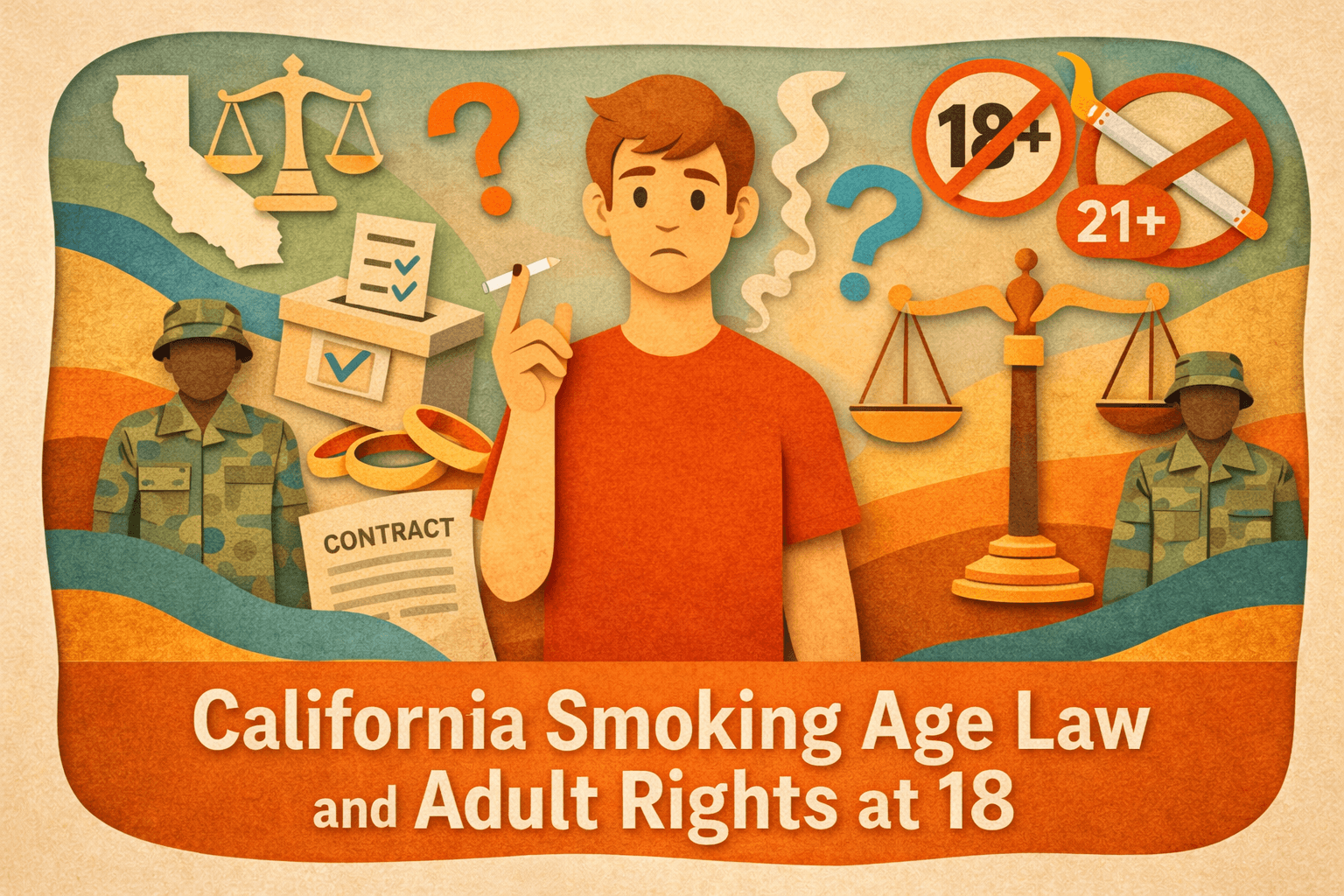
California Smoking Age Law and Adult Rights at 18

California Raised the Smoking Age to 21 — But 18-Year-Olds Can Still Do Almost Everything Else.
Quick Summary
- California’s SB X2-7 raised the minimum age to purchase tobacco products from 18 to 21, with limited exceptions for active military personnel.
- At 18, Californians can legally marry, vote, enlist in the military, purchase firearms, enter binding contracts, and grow medical marijuana independently.
- There are legitimate concerns regarding legislative coherence due to the state’s inconsistent definition of “adult” for various purposes.
- While this is a departure from our usual trust and estate litigation focus, differences in California law affect how we think about legal rights at every stage of life — including inheritance and estate planning.
The Law: SB X2-7
In 2016, California enacted SB X2-7 as part of a special legislative session on healthcare. The law amended Business and Professions Code Section 22952 and Health and Safety Code Sections 104495 and 119405 to raise the minimum age for purchasing tobacco products from 18 to 21. California became the second state in the nation, after Hawaii, to adopt a “Tobacco 21” law.
The idea behind raising the legal purchase age is simple. Many people start smoking at a young age, often before they turn 21. By increasing the age limit, the goal is to make it harder for young people to access tobacco during those early years. Research shows that most smokers begin before 21. So if access is limited during that time, fewer people are likely to pick up the habit in the first place. In short, raising the age is meant to reduce the number of young people who start smoking, and over time, lower overall tobacco use.
Let us be very clear at the outset: smoking is harmful. The health consequences are devastating and well-documented. This commentary is not a defense of smoking. It is, however, an observation about the internal consistency of California’s treatment of legal adulthood.
What 18-Year-Olds Can Still Do in California?
Under California law, the age of majority is 18. Family Code Section 6500 states plainly: “A minor is an individual who is under 18 years of age.” At 18, a person is legally an adult, with all the rights and responsibilities that status implies.
Here is what an 18-year-old Californian can legally do:
- Vote for president, governor, and every other elected office (California Constitution, Article II, Section 2)
- Enlist in the United States military and be deployed to combat zones.
- Purchase a long gun (rifle or shotgun) under both federal and California law.
- Possess a handgun in circumstances permitted by Penal Code Section 29610
- Marry without parental consent (Family Code Section 301, as amended)
- Enter into binding contracts, including purchasing real property.
- Serve on a jury and decide the fate of criminal defendants.
- Be elected mayor or to other public offices with no minimum age above 18
- Obtain a medical marijuana recommendation and cultivate cannabis under Proposition 215 and the Medical Marijuana Program Act.
But purchasing a pack of cigarettes? That requires waiting until 21.
The Hypothetical Garden Party
Imagine a gathering of Californians aged 18 to 20. The host is a 19-year-old homeowner, married, with two children, and owns a home purchased under a legally binding real estate contract. In the backyard, a medical marijuana garden grows in full compliance with state law. Several guests are active-duty Marines who recently returned from an overseas deployment. Others are debating the upcoming presidential election, in which they will all vote. Someone proudly displays a lawfully purchased shotgun.
Then a 19-year-old lights a cigarette. Under California law, this act crosses the legal line.
The point of this situation is how absurd it is. The state has decided that 18-year-olds cannot be trusted with tobacco purchases, but it does allow them to make vital decisions such as voting, military service, and gun ownership.
A Question of Legislative Consistency
This is beyond merely a humorous observation. Because it reflects how a society defines the line between childhood and adulthood, legislative consistency is important. The reasoning behind the state setting that threshold at 21 for a single consumer product but at 18 for almost all significant decisions, such as contracts, marriage, military service, and criminal responsibility, needs to be examined.
There is a legitimate public health argument. The CDC estimates that tobacco use kills about 480,000 Americans each year. Legislation aimed at reducing youth smoking is legitimate. But rather than whether the goal is worthwhile, the question is whether the approaches comply with the state’s wider legal framework.
Theoretically, California could raise the age of majority to 21 for all purposes. That would be radical, but consistent. Rather, the legislature created a single exception that retains full adult responsibility in all other situations while treating legal adults as minors for a particular behavior.
The Military Exception
SB X2-7 originally included an exception for active-duty military personnel, accepting the incongruity of telling someone who can be ordered into combat that they cannot buy tobacco. This exception was later dismissed when California further tightened its tobacco laws. The removal deepened the inconsistency: a 19-year-old Marine who served in a combat zone and lawfully owns firearms is now prohibited from purchasing cigarettes in their home state.
How This Connects to Estate and Trust Law
At Hackard Law, we specialize in trust and estate litigation, defending the rights of beneficiaries, heirs, and victims of elder abuse throughout California. So why talk about smoking age regulations?
Because estate planning and probate law are heavily influenced by the legal definition of adulthood. Anyone 18 years of age or older may make a will under California Probate Code Section 6100. Anyone who is at least eighteen years old may establish a trust under Section 15200. Testamentary capacity, the right to inherit, and the ability to serve as a trustee or executor are all determined by the legal threshold of adulthood.
Ripple effects occur when the state treats that threshold inconsistently. It is assumed that an 18-year-old has the maturity and discernment to handle a trust, execute a will that distributes millions of dollars’ worth of assets, or act as a decedent’s personal representative. That same premise should apply consistently across the legal environment.
For anyone addressing estate and trust matters in California, understanding how the law defines — and sometimes contradicts — the concept of legal capacity is essential.
The Wider Trend
California’s tobacco law was part of a nationwide trend. As of 2019, federal law (the Tobacco 21 legislation signed in December 2019) raised the minimum purchase age to 21 across all states. However, California was one of the pioneers, and its legislation continues to serve as an example of how states can treat the same population as both adults and non-adults depending on the activity.
This issue does not stop with tobacco. If the justification rests on brain development, the conversation becomes much broader. The prefrontal cortex, which governs judgment and impulse control, is generally understood to mature closer to age 25. If that standard were applied consistently, it would raise difficult questions about other legal thresholds, including contracts, marriage, military service, and even firearms ownership.
Yet no legislature has seriously moved to revisit those age limits. The law continues to recognize 18-year-olds as fully capable of making consequential decisions in nearly every other context.
That contrast suggests something important. The decision to raise the smoking age was not necessarily grounded in a unified theory of legal adulthood, but rather in what was politically achievable in a specific area of public health policy.
What This Means for Families
For families engaged in estate planning or trust administration, the key takeaway is practical: California law treats 18 as the age of full legal adulthood for purposes of inheritance, trust creation, and estate administration. Young adults have the legal capacity to inherit, to challenge a will or trust, and to serve in fiduciary roles. Knowing these rights is particularly important in blended families, where young adult children may need to assert their inheritance rights against competing interests.
If you have questions about how California law affects the rights of young adult heirs or beneficiaries, Hackard Law can provide guidance grounded in decades of real-world trust and estate litigation.
Key Definitions
- Age of Majority: The age at which a person is legally recognized as an adult. In California, this is 18 years old under Family Code Section 6500.
- Testamentary Capacity: The legal ability to create a valid will, which in California requires being at least 18 years of age and of sound mind (Probate Code Section 6100).
- SB X2-7: The California Senate bill, enacted in 2016, that raised the minimum age for purchasing tobacco products from 18 to 21.
- Fiduciary: A person entrusted with managing property or affairs on behalf of another, such as a trustee, executor, or conservator, who owes duties of loyalty and care.
What to Do Next If You Have Questions About Your Legal Rights at Age 18
- Recognize your legal standing. Under California law, you are considered a full legal adult at 18 for purposes of inheritance, estate planning, and fiduciary roles, regardless of differences in other areas of the law.
- Review any trust, will, or estate planning documents that involve you. Confirm how your rights are defined and whether your role corresponds to your perception.
- Clarify your role in the estate. Confirm whether you are a beneficiary, trustee, executor, or agent, and understand what that role requires of you.
- Review all estate documents carefully. Unusual changes or inconsistencies may signal issues that deserve closer attention.
- Gather key records, including wills, trusts, financial documents, and related correspondence.
- Keep a record of all communications with family members, trustees, and advisors.
- Do not rely on assumptions from other areas of law. In California probate matters, individuals 18 and older are treated as fully competent adults.
- Seek legal guidance if anything appears unclear or concerning. Early advice can help avoid larger disputes.
- Act promptly. Legal deadlines apply, and delay can affect your rights.
Contact Hackard Law at (916) 313-3030 to evaluate your situation and understand how California law applies to your rights.
CALL THE SAGE | When Experience Matters, Families Listen
THE EXPERTISE:
📚 50 years California trust, estate & elder financial abuse litigation
⚖️ We represent heirs, beneficiaries, and elder abuse victims
🎥 1,000+ educational videos | 7 million+ views | 4 published books
🎯 “After thousands of cases, I see the pattern others miss.”
CONTINGENCY REPRESENTATION — No Win, No Fee
Throughout California: Sacramento | Los Angeles | Bay Area
📞 CALL THE SAGE: (916) 313-3030
Subscribe for weekly insights on:
- Elder financial abuse warning signs and prevention
- Trust and estate litigation strategies
- Inheritance protection for California families
- Family protection strategies
When your inheritance is under attack, Call The Sage.
Hackard Law | 10640 Mather Blvd, Mather CA 95655
Attorney Advertisement | Michael Hackard, State Bar #71067
Related Videos
California Inheritance Blog | Over 500 Answers
Highest keyword match (keywordhits=4) and directly mirrors the blog’s theme — a rich resource of answers and insights for California families, perfectly aligned with a welcome post introducing ongoing content.
Protecting Trust Beneficiaries | Our Circle of Competence
Second-highest keyword match (keywordhits=2) and showcases Hackard Law’s core expertise — a great introductory video for new blog visitors learning what the firm is about.
Our Job is to Protect Your Family | Estate & Trust Litigation Attorneys
Tied for second in keyword hits (keywordhits=2) and delivers a strong mission-focused introduction to Hackard Law, well-suited for welcoming new readers to the blog.
Trust Beneficiary Litigation | Our Client’s First Call
Tied for second in keyword hits (keywordhits=2) and highlights the client journey from first contact — a welcoming and accessible entry point for visitors new to the firm’s blog and services.
Hackard Law: Estate, Trust & Probate Litigation for Sacramento and Northern CA
A strong firm-overview video that introduces Hackard Law’s full scope of practice — ideal alongside a welcome blog post to orient new visitors to the firm’s capabilities.
Introducing the Sage | Veteran California Estate & Trust Litigation Attorney Michael Hackard
An introduction to the attorney behind the firm, complementing a welcome blog post perfectly by putting a face and story to the brand for first-time visitors.
 Michael Hackard is the founder of Hackard Law, a California trust and estate litigation firm with more than five decades of experience protecting the inheritance rights of families across Sacramento, the San Francisco Bay Area, and Los Angeles. He is the author of four published books on inheritance protection and has produced more than 1,000 educational videos with over seven million views.