


 (916) 313-3030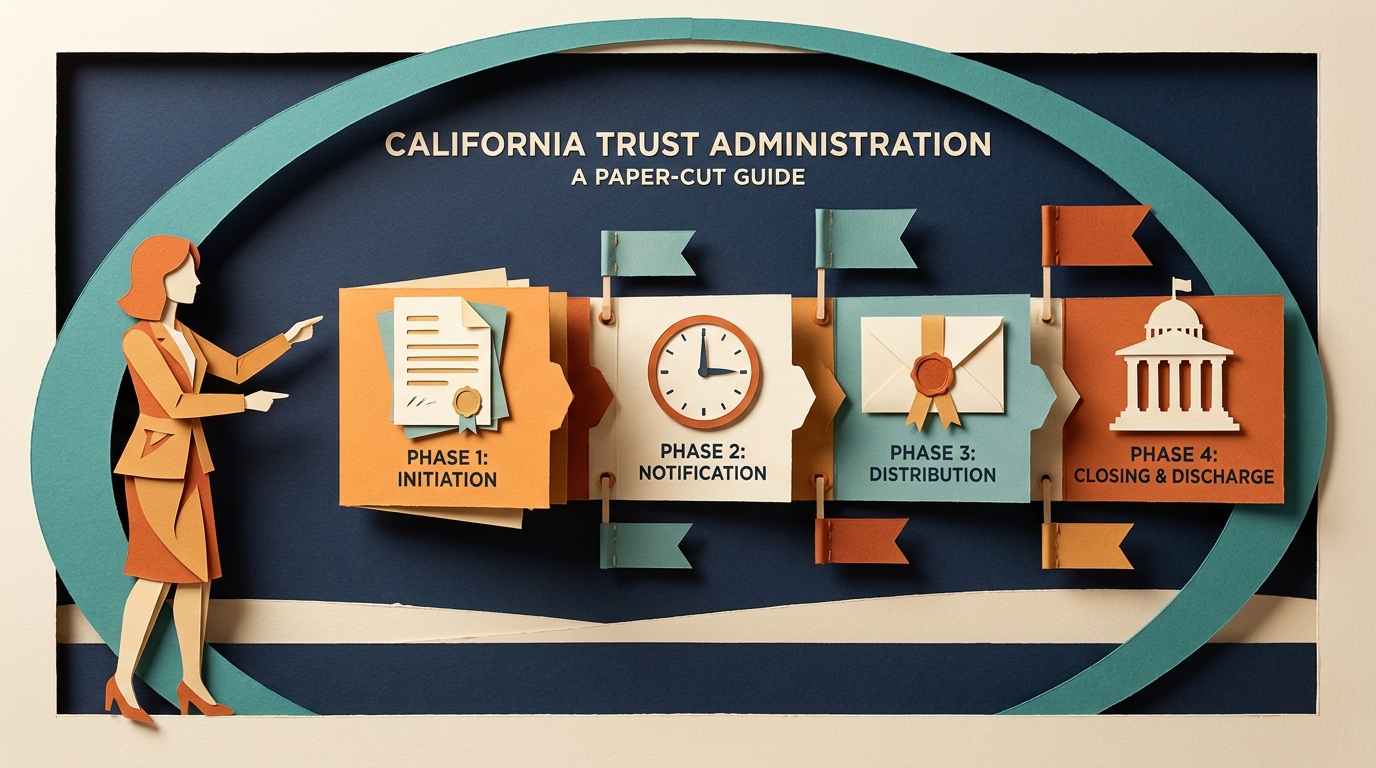
California Trust Administration Timeline: What Beneficiaries and Trustees Should Realistically Expect

A woman I will call Sandra called our office about eight months after her mother died. Her mother had done everything right — hired an estate planning attorney, signed a living trust, updated her beneficiary designations. Sandra and her brother were named equal beneficiaries. The brother was named trustee.
The brother texted every so often the first two months, saying things were going along. The texts stopped by month four. By the sixth month, Sandra had asked for a copy of the trust three times and gotten nowhere. She had once asked for an accounting, and was told that the estate was “complicated.” No letter with her name on it had ever arrived.
Sandra’s question when she called was simple: is this normal?
The answer was no. But I understood why she was not sure. Most beneficiaries have no map for this process. They know a trust exists. They know they are supposed to inherit something. Beyond that, they are operating in the dark — waiting, wondering, and trying to decide whether their frustration is reasonable or whether they are simply being impatient.
This piece is the map Sandra didn’t have. It explains the whole California trust administration process, the statutory deadlines that apply, what you’re entitled to at each step, and specific red flags that indicate a trustee’s delay has become something more serious.
How Long Does Trust Administration Actually Take in California?
The honest baseline is 6 to 12 months. That number reflects the fact that there is a formal legal process with real moving parts – asset inventories, notices to creditors, tax filings, court-related deadlines, and the coordination of professionals from CPAs to real estate agents to financial institutions.
Simple estates- a home, bank accounts, no business interests, no disputes- can close in four to six months if the trustee is organized and responsive. Complex estates involving multiple properties, business interests, taxable estates, or family conflict can run well past twelve months and sometimes stretch to two years or longer.
The range is broad because the variables are broad. Communication cannot be changed. A trustee in charge of a really complicated estate can still send written updates, respond to reasonable requests, and treat beneficiaries as the rights-holders they are.
Simple Estates vs. Complex Estates: Why the Range Is So Wide
A single-property estate with two adult beneficiaries and no disputes moves through administration relatively quickly. The trustee secures the home, notifies beneficiaries, handles the final tax return, waits out the statutory contest period, and distributes. Four to six months is achievable.
Add a rental property that needs to be sold, a small business interest that requires valuation, a dispute between siblings about personal property, or a federal estate tax return, and each of those factors adds weeks or months. None of them are improper. They are the legitimate complexity of real family wealth.
Trust Administration vs. Probate: The Key Differences California Families Should Understand
The primary reason families create living trusts is to avoid the California probate process, which typically runs twelve to eighteen months, requires court supervision at every stage, and becomes part of the public record. Trust administration is private, generally less expensive, and faster, but it is not automatic.
A living trust does not transfer assets by magic. A trustee must actively manage the process, satisfy creditors, file tax returns, and make distributions in the right sequence. Families who expect a trust to function like a joint bank account, with assets flowing instantly to beneficiaries at death, are almost always surprised by the reality.
The Phase-by-Phase California Trust Administration Timeline
Phase 1 , The First 60 Days: Securing Assets and Notifying Beneficiaries
The first sixty days are the most procedurally dense period of trust administration. The trustee must locate and secure all trust assets, obtain certified death certificates, notify the Social Security Administration, open a dedicated trust bank account, obtain a federal tax identification number for the trust, and begin the inventory process.
Most critically, the trustee must send written notices to all beneficiaries and heirs-at-law. California Probate Code §16061.7 makes this obligation explicit and time-bound. Understanding what trustee responsibilities and obligations under California law actually require is the foundation of any properly administered trust.
The 60-Day Statutory Notice Requirement Under California Probate Code §16061.7
Probate Code §16061.7 requires that a trustee shall give written notice to all beneficiaries and heirs-at-law within sixty days of the death of the settlor. The notice must include certain information, including the name and contact information of the trustee and a statement that the recipient is entitled to receive a copy of the trust document.
Missing this deadline is not a technicality. A trustee who fails to send proper notice within sixty days may expose themselves to personal liability and can undermine the legal foundation of the entire administration. The sixty-day deadline is a floor, not a suggestion.
Phase 2 , The 120-Day Contest Window: Your Right to Challenge the Trust
Once the §16061.7 notice is served, a 120-day clock begins running. During that window, any beneficiary or heir-at-law who believes the trust was procured by fraud, undue influence, or lack of capacity has the right to file a contest. After 120 days without a challenge, the trust’s validity is generally secured against those grounds.
This window is the primary structural reason why early distributions are rare and why prudent trustees do not rush to distribute assets in the first few months. Contesting a trust in California is a serious legal action with a hard deadline, and beneficiaries who miss it typically lose the right to raise those challenges permanently.
The 120-day period is not the trustee being slow. It is the trustee being careful, and that caution protects everyone, including the beneficiaries themselves.
Phase 3 , Core Administration (Months 3–9): Taxes, Creditors, and Asset Management
When the contest period has passed or is proceeding without contest, the trustee enters into the real work of administration. This phase also includes filing the decedent’s final income tax return, preparing trust income tax returns, considering whether a federal estate tax return should be filed, paying valid creditor claims, administering trust assets, and preparing any real property or business interests for sale or transfer.
For most California families, the federal estate tax return is not a factor; the 2024 threshold is $13.61 million. But the decedent’s final income tax return and the trust’s own filings are standard obligations that require coordination with a CPA and add real time to the process.
Creditor claims deserve particular attention. A trustee who distributes assets to beneficiaries before satisfying legitimate debts creates personal liability for the shortfall. Waiting for creditors to surface is not obstruction. It is fiduciary caution with legal teeth behind it.
Phase 4, Final Distribution (Months 6–12+): What Happens Before You Receive Your Inheritance
Final distribution requires the trustee to prepare a formal accounting of all assets, income, expenses, and proposed distributions, collect W-9 forms from beneficiaries, draft a distribution agreement, and make distributions only after all debts and taxes are resolved. A small reserve is typically held back to cover any final expenses before the trust account is closed.
This phase is where beneficiary frustration tends to peak. The trustee may have been communicating regularly for six months, and the finish line seems near , but the accounting takes time to prepare correctly, and any dispute about its contents can delay final distribution further. Understanding what California beneficiaries can do when a trustee delays distributions without cause is important precisely because not every delay at this stage is legitimate.
What Commonly Delays Trust Administration in California
Legitimate Reasons Trust Administration Takes Longer Than Expected
Real estate that needs repair before sale, business interests that require third-party valuation, tax returns delayed by missing financial records, creditor claims that are disputed- these are all legitimate reasons a timeline extends. A trustee navigating any of these circumstances is not failing their duties. They are doing the job under difficult conditions.
Consider also the human element. Most trustees are family members who have never administered a trust before. They are grieving, they are managing their own lives, and they are learning a complex legal process in real time. Some delay is inevitable and understandable.
When Delays Stop Being Normal: Red Flags Beneficiaries Should Watch For
But there is a category of delay that has nothing to do with complexity or grief. It has to do with a trustee who has decided, consciously or not, that the process is optional, or who is actively concealing something.
Here are the behavioral markers that distinguish a busy trustee from a problematic one.
The trustee has not sent written notice. If months have passed since the settlor’s death and you have received no written correspondence identifying the trustee and notifying you of your rights, that is not a paperwork delay. That is a failure of a statutory obligation.
The trustee refuses to share the trust document. You have a legal right to a copy of the trust. A trustee who refuses to provide it, or who provides only selected pages, is not managing a complex estate. They are withholding information you are entitled to have.
There has been no accounting. A trustee is required to account for all trust assets, income, and expenses. Trustee accountability when requests for an accounting fail is a real enforcement issue, not a theoretical one. If you have asked for an accounting and received nothing, that is a red flag.
Communication has stopped entirely. A trustee managing a legitimate estate may go weeks without news because there is nothing to report. But months of silence in response to direct questions is a different matter. Silence is often the first sign that something is wrong.
The trustee is making preferential distributions. If one beneficiary is receiving funds while others are told to wait, or if the trustee appears to be paying personal expenses from trust accounts, those are serious warning signs of self-dealing and potential trust and estate litigation territory.
The trustee is commingling funds. Trust assets must be kept separate from the trustee’s personal finances. Commingling is not an accounting error. It is a breach of fiduciary duty with potential personal liability.
Your Rights as a Beneficiary During California Trust Administration
This is the section most trust administration content skips, or buries in a footnote. I want to be direct about it.
Your rights as a beneficiary are not courtesies a trustee may extend at their discretion. They are legal entitlements established by California law. You do not need to ask nicely. You do not need to wait until the trustee decides you deserve information.
The right to written notice within 60 days. California Probate Code §16061.7 requires it. If you did not receive it, the trustee is already in violation.
The right to a copy of the trust document. Upon request, the trustee must provide you with a complete copy of the trust instrument. This is not negotiable.
The right to request a trust accounting. You are entitled to a formal accounting of all trust assets, receipts, and disbursements. A trustee who cannot or will not produce one has a problem.
The right to contest the trust within 120 days of notice. If you have grounds to believe the trust was the product of fraud or undue influence in California estate law, you have 120 days from the date of proper notice to act. That window closes permanently. Missing it is not recoverable.
The right to petition the court for trustee removal. If a trustee is breaching their fiduciary duties through self-dealing, commingling, failing to account, or simply refusing to administer the trust, you can ask a California court to remove them and appoint a successor. This is not a nuclear option reserved for extreme cases. It is a standard remedy for trustee misconduct.
When Trust Administration Becomes Trust Litigation
Most trustee-delay situations do not require a lawsuit to resolve. A well-crafted demand letter from an attorney, citing specific statutory violations and requesting specific documents by a specific date, often produces results that months of polite requests did not. Trustees who are simply disorganized or overwhelmed frequently respond to formal legal pressure in ways they never responded to family conversations.
But there are some circumstances that are different. If a trustee is actively stealing assets, paying favored beneficiaries while stonewalling other beneficiaries, or letting trust property deteriorate due to neglect, a demand letter is not the appropriate tool. It is a court petition.
California courts are given broad discretion in supervising the administration of trusts. They may require accounts, compel distributions, surcharge trustees for losses resulting from their misconduct, and remove trustees who cannot or will not perform their duties. Trust litigation is not a last resort when a trustee is actively harming the estate. It is the appropriate remedy.
The distinction matters because timing matters. A beneficiary who waits too long, hoping the trustee will come around, reluctant to disrupt family relationships, unsure whether the situation is serious enough, sometimes waits until assets have been dissipated, records have been lost, or statutes of limitations have run. The question is not whether you want to fight. The question is whether waiting makes your position better or worse.
In my experience, it is almost always worse.
A Note on the Heggstad Petition
One situation that complicates trust administration and extends timelines is the discovery that assets were never properly titled into the trust. A parent who refinanced their home and never retitled it back into the trust, or who purchased a vehicle in their own name, may have inadvertently left those assets outside the trust’s reach.
This does not necessarily mean those assets go through probate. California courts, following the Estate of Heggstad doctrine, can issue a petition that brings improperly titled assets into the trust after death, based on evidence that the settlor intended those assets to be trust property. The petition requires court involvement and adds time to administration, but it is a meaningful remedy for a common problem.
If you are a beneficiary and certain assets seem to be missing from the trust inventory, ask about this. It may explain a delay. It may also be worth investigating further, particularly if the trustee’s accounting of what is and is not in the trust does not match what you know about the estate.
What to Do With This Information
Sandra’s situation resolved, but not because the trustee came around on his own. It resolved because she stopped waiting and started acting, with legal counsel, written demands, and a clear understanding of what she was entitled to receive.
The timeline for California trust administration is real, and most of its length is legit. Taxes take time. It takes time for creditors. Real estate takes time. A trustee who is dealing with a complicated estate and is being forthright deserves patience.
But patience has limits, and those limits are defined by law, not by the trustee’s schedule. If you have been waiting months with no written notice, no trust document, no accounting, and no real communication, you are not being impatient. You are being ignored, and you have rights that do not require anyone’s permission to enforce.
Knowing the difference between a trustee who is busy and a trustee who is hiding something is, in the end, the most valuable thing a beneficiary can learn.
 Michael Hackard is the founder of Hackard Law, a California trust and estate litigation firm with more than five decades of experience protecting the inheritance rights of families across Sacramento, the San Francisco Bay Area, and Los Angeles. He is the author of six published books and has produced more than 1,000 educational videos with over seven million views.