


 (916) 313-3030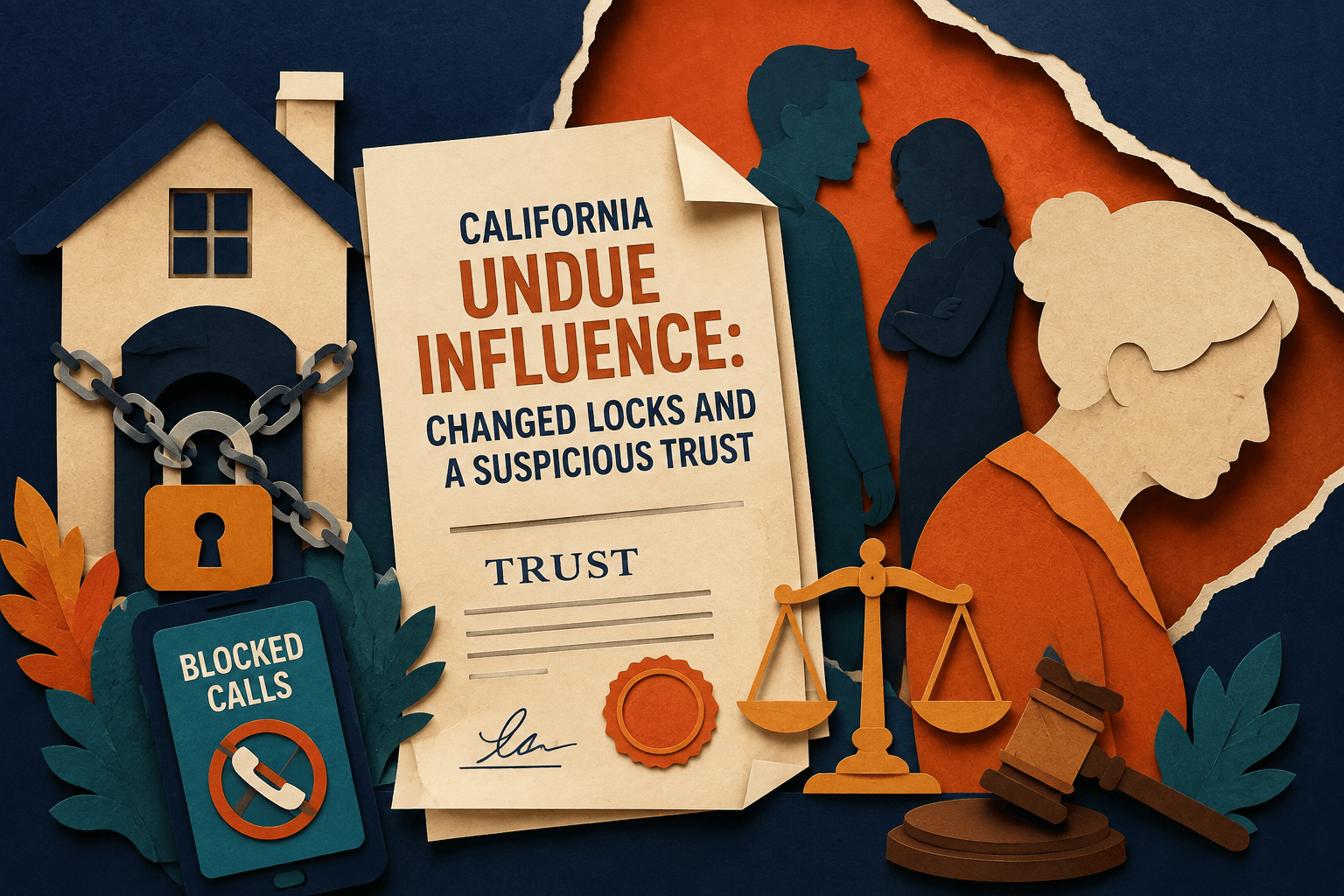
Changed Locks, Screened Calls, and a Trust That Couldn’t Spell the Children’s Names: A California Undue Influence Case

I am Michael Hackard, founder of Hackard Law, and I have spent five decades litigating California trust and estate disputes. Over those fifty years, I have written four published books on inheritance protection and produced more than 1,000 educational videos that have reached over seven million viewers. I work with families in Sacramento, the San Francisco Bay Area, and Los Angeles – families who often come to me only after they have watched, helplessly, as someone close to their parent dismantled a lifetime of relationships and redirected an entire estate.
The story I want to tell you today is one of the clearest illustrations of undue influence I have encountered. It is not a hypothetical. It is the kind of case that arrives at our door carrying years of documentation – changed locks, screened calls, a pandemic wedding, and a trust amendment signed when a ninety-two-year-old man was declining, a document so carelessly prepared that it could not correctly spell the names of the four children it was designed to erase.
Hackard Law provides contingency fee representation for qualified trust and estate litigation cases – no upfront costs to you. If you believe your family is facing a situation like the one described here, call us at (916) 313-3030.
Quick Summary
California law provides powerful tools to challenge trust and estate documents produced through undue influence, isolation, and manipulation of a vulnerable elder.
- Undue influence under California Welfare and Institutions Code section 15610.70 is defined by four factors: vulnerability, apparent authority, tactics of control, and an inequitable result.
- A trust or will signed during a period of demonstrated control can be challenged, voided, and the assets recovered.
- California Probate Code section 21380 creates a presumption of undue influence when a transfer benefits the person who drafted the document or served as a care custodian.
- Documentation gathered in real time – dated observations, records of restricted access, medical records – forms the evidentiary foundation for litigation.
- Heirs, beneficiaries, and elder abuse victims who act early preserve the strongest legal position.
Elliot’s Family and the Arrival of Lorraine
Elliot was eighty-seven years old the first time his children heard her name. His wife had died five years earlier, after fifty-seven years of marriage. He had a daughter who visited nearly every day, a son who drove up from Los Angeles, and grandchildren who stayed at the house when they were in town. Then Lorraine arrived.
She moved into Elliot’s house. His daughter came by one afternoon and found the locks had been changed. At a family Christmas gathering, Lorraine stood up and announced in front of Elliot’s children: “I have to marry him before it’s too late.” Two months later, during a pandemic lockdown, Elliot married Lorraine on her birthday. His children did not find out for approximately a year.
The calls to his children began to drop off. When Lorraine was present, Elliot did not answer the phone. He would call only when she was out of the house. When he was hospitalized, his family could reach him – and they noticed his mood lifted; he was accessible; he talked the way he always had. When Lorraine learned he was communicating with his family from the hospital, she removed his cellphone from the room. One day a text was sent from Elliot’s phone to his daughter: “Don’t call me.” His family believes Lorraine sent it.
One Day in August 2022
On a single day in August 2022, when Elliot was ninety-two years old, the following documents were executed: a new trust, a new will, a durable power of attorney, a declaration of trust, a certification of trust, an assignment of personal property, and a grant deed transferring the house into the new trust.
All on the same day. The trust named Lorraine as sole beneficiary. His four children – the people he had raised with his wife over fifty-seven years of marriage – received nothing.
The trust document that disinherited his children could not correctly spell a single one of their names.
Four months after the signing, Elliot told his son his estate was going to be split evenly among all four children when he died. The trust had already been signed. Understanding how a power of attorney can become a weapon – and how California families can fight back – is critical context for a case like this one.
Case Pattern: Same-Day Document Execution During Demonstrated Isolation
In cases where all major estate documents are signed on a single day – trust, will, power of attorney, and deed – courts look carefully at the circumstances surrounding that signing. When the record also shows restricted family access, a new intimate partner as sole beneficiary, and a declining elder, the combination creates a compelling basis for a challenge. The outcome theme in these cases is recovery of the estate and restoration of the original distribution plan.
What California Law Says About Undue Influence
California Welfare and Institutions Code section 15610.70 defines undue influence through four factors: the vulnerability of the elder, the apparent authority of the person who benefits, the tactics used – isolation, screened calls, restricted visits, control of information – and the equity of the result. When all four are present in the record, a trust or estate document signed during that period of control can be challenged, voided, and the assets recovered.
For families in the Los Angeles area and across Southern California, undue influence in California estate law is one of the most litigated grounds for contesting a trust. The pattern is consistent: a new person enters an elder’s life, access to family is gradually restricted, and estate documents are amended to benefit the newcomer at the expense of lifelong heirs and beneficiaries.
California Probate Code section 21380 adds another layer of protection. A transfer to a person who drafted the instrument, or to a care custodian, is presumptively the product of undue influence. The burden shifts to the person who received the transfer to prove otherwise. That presumption is one of the most powerful tools in these cases – and it is triggered by exactly the pattern Elliot’s family is living. Families navigating Los Angeles estate litigation involving these facts should understand how quickly this presumption can shift the legal landscape.
Case Pattern: The Presumption Shifts the Burden
One pattern that Hackard Law has frequently observed is the designation of a caregiver or new romantic partner as the principal beneficiary of a trust amendment that was carried out while the elder was in their daily care. The burden of proof under Probate Code section 21380 was placed squarely on the beneficiary to justify the transfer when the record revealed that the beneficiary had also participated in setting up the signing. Meeting that burden in contested litigation is challenging.
The Mechanics of Isolation
Isolation is not always dramatic. It rarely begins with changed locks. It begins with a phone call that goes unanswered. A visit that is cut short. A holiday gathering where the elder seems distracted, managed, watched. By the time the locks are changed, the pattern has been running for months.
I have seen this progression in cases across California. The person who benefits from the isolation is almost always present when the elder communicates with family. The elder’s affect changes when that person is removed from the room – in Elliot’s case, visibly so during his hospitalizations. That behavioral contrast, documented and presented to a court, is powerful evidence of the coercive environment in which estate documents were signed.
For families who are watching these patterns form right now, the most important thing to understand is that guarding against elder financial abuse requires action before the documents are signed, not after. The evidence you preserve today is the foundation of the legal remedies available tomorrow.
The Human Cost Behind the Legal Strategy
For decades, I have stood with families who did everything right – they visited, they called, they showed up – and still watched a stranger walk away with everything their parent built over a lifetime. Discovery, forensic document analysis, and the pursuit of justice through California’s undue influence statutes are not just legal strategies. They are safeguards for families threatened by manipulation and fraud.
The financial toll grows with every month a wrongful transfer goes unchallenged. Assets are spent. Real property changes hands. And the fracture within the family – the grief of a parent who may not have understood what he was signing – often runs too deep for any judgment to fully mend. A steadfast commitment to truth, pursued through litigation, restores what dishonesty tried to steal.
If your family is facing a situation like Elliot’s, you are not alone, and you are not without remedies. Hackard Law litigates these cases across California, including in the Los Angeles area and Glendale, on a contingency fee basis. You can also review our contingency fee representation guide to understand how this works before you call.
Key Definitions
- Undue influence: Excessive persuasion that overcomes a person’s free will and causes them to act in a way they would not otherwise have chosen, defined under California Welfare and Institutions Code section 15610.70.
- Vulnerability: A factor in the undue influence analysis referring to the elder’s physical or cognitive condition, dependency, or isolation that makes them susceptible to manipulation.
- Apparent authority: The perceived power or trust that a person holds over an elder, such as a caregiver, romantic partner, or financial advisor.
- Tactics of control: Behaviors used to isolate an elder from family and support systems, including changed locks, screened calls, restricted visits, and control of financial information.
- Equity of the result: The fairness of the transfer – courts examine whether the outcome makes sense given the elder’s prior expressed intentions and family relationships.
- Probate Code section 21380: A California statute that creates a presumption of undue influence when a donative transfer benefits the person who drafted the instrument or served as a care custodian.
- Shifting burden: Once a presumption of undue influence is established, the person who received the transfer must prove the transfer was not the product of undue influence.
- Grant deed: A legal document that transfers real property ownership, often used in estate planning to move a home into a trust.
- Donative transfer: A transfer of property made as a gift, including transfers through a trust, will, or deed.
- Contemporaneous documentation: Written records made at or near the time of observed events, which carry significant evidentiary weight in undue influence litigation.
What to Do Next
- Write down everything you observe – changed locks, unanswered calls, restricted visits – and date every entry.
- Get copies of any trust, will, or deed documents if you have access to them, and note when they were signed.
- Look for patterns in the elder’s behavior when the suspected influencer is present versus absent.
- Try to avoid confronting the suspected influencer directly, as this can accelerate isolation and document changes.
- Reach out to the elder’s physician, if possible, to document any concerns about cognitive decline or undue influence.
- Look for any prior estate planning documents that reflect the elder’s original intentions.
- Try to maintain contact with the elder through any available channel and document those communications.
- Review what California beneficiaries need to know about their rights by visiting our beneficiary rights resource.
- Call Hackard Law at (916) 313-3030 – the sooner you act, the stronger your evidentiary foundation.
- Visit our contact page to reach us online and schedule a consultation.
CALL THE SAGE | When Experience Matters, Families Listen
🏛️ We practice California trust & estate & elder financial abuse litigation
⚖️ We represent heirs, beneficiaries, and elder abuse victims
🎥 1,000+ educational videos | 7 million+ views | 4 published books
🎯 “After thousands of cases, I see the pattern others miss.”
CONTINGENCY REPRESENTATION – No Win, No Fee
Throughout California: Sacramento | Los Angeles | Bay Area
📞 CALL THE SAGE: (916) 313-3030
Subscribe for weekly insights on:
- Elder financial abuse warning signs and prevention
- Trust and estate litigation strategies
- Inheritance protection for California families
- Family protection strategies
When your inheritance is under attack, Call The Sage.
Hackard Law | 10640 Mather Blvd, Mather CA 95655
Attorney Advertisement | Michael Hackard, State Bar #71067
RELATED VIDEOS
Undue Influence in a Trust | A Typical Fact Pattern
Walks through a real-world undue influence scenario involving trust manipulation and elder isolation.
Inheritance Heists Ch. 9: Caregiver Undue Influence Against Seniors
Examines how caregivers exploit vulnerable seniors to redirect inheritances away from family.
Should a Paid Caregiver Inherit $4 Million? | Undue Influence
Explores a case where a caregiver stood to inherit millions from an elderly client.
Estate Plan Sabotage: How to Stop Undue Influence Before It’s Too Late
Covers warning signs and legal steps families can take to protect an elder’s estate plan.
Establishing Undue Influence & Elder Financial Abuse | CA Trust Litigation
Explains how to build a legal case proving undue influence and financial elder abuse in California.
“I Leave My Family Nothing” | House Fights & Undue Influence
Looks at disputes where outsiders manipulate elders into cutting their own children out of estates.
 Michael Hackard is the founder of Hackard Law, a California trust and estate litigation firm with more than five decades of experience protecting the inheritance rights of families across Sacramento, the San Francisco Bay Area, and Los Angeles. He is the author of six published books on inheritance protection and has produced more than 1,000 educational videos with over seven million views.