


 (916) 313-3030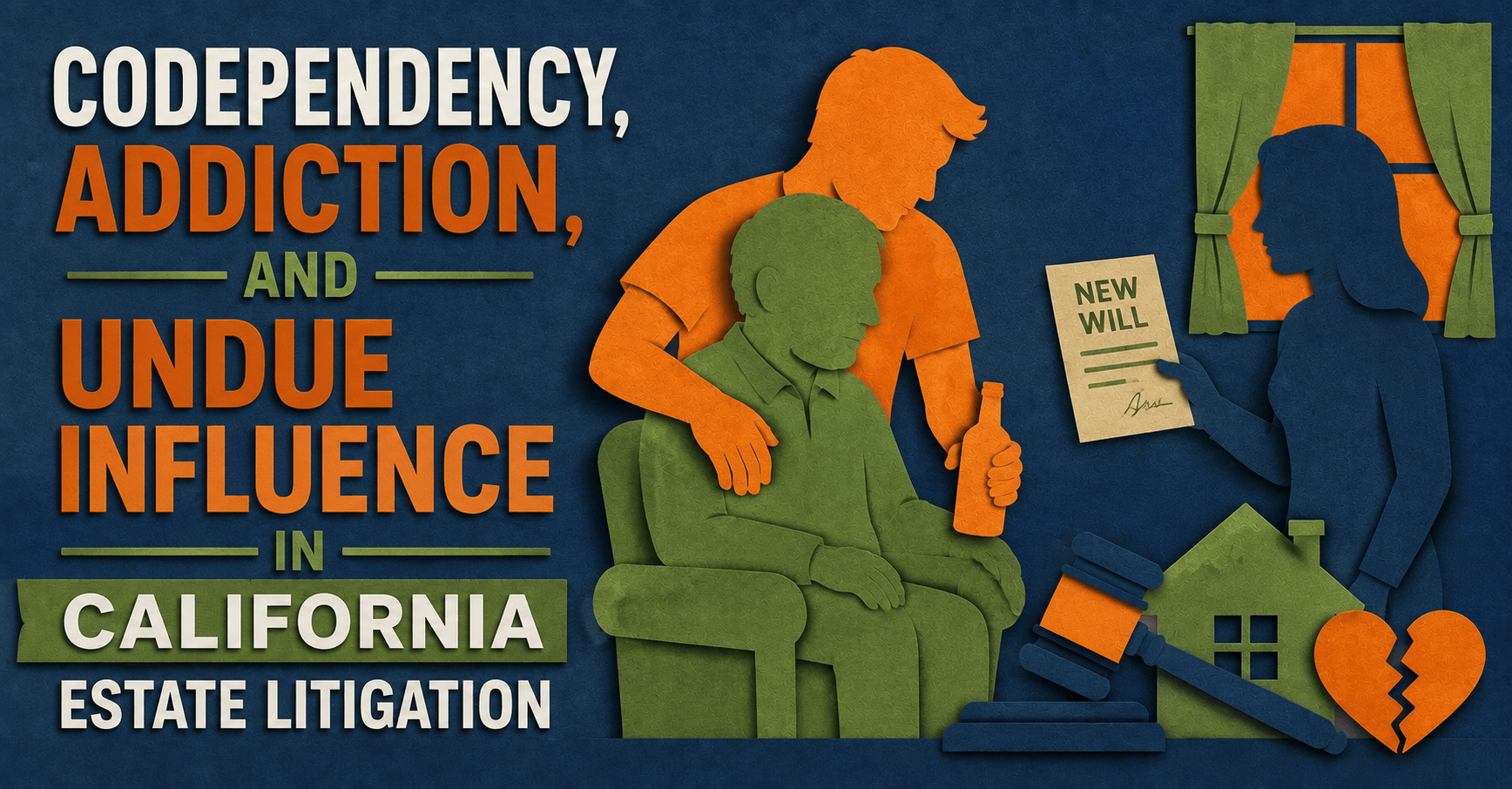
Codependency, Addiction, and Undue Influence in California Estate Litigation

When Love Becomes Leverage
I am Michael Hackard, founder of Hackard Law. Over five decades of practice, I have fought for heirs, beneficiaries, and elder abuse victims whose inheritances were taken through manipulation, deception, and financial exploitation. I have written four books on inheritance protection – including The Wolf at the Door: Undue Influence and Elder Financial Abuse – and produced more than 1,000 educational videos that have reached over seven million viewers. My firm serves families across Sacramento, the San Francisco Bay Area, and Los Angeles, and I have seen firsthand how addiction within a family can quietly transform into a legal crisis.
This post focuses on a pattern I encounter constantly in estate and trust litigation: the intersection of codependency, addiction, and undue influence. It straddles psychology and law, and while I am not a psychologist, I know what these dynamics look like in a courtroom.
Hackard Law provides contingency fee representation for qualified cases – no upfront costs to you. If your family has been affected by undue influence or elder financial abuse, call us at (916) 313-3030.
Quick Summary
Codependent relationships between adult children with addictions and their elderly parents are conducive to undue influence in California estate and trust litigation. When a parent’s free will is subordinated to the influence of an addicted child, the legal consequences may deprive other heirs and beneficiaries of their rightful inheritance.
- Codependency is defined as a dysfunctional helping relationship that enables addiction, immaturity, or irresponsibility
- Undue influence means excessive persuasion that overcomes another person’s free will and produces inequitable results
- Addicted adult children often pressure elderly parents to redirect trust or will distributions in their favor
- These transfers frequently exclude siblings and other rightful beneficiaries
- California law provides remedies to challenge estate changes made under undue influence
What Codependency Looks Like in Estate Cases
Codependent relationships are not always obvious. A loving parent does not automatically condone wrongdoing when their adult child struggles. However, the distinction between manipulation and devotion vanishes when that love is routinely abused.
In estate litigation, codependency typically surfaces through a cluster of behaviors. The parent makes excuses for the addicted child, covers up destructive conduct, and absorbs financial consequences to protect the relationship. The parent fears that cutting off financial support will push the child toward theft, violence, or worse. That fear is real – and it is precisely what a manipulative child can exploit.
Another indicator is avoiding acts of violence, aggression, or carelessness in favor of imposing penalties. The dynamic deepens each time a parent handles the fallout without the child suffering any repercussions. With time, the needs and demands of the addicted child increasingly influence the parent’s decision-making.
For a broader look at how undue influence operates in California estate law, the undue influence in California estate law resource provides essential background.
How Addiction Fuels Undue Influence Claims
Undue influence, as defined under California law, is excessive persuasion that causes a person to act or refrain from acting by overcoming their free will, resulting in inequity. It is not simply persuasion. It is persuasion that crosses into coercion – subtle or overt – that strips the victim of genuine choice.
Adult children with addictions frequently learn how to apply this type of pressure. In order to keep the parent focused on the child’s immediate needs rather than long-term estate planning goals, they may isolate the elderly parent from other family members, foster financial dependency, or fabricate crises.
The result, in many cases, is a trust amendment or will change that funnels assets to the addicted child alone, cutting out siblings and other beneficiaries who had every reason to expect an equal or fair share. These changes often happen quietly, sometimes with the help of a compliant attorney who has no knowledge of the family’s history.
Case Pattern: A Pattern of Isolation and Redirection
In one instance that Hackard Law has litigated, an elderly parent with a substance-dependent adult child living at home gradually changed her trust over a number of years, increasing the child’s share while decreasing distributions to two other children. Only after the parent’s passing did the other kids find out about the changes. The amendments tracked periods of documented financial pressure from the addicted child, and evidence gathered during litigation revealed the parent had been cut off from outside contact. On the basis of undue influence, the case moved forward to a challenge.
The Financial Dimension: What Gets Transferred and How
Financial assistance is the most visible element of codependency in estate cases. The parent provides money, property, or other assets to the addicted child – often repeatedly – under circumstances where a clearer-eyed decision-maker would not. These transfers happen during the parent’s lifetime and, critically, are also embedded into estate planning documents.
Wealth can be redirected through real estate transfers, beneficiary designation changes, trust amendments, and new wills. These modifications may be legally voidable if they are made under the influence of an addicted child who has instilled fear and dependence in a parent.
California courts examine factors including the vulnerability of the elder, the influencer’s apparent authority, the actions used to apply pressure, and the equity of the resulting transfer. A sudden, dramatic change in estate distribution that benefits one child at the expense of others – particularly when that child has a history of addiction and financial exploitation – raises serious questions that courts are prepared to examine.
For a deeper look at how inheritance heists through undue influence are challenged, this resource on trust traps and undue influence is worth reviewing.
Case Pattern: A Pattern of Gradual Financial Control
Another pattern involved an addict son who, after a financial crisis, moved in with his widowed father. The father replaced his previous estate planning lawyer, redirected his mail, and combined his bank accounts over eighteen months. Almost all assets were transferred to the son through the signing of a new trust. After the father passed away, the siblings kept Hackard Law. The son’s documented history of financial exploitation within the family and the father’s cognitive vulnerability were the main points of contention in the lawsuit.
What California Law Offers Heirs and Beneficiaries
California provides substantial legal resources for heirs, beneficiaries, and victims of elder abuse who think a loved one’s estate plan was altered under duress. Probate courts may declare will clauses, trust amendments, and asset transfers made under duress void.
Claims may also arise under California’s Elder Abuse and Dependent Adult Civil Protection Act, which provides enhanced remedies including attorney fee recovery in appropriate cases. The elder financial exploitation resource outlines how these claims are structured.
Hackard Law litigates these cases across Sacramento County probate courts and throughout California’s major urban centers. Michael Hackard identifies the evidentiary threads – medical records, financial account histories, witness accounts, and estate planning timelines – that allow courts to reconstruct what actually happened in the months or years before a contested document was signed.
Beyond legal tactics, discovery, forensic analysis, and the pursuit of justice protect families threatened by fraud and undue influence. I have supported families who were helpless against a sibling who had stolen everything for decades. After a parent passes away, the financial cost increases with each month that goes by, and the rift in the family is frequently too great for any judgment to heal. However, accountability is important. What dishonesty attempted to steal is restored by an unwavering dedication to the truth.
Key Definitions
- Codependency: A dysfunctional relationship pattern in which one person enables another’s addiction, poor mental health, or irresponsibility, often at personal cost.
- Undue influence: Excessive persuasion that overcomes a person’s free will and causes them to act in a way that produces inequitable results, as defined under California law.
- Trust amendment: A legal document modifying the terms of an existing trust, which may be challenged if executed under undue influence or without testamentary capacity.
- Elder financial abuse: The wrongful taking, concealment, or appropriation of an elder’s property or assets, often by a person in a position of trust or authority.
- Isolation: A common tactic in undue influence cases where the influencer limits the elder’s contact with family, friends, or advisors to increase dependency.
- Testamentary capacity: The legal and mental ability to understand the nature and effect of making a will or trust amendment.
- Beneficiary designation: A named recipient of assets such as life insurance or retirement accounts, which can be challenged when changed under undue influence.
- Probate court: The California court with jurisdiction over estate disputes, trust contests, and elder financial abuse claims.
- Equitable remedy: A court-ordered outcome designed to restore fairness, such as setting aside a fraudulent transfer or voiding an improperly obtained trust amendment.
What to Do Next
- Keep an eye out for abrupt modifications to an elderly parent’s estate plan that disproportionately benefit one child, particularly if that child has a history of addiction or unstable finances.
- Get copies of any trust amendments, will changes, or beneficiary designation updates made in the last several years of the parent’s life.
- Try to avoid confronting the suspected influencer directly before speaking with an attorney, as this can affect evidence and legal strategy.
- Look for signs of isolation – changes in the parent’s communication patterns, new gatekeepers controlling access, or unexplained estrangement from other family members.
- Gather financial records showing unusual transfers, new account signatories, or large cash withdrawals during the period of concern.
- Document any remarks the parent made about their estate-planning intentions before the contested changes.
- Examine whether the parent’s medical records show signs of vulnerability, dependency, or cognitive decline during the pertinent time frame.
- Try to avoid waiting too long – California has statutes of limitations that apply to trust contests and elder financial abuse claims.
- Review the Sacramento contested will and trust lawyer page to understand your litigation options.
- Call Hackard Law at (916) 313-3030 to share your story and learn whether your case qualifies for contingency fee representation. You can also reach us through the contact page.
CALL THE SAGE | When Experience Matters, Families Listen
🏛️ We practice California trust & estate & elder financial abuse litigation
⚖️ We represent heirs, beneficiaries, and elder abuse victims
🎥 1,000+ educational videos | 7 million+ views | 4 published books
🎯 “After thousands of cases, I see the pattern others miss.”
CONTINGENCY REPRESENTATION – No Win, No Fee
Throughout California: Sacramento | Los Angeles | Bay Area
📞 CALL THE SAGE: (916) 313-3030
Subscribe for weekly insights on:
- Elder financial abuse warning signs and prevention
- Trust and estate litigation strategies
- Inheritance protection for California families
- Family protection strategies
When your inheritance is under attack, Call The Sage.
Hackard Law | 10640 Mather Blvd, Mather CA 95655
Attorney Advertisement | Michael Hackard, State Bar #71067
RELATED VIDEOS
Meth Addiction | Trust, Estate and Elder Financial Abuse Litigation
Explores how methamphetamine addiction intersects with elder financial abuse and estate disputes.
Countering Undue Influence | CA Estate Litigation
Walks through legal strategies families can use to fight undue influence claims in California.
Establishing Undue Influence & Elder Financial Abuse | CA Trust Litigation
Explains what it takes to prove undue influence and elder financial abuse in trust litigation.
Inheritance Heists Ch. 6: Undue Influence in Estate and Trust Disputes
Covers how manipulative individuals exploit vulnerable people to redirect inheritances in their favor.
Wills & Undue Influence | Suspension of the Exercise of Reason
Examines how pressure and manipulation can override a testator’s free will in will contests.
Changes in California Estate Litigation: Elder Financial Abuse & Undue Influence
Reviews evolving California law on elder financial abuse and undue influence in estate cases.
 Michael Hackard is the founder of Hackard Law, a California trust and estate litigation firm with more than five decades of experience protecting the inheritance rights of families across Sacramento, the San Francisco Bay Area, and Los Angeles. He is the author of six published books on inheritance protection and has produced more than 1,000 educational videos with over seven million views.