


 (916) 313-3030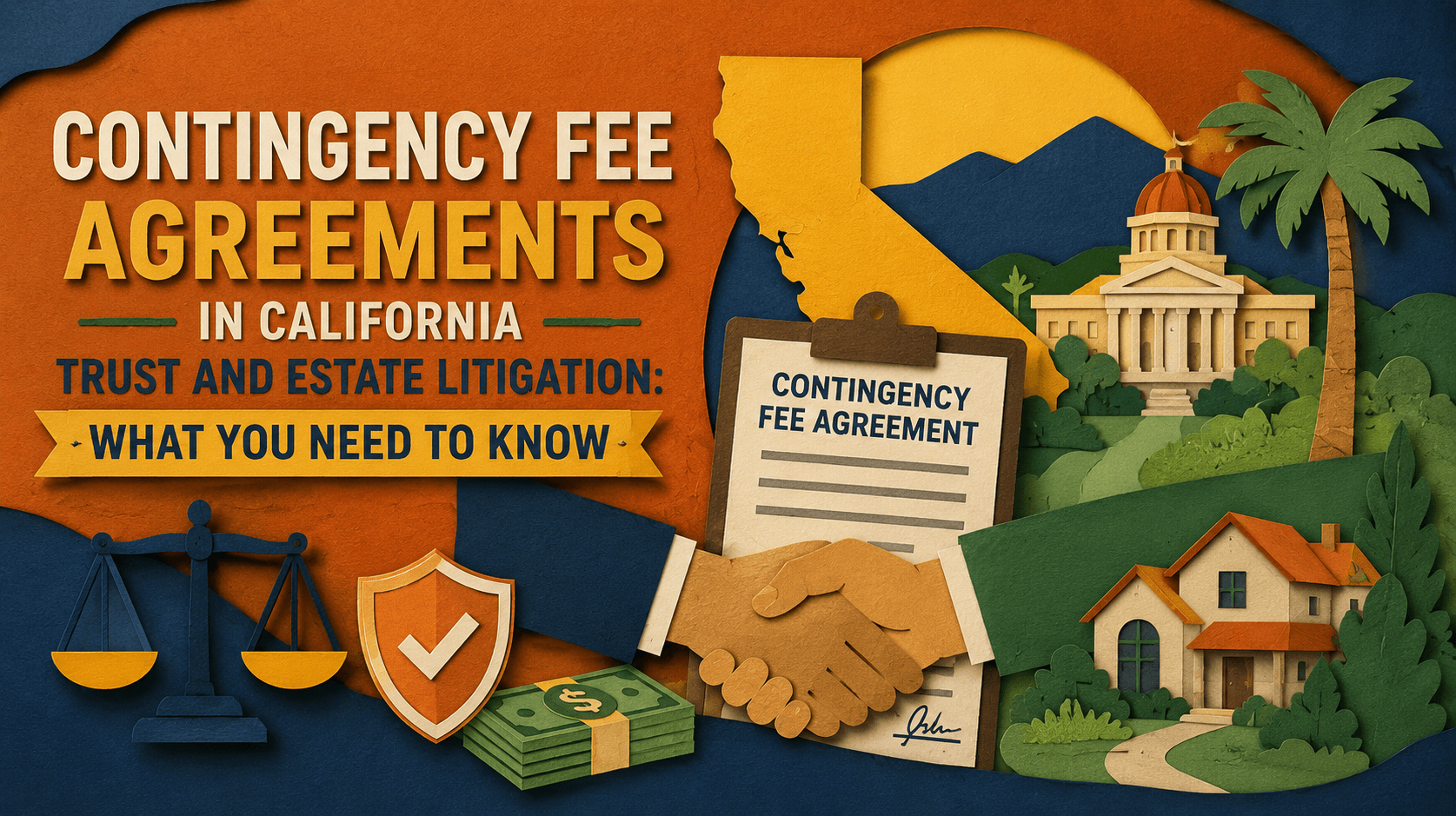
Contingency Fee Agreements in California Trust and Estate Litigation: What You Need to Know

When You’ve Been Cut Out of an Inheritance
I am Michael Hackard, founder of Hackard Law, and for five decades I have fought alongside families facing some of the most painful legal battles imaginable – being cut out of a trust, disinherited without explanation, or discovering that a loved one’s estate was not distributed as intended. I have written four books on inheritance protection and produced more than 1,000 educational videos that have reached over seven million viewers. My firm serves families throughout Sacramento, the San Francisco Bay Area, and Los Angeles.
If you believe you have been wrongfully excluded from an estate, probate distribution, or trust inheritance, the single most important thing I can tell you is this: time matters. California law sets strict deadlines on will, estate, and trust challenges – and the clock starts sooner than most people realize.
Hackard Law offers contingency fee representation for qualified cases, meaning no upfront costs to you. Call us at (916) 313-3030 to discuss whether your case qualifies.
Quick Summary
Contingency fee agreements allow heirs, beneficiaries, and elder abuse victims to pursue estate and trust litigation without paying attorney’s fees unless there is a recovery. California statutes of limitation are uniform statewide and apply regardless of where the dispute arises.
- Contingency fees are tied to a favorable outcome – no recovery, no fee
- Time limits apply uniformly across California, from Sacramento to San Diego
- Fee structures can be tailored: pure contingency, reduced hourly plus contingency, or hybrid arrangements
- Written fee agreements with proper disclosures are required by California law
- Not every case qualifies, but many trust and estate disputes do
Why Time Is the Enemy After Disinheritance
Grief, betrayal, and disbelief are a powerful combination. When a family member discovers they have been cut out of a trust or estate – sometimes after years of caring for an aging parent – the emotional weight can be paralyzing. That paralysis has a legal cost.
California’s statutes of limitation apply uniformly whether a trust or probate dispute arises in Sacramento, Oakland, San Francisco, or Los Angeles. The law does not extend deadlines for those who delay, regardless of how understandable the delay may be. Missing a filing window can permanently eliminate a valid legal claim.
For families navigating Sacramento County probate litigation, understanding these deadlines early is not just helpful – it is essential. An attorney can identify which statutes apply to your specific situation and how much time remains.
Case Pattern: A sibling was named sole trustee and sole beneficiary after a last-minute trust amendment, a family member finds out after a parent passes away. The family deals with their loss for several months. Important deadlines have drastically decreased by the time they speak with an attorney. More options would have been preserved if action had been taken sooner.
How Contingency Fee Agreements Work in Estate Litigation
One of the most common barriers to pursuing a trust or estate claim is cost. Hourly rates for experienced litigation attorneys can reach hundreds of dollars per hour, and complex estate disputes often take years to resolve. For many heirs and beneficiaries, that financial reality makes litigation feel out of reach.
Contingency fee agreements change that calculation. Under a contingency arrangement, the attorney’s fee is based on a percentage of the recovery – whether that recovery comes through a verdict, judgment, settlement, or compromise. If there is no recovery, there is no attorney’s fee. This structure aligns the attorney’s interests directly with the client’s.
The contingency fee guide for California trust and estate litigation published by Hackard Law walks through how these arrangements are structured and what clients should look for when evaluating their options. Understanding the basics before your first consultation puts you in a stronger position.
Contingency fees are available when a money recovery – or something of equivalent value, such as real estate – can be awarded. If a recovery consists of payments spread over time, the agreement can calculate the present cash value of that income stream, with attorney’s fees paid from the first funds or property the client receives.
The Different Fee Structures Available
Not every estate dispute fits a single fee model. Hackard Law recognizes that circumstances vary, and fee arrangements can be structured accordingly. There are three primary models worth understanding.
A pure contingency arrangement means the attorney receives a percentage of the recovery and nothing if the case does not succeed. A reduced hourly plus contingency hybrid lowers the ongoing hourly rate in exchange for a smaller percentage of any recovery. A negotiated payment option can also be explored between attorney and client depending on the nature of the case and the assets at stake.
For those researching what contingency fees mean for trust litigation representation, the key takeaway is that the arrangement must be mutual – a willing attorney and a willing client, with a written agreement that includes all required California disclosures.
Case Pattern: A beneficiary excluded from a trust containing significant real property consults Hackard Law. Because real estate can be awarded as part of a recovery, a contingency fee arrangement is structured around the property’s value. The beneficiary pursues litigation without any upfront payment, and the fee is resolved from the proceeds of the outcome.
What Cases Qualify for Contingency Representation
Contingency fees are not available in every matter. Cases that involve a clear potential recovery – financial assets, real property, business interests – are the strongest candidates. Cases that are primarily seeking injunctive relief or non-monetary outcomes are less likely to qualify.
Trust disputes, will contests, elder financial abuse claims, and probate challenges often involve recoverable assets and are frequently appropriate for contingency arrangements. Hackard Law evaluates each case individually. The Sacramento contested will and trust lawyer page outlines the types of disputes the firm handles across Northern California.
Understanding the eight stages of trust and estate litigation can also help potential clients appreciate the scope of what they are entering and why the fee structure matters at every phase – from initial investigation through trial or settlement.
What the Law Requires in Fee Agreements
California law mandates that contingency fee agreements be in writing and include specific disclosures. This is not a formality – it is a protection for the client. A proper written agreement should clearly state the percentage the attorney will receive, how costs are handled, what happens if the case settles versus goes to verdict, and how fees are calculated if recovery occurs over time.
Heirs, beneficiaries, and elder abuse victims deserve to understand exactly what they are agreeing to before signing anything. I have seen too many families enter agreements they did not fully understand. Transparency at the outset is not just a legal requirement – it is the foundation of a working attorney-client relationship.
For families uncertain about where to begin, the top ten most common probate, trust, and estate battles resource provides context on the types of disputes that regularly lead to litigation and what the litigation process typically involves.
Key Definitions
- Contingency fee: An attorney’s fee calculated as a percentage of the recovery, owed only if the case succeeds.
- Statute of limitations: The legal deadline by which a claim must be filed; varies by claim type but applies uniformly across California.
- Hybrid fee arrangement: A fee structure combining a reduced hourly rate with a smaller contingency percentage on recovery.
- Recovery: The total value received through a verdict, judgment, settlement, or compromise, including cash and non-cash assets like real estate.
- Present cash value: A calculation used when recovery is paid over time, converting future payments into a current dollar equivalent for fee purposes.
- Written fee agreement: A California-required document detailing all terms of the attorney-client fee arrangement, including disclosures.
- Probate dispute: A legal challenge arising from the administration or distribution of a deceased person’s estate through the court system.
- Trust contest: A legal action challenging the validity or terms of a trust, often based on undue influence, fraud, or lack of capacity.
- Disinheritance: The act of excluding an expected heir or beneficiary from receiving assets through a will, trust, or estate plan.
What to Do Next
- Look for any documents you have received from the trustee, executor, or estate attorney – these establish timelines.
- Get copies of the trust, will, or any amendments as soon as possible.
- Try to avoid signing any waivers or releases before speaking with an attorney.
- Write down a timeline of events, including when you learned of the disinheritance and any communications with other family members.
- Look for evidence of recent changes to the estate plan, particularly those made when a loved one was ill or isolated.
- Try to avoid confronting other family members directly before consulting counsel – it can complicate the legal process.
- Contact an attorney promptly, as statutes of limitation can close your options faster than you expect.
- Learn more about your options through the Michael Hackard attorney bio and the firm’s approach to contested estate matters.
- Call Hackard Law at (916) 313-3030 to discuss whether a contingency fee arrangement is available for your case.
- Visit the contact page to schedule a consultation and take the first step toward protecting your inheritance rights.
CALL THE SAGE | When Experience Matters, Families Listen
🏛️ We practice California trust & estate & elder financial abuse litigation
⚖️ We represent heirs, beneficiaries, and elder abuse victims
🎥 1,000+ educational videos | 7 million+ views | 4 published books
🎯 “After thousands of cases, I see the pattern others miss.”
CONTINGENCY REPRESENTATION – No Win, No Fee
Throughout California: Sacramento | Los Angeles | Bay Area
📞 CALL THE SAGE: (916) 313-3030
Subscribe for weekly insights on:
- Elder financial abuse warning signs and prevention
- Trust and estate litigation strategies
- Inheritance protection for California families
- Family protection strategies
When your inheritance is under attack, Call The Sage.
Hackard Law | 10640 Mather Blvd, Mather CA 95655
Attorney Advertisement | Michael Hackard, State Bar #71067
RELATED VIDEOS
Contingency Fee Agreements in CA Estate, Trust & Probate Litigation
Explains how contingency fee agreements work in California estate and trust cases.
California Trust Litigation Contingency Fees | The Pros and Cons
Walks through the advantages and drawbacks of contingency fees in trust disputes.
Inheritance Heists Ch. 3: Why Contingency Fees Work for Beneficiaries in Trust Litigation
Breaks down why contingency fee arrangements benefit beneficiaries fighting inheritance disputes.
Contingency Fees | CA Trust and Estate Litigation Equalizer
Discusses how contingency fees level the playing field for heirs in California litigation.
Trust Litigation Contingency Fees | Shifting the Balance of Power
Covers how contingency fee arrangements shift leverage toward beneficiaries in trust battles.
Contingency Fees | Access To Probate, Trust & Estate Litigation
Explores how contingency fees open the door to estate litigation for families without upfront funds.
 Michael Hackard is the founder of Hackard Law, a California trust and estate litigation firm with more than five decades of experience protecting the inheritance rights of families across Sacramento, the San Francisco Bay Area, and Los Angeles. He is the author of six published books and has produced more than 1,000 educational videos with over seven million views.