Why Contingency Fee Litigation Is Built on Strategy, Not Chance
I’m Michael Hackard, founder of Hackard Law. Over five decades of practice, I have fought for heirs, beneficiaries, and elder abuse victims across California – from Sacramento and the San Francisco Bay Area to Los Angeles. I have written four books on inheritance protection and produced more than 1,000 educational videos, which have reached over 7 million viewers. One question I hear often is whether taking an estate or trust case on a contingency fee basis is a form of gambling. I want to answer that directly, because the confusion is understandable – and the distinction matters enormously to the families we serve.
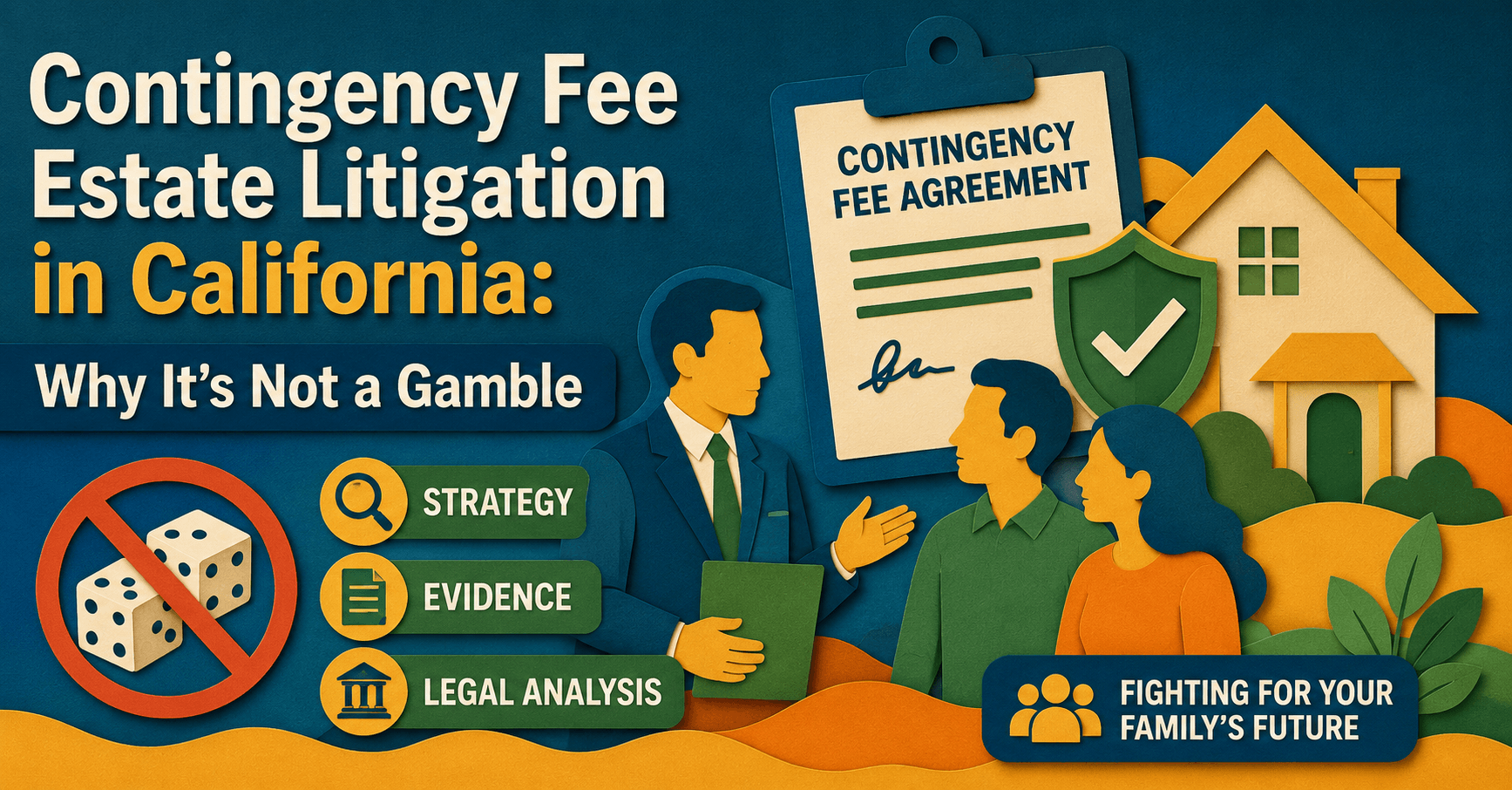
A contingency fee means the attorney agrees to represent you for a fixed percentage of whatever is retrieved. You pay nothing up front. If there is no recovery, there is no fee. For families who have already lost assets to fraud, undue influence, or trustee misconduct, this arrangement is often the only route to justice.
Hackard Law provides contingency fee representation for qualified estate, trust, and catastrophic injury cases – no upfront costs required. To find out whether your case qualifies, call us at (916) 313-3030.
Quick Summary
Contingency fee estate litigation in California is a disciplined, strategy-driven process – not a roll of the dice. Hackard Law evaluates each case via thorough intake, fact analysis, and legal theory before accepting representation.
Families can seek justice without paying upfront legal fees thanks to contingency fees.
These agreements remain controlled by specific statutory and ethical rules established by California law.
Parties, records, witnesses, wrongdoing, and relevant lawful standards are all included in case evaluation.
Early planning, perseverance, and diligence lower uncertainty and enhance results.
Accepted cases show a rational assessment that victory is attainable rather than just feasible.
What a Contingency Fee Agreement Actually Means
Under a contingency fee arrangement, the lawyer’s compensation is totally dependent on the outcome of the case. In California, certain legal and ethical requirements still apply to the disclosure and structure of these agreements. Both the client and the attorney negotiate the percentage, and the terms must be recorded.
In addition to making legal services easier to access, this arrangement directly aligns the client’s and the lawyer’s interests. When Hackard Law takes on a contingency case, both the client’s claim and the firm’s time, money, and strategy are at stake. That common interest serves as a strong incentive for deliberate planning.
For families dealing with trust disputes, inheritance theft, or elder financial abuse, the contingency fee modelcan mean the difference between fighting back and walking away from a rightful inheritance.
Why Contingency Fee Litigation Is Not Gambling
Some critics call contingency fee lawyers gamblers. I disagree, and the distinction is not semantic. Chance-based gambling produces outcomes driven by random events – a player has no ability to influence whether the dice land in their favor. Estate and trust litigation is fundamentally different.
Yes, there are risks. Yes, outcomes are uncertain. Random events can affect any case. But the cases Hackard Law accepts are not chosen by chance. They are chosen after a methodical evaluation of the facts, the parties, the documents, and the law. That evaluation is what separates informed legal judgment from a coin flip.
To understand the full arc of how a trust or estate dispute unfolds from filing to resolution. The eight stages of trust and estate litigation offer a precise framework for what families can expect.
Case Pattern: Shortly before death, a family member suspected that a sibling had tricked an elderly parent into rerouting trust assets. The legal team discovered behavior consistent with undue influence after examining witness statements, financial documents, and the timeline of estate plan modifications. Through mediation, the issue was settled amicably, returning the intended distribution to the surviving heirs.
How Hackard Law Evaluates a Case Before Accepting It
The intake process at Hackard Law is where uncertainty begins to shrink. Before agreeing to represent a client on a contingency basis, the firm examines a wide range of factors.
Who are the parties? What are their relationships – spouse, child, caregiver, stepparent, trustee, beneficiary? Where are they located, and how credible are they likely to appear to a mediator or judge? What documents exist, and what do they reveal? Were there accomplices? Was an attorney involved in the planning, and does that involvement help or hurt the case?
Beyond the parties and documents, the firm looks at conduct. Did someone plot in secret? Did they lie, cheat, or steal? Was there a cover-up? These are not hypothetical questions – they are the building blocks of legal theories that can shift burdens of proof, establish elder financial abuse, support fraud claims, or trigger trustee liability.
For families in the Los Angeles area facing inheritance theft or trust fraud, estate fraud litigation in Los Angeles follows the same rigorous intake standards applied statewide.
Case Pattern: In a case involving a caregiver named successor trustee by a cognitively declining elder, document review revealed a pattern of asset transfers inconsistent with the elder’s prior estate plan. The legal team applied elder financial abuse statutes and pursued recovery. The outcome demonstrated that early, thorough case analysis – not luck – drives results.
Lawful Standards That Shape Every Case
Estate and trust litigation involves layered legal rules, and knowing which rules apply – and how to use them – is what separates effective advocacy from guesswork. Hackard Law applies these standards from the first day of case review.
Preliminary rules can shift the burden of proof to the opposing party. Rules governing aiding and abetting liability can expand the circle of responsibility beyond the primary actor. The standards for drafting attorney involvement: elder financial abuse, fraud identification, incapacity, undue influence, and trustee conduct each carry their own critical analytical system.
For clients in Northern California, the Sacramento estate lawyer practice applies the same legal depth to local probate and trust disputes. Clients throughout California can review Hackard Law’s service areas to confirm coverage in their region.
Diligence, Persistence, and a Plan
Once a case is accepted, the work of reducing uncertainty continues. Effective client intake, ongoing fact gathering, and precise legal theory application are not one-time events – they are continuous disciplines. As new facts emerge through discovery, the plan adapts. Advocacy before a mediator, a judge, or a jury is not improvised. It is the product of preparation that began long before anyone walked into a hearing room.
For decades, I have stood with families who felt powerless against those who had taken advantage of a vulnerable loved one. I have seen the financial toll grow when families delay action, and I have seen the fracture run too deep for any judgment to mend the relationships lost along the way. Discovery, forensic analysis, and the search for justice are not just legal strategies – they are safeguards for families threatened by undue influence and fraud. A firm dedication to truth restores what dishonesty tried to steal.
Contingency fee: A legal fee arrangement where the attorney is paid a percentage of the recovery only if the case succeeds – no recovery, no fee.
Burden of proof: The obligation to present sufficient evidence to support a legal claim; certain rules can shift this burden to the opposing party.
Undue influence: Improper pressure exerted on a person that overrides their free will, often used to manipulate estate planning documents.
Elder financial abuse: The wrongful taking, concealment, or retention of an elder’s property or assets, subject to augmented civil remedies under California law.
Trustee liability: Legal responsibility a trustee bears for breaching fiduciary duties owed to trust beneficiaries.
Aiding and abetting liability: Legal exposure for a party who knowingly assists another in committing a wrongful act, even without being the primary actor.
Incapacity: A legal determination that a person lacked the mental ability to understand or execute a legal document at the time it was signed.
Fraud: An intentional misrepresentation or concealment of a material fact made to induce another party to act to their detriment.
Mediation: A structured negotiation process facilitated by a neutral third party, often used to resolve trust and estate disputes before or during litigation.
Discovery: The formal pre-trial process through which parties obtain documents, records, and testimony from each other and third parties.
What to Do Next
Look for any documents – trust agreements, amendments, financial records, or correspondence – that may show suspicious changes or transfers.
Get copies of the most recent version of the trust or will, along with any prior versions if available.
Write down a timeline of events, including when the elder’s health or cognitive state changed and when new documents were signed.
Try to avoid confronting the suspected party directly before speaking with an attorney, as this can affect the case.
Look for any witnesses – family members, neighbors, physicians, or former caregivers – who observed the elder’s condition or the conduct in question.
Try to avoid signing any documents presented by a trustee or estate representative until you have had an independent legal review.
Look into whether California’s elder financial abuse statutes may apply, which can provide enhanced remedies, including double damages and attorney fees.
Get a case evaluation before assuming litigation is too expensive – contingency fee representation may be available at no upfront cost.
Call Hackard Law at (916) 313-3030 to discuss your situation with our team.
Visit our contact page to submit your information and schedule a consultation.
CALL THE SAGE | When Experience Matters, Families Listen
🏛️ We practice California trust & estate & elder financial abuse litigation
⚖️ We represent heirs, beneficiaries, and elder abuse victims
Covers how contingency fees open the door to litigation for families without upfront funds.
Frequently Asked Questions
In a contingency fee case, Hackard Law agrees to represent you for a percentage of whatever is recovered – you pay no attorney fees upfront. California law requires the agreement to be in writing and sets specific rules about how the fee is structured. If there is no recovery, there is no fee.
The firm evaluates the parties involved, the documents, witness credibility, the nature of the alleged misconduct, and which legal standards apply – including rules for undue influence, elder financial abuse, fraud, and trustee liability. Only cases with a genuine path to recovery are accepted.
Yes. Hackard Law serves clients across California, including in Sacramento, the San Francisco Bay Area, and Los Angeles. The same intake standards and legal frameworks apply regardless of where the case is filed.
Common theories include undue influence, elder financial abuse, breach of fiduciary duty, fraud, and aiding and abetting liability. The applicable theory depends on the facts – which is why thorough case evaluation before filing is essential.
Timelines vary depending on complexity, the number of parties, and whether the case settles in mediation or proceeds to trial. Many cases resolve through negotiated settlement, but Hackard Law prepares every case as if it will go before a judge or jury.
About the Author
Michael Hackard is the founder of Hackard Law, a California trust and estate litigation firm with more than five decades of experience protecting the inheritance rights of families across Sacramento, the San Francisco Bay Area, and Los Angeles. He is the author of six published books on inheritance protection and has produced more than 1,000 educational videos with over seven million views.


 (916) 313-3030