


 (916) 313-3030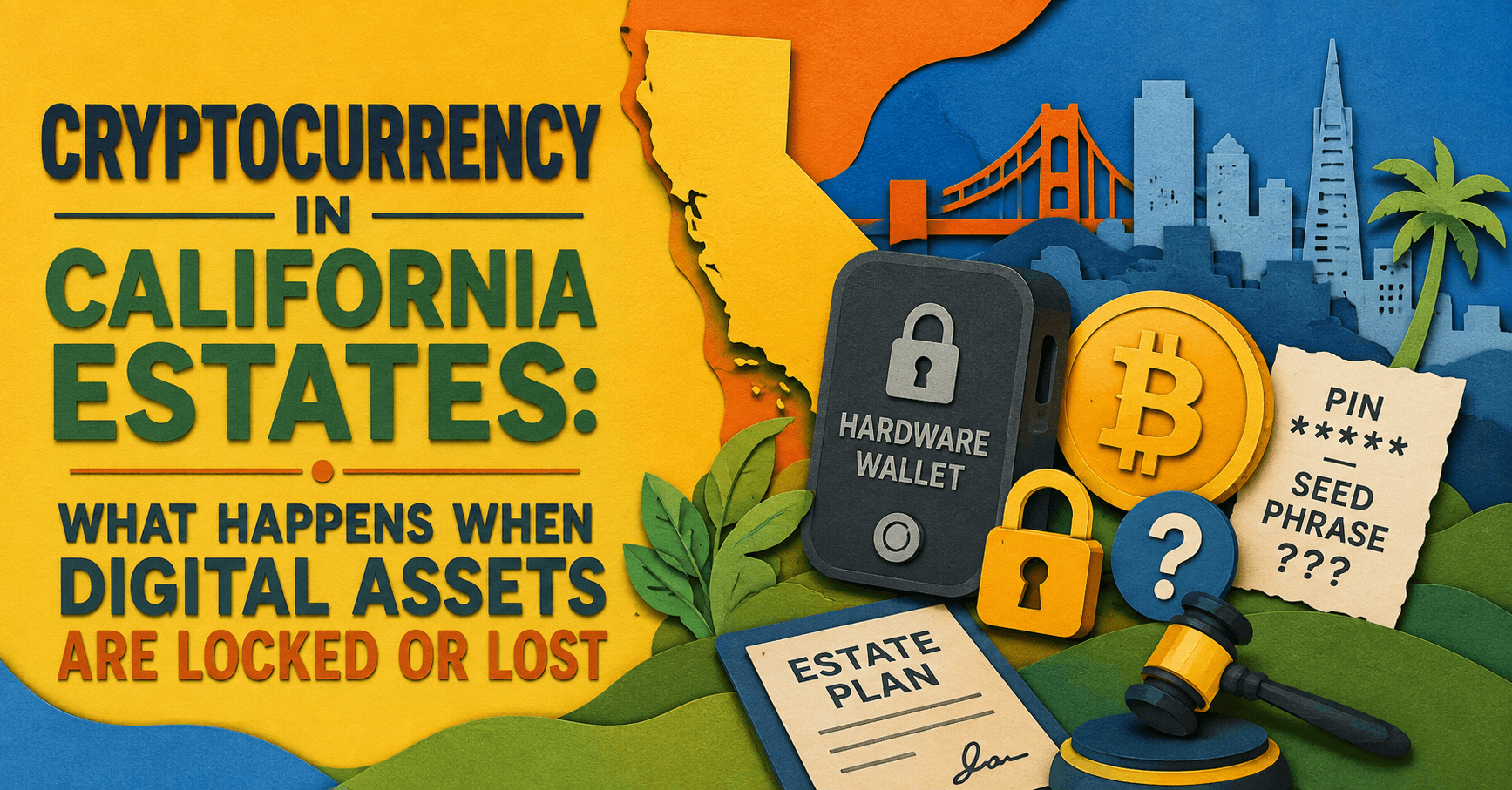
Cryptocurrency in California Estates: What Happens When Digital Assets Are Locked or Lost

When Digital Wealth Disappears at Death
I am Michael Hackard, founder of Hackard Law, and over five decades of practice, I have fought for heirs, beneficiaries, and elder abuse victims across California – from Sacramento to the San Francisco Bay Area and Los Angeles. I have written four books on inheritance protection and produced more than 1,000 educational videos that have drawn over seven million views. In that time, I have watched the landscape of estate assets shift dramatically. Real estate, bank accounts, and brokerage portfolios are still at the center of most inheritance disputes. But increasingly, families come to me facing a problem that did not exist a generation ago: a loved one has died, leaving significant wealth locked inside a hardware cryptocurrency wallet, and no one knows the PIN.
This is not a fringe issue. Billions of dollars in digital assets are estimated to be inaccessible because owners died without documenting how to access them. For California families, that means a real inheritance may be permanently out of reach – unless the right legal and technical steps are taken quickly.
Hackard Law provides contingency fee representation for qualified estate and trust litigation matters – no upfront costs required. If your family is dealing with a locked digital asset, a crypto-related inheritance dispute, or suspected financial exploitation involving cryptocurrency, call us at (916) 313-3030.
Quick Summary
Because digital assets can become permanently inaccessible when owners pass away without leaving access credentials, cryptocurrency poses special challenges for California estate administration. Crypto-related legal disputes are becoming more common in California probate courts, and families require both technical recovery assistance and legal counsel.
- Hardware wallets lock private keys offline, making recovery nearly impossible without a PIN or seed phrase
- Entering the wrong PIN too many times can permanently destroy the wallet and its contents
- Forensic recovery firms use advanced techniques – including electromagnetic pulse methods – to attempt access
- Blockchain tracing tools can follow stolen or transferred crypto across international borders
- California estate litigation attorneys can pursue legal remedies when crypto assets are misappropriated
What Is a Hardware Wallet and Why Does It Matter to Your Estate
A hardware wallet is a physical device that stores the private keys needed to access cryptocurrency offline. Unlike keeping funds on an exchange, a hardware wallet gives the owner complete control – no bank, no government, no intermediary. That independence is the appeal. It is also the danger.
A hardware wallet does not automatically pass to heirs upon the death of its owner. The assets within could be permanently frozen in the absence of the PIN or a backup seed phrase. Recovery companies have verified that a self-destruct sequence that wipes the device is triggered by inputting an incorrect PIN three times. Then, unless there is another backup, the underlying bitcoin is lost.
This presents a serious issue for California families undergoing probate. The asset’s worth is theoretical if no one can access it, even if it appears on a tax return or financial statement. A machine cannot be forced to open by a court.
Case Pattern: A family from California found out their father had several hundred thousand dollars in cryptocurrencies stored on a hardware wallet. He had left no written instructions, but he had mentioned the investment. The wallet could not be accessed even after engaging a forensic recovery company. The asset had to be completely written off by the estate; this loss may have been avoided with basic documentation.
Legal Disputes Involving Cryptocurrency Are Growing in California Courts
Not every crypto dispute involves a locked wallet. Some of the most contentious cases arise when a family member or caregiver gains unauthorized access to a decedent’s cryptocurrency and transfers it before or after death. Because crypto transactions are irreversible and can cross international borders in seconds, tracing and recovering those assets requires a combination of legal action and blockchain forensics.
California probate courts are beginning to grapple with these cases. Judges must determine the value of digital assets at the time of death, whether transfers were authorized, and whether any fiduciary duty was breached. The 8 stages of trust and estate litigation apply equally to digital asset disputes – from initial demand letters through discovery, trial, and judgment enforcement.
Blockchain analysis can trace a transaction from wallet to wallet, but the harder task is connecting a wallet address to a real person. Forensic investigators use IP data from crypto exchanges, geolocation records, and other digital footprints to identify who moved the funds. That information then becomes evidence in a California probate or civil proceeding.
Elder Financial Exploitation and Cryptocurrency
One pattern that concerns me deeply involves elderly Californians who are persuaded – through manipulation or outright fraud – to transfer cryptocurrency to a caregiver, a new romantic partner, or a family member who has gained undue influence. Because crypto transfers are instant and irreversible, by the time family members notice, the funds may already be gone.
California’s Elder Abuse and Dependent Adult Civil Protection Act provides strong remedies, including double damages and attorney fee recovery, when financial exploitation is proven. These remedies apply to cryptocurrency theft just as they do to the unauthorized transfer of real estate or bank funds. The challenge is acting quickly. Every day that passes makes tracing and recovery harder.
Case Pattern: An elderly Northern California woman transferred a substantial amount of cryptocurrency to a caregiver over several months. After her death, her adult children discovered the transfers through exchange records. A civil action was filed under California elder abuse statutes, and the forensic trail through the blockchain helped establish the pattern of exploitation.
For a broader look at how estate theft plays out in California courts, the top 10 most common probate, trust, and estate battles offers useful context on the types of disputes families face.
How Forensic Recovery Works – and Its Limits
Forensic cryptocurrency recovery is a rapidly evolving field. Recovery firms now use techniques that would have seemed impossible a decade ago – slowing electrical signals along a wire, applying electromagnetic pulses to microcontrollers, and using proprietary software to reconstruct partial passwords. Psychological profiling of the original owner – drawing on known habits, significant dates, and personal data – can help narrow down possible PINs or seed phrases.
But these methods are not guaranteed. Hardware wallets are designed to resist exactly this kind of intrusion. Recovery firms work only on air-gapped machines with no internet connection, and they never work directly on the original wallet – only on encrypted copies. The security protocols are rigorous because the stakes are high and a single mistake can destroy the asset permanently.
Families considering forensic recovery should vet any firm carefully, verify regulatory compliance, and confirm that the firm checks clients against OFAC sanction lists. The combination of legal oversight and technical recovery gives families the best chance at reclaiming what belongs to them.
For California families in the Bay Area, Oakland estate litigation and Santa Clara estate litigation attorneys at Hackard Law can coordinate with forensic recovery teams while pursuing parallel legal remedies.
Key Definitions
- Cryptocurrency: A digital currency secured through cryptography and decentralized computer networks, with no bank or government intermediary.
- Hardware wallet: A physical device that stores private keys offline, giving the owner direct control over digital assets.
- Private key: A unique cryptographic code that allows the holder to access and transfer cryptocurrency; losing it means losing access to the funds.
- Seed phrase: A backup sequence of words generated when a hardware wallet is set up; it can restore access if the wallet is lost or damaged.
- Air-gapped machine: A computer that has never been connected to the internet, used in forensic recovery to prevent hacking during sensitive operations.
- Blockchain analysis: The process of tracing cryptocurrency transactions across the public ledger to identify the flow of funds.
- OFAC compliance: Verification against the U.S. Treasury’s Office of Foreign Assets Control sanction list, required for legitimate crypto recovery and legal proceedings.
- Elder financial exploitation: The illegal or improper use of an elder’s funds, property, or assets, including cryptocurrency, by a person in a position of trust.
- Contingency fee representation: A legal fee arrangement where the attorney is paid only if the case results in a recovery – no upfront cost to the client.
- Fiduciary duty: A legal obligation to act in another person’s best interest, applicable to trustees, executors, and agents under a power of attorney.
What to Do Next
- Look for any documentation your loved one may have left regarding cryptocurrency holdings – hardware wallets, seed phrases, exchange account records, or notes about digital assets.
- Get copies of financial statements and tax returns for the past three to five years to identify any crypto-related transactions or reported holdings.
- Try to avoid touching or attempting to access a hardware wallet without professional guidance – incorrect PIN attempts can permanently destroy the device.
- Look for a forensic cryptocurrency recovery firm with verifiable credentials, regulatory compliance, and a documented security protocol before handing over any device.
- Get copies of any exchange account records, which may reveal wallet addresses, transaction history, and the identity of recipients.
- Try to avoid delay if you suspect cryptocurrency was transferred to an unauthorized person before or after your loved one’s death – blockchain evidence can fade as accounts are closed.
- Look into California’s elder abuse statutes if the person who died was elderly and the transfers appear to have been made under manipulation or undue influence.
- Review the contingency fee representation guide to understand how Hackard Law handles qualified cases with no upfront cost.
- For Los Angeles families, explore LA estate litigation options and Glendale estate litigation resources.
- Call Hackard Law at (916) 313-3030 to discuss your situation with an attorney who understands both the legal and technical dimensions of cryptocurrency estate disputes. You can also reach us through our contact page.
CALL THE SAGE | When Experience Matters, Families Listen
🏛️ We practice California trust & estate & elder financial abuse litigation
⚖️ We represent heirs, beneficiaries, and elder abuse victims
🎥 1,000+ educational videos | 7 million+ views | 4 published books
🎯 “After thousands of cases, I see the pattern others miss.”
CONTINGENCY REPRESENTATION – No Win, No Fee
Throughout California: Sacramento | Los Angeles | Bay Area
📞 CALL THE SAGE: (916) 313-3030
Subscribe for weekly insights on:
- Elder financial abuse warning signs and prevention
- Trust and estate litigation strategies
- Inheritance protection for California families
- Family protection strategies
When your inheritance is under attack, Call The Sage.
Hackard Law | 10640 Mather Blvd, Mather CA 95655
Attorney Advertisement | Michael Hackard, State Bar #71071067
RELATED VIDEOS
Cryptocurrency and Estate Law | New Challenges
Explores the emerging legal issues cryptocurrency creates for estates and inheritance.
Inheritance Heists Ch. 10: Cryptocurrency in Estate and Trust Disputes
Examines how crypto assets become contested in estate and trust litigation.
Uncovering Hidden Assets in Estate Litigation: Tools, Tactics, and Court Orders
Covers legal tools attorneys use to locate and recover concealed estate assets.
Thou Shalt Not Steal | From Decedents’ Estates
Addresses theft and misappropriation of assets from a deceased person’s estate.
Probate vs Nonprobate Transfers | How Assets Transfer at Death
Explains how different asset types pass to heirs when someone dies.
Estates, Safes & Safe Deposit Boxes | What’s the Risk?
Looks at the risks of storing valuables in locked containers within estates.
 Michael Hackard is the founder of Hackard Law, a California trust and estate litigation firm with more than five decades of experience protecting the inheritance rights of families across Sacramento, the San Francisco Bay Area, and Los Angeles. He is the author of six published books and has produced more than 1,000 educational videos with over seven million views.