


 (916) 313-3030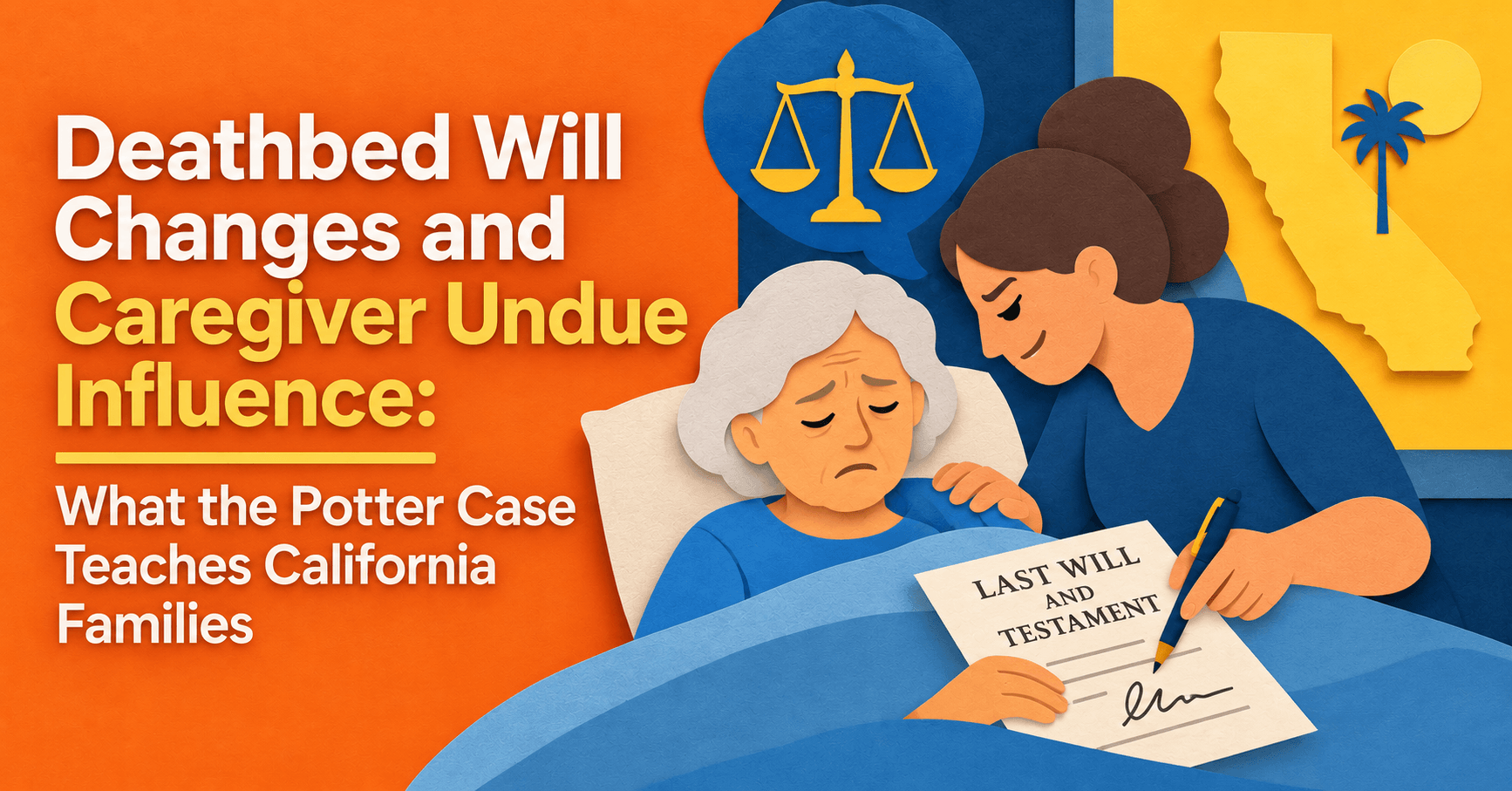
Deathbed Will Changes and Caregiver Undue Influence: What the Potter Case Teaches California Families

When a Late-Life Will Change Becomes a Legal Battle
I am Michael Hackard, founder of Hackard Law. Over five decades of practice, I have fought for heirs, beneficiaries, and elder abuse victims across California – from Sacramento and the San Francisco Bay Area to Los Angeles. I have written four published books on inheritance protection and produced more than 1,000 educational videos that have reached over seven million viewers. One theme runs through nearly every case I have handled: when someone changes a will or trust near the end of life, the risk of a legal challenge rises sharply. The story of Eleanor Potter and her caregiver illustrates exactly why.
Hackard Law offers contingency fee representation for qualified cases – no upfront costs to you. If you believe a late-life estate change was the product of undue influence or fraud, call us today at (916) 313-3030.
Quick Summary
The Potter case from Maine is a cautionary tale with direct lessons for California families navigating estate disputes involving caregivers and last-minute will changes.
- Eleanor Potter changed her will seven months before death, cutting out a major institution and naming her caregiver as the primary beneficiary
- A jury found evidence of undue influence and awarded the original beneficiary $3.3 million plus $1 million in punitive damages
- Late-life estate changes – especially those benefiting a caregiver – draw intense legal scrutiny
- California law provides strong tools to challenge these transfers when manipulation is suspected
- Acting quickly after a suspicious change is critical to preserving your legal options
The Potter Case: A $4.3 Million Verdict Against a Caregiver
Eleanor Potter was 89 years old when she died in 2015. She and her husband Newell had built a full life together in Maine – 41 years of marriage, extensive travel, a wide circle of friends, and a collection of art and antiques accumulated over decades. Eleanor worked at IBM for 40 years and was active in civic life. After accounting for all other bequests, her estate held $3.3 million in art and cash.
In March 2014, Potter signed a will naming the Portland Museum of Art as the remainder beneficiary. Seven months later, in October 2014, she signed a new estate plan with new lawyers. The museum received nothing. Her longtime caretaker, Anne Marie Germain, became the sole remainder beneficiary.
The museum sued Germain after Potter passed away in 2015, claiming that she had coerced and threatened Potter into altering her estate plan. Potter’s actions were motivated by gratitude for years of devoted service, according to Germain’s lawyer. He cited a doctor’s appointment the day following the signing, during which Potter was observed to be in a good mood and showing no signs of being under the influence.
In July 2019, a nine-member jury disagreed. They sided with the museum and awarded $3.3 million – the original bequest – plus $1 million in punitive damages against the caretaker.
Why Late-Life Estate Changes Draw So Much Scrutiny
The Potter verdict is not an isolated result. Courts and juries across the country – including in California – view last-minute changes to wills and trusts with heightened skepticism, and for good reason. The combination of advanced age, physical dependence on a caregiver, and a sudden shift in beneficiary designations raises a pattern that courts have seen many times before.
Undue influence has a broad definition in California. Overt threats are not necessary. Isolation, emotional manipulation, progressive dependence, and the gradual deterioration of an elder’s autonomous judgment are some examples. The burden of justifying a change made just months before death falls heavily on the caregiver who stands to gain millions from it.
You can learn more about how poor drafting and late-stage planning decisions lead to courtroom battles – a pattern Hackard Law confronts regularly in California litigation.
Case Pattern: A Caregiver Named Overnight
An elderly California man with no children revised his trust to name his in-home caregiver as the primary beneficiary just weeks before his death. His nieces and nephews, who had been named in the prior trust, contacted Hackard Law. Investigation revealed that the caregiver had accompanied the man to every attorney meeting, had access to his finances, and had gradually cut off contact with family. The case resolved in favor of the family.
The Mechanics of Undue Influence in Caregiver Cases
Caregivers occupy a position of profound trust. They help with daily activities, manage medications, control access to visitors, and often become the primary human connection for an isolated elder. That closeness, when exploited, becomes the mechanism of control.
California Welfare and Institutions Code section 15610.70 sets out the factors courts examine when evaluating undue influence: the vulnerability of the victim, the apparent authority of the influencer, the tactics used, and the equity of the result. A caregiver who stands to inherit millions while the elder’s longtime friends and family receive nothing presents a fact pattern that checks nearly every box.
The timing of a change matters enormously. A will revised at age 89, seven months before death, by someone who had already named a major institution as beneficiary just months earlier, raises immediate questions. Who introduced the new lawyers? Who drove the elder to the appointment? Who was present during the signing? These are the questions that litigation uncovers.
For a broader look at the types of disputes that arise in these situations, the top 10 most common probate, trust, and estate battles offers useful context.
California’s Legal Framework for Challenging Suspicious Transfers
California provides several legal avenues to challenge a will or trust change that resulted from undue influence or fraud. A will contest filed in probate court can challenge the validity of the document itself. A trust contest can seek to void amendments made under suspicious circumstances. And where a caregiver has financially exploited an elder, California’s Elder Abuse and Dependent Adult Civil Protection Act may provide additional remedies – including the recovery of attorney fees and enhanced damages.
The standard of proof in a will contest is a preponderance of the evidence – more likely than not. That is a lower bar than criminal cases, which is why civil litigation can succeed even when no criminal charges are filed. The Potter jury found by that standard that Germain had exerted undue control, and the financial consequences for her were severe.
Case Pattern: The New Lawyer, the New Will
A California woman in her late eighties had worked with the same estate planning attorney for years. After a new caregiver entered her home, she suddenly switched to a different law firm – one the caregiver had recommended – and signed documents leaving the caregiver a significant share of her estate. Her adult children challenged the transfer. The new attorney had no prior relationship with the woman and had met with her only once, with the caregiver present throughout. The court found the circumstances sufficient to void the amendment.
Understanding how to choose the right probate lawyer for a contested situation like this is an important first step for any family facing these facts.
What the Potter Case Means for California Families
For decades, I have stood with families who discovered – often too late – that someone had quietly redirected a lifetime of savings away from the people who were supposed to receive it. The financial toll grows with every month of delay. The fracture often runs too deep for any judgment to mend. But the law still offers a path.
Discovery, forensic analysis, and the pursuit of justice – these are not just legal strategies, but safeguards for families threatened by undue influence and fraud. A steadfast commitment to truth restores what dishonesty tried to steal. The Potter case is proof that juries understand this, and that courts will hold those who exploit vulnerable elders accountable.
If someone you love changed their estate plan late in life under circumstances that feel wrong, do not wait. The window to act in California is limited, and early investigation makes the difference between a recoverable situation and a lost inheritance.
Hackard Law handles these cases on a contingency fee basis – meaning you pay nothing unless we recover for you.
Key Definitions
- Undue influence: Pressure or manipulation that overcomes a person’s free will, causing them to make estate decisions they would not otherwise have made.
- Will contest: A legal proceeding challenging the validity of a will, typically on grounds of lack of capacity, undue influence, or fraud.
- Remainder beneficiary: The person or entity who receives what is left of an estate after all specific bequests and expenses have been paid.
- Punitive damages: An award beyond actual losses, imposed to punish particularly wrongful conduct and deter similar behavior.
- Caregiver financial exploitation: The misuse of a position of trust and access to manipulate an elder’s financial or estate decisions for personal gain.
- Testamentary capacity: The legal standard for mental competence required to execute a valid will – understanding the nature of the act, the extent of one’s property, and who the natural heirs are.
- Estate plan amendment: A change to a will or trust, which can be challenged if made under suspicious circumstances near the end of life.
- Elder Abuse and Dependent Adult Civil Protection Act: California’s statute providing civil remedies – including enhanced damages and attorney fees – for financial exploitation of elders.
What to Do Next
- Look for sudden changes in an elder’s estate plan, especially after a new caregiver entered their life.
- Get copies of any new wills, trust amendments, or beneficiary designation changes as soon as possible.
- Try to find out whether the elder had independent legal counsel – someone not introduced or recommended by the caregiver.
- Look for signs of isolation: reduced contact with family, changed phone numbers, restricted visits.
- Document any statements the elder made about their wishes before the change occurred.
- Try to avoid delay – California has strict deadlines for contesting a will or trust after a death.
- Reach out to Hackard Law for a confidential consultation about your options.
- Call Hackard Law at (916) 313-3030 to speak with our team about a potential case.
- Visit our contact page to reach us online and schedule your consultation.
CALL THE SAGE | When Experience Matters, Families Listen
🏛️ We practice California trust & estate & elder financial abuse litigation
⚖️ We represent heirs, beneficiaries, and elder abuse victims
🎥 1,000+ educational videos | 7 million+ views | 4 published books
🎯 “After thousands of cases, I see the pattern others miss.”
CONTINGENCY REPRESENTATION – No Win, No Fee
Throughout California: Sacramento | Los Angeles | Bay Area
📞 CALL THE SAGE: (916) 313-3030
Subscribe for weekly insights on:
- Elder financial abuse warning signs and prevention
- Trust and estate litigation strategies
- Inheritance protection for California families
- Family protection strategies
When your inheritance is under attack, Call The Sage.
Hackard Law | 10640 Mather Blvd, Mather CA 95655
Attorney Advertisement | Michael Hackard, State Bar #71067
RELATED VIDEOS
Shattered Trust: Challenging Power of Attorney Abuse
Explores how victims can fight back against power of attorney manipulation and abuse.
POA Vultures | Power of Attorney Abuse
Examines predatory individuals who exploit power of attorney to steal from vulnerable elders.
Key Tips to Fight Wrongful House Transfers | CA Estate & Trust Litigation
Covers legal strategies for challenging property transfers made under suspicious or coercive circumstances.
Safeguarding the Family Legacy: Sandra’s Story | Hackard Law
A real client story about protecting an inheritance from those who sought to take it.
What Happened to Mom & Dad’s House? | CA Estate & Trust Litigation
Looks at how family homes can be wrongfully transferred away from rightful heirs.
 Michael Hackard is the founder of Hackard Law, a California trust and estate litigation firm with more than five decades of experience protecting the inheritance rights of families across Sacramento, the San Francisco Bay Area, and Los Angeles. He is the author of six published books on inheritance protection and has produced more than 1,000 educational videos with over seven million views.