


 (916) 313-3030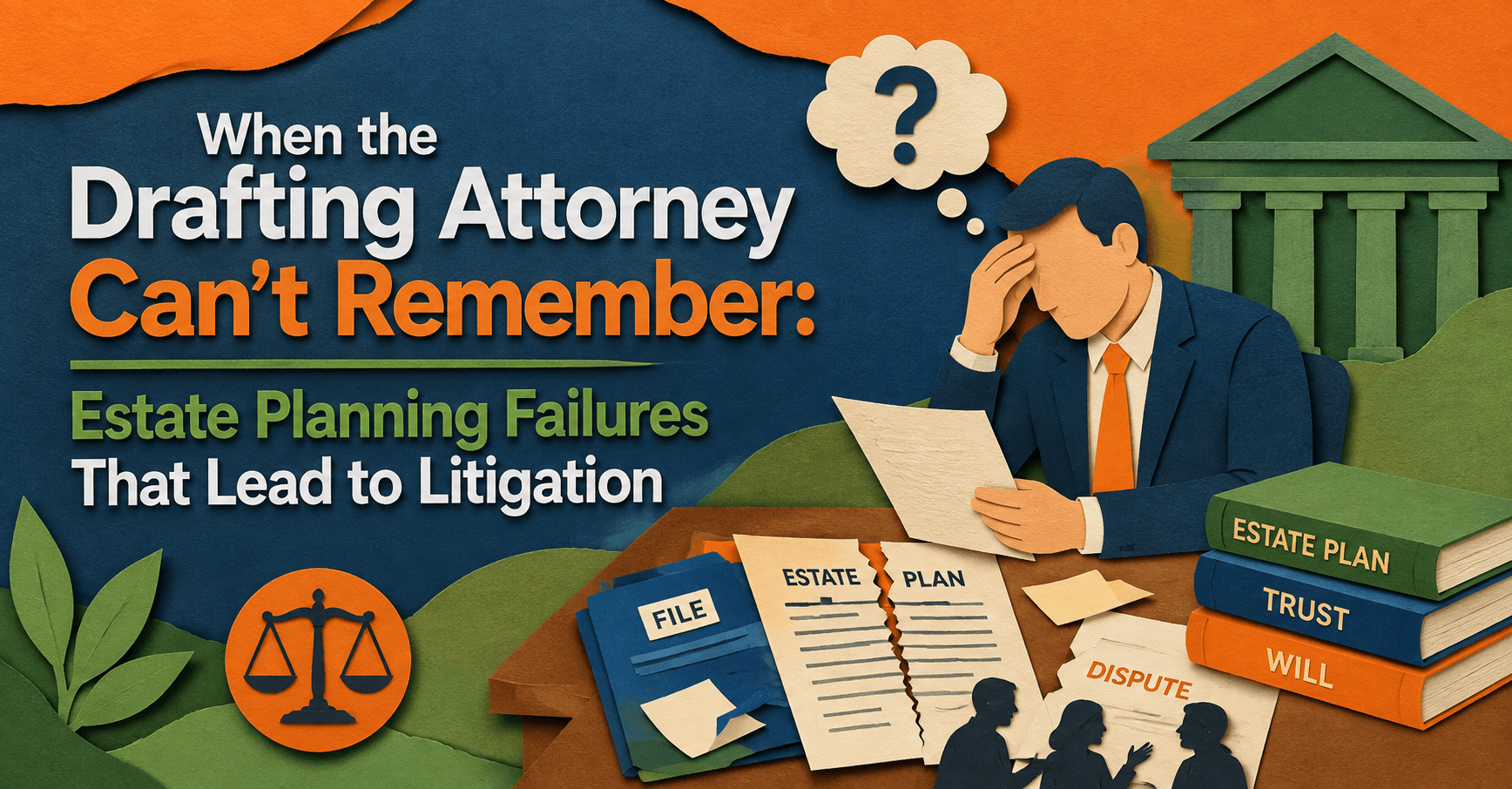
When the Drafting Attorney Can’t Remember: Estate Planning Failures That Lead to Litigation
The Attorney Who Couldn’t Recall Anything
I am Michael Hackard, founder of Hackard Law. Over five decades of practice, I have fought for heirs, beneficiaries, and elder abuse victims whose inheritances were stripped away – not always by a scheming stranger, but sometimes by the very attorney who drafted the estate plan. I have taken more drafting attorney depositions than I can count, and I have never once heard a drafting attorney admit that he prepared a will or trust for a client who lacked capacity or was under undue influence. Not once. That pattern has repeated itself across Sacramento, the San Francisco Bay Area, and Los Angeles, in courtrooms and deposition rooms alike.
I have written four books on inheritance protection and produced more than 1,000 educational videos with over seven million views – because families deserve to understand what goes wrong before it happens to them. This post pulls back the curtain on the drafting failures, document preparer schemes, and insurance agent arrangements that quietly undermine estate plans and ultimately fuel litigation.
Hackard Law provides contingency fee representation for qualified estate and trust cases – no upfront costs to you. If your family has been harmed by a flawed estate plan or a compromised drafting process, call us today at (916) 313-3030.
Quick Summary
Estate planning failures come in many forms, and the drafting attorney’s assurance that everything was done properly is rarely the end of the story.
- Document preparers and insurance sales agents often target elders with low-cost or flat-fee estate plans that lack proper legal oversight.
- Drafting attorneys who rely on third-party referrals frequently skip the individualized review that California law and professional ethics require.
- Videotaped capacity interviews, illiterate signers, blind clients, and non-English speakers have all appeared in cases Hackard Law has litigated.
- A drafting attorney who testifies by speculation rather than recollection does serious damage to the credibility of the estate plan.
- Families in the Bay Area and across California have legal options when a flawed drafting process calls a will or trust into question.
Document Preparers: A Cheap Plan With an Expensive Aftermath
California law allows legal document assistants – known as LDAs – to help complete legal forms, but they are explicitly prohibited from giving legal advice. That prohibition exists for good reason. Document preparers frequently advertise to elders, promising peace of mind, probate avoidance, and a living trust for a flat fee of $400 to $900 or more. What the elder receives is a set of forms prepared without the direct supervision of a licensed California attorney.
The preparer often implies – sometimes outright states – that the completed documents are legally sufficient. In many cases they are not. The gaps, ambiguities, and one-size-fits-all provisions in those documents become the raw material for costly courtroom battles that consume far more than the elder ever saved on the original plan. An inexpensive estate plan can turn out to be extraordinarily expensive for the heirs left behind.
Case Pattern: A flat-fee living trust prepared by a non-attorney document service
An elder in the East Bay paid a modest flat fee for a living trust package. The preparer had no attorney on staff and provided no legal advice. After the elder passed, the family discovered the trust failed to account for a significant real property interest and contained provisions that could not be enforced under California law. The dispute that followed consumed years and far exceeded what competent legal drafting would have cost.
Insurance Agents, Referral Schemes, and the Attorney Who Signs Everything
A more troubling pattern involves insurance sales agents who are not licensed to practice law but who cold-call elders, send mailers, and arrange in-home meetings to sell estate planning packages. These packages – often priced at $3,000 or more – are marketed as comprehensive solutions. An attorney is nominally brought in to sign off on the documents and lend a veneer of legitimacy to the transaction.
The arrangement is ethically compromised from the start. The attorney may receive only $400 or $500 of the fee paid by the elder. Clients typically never meet with the lawyer in any meaningful way. The attorney uses whatever standard documents the agent provides without conducting an independent review of the client’s circumstances, capacity, or wishes. Attorneys who participate in these arrangements violate California’s rules of professional conduct, including the prohibition against aiding others in the unauthorized practice of law.
Hackard Law has deposed attorneys in these arrangements who testified to preparing roughly 50 estate plans per year for clients funneled to them by a cold-calling agent – with no individualized review of any kind. Understanding the eight stages of trust and estate litigation helps families appreciate how far down the road these initial failures can travel.
Videotaped Capacity Interviews and Other Courtroom Gifts
Some drafting attorneys attempt to protect themselves – and their clients – by videotaping the estate plan signing. In the right circumstances, a thoughtful video can be useful evidence of a client’s capacity and understanding. In the wrong circumstances, it becomes the most damaging exhibit in the contesting party’s case.
I have seen a video in which a drafting attorney opened the capacity interview by asking his elderly client, “Who am I?” The elder, looking genuinely uncertain, responded: “You’re my friend.” The attorney, apparently dissatisfied, pivoted to a closed-ended question: “I’m your lawyer, aren’t I?” The elder agreed – appearing relieved to have a yes-or-no option. A neuropsychologist who reviewed the tape later said he wanted to use it as a teaching example for his students. Not as a model of best practices, but as a demonstration of what not to do.
That video is not an isolated incident. Quite a number of attorney-produced videos have appeared in cases as evidence supporting claims of undue influence or lack of capacity – the opposite of what the attorney intended when he pressed record.
Case Pattern: A videotaped signing that became the centerpiece of a capacity challenge
In an Alameda County matter, a drafting attorney videotaped the execution of a living trust amendment that significantly changed the distribution of a substantial estate. The video, rather than confirming capacity, showed the elder confused about basic facts, agreeing to leading questions, and looking to a third party present in the room before answering. The footage became central evidence in the Alameda County estate litigation that followed.
When the Elder Couldn’t Read, Couldn’t See, or Couldn’t Speak English
Among the drafting failures Hackard Law has encountered in litigation, some stand out for their starkness. A living trust provided to a client who was illiterate and could not read or understand it. A blind elder who signed a trust whose terms were supplied by a third party and never read aloud to him. Complex trust documents drafted for clients who did not speak English, with only a cursory summary provided by an in-house person who was not fluent in the elder’s native language.
Each of these situations raises serious questions about whether the elder understood – or could have understood – what they were signing. California’s State Bar publishes a plain-language brochure titled “Do I Need a Living Trust?” that explains what a living trust is, how it works, what it costs, and how to avoid promoters who exploit elders’ desire for simple, affordable planning. The fact that these drafting failures continue despite readily available guidance reflects something deeper than oversight.
For families in Oakland, the East Bay, and across the Bay Area, these failures are not abstract. They are the foundation of trust and probate battles that divide families and consume inheritances. Understanding how estate planning communication breaks down is a first step toward preventing it.
The Attorney Who Speculates Instead of Remembers
In deposition after deposition, I have heard drafting attorneys respond to questions about the preparation, review, and execution of a trust with some version of: “I don’t recall exactly, but I can speculate.” Attorneys are trained in precision. They know that to speculate means to consider something in an idle or casual manner, without sufficient evidence to reach a sound conclusion. And yet some offer speculation as a substitute for testimony.
Imagine sitting as a juror and hearing the attorney who drafted the document at the center of the dispute tell you that he is in doubt – that he lacks sufficient evidence to reach a meaningful conclusion about what he did and why. The credibility damage is severe. And it often leaves the estate plan without its most important defender.
For decades, I have stood with families who were told that the drafting attorney’s word should be the end of the inquiry. It rarely is. Doctor’s records, neuropsychological evaluations, testimony from family members and caregivers, financial records, and the documents themselves all tell a story that speculation cannot erase. Discovery, forensic analysis, and the pursuit of justice are not just legal strategies – they are safeguards for families threatened by undue influence, incapacity, and the failures of those entrusted to protect them. A steadfast commitment to truth restores what dishonesty tried to steal. The fracture that runs through a family after a compromised estate plan often runs too deep for any judgment to fully mend – but accountability matters, and the financial toll grows when families wait.
Key Definitions
- Legal Document Assistant (LDA): A California-authorized non-attorney who may assist in completing legal forms but is prohibited from giving legal advice or opinion.
- Document preparer: A general term for a non-attorney service that prepares legal documents, often without LDA certification and sometimes in violation of the prohibition on unauthorized practice of law.
- Unauthorized practice of law: Providing legal services – including legal advice, document drafting with legal guidance, or representation – without a valid California law license.
- Testamentary capacity: The legal standard requiring that a person making a will or trust understand the nature of the document, the extent of their property, and the identity of their natural heirs.
- Undue influence: Pressure or manipulation that overcomes a person’s free will in making estate planning decisions, often targeting elders with cognitive vulnerability.
- Drafting attorney: The lawyer who prepares and supervises the execution of a will, trust, or other estate planning document.
- Cold-call estate planning: A sales practice in which insurance agents or document sellers contact elders unsolicited to sell estate planning packages, often without individualized legal review.
- One-size-fits-all estate plan: A standardized set of estate planning documents applied without meaningful customization to an individual’s circumstances, assets, or wishes.
- Capacity interview: A meeting – sometimes recorded – in which a drafting attorney attempts to document that the client understood and freely executed the estate plan.
- Contingency fee representation: A fee arrangement in which the attorney is paid only if the case is successfully resolved, with no upfront cost to the client.
What to Do Next
- Look for signs that a loved one’s estate plan was prepared by a document service rather than a licensed attorney supervising the process directly.
- Get copies of the original estate planning documents, any amendments, and any correspondence between the elder and the drafter.
- Try to identify whether an insurance agent or third-party referral source was involved in connecting the elder to the drafting attorney.
- Look for medical records, cognitive evaluations, or physician notes from around the time the documents were signed.
- Try to avoid destroying, deleting, or moving any documents, emails, or files that may be relevant to the drafting process.
- Look for any video recordings made during the signing or capacity interview – these can be powerful evidence in either direction.
- Get a timeline together: when was the document signed, who was present, and what changed in the elder’s health or relationships around that time.
- Reach out to family members or caregivers who may have witnessed the signing or observed the elder’s condition during that period.
- Review the contingency fee options available for estate and trust litigation – cost should not prevent a family from pursuing justice.
- Call Hackard Law at (916) 313-3030 to share your story with our team, or visit our contact page to get started with a free consultation.
CALL THE SAGE | When Experience Matters, Families Listen
🏛️ We practice California trust & estate & elder financial abuse litigation
⚖️ We represent heirs, beneficiaries, and elder abuse victims
🎥 1,000+ educational videos | 7 million+ views | 4 published books
🎯 “After thousands of cases, I see the pattern others miss.”
CONTINGENCY REPRESENTATION – No Win, No Fee
Throughout California: Sacramento | Los Angeles | Bay Area
📞 CALL THE SAGE: (916) 313-3030
Subscribe for weekly insights on:
- Elder financial abuse warning signs and prevention
- Trust and estate litigation strategies
- Inheritance protection for California families
- Family protection strategies
When your inheritance is under attack, Call The Sage.
Hackard Law | 10640 Mather Blvd, Mather CA 95655
Attorney Advertisement | Michael Hackard, State Bar #71071067
RELATED VIDEOS
Shattered Trust: Challenging Power of Attorney Abuse
Explores how power of attorney abuse harms elders and what victims can do.
Breach of Trust Triggers | Trust Accounting & Trustee Removal
Explains what actions can trigger a breach of trust claim and trustee removal.
My Brother Stole My Mom’s House | Tales of Estate Wrongdoing
Real stories of family members wrongfully taking estate assets from aging parents.
I Wish I Had A Trust Protector | California Trustee Abuses
Discusses how a trust protector could prevent common trustee abuses in California.
Top 5 Mistakes to Avoid When Hiring a Trust Administration Lawyer
Walks through the most common errors families make when selecting legal representation.
 Michael Hackard is the founder of Hackard Law, a California trust and estate litigation firm with more than five decades of experience protecting the inheritance rights of families across Sacramento, the San Francisco Bay Area, and Los Angeles. He is the author of six published books on inheritance protection and has produced more than 1,000 educational videos with over seven million views.