


 (916) 313-3030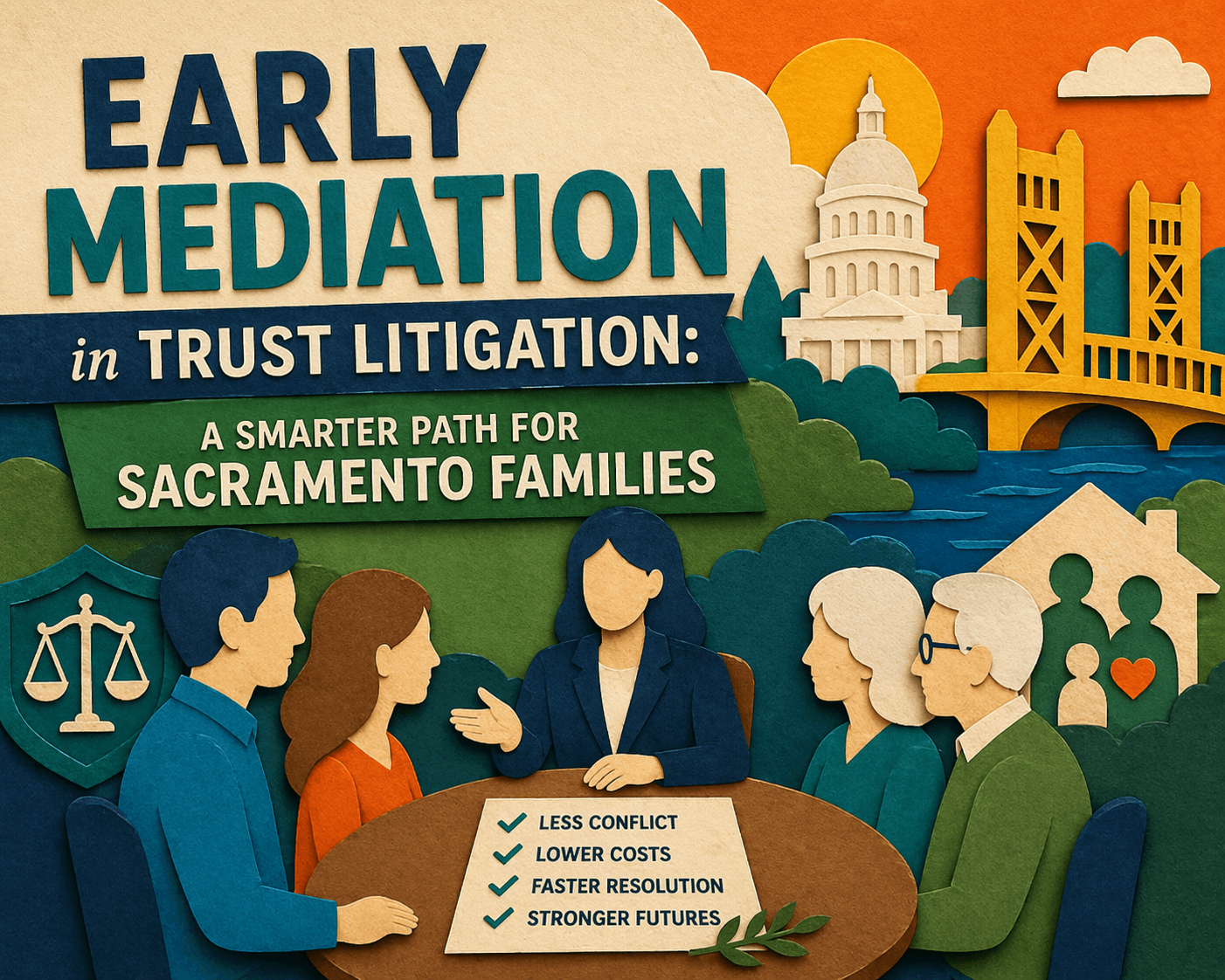
Early Mediation in Trust Litigation: A Smarter Path for Sacramento Families

Why Early Mediation Matters in Trust and Estate Disputes
I’m Michael Hackard, founder of Hackard Law. Over more than five decades of litigating trust and estate disputes, I have watched families endure years of courtroom battles only to settle on the courthouse steps for less than they could have obtained months or years earlier. That hard-won perspective — shaped by four published books on inheritance protection and more than 1,000 educational videos with over seven million views — has convinced me that early mediation deserves serious consideration in every case.
Hackard Law represents heirs, beneficiaries, and elder abuse victims across Sacramento, the San Francisco Bay Area, and Los Angeles. In each of these regions, trust and estate litigation clogs overburdened courts, driving up costs and stretching timelines far beyond what most families expect. When the facts support it, guiding a case toward early mediation can produce results that are faster, less expensive, and far easier on the family.
Early mediation does not mean giving up the fight. It means choosing the battlefield wisely. A firm that knows how to litigate aggressively also knows when to pivot toward resolution.
Hackard Law provides contingency fee representation, meaning there are no upfront costs for qualified cases.
If you are facing a trust or estate dispute and want to explore whether early mediation could work for your family, call Hackard Law at (916) 313-3030 for a consultation.
Quick Summary: Early Mediation in Trust Litigation
Early mediation allows disputing parties to resolve trust and estate conflicts before years of litigation drain the estate and the family’s patience. A skilled mediator acts as a neutral referee, helping parties move past hardened positions and reach practical outcomes.
- Mediation set early in a case — or even before filing — can save significant time and legal expense.
- Common causes of trust disputes that benefit from mediation include trustee misconduct, wasteful spending, and delayed distributions.
- An early resolution protects a larger portion of the estate for the beneficiaries of the trust.
- Families avoid the emotional toll of a protracted legal battle.
The Problem: Underfunded Courts and Endless Delays
California’s court system faces chronic underfunding. Probate divisions in Sacramento County and across the state carry heavy caseloads. Hearings that should happen in weeks often take months. Trials get continued. Discovery drags on. Meanwhile, the trust estate itself may be bleeding money.
A trustee accused of misconduct may use trust funds to pay for legal defense against the very beneficiaries the trust was created to serve. Every dollar spent on the trustee’s legal fees is a dollar that will never reach the family. When beneficiaries face delays in receiving their rightful distributions, frustration mounts, and the sense that the system is rigged becomes overwhelming.
Justice delayed truly can become justice denied. When a case sits in the court system for eighteen months or two years before meaningful progress, beneficiaries are left watching the estate shrink while they wait.
Why Early Mediation Works: The Vaccine Analogy
Michael Hackard compares early mediation to a vaccine. Inoculating a person against a disease is smarter, safer, and far easier on the body than a hospital stay treating the disease after it takes hold. In the same way, resolving a trust dispute through mediation — before it metastasizes into years of litigation — is often smarter, cheaper, and less damaging to the family.
Mediation works by bringing a neutral third party into the room. That mediator acts as a referee, helping each side see the strengths and weaknesses of their position. Parties who have dug into bitter, hardened stances often need that outside perspective to move toward resolution. Skilled estate and trust mediation in Sacramento gives families a structured process to reach agreement without surrendering control to a judge.
The emotional and financial benefits are equally genuine. The tedious stress of depositions, motions, and trial preparation is avoided by families who settle disputes through mediation. They preserve relationships that would have been destroyed by courtroom warfare.
Case Pattern: The Draining Defense
A successor trustee used trust funds to hire attorneys who fought every request for an accounting. Over two years, legal fees consumed nearly a quarter of the estate’s liquid assets. When the parties finally agreed to mediation, both sides recognized the waste. The beneficiaries recovered a meaningful share of what remained — but early mediation before that spending spree would have preserved far more for the family.
When Early Mediation Makes the Most Sense
Not every trust dispute is a candidate for mediation on day one. Mediation works best when certain conditions align.
The first condition is identifiable assets. Trust disputes often involve real estate, securities, and cash. When the estate’s assets are clear and verifiable, both sides have enough information to negotiate in good faith. Sacramento families dealing with contested wills and trusts often find that the facts are not seriously in dispute — the question is how to divide the assets fairly.
The second condition is mutual willingness. Mediation requires both sides to participate. A trustee who refuses to engage in any form of accountability will not suddenly become cooperative in mediation. However, the mere act of filing a lawsuit — or signaling a credible intent to litigate — can change the calculus.
The third condition is experienced counsel. An attorney who knows the most common probate, trust, and estate battles can evaluate what a case is worth before mediation begins. That preparation drives better outcomes.
Case Pattern: The Quick Pivot
An elderly parent’s trust was changed under suspicious circumstances just weeks before they died. The children who were disinherited prepared their case and submitted a petition. Their lawyer suggested mediation within 60 days rather than waiting 2 years for a trial. In the face of overwhelming evidence and the possibility of a costly battle, the other side consented to reinstate a significant portion of the initial distribution plan. In a fraction of the time it would have taken a legal battle, the family reached an agreement.
The Role of the Mediator as Referee
Michael Hackard identifies the mediator’s role as fundamentally that of a referee. In trust and estate disputes, family members often carry decades of resentment, rivalry, and grief. Those emotions harden positions and make direct negotiation nearly impossible.
A mediator creates space for each side to be heard without the adversarial structure of a courtroom. The mediator can deliver difficult messages — “your case has weaknesses here” — in a way that allows a party to reconsider without feeling defeated. Saving face matters in family disputes. A settlement reached in mediation feels very different from a judgment imposed by a court.
Families are also granted privacy through mediation. Probate proceedings are open to the public. Discussions during mediation are private. This confidentiality can be a huge benefit for families who are worried about preserving their legacy.
Mediation Does Not Mean Weakness
Some families hesitate to pursue mediation because they worry it signals a lack of confidence in their case. The opposite is true. Proposing mediation from a position of legal strength — backed by solid evidence and a clear theory of the case — sends a powerful message.
It tells the other side: we are prepared to litigate this to trial, but we are also rational enough to seek the most efficient path to a fair result. Experienced trust litigation attorneys know that pursuing contingency fee representation demonstrates a firm’s confidence that the case has real value. That same confidence fuels effective mediation.
Legal action is still the last resort. The courtroom is always accessible in the event that mediation is unsuccessful. Even in cases where a full settlement is not reached, the attempt itself frequently reduces the scope of the litigation, clarifies the priorities of both parties, and narrows the issues.
Key Definitions
- Mediation: A voluntary, confidential process in which a neutral third party helps disputing parties reach a mutually acceptable resolution without a trial.
- Trustee: The person or entity responsible for managing a trust’s assets and distributing them according to the trust’s terms.
- Beneficiary: A person entitled to receive assets or benefits from a trust, will, or estate.
- Successor Trustee: The individual who takes over management of a trust after the original trustee dies, resigns, or becomes incapacitated.
- Accounting: A formal report detailing all trust transactions, including income, expenses, distributions, and asset values, that a trustee may be required to provide.
- Wasteful Trustee Spending: The use of trust funds for purposes that do not benefit the trust or its beneficiaries, including paying legal fees to defend a trustee’s own misconduct.
- Probate Litigation: Court proceedings to resolve disputes over the administration of a deceased person’s estate, including will contests and trust disputes.
- Contingency Fee: A fee arrangement in which the attorney’s compensation depends on achieving a favorable outcome, eliminating upfront legal costs for the client.
What to Do Next
- Gather all trust documents, amendments, and correspondence related to the dispute.
- Document any trustee conduct that appears wasteful, self-serving, or contrary to the trust’s terms.
- Identify the estate’s major assets — real estate, bank accounts, securities, and personal property.
- Request a formal accounting from the trustee if one has not been provided.
- Consult with a Sacramento estate lawyer who litigates trust and estate cases and understands when mediation adds value.
- Ask about contingency fee options to eliminate the barrier of upfront legal costs.
- Consider whether early mediation — before or soon after filing — could produce a faster, less expensive resolution.
- Do not wait. Delays allow trust assets to diminish and evidence to disappear.
If your family is caught in a trust or estate dispute and you want to know whether early mediation could produce a better result, call Hackard Law at (916) 313-3030.
CALL THE SAGE | When Experience Matters, Families Listen
🏛️ We practice California trust & estate & elder financial abuse litigation
⚖️ We represent heirs, beneficiaries, and elder abuse victims
🎥 1,000+ educational videos | 7 million+ views | 4 published books
🎯 “After thousands of cases, I see the pattern others miss.”
CONTINGENCY REPRESENTATION – No Win, No Fee
Throughout California: Sacramento | Los Angeles | Bay Area
📞 CALL THE SAGE: (916) 313-3030
Subscribe for weekly insights on:
• Elder financial abuse warning signs and prevention
• Trust and estate litigation strategies
• Inheritance protection for California families
• Family protection strategies
When your inheritance is under attack, Call The Sage.
Hackard Law | 10640 Mather Blvd, Mather CA 95655
Attorney Advertisement | Michael Hackard, State Bar #71067
RELATED VIDEOS
Early Mediation in Trust Litigation | Efficient and Effective?
Trust & Estate Mediation | Is Timing Everything?
Sacramento Estate and Trust Litigation Settlements | What’s Next?
Sacramento Trust Litigation Attorney | Results Matter
Do I Need a Trust Litigation Attorney? | CA Trust Lawsuits
Trust & Estate Litigation Cases | Sacramento and Los Angeles
 Michael Hackard is the founder of Hackard Law, a California trust and estate litigation firm with more than five decades of experience protecting the inheritance rights of families across Sacramento, the San Francisco Bay Area, and Los Angeles. He is the author of four published books on inheritance protection and has produced more than 1,000 educational videos with over seven million views.