


 (916) 313-3030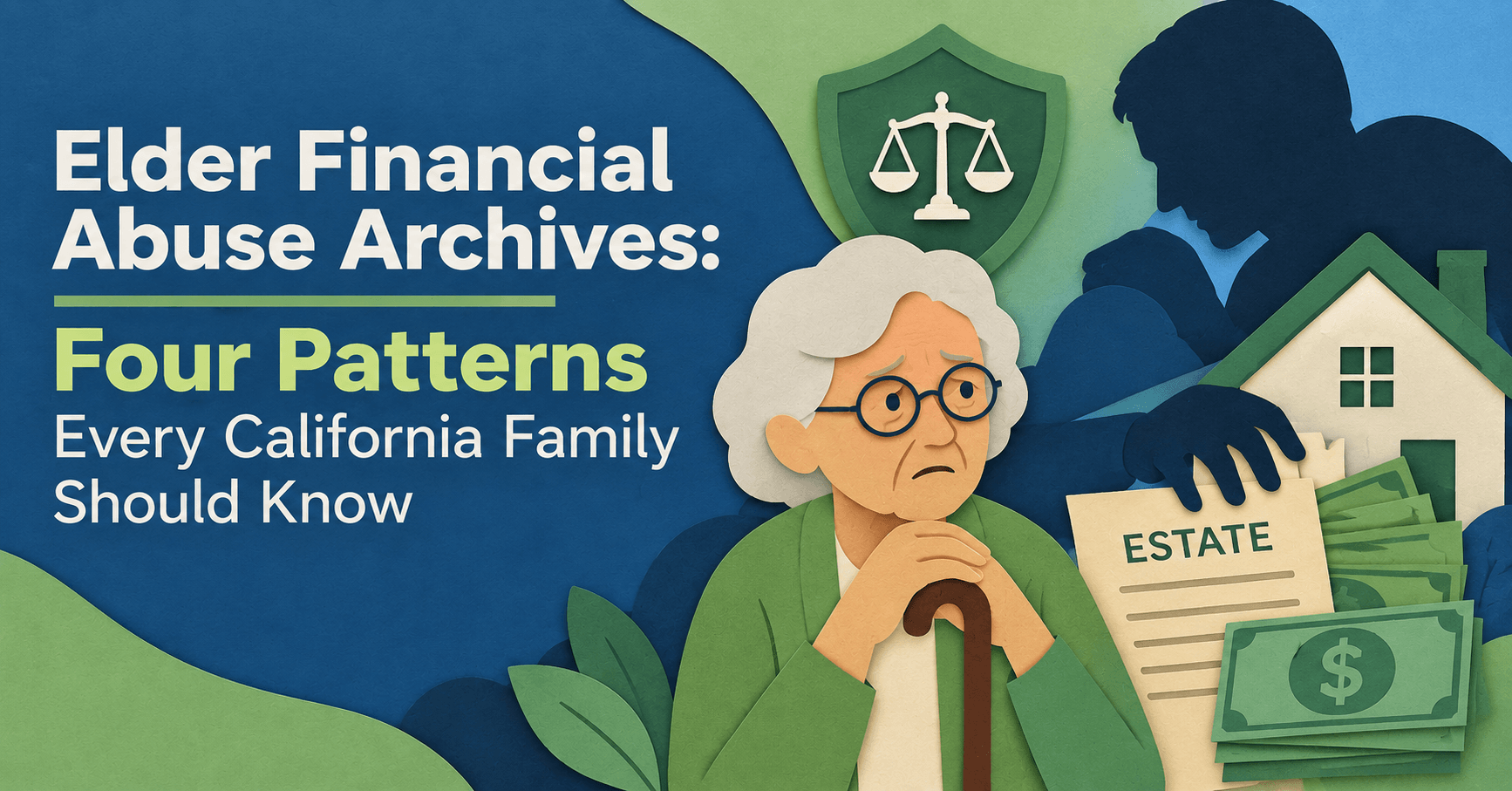
Elder Financial Abuse Archives: Four Patterns Every California Family Should Know

Four Tales From the Elder Financial Abuse Archives
I’m Michael Hackard, founder of Hackard Law. Over five decades of practice, I have fought for heirs, beneficiaries, and elder abuse victims across California – from Sacramento and the San Francisco Bay Area to Los Angeles. My firm focuses exclusively on estate, trust, and elder financial abuse litigation, and I have written four published books on inheritance protection, including The Wolf at the Door: Undue Influence and Elder Financial Abuse. I have also produced more than 1,000 educational videos that have reached over seven million viewers. That body of work grows from a single conviction: California families deserve to know what threatens them before it is too late.
In this post, I draw from what I call the Elder Financial Abuse Archives – a collection of recurring patterns that surface again and again in California litigation. Four of those patterns deserve your attention right now.
Hackard Law provides contingency fee representation for qualified elder financial abuse and estate litigation cases – no upfront costs to you. To speak with our team, call (916) 313-3030.
Quick Summary
Elder financial abuse takes many forms in California, and no family – regardless of wealth or standing – is fully immune. Understanding the recurring patterns is the first step toward protecting a loved one.
- Public officials and employees are not above committing financial misconduct against elders
- Accounting fraud can occur even when a trusted professional is involved
- Family members are among the most common perpetrators of elder financial abuse
- Even ultra-high-net-worth families face mental competency disputes and inheritance battles
- California law provides civil remedies, including double damages, for proven elder financial abuse
Pattern One: Public Officials and the Illusion of Accountability
John Adams reminded us that we are a nation of laws, not of men – a recognition that every person, regardless of title or position, is capable of error or wrongdoing. That principle applies directly to elder financial abuse. Public officials and public employees have been found, in California litigation, to have exploited their positions of trust at the expense of vulnerable elders.
Oversight matters. When the person responsible for protecting an elder’s interests holds a position of public authority, the abuse can be harder to detect and even harder to challenge. Heirs, beneficiaries, and elder abuse victims who suspect misconduct by a person in a position of institutional trust should not assume that title alone means integrity.
Early legal intervention is often the difference between recovering assets and losing them permanently. The elder financial abuse and estate transfer resources available through Hackard Law address exactly this kind of situation.
Pattern Two: Accounting Fraud and the Limits of Professional Trust
One of the most common instincts when managing an elder’s estate is to bring in a trusted accountant. It is a sound instinct. Professional accounting creates a record, introduces oversight, and adds a layer of protection. But accountants are human beings. They make mistakes – and in some cases, they do worse.
Accounting fraud in trust and estate matters can take subtle forms: misclassified distributions, manipulated valuations, concealed transactions. When a fiduciary relies on fraudulent accounting, the downstream harm to beneficiaries can be severe. A thorough forensic review of financial records is often necessary to uncover what ordinary audits miss.
Case Pattern: Accounting irregularities in a trust
Following the death of their mother, a family learned that her trust’s distributions had been routinely understated for years. A forensic accountant hired during the legal proceedings discovered a pattern of misclassified withdrawals that had taken substantial assets from the designated beneficiaries. The estate received a sizable settlement in the case.
For a broader look at the civil remedies available when financial abuse is proven, including double damages and attorney fee recovery, see California’s civil remedies for elder financial abuse.
Pattern Three: Family Cruelty and the Hardest Cases
Of all the patterns in the Elder Financial Abuse Archives, family-perpetrated abuse is the one that carries the deepest wound. It is a shock – and it should remain one. When adult children, grandchildren, or other relatives exploit a parent or grandparent for financial gain, the harm is not just financial. The fracture often runs too deep for any judgment to mend.
Yet it happens. Caregiving relationships create proximity and opportunity. Isolation from other family members is a common tactic. Changes to estate documents – wills, trusts, beneficiary designations – often follow a period of increasing control over the elder’s daily life. California courts take these patterns seriously, and so does Hackard Law.
Case Pattern: Caregiver family member and estate document changes
After his father’s health deteriorated, an adult son moved in with him. The father gradually cut off contact with his other children over the course of the following two years. Shortly before the father passed away, a new trust amendment was signed, leaving the son the entire estate. A documented pattern of dependency and isolation was uncovered during litigation, which bolstered the excluded siblings’ claim of undue influence.
If you suspect a family member is being financially exploited, the elder financial exploitation resources at Hackard Law provide a starting point for understanding your options.
Pattern Four: No One Is Too Wealthy to Be Targeted
There is a quiet assumption in some families that significant wealth provides protection. It does not. Mental competency disputes and inheritance battles exist in the highest tiers of California wealth. When the stakes involve hundreds of millions of dollars, the litigation is often equally well-funded on both sides – and the legal maneuvering can be intense.
It is more difficult for heirs, beneficiaries, and victims of elder abuse in wealthy families to prove their claims. It is like withstanding a formidable adversary. Regardless of the size of the estate, discovery, forensic analysis, and the pursuit of justice are more than legal tactics; they protect families under threat of fraud and undue influence.
For decades, I have stood with families at exactly this kind of crossroads. I have seen the financial toll grow when action is delayed. I have also seen what a steadfast commitment to truth can restore. Whether the estate is modest or enormous, the legal principles are the same – and so is the urgency.
Learn more about how California beneficiaries can protect their rights in this guide to the five things every trust beneficiary should know.
Key Definitions
- Elder financial abuse: The wrongful taking, concealment, or appropriation of an elder’s money, property, or assets by a person in a position of trust or confidence.
- Undue influence: Excessive persuasion that overcomes the free will of an elder, causing them to act in a way they would not have otherwise chosen.
- Fiduciary: A person legally obligated to act in another’s best interest, such as a trustee, executor, or agent under a power of attorney.
- Mental competency: The legal standard for determining whether a person had sufficient capacity to execute a will, trust, or other legal document.
- Accounting fraud: The deliberate manipulation or falsification of financial records to conceal misappropriation or mismanagement of assets.
- Contingency fee: A fee arrangement in which the attorney is paid only if the case results in a recovery – no upfront cost to the client.
- Double damages: A civil remedy available under California elder abuse law that allows a court to award twice the actual damages proven in qualifying cases.
- Isolation tactic: A pattern of behavior in which a potential abuser limits an elder’s contact with family, friends, or advisors to increase control and opportunity.
- Forensic accounting: A focused financial investigation used in litigation to trace assets, identify fraud, and reconstruct financial records.
- Probate litigation: Court proceedings to resolve disputes over a deceased person’s estate, including will contests, trust challenges, and fiduciary misconduct claims.
What to Do Next
- Look for changes in an elder’s estate documents – especially new amendments made during periods of health decline or isolation.
- Get copies of any trust, will, or power of attorney documents that affect your loved one’s estate as early as possible.
- Look for patterns of financial control, such as a single family member managing all accounts and limiting access to others.
- Try to avoid confronting a suspected abuser directly before speaking with an attorney – doing so can accelerate asset transfers.
- Look for a California attorney who handles elder financial abuse cases on a contingency fee basis so cost is not a barrier to action.
- Get a forensic accounting review if you suspect that trust distributions or financial records have been manipulated.
- Try to document all observations – dates, conversations, behavioral changes – in writing as soon as you notice them.
- Review the guarding against elder financial abuse guide for a deeper overview of California-specific protections.
- Call Hackard Law at (916) 313-3030 to discuss your situation with our litigation team.
- Visit our contact page to request a free consultation online.
CALL THE SAGE | When Experience Matters, Families Listen
🏛️ We practice California trust & estate & elder financial abuse litigation
⚖️ We represent heirs, beneficiaries, and elder abuse victims
🎥 1,000+ educational videos | 7 million+ views | 6 published books
🎯 “After thousands of cases, I see the pattern others miss.”
CONTINGENCY REPRESENTATION – No Win, No Fee
Throughout California: Sacramento | Los Angeles | Bay Area
📞 CALL THE SAGE: (916) 313-3030
Subscribe for weekly insights on:
- Elder financial abuse warning signs and prevention
- Trust and estate litigation strategies
- Inheritance protection for California families
- Family protection strategies
When your inheritance is under attack, Call The Sage.
Hackard Law | 10640 Mather Blvd, Mather CA 95655
Attorney Advertisement | Michael Hackard, State Bar #71067
RELATED VIDEOS
The Wolf at the Door: Ep. 3 | How Elder Financial Abuse Happens
Explains the common ways financial abusers target and exploit vulnerable elders.
The Wolf at the Door: Ep. 14 | Stories of Elder Financial Abuse
Real stories illustrate how elder financial abuse unfolds across different situations.
The Wolf at the Door: Ep. 4 | Signs of Elder Financial Abuse
Walks through the warning signs families should watch for in a loved one’s finances.
The Wolf at the Door: Ep. 25 | Statistics on Elder Financial Abuse
Presents data on how widespread elder financial abuse is across the country.
Elder Inheritance Thefts | What Can We Do?
Discusses legal options available when a family member’s inheritance has been stolen.
The Wolf at the Door: Ep. 17 | Contingency Fees in Elder Financial Abuse Lawsuits
Explains how contingency fee arrangements work for elder financial abuse cases.
 Michael Hackard is the founder of Hackard Law, a California trust and estate litigation firm with more than five decades of experience protecting the inheritance rights of families across Sacramento, the San Francisco Bay Area, and Los Angeles. He is the author of six published books and has produced more than 1,000 educational videos with over seven million views.