


 (916) 313-3030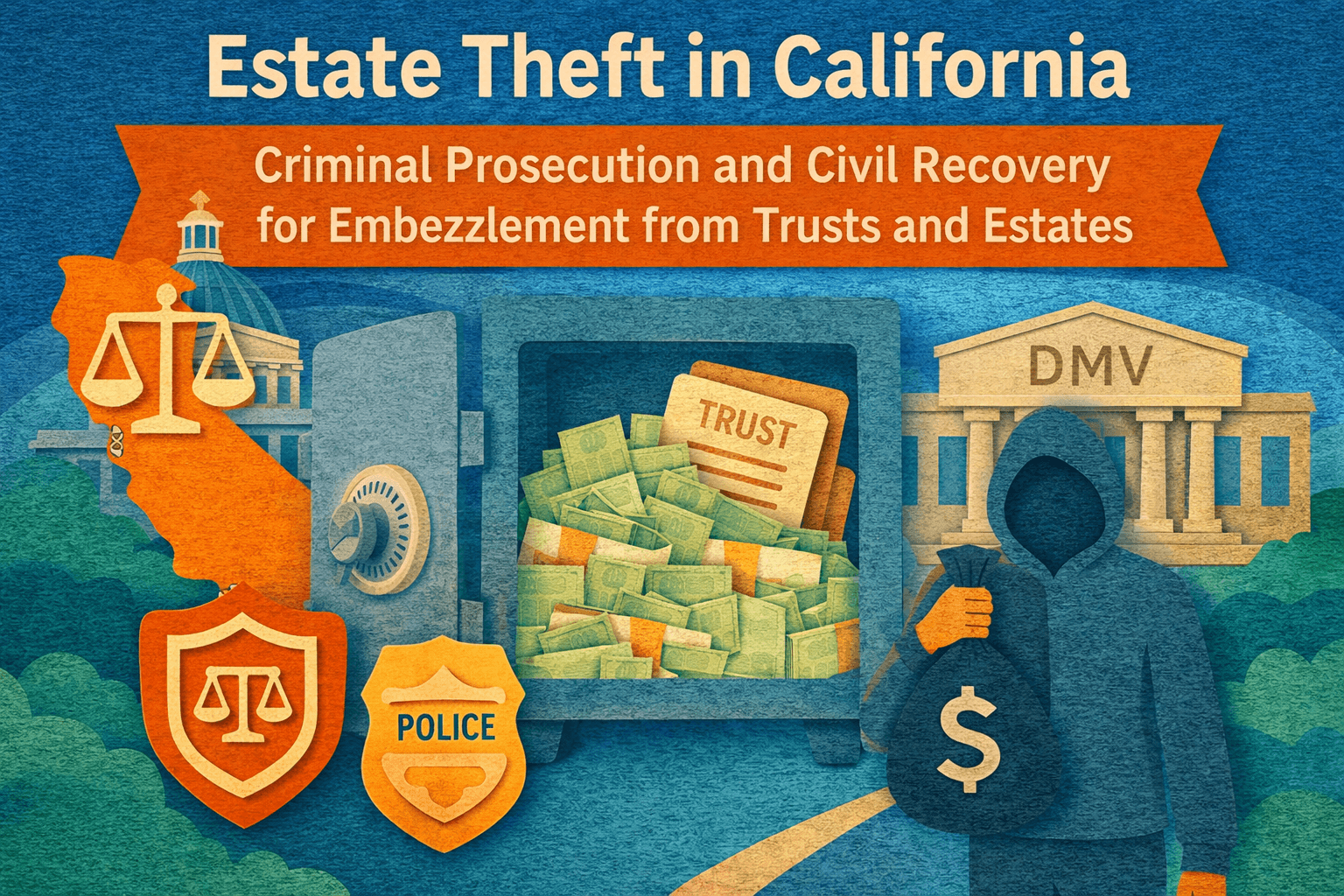
Estate Theft in California: Criminal Prosecution and Civil Recovery for Embezzlement from Trusts and Estates

Estate Theft Is Rare — But It Still Happens
I am Michael Hackard, founder of Hackard Law. Over more than five decades of practicing California trust and estate litigation, I have seen the full spectrum of disputes that arise when families lose a loved one. I have written four published books on inheritance protection and produced more than 1,000 educational videos with over seven million views — all dedicated to educating families about their rights. Most estate disputes involve honest disagreements between heirs, beneficiaries, trustees, and executors. These conflicts run hot, much like hard-fought political campaigns with allegations and counter-allegations flying back and forth. Much of what gets said in the heat of litigation is later softened or withdrawn altogether.
But some cases go beyond heated disagreements. Some cases involve outright theft from an estate. Hackard Law represents families across Sacramento, the San Francisco Bay Area, and Los Angeles who discover that someone entrusted with managing estate assets has instead stolen from them. I am disheartened to report that estate embezzlement still exists, though I am glad to say it remains rare. When theft is discovered, families are almost universally shocked: How could this happen?
Hackard Law provides contingency fee representation, meaning there are no upfront costs for qualified cases. Families facing estate theft should not let financial barriers prevent them from pursuing recovery.
If you suspect estate theft or embezzlement, call Hackard Law at (916) 313-3030 for a consultation.
Quick Summary: Estate Theft and Civil Recovery
Estate theft occurs when someone entrusted with managing or administering estate assets diverts those assets for personal gain. California law provides both criminal and civil remedies, and families must understand the distinction between the two paths.
- Paralegals, attorneys, family members, and even public officials have been prosecuted for stealing from estates.
- Criminal prosecution is the responsibility of law enforcement — victims should report theft to local authorities.
- Civil lawsuits provide a separate path for families to recover damages and stolen assets.
- Hackard Law litigates civil cases against those who commit estate theft, pursuing recovery in California courts.
- Threatening criminal prosecution to extract a settlement constitutes extortion under California law — families must avoid this mistake.
Real-World Examples of Estate Embezzlement
Estate theft takes many forms, and the perpetrators are not always who you would expect. Consider these real-world examples that illustrate how estate embezzlement unfolds.
In May 2015, a paralegal was arrested and jailed for stealing approximately $150,000 from an estate managed by her law firm employer. The theft was devastating because a part of it had been established to provide for a special needs child. He was also charged with handling sensitive legal documents and took advantage of her access to divert funds.
Also, in September 2015, a woman was accused of taking her sister’s share of their deceased father’s estate. She filed fraudulent documents with the county, claiming she was the sole heir. The charges included attempted theft by unlawful taking, tampering with public records, writing bad checks, and false swearing.
In December 2015, a former city councilman was jailed for two to five years for stealing $50,000 from the trust fund of an elderly widow suffering from dementia. He used the stolen funds to make political donations in hopes of becoming a political powerbroker. And in April 2016, a suspended attorney was arrested on charges of stealing more than $250,000 from an estate.
So, these cases share a common thread: a person in a position of trust — a legal professional, a family member, a public figure — exploited that position for personal gain. Families discovered the theft only after significant damage had already occurred. Understanding the most common probate and estate battles helps families recognize warning signs before losses mount.
Case Pattern: The Trusted Insider — A family discovered that a longtime legal assistant had quietly siphoned funds from a trust account over several years. The assistant wrongfully used her daily access to account records and forged routine-looking transactions. The family only learned of the theft when a new trustee conducted a thorough accounting. Civil litigation recovered a substantial portion of the diverted funds.
Criminal Prosecution vs. Civil Recovery: Understanding the Difference
When estate theft is discovered, families must understand that two separate legal tracks exist — and they serve different purposes.
Criminal prosecution is the responsibility of law enforcement. If you believe an estate in which you have an interest has been the victim of embezzlement or theft, you should contact local law enforcement with your concerns. Police and district attorneys decide whether to file criminal charges, and the state prosecutes the case. A criminal conviction can result in imprisonment, fines, and restitution orders.
Civil recovery is a separate process. A civil lawsuit allows heirs, beneficiaries, and elder abuse victims to pursue financial recovery for damages caused by the theft. Civil cases operate under a different burden of proof — preponderance of the evidence rather than beyond a reasonable doubt — and can result in monetary judgments, asset recovery, and, in some cases, enhanced damages.
Hackard Law is a civil law firm. Michael Hackard and his team litigate against those who commit estate theft in the civil courts of California. Families who want to understand the stages of trust and estate litigation can learn how civil cases proceed from investigation through trial.
One critical warning: it is illegal to threaten criminal prosecution against a person unless that person settles a civil claim. Such threats can constitute extortion under California law. Families must keep criminal reporting and civil recovery on separate, parallel tracks. Report suspected crimes to law enforcement. Retain a civil attorney to pursue financial recovery.
Case Pattern: The Parallel Tracks — A family reported suspected estate embezzlement to local law enforcement while simultaneously retaining civil counsel. The criminal investigation led to charges, and the civil case proceeded independently, resulting in a judgment that allowed the family to recover a meaningful portion of the stolen assets. The family’s decision to pursue both paths — without conflating them — proved essential to protecting their rights.
Who Commits Estate Theft?
Estate embezzlement is not limited to any single category of person. The examples above show that perpetrators include legal professionals, family members, public officials, and even attorneys themselves.
Paralegals and law firm employees who handle estate accounts on a daily basis sometimes exploit their access. They know the systems, they control the paperwork, and they can disguise transactions within routine administrative activity. Families and supervising attorneys may not discover the theft for months or years.
Family members with access to estate documents may forge signatures, file fraudulent court documents, or simply transfer assets to themselves. The emotional complexity of family relationships can delay discovery — siblings and children may be reluctant to suspect a relative of theft.
Attorneys and fiduciaries who abuse their positions face severe consequences, including disbarment and criminal prosecution. But the damage to the estate and its beneficiaries is often done long before accountability arrives. Families across California can learn what beneficiaries must know to protect their inheritance rights from the outset.
Public officials and community figures occasionally exploit relationships with elderly or vulnerable individuals. The trust placed in them by virtue of their public standing provides cover for their misconduct.
Protecting Your Rights Through Civil Litigation
Civil litigation for estate theft recovery follows a structured process. Hackard Law investigates the circumstances of the theft, identifies the responsible parties, traces the diverted assets, and files civil actions in the appropriate California court.
Recovery in civil court may include the return of stolen assets, compensatory damages, and, in cases involving elder financial abuse, enhanced penalties including double damages and attorney fee recovery under California’s Elder Abuse Act. The civil process empowers families to hold those responsible financially accountable, regardless of whether criminal charges are filed.
Families should know that contingency fee representation bridges the gap between discovering theft and obtaining legal help. Not every family can afford hourly legal fees in the midst of an estate crisis. Contingency arrangements allow families to pursue recovery without bearing the upfront costs of litigation.
Timeliness matters. California statutes of limitations apply to civil claims arising from estate theft. Delayed action can result in lost opportunities for recovery. Families who suspect theft should consult with a civil attorney promptly.
Key Definitions
- Estate Embezzlement: The theft or misappropriation of assets from a trust, estate, or probate proceeding by a person entrusted with managing those assets.
- Criminal Prosecution: A legal proceeding initiated by law enforcement and the state to hold a person criminally accountable for theft or fraud. Conviction can result in imprisonment and fines.
- Civil Recovery: A lawsuit filed by heirs, beneficiaries, or other aggrieved parties to recover financial damages caused by estate theft. Operates under a lower burden of proof than criminal cases.
- Fiduciary Duty: The legal obligation of a trustee, executor, or administrator to act in the best interests of the estate and its beneficiaries. Breach of this duty can give rise to both civil and criminal liability.
- Elder Financial Abuse: The illegal or improper use of an elder’s funds, property, or assets. California’s Elder Abuse Act provides civil remedies, including double damages and attorney fee recovery.
- Extortion: In the estate context, the illegal act of threatening criminal prosecution against a person to coerce a civil settlement. Victims must avoid this conduct.
- Statute of Limitations: The deadline by which a civil lawsuit must be filed. Missing this deadline can permanently bar recovery.
- Contingency Fee Representation: A fee arrangement in which the attorney’s compensation is contingent on recovery, eliminating upfront costs for the client. Learn more in the guide to contingency fee representation.
- Preponderance of the Evidence: The burden of proof in civil cases requires that the claim is more likely true than not. This is a lower standard than the criminal standard of beyond a reasonable doubt.
What to Do Next If You Suspect Estate Theft
- Report suspected theft or embezzlement to local law enforcement immediately.
- Do not threaten criminal prosecution against the suspected perpetrator as a negotiation tactic — this can constitute extortion.
- Gather and preserve any documents, financial statements, or communications that may support your concerns.
- Request a formal accounting from the trustee or executor to identify discrepancies.
- Consult with a civil trust and estate litigation attorney to evaluate your options for financial recovery.
- Understand that criminal prosecution and civil recovery are separate legal processes that can proceed simultaneously.
- Act promptly — California statutes of limitations apply to civil claims, and delay can forfeit your rights.
- Contact Hackard Law at (916) 313-3030 to discuss your situation and learn whether your case qualifies for contingency fee representation.
If you believe an estate in which you have an interest has been the victim of theft, call Hackard Law at (916) 313-3030 to discuss your legal options.
CALL THE SAGE | When Experience Matters, Families Listen
THE EXPERTISE:
📚 50 years California trust, estate & elder financial abuse litigation
⚖️ We represent heirs, beneficiaries, and elder abuse victims
🎥 1,000+ educational videos | 7 million+ views | 4 published books
🎯 “After thousands of cases, I see the pattern others miss.”
CONTINGENCY REPRESENTATION — No Win, No Fee
Throughout California: Sacramento | Los Angeles | Bay Area
📞 CALL THE SAGE: (916) 313-3030
Subscribe for weekly insights on:
• Elder financial abuse warning signs and prevention
• Trust and estate litigation strategies
• Inheritance protection for California families
• Family protection strategies
When your inheritance is under attack, Call The Sage.
Hackard Law | 10640 Mather Blvd, Mather CA 95655
Attorney Advertisement | Michael Hackard, State Bar #71067
RELATED VIDEOS
Trust Accountings | Discovery of Fraud and Embezzlement
Direct topical match — the blog’s core subject is estate embezzlement and theft from trusts. This video on discovering fraud through trust accountings is the single most relevant candidate.
Watch Out for Estate Sale Fraud | WKYC Interview
Directly addresses estate fraud, aligning with the blog’s focus on theft, embezzlement, and protecting heirs from dishonest actors.
Placer County Senior Exploitation | Homes and Estates & Trusts
The blog discusses elder financial abuse and the California Elder Abuse Act as a civil remedy. This video on senior exploitation is a strong thematic match.
Brain Tumors, Strokes & Estate Cheats Lying in Wait | Estate Litigation
The phrase ‘estate cheats’ directly mirrors the blog’s theme of insider theft and exploitation of vulnerable beneficiaries, including the councilman who stole from an elderly widow with dementia.
East Bay Estate Litigation Attorneys | Constructive Trusts
Constructive trusts are a key civil recovery remedy for stolen estate assets — directly relevant to the blog’s section on civil litigation and financial recovery for estate theft victims.
California Disputed Trusts & Estates | Safecrackers
The ‘safecrackers’ metaphor maps well to the blog’s insider-theft narrative — people exploiting privileged access to estate accounts — and supports the broader California trust dispute context.
 Michael Hackard is the founder of Hackard Law, a California trust and estate litigation firm with more than five decades of experience protecting the inheritance rights of families across Sacramento, the San Francisco Bay Area, and Los Angeles. He is the author of four published books on inheritance protection and has produced more than 1,000 educational videos with over seven million views.