


 (916) 313-3030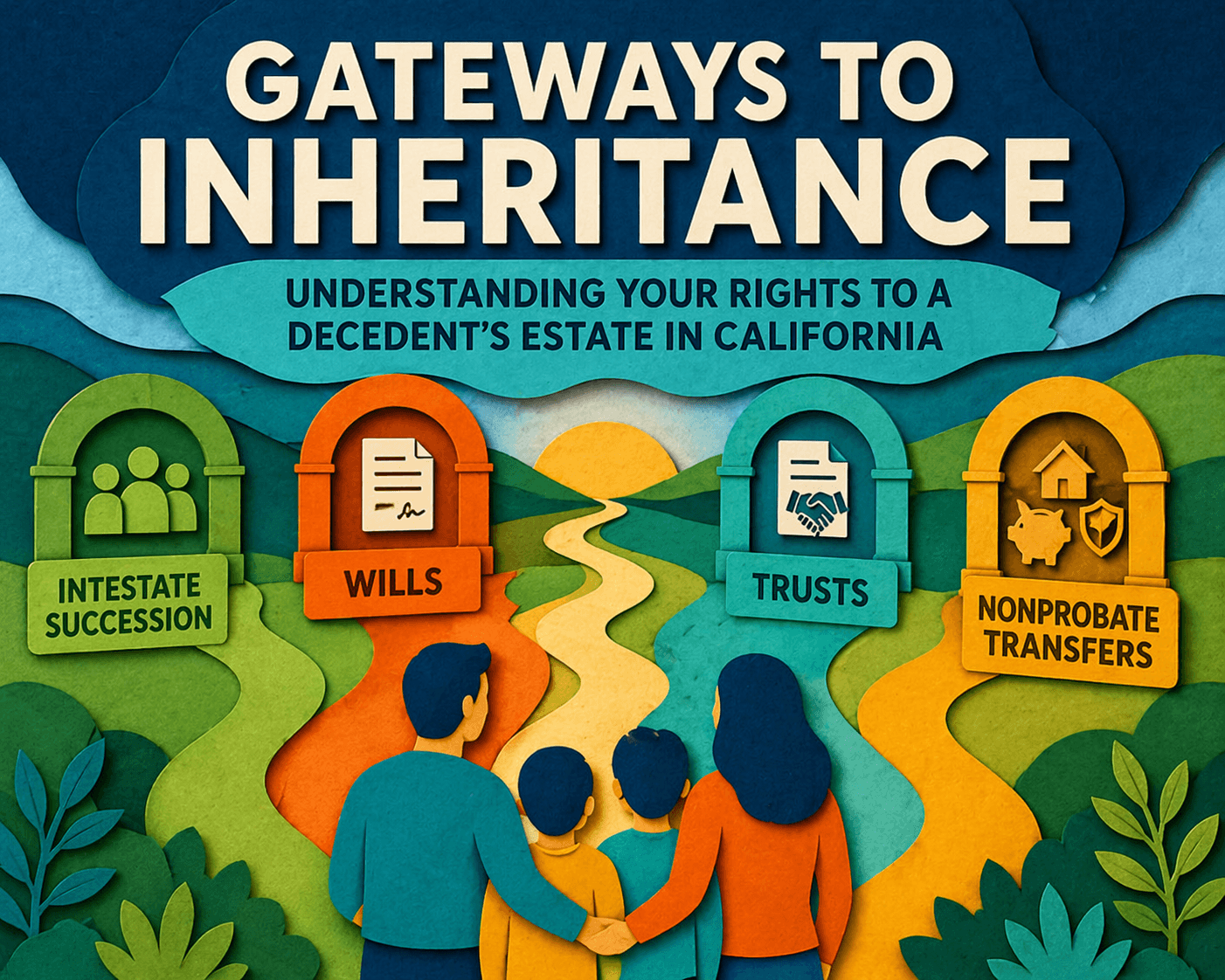
Gateways to Inheritance: Understanding Your Rights to a Decedent’s Estate in California

Who Gets What – and Why It Matters
I’m Michael Hackard, founder of Hackard Law. Over five decades of practice, I have fought for heirs, beneficiaries, and elder abuse victims across California – from Sacramento and the San Francisco Bay Area to Los Angeles. I have published four books on inheritance protection and produced more than 1,000 educational videos, which have reached over 7 million viewers. Each year, Hackard Law responds to more than 1,000 inquiries from people trying to understand their rights to a loved one’s estate. Most of those questions share a common thread: what am I entitled to, and how do I protect it?
Knowledge of estate and trust law is not intuitive. The California Probate Code alone runs 1,252 pages. My primary trust reference spans eight volumes and 2,464 pages. Spending an hour – or even ten – searching the internet rarely gives families the clarity they need when real money and real relationships are at stake. That is why I want to share a clear, grounded explanation of the gateways to inheritance in California.
Hackard Law provides contingency fee representation for qualified cases – no upfront costs to you. To speak with our team, call (916) 313-3030.
Quick Summary
California law provides several distinct legal pathways through which a person may inherit a decedent’s assets. Each pathway carries different rights, timelines, and protections.
- California’s intestacy laws decide who inherits based on family ties when a person passes away without an estate plan.
- Although they are the most popular formal means of inheritance, wills and trusts do not always cover every asset.
- Through nonprobate transfers like joint tenancy, payable-on-death accounts, and life insurance beneficiary designations, many assets pass completely outside of probate.
- Different gateways grant different rights, and conflicts or manipulation of those pathways give rise to disputes.
When There Is No Estate Plan: Intestate Succession
When a person dies without a will, trust, or any other estate planning document, California law steps in through a process called intestate succession. The state’s statutory framework determines who inherits based on the decedent’s surviving family relationships.
The rules follow a clear hierarchy. Children inherit everything if a parent dies without a surviving spouse. A spouse inherits everything if the decedent leaves no children, parents, siblings, or nieces and nephews. Beyond those core scenarios, California law sets out a range of allocation formulas depending on which relatives survive. If you are unsure where you fall, the statute is the starting point – not assumptions or family lore.
Intestate succession disputes often arise when the family tree is complicated – blended families, estranged relatives, or children from multiple relationships. Those disputes can become contentious quickly, and understanding the legal framework before a conflict escalates is always the better path. Families across Sacramento County and throughout California regularly face these questions.
Wills and Trusts: The Most Common Inheritance Gateways
A will is a legally binding statement of a person’s wishes for how their assets will be divided after their death. The court-supervised probate process must be finished before assets are given to beneficiaries. In contrast, a trust is a fiduciary arrangement whereby the trustor, who established the trust, transfers assets to a trustee, who retains and oversees them for the benefit of designated beneficiaries.
Because they enable assets to pass to beneficiaries without the delay and public exposure of probate, trusts are widely used in California. But neither wills nor trusts are immune to challenge. A will may be contested on grounds of lack of capacity or undue influence. A trust may be challenged for the same reasons, or because a trustee has failed to carry out their duties properly. When a trustee delays distributions without cause, beneficiaries have legal options – and understanding those options early matters enormously.
Case Pattern: After a parent passed away, a family member acting as the only trustee repeatedly delayed payments to siblings, arguing that the estate was still being managed years later. Following legal action, distributions were mandated, and the trustee was forced to account for all trust assets. A prompt legal response could have lessened the financial and psychological toll that the delay had taken on beneficiaries.
For a more in-depth analysis of how these disputes progress, the eight stages of trust and estate litigation offer a helpful road map.
Nonprobate Transfers: Assets That Pass Outside the Will
Wills and trusts often do not capture every asset a person owns. A substantial portion of many estates passes through what California law calls nonprobate transfers – mechanisms that move property directly to a named beneficiary at death, bypassing the probate court entirely.
Common nonprobate transfer vehicles include real property held in joint tenancy, bank and brokerage accounts held in joint tenancy or with payable-on-death (POD) or transfer-on-death (TOD) designations, life insurance policies that name a specific beneficiary, and retirement accounts. These designations control the outcome regardless of what a will says. A beneficiary named on a life insurance policy twenty years ago will receive those funds even if a later will names someone else.
This disconnect between a formal estate plan and beneficiary designations is one of the most common sources of inheritance disputes. Families in Oakland, Los Angeles, Santa Clara, and across California discover too late that a loved one’s assets were already spoken for – and not always in the way the family expected. Challenging a life insurance claim or a beneficiary designation requires prompt action and a clear legal strategy.
Case Pattern: An adult child discovered after a parent’s death that the parent’s largest brokerage account had a TOD designation naming a caregiver who had moved into the home during the parent’s final illness. The designation had been changed just months before death. Litigation focused on whether the parent had the capacity and freedom of will to make that change – or whether it reflected manipulation.
Why Different Gateways Give Different Rights
One of the most important things I tell callers is this: the gateway through which you stand to inherit determines the rights you have and the legal tools available to you. An heir under intestacy has different standing than a named trust beneficiary. A joint tenant has rights that a residuary legatee under a will does not. A beneficiary on a retirement account may receive funds that are entirely shielded from creditors – or from other heirs.
This is why a surface-level reading of California estate law rarely gives families the full picture. The top 10 most common probate, trust, and estate battles reflect precisely this complexity – disputes that arise not because the law is unclear, but because families do not know which gateway applies to them or what it permits.
Hackard Law litigates these cases across California. Understanding the contingency fee structure that makes this representation accessible is a good first step – the contingency fee guide explains how qualified cases are handled without upfront costs.
The Human Stakes Behind Every Inheritance Question
I have supported families during some of their most trying times for decades. The grief, uncertainty, and occasionally the betrayal that surrounds them are just as real as the legal issues. For families who believed that a loved one’s wishes would be respected, discovery, legal analysis, and the pursuit of justice are more than just official procedures.
When those wishes are frustrated – whether by a flawed estate plan, a disputed beneficiary designation, or outright manipulation – the financial toll grows. And the fracture within families often runs too deep for any judgment alone to mend. A steadfast commitment to the truth, pursued through the right legal channels, restores what dishonesty or negligence tried to take.
I have seen this pattern repeat across California. The families who act early, who ask the right questions, and who find experienced legal counsel are the ones most likely to protect what their loved ones intended.
Key Definitions
- Intestacy: The condition of dying without a valid will or trust, causing California’s statutory inheritance rules to govern asset distribution.
- Will: A legal document declaring a person’s wishes for property distribution after death, subject to court-supervised probate.
- Trust: A fiduciary arrangement in which a trustee holds and manages assets for the benefit of named beneficiaries.
- Trustee: The person or institution responsible for managing and distributing trust assets according to the trust’s terms.
- Beneficiary: A person named to receive assets through a will, trust, life insurance policy, retirement account, or other transfer vehicle.
- Nonprobate transfer: A transfer of property at death that passes directly to a beneficiary outside the probate process.
- Payable-on-death (POD): A bank account designation that transfers funds directly to a named beneficiary upon the account holder’s death.
- Transfer-on-death (TOD): A designation used for brokerage accounts and real property that functions similarly to a POD designation.
- Joint tenancy: A form of co-ownership in which the surviving owner automatically inherits the deceased owner’s share.
- Intestate succession: The specific order and formula California law uses to distribute a decedent’s estate when no valid estate plan exists.
What to Do Next
- Look for all estate planning documents – wills, trusts, amendments, and codicils – as soon as possible after a loved one’s death.
- Get copies of all beneficiary designations on life insurance policies, retirement accounts, and financial accounts.
- Look for any joint tenancy deeds or transfer-on-death property designations recorded in the county where real estate is located.
- Try to avoid making assumptions about what you are entitled to based on family conversations – the legal documents control.
- Look for any recent changes to documents or designations, particularly those made during a period of illness or dependency.
- Try to avoid delay – many California inheritance claims have strict filing deadlines.
- Reach out to an attorney who handles estate and trust litigation, not just estate planning, if you suspect a dispute is forming.
- Review the service areas page to confirm Hackard Law serves your region.
- Call Hackard Law at (916) 313-3030 to discuss your situation with our team.
- Visit our contact page to request an online consultation.
CALL THE SAGE | When Experience Matters, Families Listen
🏛️ We practice California trust & estate & elder financial abuse litigation
⚖️ We represent heirs, beneficiaries, and elder abuse victims
🎥 1,000+ educational videos | 7 million+ views | 4 published books
🎯 “After thousands of cases, I see the pattern others miss.”
CONTINGENCY REPRESENTATION – No Win, No Fee
Throughout California: Sacramento | Los Angeles | Bay Area
📞 CALL THE SAGE: (916) 313-3030
Subscribe for weekly insights on:
- Elder financial abuse warning signs and prevention
- Trust and estate litigation strategies
- Inheritance protection for California families
- Family protection strategies
When your inheritance is under attack, Call The Sage.
Hackard Law | 10640 Mather Blvd, Mather CA 95655
Attorney Advertisement | Michael Hackard, State Bar #71067
RELATED VIDEOS
What If There’s No Will? | Get Inheritance Rights in Writing
Explains what happens to your inheritance when no will exists.
Top 10 Types of Estate Battles | CA Probate & Trust Litigation
Walks through the most common disputes that arise in California estates.
California’s High-Stakes Estate and Trust Litigators | Beneficiary Rights
Covers how California beneficiaries can protect their inheritance rights in court.
Trust & Estate Meltdowns | Stepchildren and Stepmothers
Examines inheritance conflicts that erupt in blended family situations.
LA Estate, Trust & Probate Litigation | The Basics
Introduces the fundamentals of probate and trust litigation in California.
Million-Dollar Questions | Abused Trust and Estate Beneficiaries
Addresses the legal options available when beneficiaries are taken advantage of.
 Michael Hackard is the founder of Hackard Law, a California trust and estate litigation firm with more than five decades of experience protecting the inheritance rights of families across Sacramento, the San Francisco Bay Area, and Los Angeles. He is the author of four published books on inheritance protection and has produced more than 1,000 educational videos with over seven million views.