


 (916) 313-3030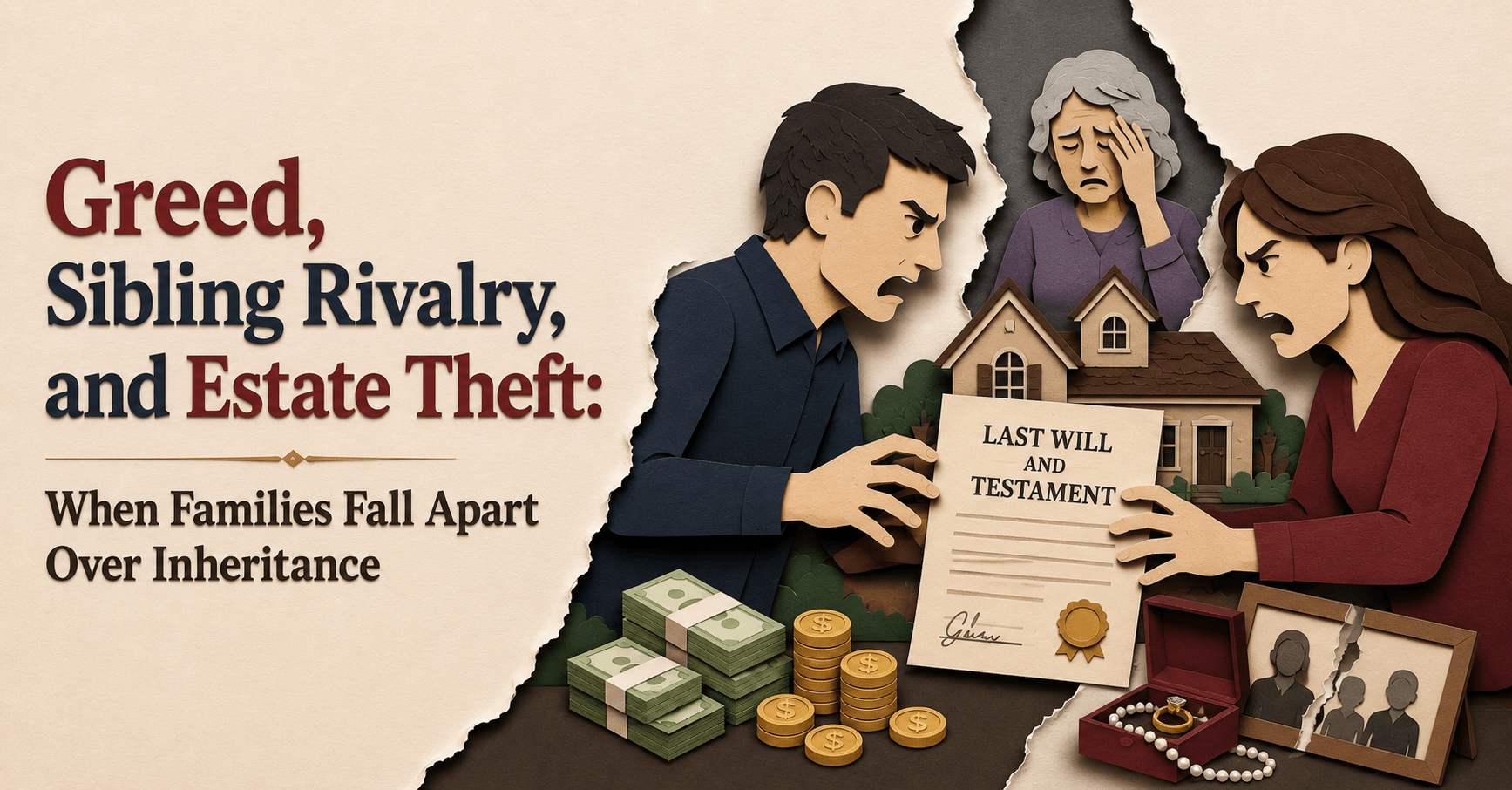
Greed, Sibling Rivalry, and Estate Theft: When Families Fall Apart Over Inheritance

Story I Have Heard Too Many Times
I am Michael Hackard, founder of Hackard Law. Over five decades of practice, I have fought for heirs, beneficiaries, and elder abuse victims whose inheritances were taken by someone they trusted – often a sibling, sometimes a caregiver. I have published four books on inheritance protection and produced more than 1,000 educational videos with over seven million views. The pattern I describe in this post is one I know deeply, and it plays out in Sacramento, across the San Francisco Bay Area, and throughout Los Angeles with striking consistency.
The call comes in – sometimes an email – from a son or daughter who suspects that a sibling has taken their parent’s estate. The parent is often isolated, vulnerable, and either still alive or recently deceased. The outlines of the dispute are familiar before the caller finishes their first sentence: parental isolation, secret property transfers, a changed estate plan, and a sibling who refuses to let go of what they took.
Hackard Law provides contingency fee representation – no upfront costs for qualified cases. If you believe your family’s inheritance has been stolen, call us at (916) 313-3030.
Quick Summary
Sibling estate theft is one of the most common and destructive forms of inheritance dispute in California. Greed, isolation, and manipulation combine to strip heirs and beneficiaries of what rightfully belongs to them.
- A vulnerable parent is isolated from most of their children by one favored child.
- Estate plans are changed – often secretly – to benefit the isolating sibling.
- Property, life insurance policies, and bank accounts are redirected without the parents’ true understanding.
- Caregivers sometimes engineer these transfers for their own benefit.
- Legal intervention can expose the scheme and pursue recovery for affected heirs.
The Anatomy of a Sibling Inheritance Dispute
The stories share a common structure. A daughter – one of three siblings – moves her mother away from familiar surroundings and cuts off contact with the other children. The mother’s long-standing estate plan, which provided equally for all her children, is quietly revised. The revising child arranges meetings with the drafting attorney. Properties valued in the millions end up in one person’s hands.
Sometimes it is a life insurance policy, changed to name only one beneficiary. Sometimes it is a house whose title has been transferred – without the parent’s real understanding – to a child or that child’s spouse. In other situations, a paid caregiver engineers the changes for personal gain. The vehicle varies. The destination is the same: one person takes what was meant for everyone.
For a broader look at how these disputes unfold across California, the top 10 most common probate, trust, and estate battles captures the full range of what families face.
Case Pattern: Caregiver-Assisted Transfer
An elderly father in his eighties, a widower, engaged the services of a live-in caregiver after falling victim to an accident. A few months down the line, his children realized that he was no longer responding to their calls. Upon the father’s death, it emerged that his house had been put under the name of the caregiver via a deed done two weeks into her residence there.
What Greed Actually Looks Like
INSEAD, one of the world’s leading business schools, has described seven warning signs of what it calls the Greed Syndrome. The profile maps almost perfectly onto what Hackard Law encounters in contested inheritance cases.
Greedy people are overly self-centered – always focused on their own needs, rarely on anyone else’s. They view the world as a zero-sum game: the more others receive, the less they have, so they fight to take everything. They lack empathy and have little difficulty causing pain to family members who stand in their way. They are skilled manipulators – charming when it serves them, ruthless when it does not. And they are not good at respecting boundaries. They will compromise moral values and exploit legal loopholes to hold onto what they have taken.
The biblical lesson of Cain and Abel is worth remembering here. The question – am I my brother’s keeper? – has an answer. Yes. The fracture that greed opens between siblings rarely heals, and no court judgment can fully restore what was broken.
Case Pattern: The Revised Trust
Three adult children expected equal shares under their mother’s revocable trust, a plan she had maintained for over twenty years. After one sibling moved in to help with caregiving, the trust was amended twice in fourteen months. By the time the mother passed, the caregiving sibling held nearly the entire estate. Litigation centered on capacity and undue influence, and the case resolved favorably for the other heirs through mediation.
How These Cases Play Out in Court and at the Settlement Table
Many of these disputes reach a mandatory settlement conference – what lawyers call an MSC – before trial. Others go to private mediation through services like JAMS, ADR Services, or Signature Resolution. In either setting, the parties sit in separate rooms while a mediator carries offers and arguments between them.
What I observe at those tables is that the sibling who took the estate rarely comes in ready to give it back. They have often spent months or years convincing themselves that what they did was justified – that they were the one who sacrificed, the one who cared, the one who deserved it. The litigation process, including discovery, forensic accounting, and witness testimony, is what changes the calculus. When the evidence of manipulation is laid out clearly, settlement becomes more realistic.
For heirs and beneficiaries in the Bay Area navigating these disputes, Oakland estate litigation and Alameda County mediation resources are available through Hackard Law. Families in Santa Clara County can also find dedicated support through Santa Clara estate litigation.
Discovery, forensic analysis, and the pursuit of justice – these are not just legal strategies, but safeguards for families threatened by undue influence and fraud. A steadfast commitment to truth restores what dishonesty tried to steal.
Protecting Beneficiaries Before and After the Theft
For decades, I have stood with families who came to me after realizing that someone had already taken what their parent intended for them. Early intervention – before estate documents are changed, before property is transferred – is always better. But even when the taking has already happened, the law provides meaningful remedies.
California’s elder financial abuse statutes allow for double damages and attorney fee recovery in qualifying cases. Undue influence claims can void trust amendments and deed transfers. Fraud claims can reach assets that have already changed hands. The financial toll grows when families wait, and the fracture often runs too deep for any judgment to mend the relationship – but a judgment can return what was stolen.
Knowing your rights as a beneficiary is the first step. Five things California trust beneficiaries must know is a strong starting point. For guidance on elder financial abuse specifically, guarding against elder financial abuse in California trust litigation covers the key legal protections available.
Key Definitions
- Undue influence: Pressure applied to a vulnerable person that overrides their free will, causing them to make estate planning decisions they would not otherwise make.
- Isolation: The deliberate cutting off of a parent from other family members, often used to create dependence and control over estate decisions.
- Revocable trust amendment: A change to a living trust that can be challenged if made under undue influence or when the grantor lacked legal capacity.
- Deed transfer: The legal mechanism by which real property ownership changes hands; transfers made under manipulation can be voided through litigation.
- Elder financial abuse: The wrongful taking, concealment, or appropriation of an elder’s financial resources, which carries enhanced civil penalties under California law.
- Mandatory settlement conference (MSC): A court-ordered meeting designed to encourage resolution before trial, often the first formal opportunity for parties to negotiate.
- Alternative dispute resolution (ADR): Processes such as mediation and arbitration used to resolve disputes outside of a courtroom trial.
- Capacity: The legal standard for whether a person had sufficient mental ability to understand and execute an estate planning document at the time it was signed.
- Contingency fee: A fee arrangement in which the attorney is paid only if the case results in a recovery, with no upfront cost to the client.
What to Do Next
- Look for signs of isolation – if a parent has stopped responding to calls or visits, that pattern matters legally.
- Get copies of the most recent trust documents, deeds, and beneficiary designations as early as possible.
- Write down a timeline of events: when contact changed, when documents were signed, what you observed about your parent’s condition.
- Try to avoid confronting the suspected sibling directly before speaking with an attorney, as early confrontations can complicate the case.
- Look for a lawyer who handles trust, estate, and elder financial abuse litigation on a contingency basis – choosing the right probate lawyer explains what to look for.
- Understand that mediation is often part of the process – having an attorney who is experienced at the settlement table matters as much as courtroom skill.
- Call Hackard Law at (916) 313-3030 to discuss your situation with an attorney who has litigated these cases across California for five decades.
- Visit our contact page to reach us online and tell us about your case.
CALL THE SAGE | When Experience Matters, Families Listen
🏛️ We practice California trust & estate & elder financial abuse litigation
⚖️ We represent heirs, beneficiaries, and elder abuse victims
🎥 1,000+ educational videos | 7 million+ views | 4 published books
🎯 “After thousands of cases, I see the pattern others miss.”
CONTINGENCY REPRESENTATION – No Win, No Fee
Throughout California: Sacramento | Los Angeles | Bay Area
📞 CALL THE SAGE: (916) 313-3030
Subscribe for weekly insights on:
• Elder financial abuse warning signs and prevention
• Trust and estate litigation strategies
• Inheritance protection for California families
• Family protection strategies
When your inheritance is under attack, Call The Sage.
Hackard Law | 10640 Mather Blvd, Mather CA 95655
Attorney Advertisement | Michael Hackard, State Bar #71067
RELATED VIDEOS
Sibling Estate & Trust Duels | Drama and Trauma
Explores the emotional and legal battles that erupt between siblings over inheritances.
Cut Out of the Inheritance? | Hackard Law Estate Litigation FAQ
Answers common questions from heirs who believe they were wrongfully cut out of an estate.
Untold Stories of Family Estate Disputes | CA Probate Litigation
Shares real-world family estate conflict stories from California probate litigation experience.
Securing Your Inheritance: High-Stakes Estate and Trust Litigators | Hackard Law
Explains how experienced litigators fight to recover inheritances taken through manipulation or theft.
Estate Disputes and Fiduciary Breaches Protecting Your Legacy
Covers what happens when trusted parties breach their duties and put your legacy at risk.
Love, Loss & Litigation: How Grief Fuels Estate Disputes | Michael Hackard
Michael Hackard discusses how grief and family dynamics drive inheritance conflicts into courtrooms.
 Michael Hackard is the founder of Hackard Law, a California trust and estate litigation firm with more than five decades of experience protecting the inheritance rights of families across Sacramento, the San Francisco Bay Area, and Los Angeles. He is the author of six published books and has produced more than 1,000 educational videos with over seven million views.