


 (916) 313-3030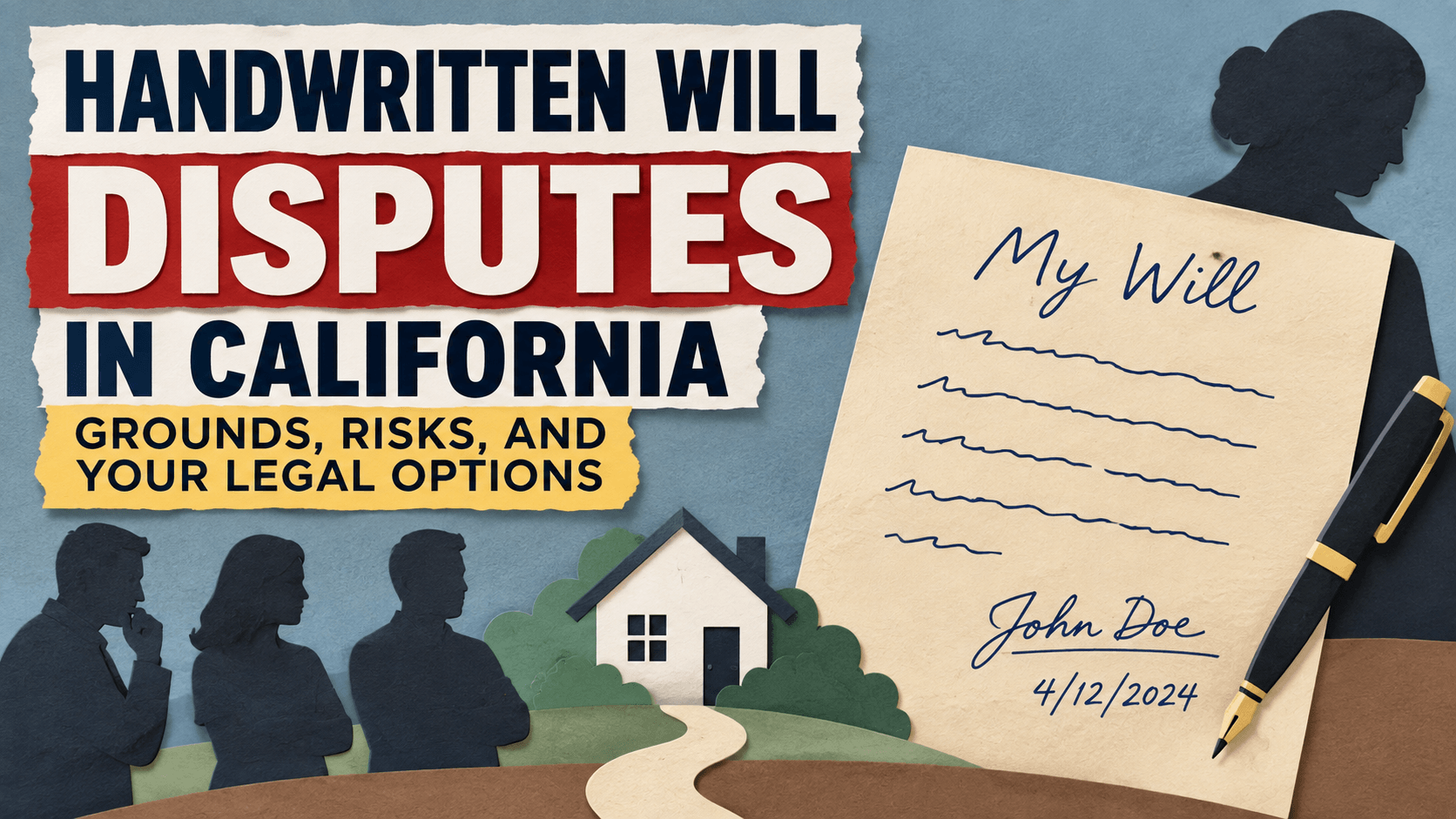
Handwritten Holographic Will Disputes in California: Grounds, Risks, and Your Legal Options
Handwritten Holographic Will Disputes in California: Grounds, Risks, and Your Legal Options
Margaret had spent forty years building her estate plan. A formal revocable trust, three adult children named as equal beneficiaries, and a successor trustee she trusted completely. Then, in the last eighteen months of her life, a live-in caregiver moved in. The children visited less. Phone calls went unreturned. And when Margaret died, her children discovered a handwritten note on yellow legal paper, dated six weeks before her death, leaving the house and most of her savings to the caregiver who had been managing her medications, her mail, and her daily life.
That piece of paper triggered two years of litigation.
I have seen this sequence more times than I can count. A formal estate plan, built with care over decades, displaced by a handwritten document that required nothing more than a pen, a date, and a signature. California law allows that. The same law also provides the grounds to challenge it.
What Makes a Holographic Will Valid in California?
California Probate Code § 6111: The Three Requirements
California Probate Code § 6111 sets out three requirements for a valid holographic will. The material provisions must be written entirely in the testator’s handwriting. The document must be signed by the testator. And it must be dated. That is the complete list. No witnesses. No notary. No attorney. No one in the room but the person holding the pen.
It’s no coincidence that it’s minimalist. The holographic will law in California represents a conscious policy decision: individuals ought to be free to communicate their last desires without being subjected to formalities. Legal helplessness shouldn’t apply to someone who is dying in a hospital or stranded somewhere without access to legal representation. That concern is respected by the statute.
But it creates a document with almost no independent record of what was actually happening when it was written.
What Happens When a Holographic Will Is Typed, Witnessed, or Notarized
A typed document that attempts to function as a will must comply with California Probate Code § 6110, which governs formal attested wills. That requires two witnesses who sign in the testator’s presence and in the presence of each other. A holographic will that is partially typed, or that incorporates printed text as its material provisions, loses its holographic classification entirely. Families sometimes try to “clarify” a handwritten document after the fact, adding typed annotations or printed pages. That intervention can destroy the document’s legal standing rather than protect it.
Notarization does not substitute for witness attestation under § 6110, and it adds nothing to a holographic will’s validity under § 6111. A notarized holographic will is not more valid than one without a notary’s stamp. It is simply a holographic will with a notary stamp on it.
Why No Witnesses Means No One Can Vouch for What Happened
The majority of holographic will disputes stem from this structural weakness. An attorney who oversees the execution of a formal will may subsequently testify regarding the testator’s behavior, their declared intentions, and whether anything about the execution appeared forced or unclear. The same can be done by two witnesses. No one was present with a holographic will. The lack of contemporaneous evidence is the starting point for both sides of a dispute, and it almost always leads to a challenge.
The Thomas Kinkade Estate: When a Handwritten Note Triggers Probate War
Competing Documents, Competing Claims
Thomas Kinkade, known as the “Painter of Light,” died in April 2012. He had a formal estate plan that named his estranged wife, Nanette Kinkade, as the primary beneficiary. He also had a girlfriend, Amy Pinto-Walsh, with whom he had been living. Shortly before his death, Kinkade wrote handwritten notes that purported to leave Pinto-Walsh ten million dollars for a museum, the home they shared, and a neighboring property.
The handwriting in those notes was reportedly poor. Questions arose about his condition when he wrote them. His formal estate plan had never been updated to reflect his new relationship. The result was a probate court forced to determine which documents controlled his estate, with two sets of lawyers arguing two incompatible positions.
What the Kinkade Dispute Reveals About Holographic Will Vulnerability
The Kinkade case is not a cautionary tale about eccentric artists or extraordinary wealth. It is an illustration of what happens when informal documents collide with formal ones, and no one was present at the critical moment to record what was actually intended. The questions the probate court faced were the same questions courts face in every holographic will dispute: Was he competent when he wrote this? Was he acting freely? Did he understand what he was doing?
Those questions are hard to answer when the only record is the document itself.
Why a Settlement Is Still a Failure of Testamentary Intent
The Kinkade dispute was resolved in private. The conditions were never made public. That result was interpreted as a resolution by some. It seemed like a failure to me. Litigation expenses were covered by the estate. Attorneys were paid by the parties. Furthermore, it was never conclusively determined what Thomas Kinkade truly intended when he signed his official estate plan and wrote those notes. The public record was terminated by the settlement. His desires were not fulfilled.
That is what holographic will litigation costs, even when it ends without a verdict.
Five Grounds for Contesting a Holographic Will in California
Lack of Testamentary Capacity at the Time of Signing
California Probate Code § 6100.5 sets the testamentary capacity standard. At the moment of signing, the testator must have understood what a will does, the nature and extent of their property, who their natural heirs are, and how the document distributes what they own. The assessment is made at the exact moment of execution, not from general medical history.
This distinction matters enormously in practice. A dementia diagnosis does not void a holographic will. A person with a diagnosed cognitive impairment may still have a lucid interval during which they possess full testamentary capacity. But the reverse is also true: a person without a formal diagnosis may have been profoundly confused on the specific day they wrote a handwritten will. What the medical records, caregiver logs, pharmacy records, and cognitive evaluations show about that particular period is what drives the capacity analysis.
When no attorney was present and no witnesses observed the execution, that evidence becomes the entire record. Building it requires careful investigation.
Undue Influence — Especially in Caregiver and New Partner Scenarios
California Welfare and Institutions Code § 15610.70 defines undue influence through four factors: the testator’s vulnerability, the influencer’s authority or control over the testator, the tactics employed, and whether the resulting distribution is inequitable given the circumstances. When a caregiver, new romantic partner, or person with financial control over an elderly testator appears as the primary beneficiary of a last-minute holographic will, California law shifts the burden of proof. The proponent of that document must demonstrate it reflects a free and independent choice.
That change in presumption is important. This means that when the beneficiary is someone who held a position of trust or control over the testator, the burden of proof rests with the person attempting to enforce the holographic will rather than the person contesting it. For more on how courts analyze this pattern, our discussion of undue influence in California estate law covers the legal framework in detail.
Fraud and Forgery: When Handwriting Itself Becomes the Evidence
Fraud in the testamentary context means the testator was deceived, either about what they were signing or about material facts that shaped their decision. Forgery means the document or signature was fabricated entirely. Both grounds are more common in holographic will disputes than in formal will contests, for an obvious reason: the entire document is handwriting. When authenticity is questioned, forensic handwriting analysis becomes central to the case.
I have worked with forensic document examiners who can identify tremor patterns inconsistent with voluntary writing, letter formations that suggest the writer was copying rather than composing, and ink dating that contradicts the stated execution date. These are not exotic techniques. They are standard tools in holographic will litigation. For a broader discussion of fraud patterns in estate proceedings, our analysis of common acts of fraud in probate and estate litigation addresses the mechanisms courts look for.
Defective Execution: Missing Dates, Unclear Writing, and Ambiguous Terms
A holographic will that lacks a date is presumptively invalid under § 6111. A document with handwriting so unclear that the property descriptions cannot be determined creates interpretive chaos in probate. Ambiguous beneficiary designations, missing executor appointments, and imprecise asset descriptions all generate litigation costs that consume the estate before anyone receives anything.
Multiple handwritten amendments or notes create a separate problem. When a testator writes several documents over time, each purporting to modify the last, the probate court must determine which controls, whether each meets the statutory requirements independently, and whether any later document revokes earlier ones. That analysis is expensive and uncertain.
Conflicting Documents: When a Holographic Will Tries to Override a Trust or Prior Estate Plan
In California estate disputes, this is the most explosive fact pattern. A formal revocable trust is a comprehensive estate planning document that is usually the result of years of careful consideration and is executed under the supervision of an attorney. Every interested party will have an attorney presenting their case when a last-minute holographic will attempts to supersede that trust, and the probate court will determine which document takes precedence.
The legal analysis is not simple. Since the assets of a trust are held in a different legal capacity than those of a probate estate, a will typically cannot directly revoke a trust. However, a holographic will can lead to years of litigation over documents intended to provide clarity, redirect assets that were never properly transferred into the trust, and raise questions about the testator’s intent. Our page on contesting a trust in California addresses the specific mechanics of trust challenges when competing instruments are involved.
If a holographic will has displaced you from an inheritance you expected, Hackard Law can evaluate whether grounds for a contest exist and what evidence would support a viable challenge.
The Caregiver Problem: Why Holographic Wills and Elder Vulnerability Are a Dangerous Combination
How Isolation Creates the Conditions for Testamentary Exploitation
The pattern is consistent across hundreds of cases. An elderly person becomes dependent on a caregiver for daily needs. The caregiver gradually assumes control over communications, finances, and social access. Family members find their visits discouraged, their calls unreturned, their relationship with the testator managed and filtered. By the time a handwritten will surfaces, the isolation has been in place for months or years.
The U.S. Department of Justice Elder Justice Initiative has identified caregiver isolation and financial control as the dominant mechanisms of elder testamentary exploitation. These are not random acts of opportunism. They are deliberate patterns, executed over time, that position the caregiver as the testator’s entire world before the pen ever touches paper. Our discussion of elder financial exploitation and the broader patterns of elder financial abuse addresses how California law responds to these fact patterns.
California’s Undue Influence Presumption When Caregivers Benefit
California’s undue influence framework under § 15610.70 was designed with this pattern in mind. The four-factor analysis asks courts to look at vulnerability, authority, tactics, and inequity together. All four factors are present at the same time when a live-in caregiver becomes the only beneficiary of a holographic will created during their care period. The testator was susceptible. The caregiver was in charge. Isolation was a strategy. Furthermore, the term “inequitable distribution” refers to the removal of family members who were listed in a previous estate plan.
When those factors align, the burden shifts. The caregiver-beneficiary must prove the document reflects free and independent choice, not the product of a relationship built on dependency and control. California also provides civil remedies for elder financial abuse, including double damages and asset recovery in appropriate cases.
What the U.S. DOJ Elder Justice Initiative Says About Caregiver Financial Control
According to the DOJ’s Elder Justice Initiative, caregivers’ financial exploitation of elderly people follows predictable structural patterns, such as managing incoming mail, controlling banking access, intercepting communications with financial advisors and attorneys, and gradually replacing the elder’s expressed wishes with the caregiver’s preferences. Criminal prosecutions are not always the result of these patterns. However, they consistently result in civil litigation. Understanding why seniors with cognitive decline are prime targets for manipulation in California is essential context for evaluating any holographic will dispute involving an elderly testator.
Who Has Legal Standing to Contest a Holographic Will in California?
Heirs Under Intestate Succession
If a holographic will were set aside entirely, California’s intestate succession laws would determine who inherits. The people who would benefit from that outcome have standing to contest the will. That typically means the testator’s surviving spouse, children, and grandchildren, in the order established by the Probate Code. A person who would inherit more without the holographic will than with it has a direct financial stake in the contest.
Beneficiaries Named in a Prior Will — The Most Overlooked Category
This category deserves more attention than it typically receives. A person named as a beneficiary in a prior formal will, who would receive more under that document than under the later holographic will, has standing to challenge the holographic document. This is precisely the situation in cases like Margaret’s: adult children named equally in a formal trust, displaced by a caregiver named in a last-minute handwritten note. The prior beneficiaries have not lost their legal standing simply because a new document appeared.
What “Interested Person” Means Under California Probate Code § 48
California Probate Code § 48 defines “interested person” broadly to include heirs, devisees, children, spouses, creditors, beneficiaries, and any others having a property right in or claim against the estate. The practical effect is that the people most likely to contest a holographic will , displaced heirs, prior beneficiaries, family members who would inherit under intestate succession , are almost always covered. Standing is rarely the obstacle. The question is whether the substantive grounds for a contest are present and provable.
Holographic Wills vs. Formal Wills: A Litigation Risk Comparison
What a Formal Will Has That a Holographic Will Doesn’t
According to California Probate Code § 6110, two impartial witnesses must witness the signing of a formal attested will and attest to the testator’s apparent capacity and voluntary execution. A contemporaneous record of the testator’s declared intentions, their comprehension of the document, and the execution’s circumstances is made by the lawyer overseeing that procedure. That record is not conclusive, but it is powerful evidence that a holographic will simply cannot produce.
The hidden dangers of informal estate planning conversations extend beyond holographic wills, but they are most acute when the informal document is the only record of the testator’s final wishes.
The Absence of an Attorney’s Contemporaneous Record
In a formal will contest, I am working against a contemporaneous record of the testator’s intent when I depose a supervising attorney. The testator’s words, questions, and reactions to explanations of the document’s provisions, as well as any unusual aspects of the execution, can all be discussed in the attorney’s testimony. Overcoming that testimony is challenging. There is no comparable witness for a holographic will. The document is self-contained.
Codicils and Amendments: When Multiple Handwritten Notes Create Chaos
A codicil to a holographic will must itself meet the requirements of § 6111: handwritten, signed, and dated. A typed amendment does not qualify. When a testator writes multiple handwritten notes over time, each purporting to modify or supersede earlier documents, the probate court faces a layered interpretive problem. Which note controls which property? Does a later note revoke an earlier one entirely, or only to the extent of inconsistency? These questions generate litigation costs that no estate should have to absorb.
Warning Signs That a Holographic Will Dispute May Be Warranted
The Testator Was Elderly, Ill, or Cognitively Impaired
Age and illness alone do not void a holographic will. But they are the starting point for a capacity analysis under § 6100.5. The question of what was truly going on on the day the testator wrote the document becomes crucial when they were in their eighties, dealing with a serious illness, or had been diagnosed with cognitive impairment in the time leading up to execution. One of the first things we look for in any holographic will dispute is medical records from that era.
A Caregiver, New Partner, or Financially Controlling Person Is the Primary Beneficiary
The undue influence analysis under § 15610.70 and frequently the elder financial abuse statutes are triggered by this pattern of facts. The legal presumptions change in favor of the challenger when the person who had access to the testator is also the one who stands to gain the most from the holographic will. Although this change significantly alters the burden of proof, it does not ensure success.
The Document Conflicts With an Established Estate Plan or Trust
The most accurate indicator of contested litigation is a holographic will that appears out of nowhere and replaces a formal trust that has existed for decades. The individuals displaced by that document have a prior instrument that reflects the testator’s long-term intentions, standing, and motive. That history is not disregarded by courts. Our trust and estate litigation practice addresses these conflicts directly.
The Handwriting, Date, or Property Descriptions Are Unclear or Disputed
A document designed for litigation is a holographic will with dubious handwriting, a date that appears to be at odds with other evidence, or property descriptions that don’t match the estate’s actual assets. These are serious technical issues. These are serious flaws that affect the will’s enforceability and validity.
If you recognize your situation in these warning signs, an honest evaluation of the evidence is the right first step. Not every surprising holographic will is a fraudulent one. California law gives people the right to change their minds in their own handwriting, and courts respect that right. The question is whether the document reflects a free, competent, and informed decision, or the last act of someone who was manipulated, deceived, or no longer capable of understanding what they were signing. That distinction deserves to be stated plainly before anyone decides how to proceed.
How Hackard Law Approaches Holographic Will Disputes
Evaluating Capacity and Undue Influence Evidence
We begin every holographic will dispute with the medical record from the execution period. Physician notes, cognitive evaluations, pharmacy records, and caregiver logs from the weeks and months surrounding the execution date build the factual foundation for a capacity challenge. We also look at the testator’s financial records, communications, and social patterns from that period, because isolation and financial control often leave documentary traces even when no one was watching for them.
Working With Forensic Handwriting Experts
When authenticity is in question, we work with forensic document examiners who can analyze handwriting characteristics, ink dating, paper composition, and the physical evidence of how a document was created. These experts do not speculate. They apply established methodologies to answer specific questions about whether a document is what it purports to be. In holographic will disputes, that analysis can be dispositive.
Representing Displaced Heirs and Prior Beneficiaries Throughout California
Our estate litigation practice is built around the people that unexpected documents displaced. We represent adult children named in formal trusts who discover a caregiver inherited everything. We represent prior beneficiaries whose inheritances were redirected by last-minute handwritten notes. We represent families who suspect that a holographic will was the product of manipulation, cognitive decline, or outright fraud.
The filing deadlines for will contests in California are strict and non-negotiable. Missing them permanently forecloses rights that cannot be recovered through any other legal avenue. Preserving the original document, reconstructing the timeline from medical and financial records, and understanding the grounds for a viable contest are the immediate priorities when a holographic will has displaced an inheritance you expected.
California’s Sacramento County probate litigation and courts throughout the state handle these disputes regularly. The law provides the grounds. The evidence provides the case. What displaced heirs need is an honest evaluation of whether those elements align into something a court can act on.
 Michael Hackard is the founder of Hackard Law, a California trust and estate litigation firm with more than five decades of experience protecting the inheritance rights of families across Sacramento, the San Francisco Bay Area, and Los Angeles. He is the author of six published books and has produced more than 1,000 educational videos with over seven million views.