


 (916) 313-3030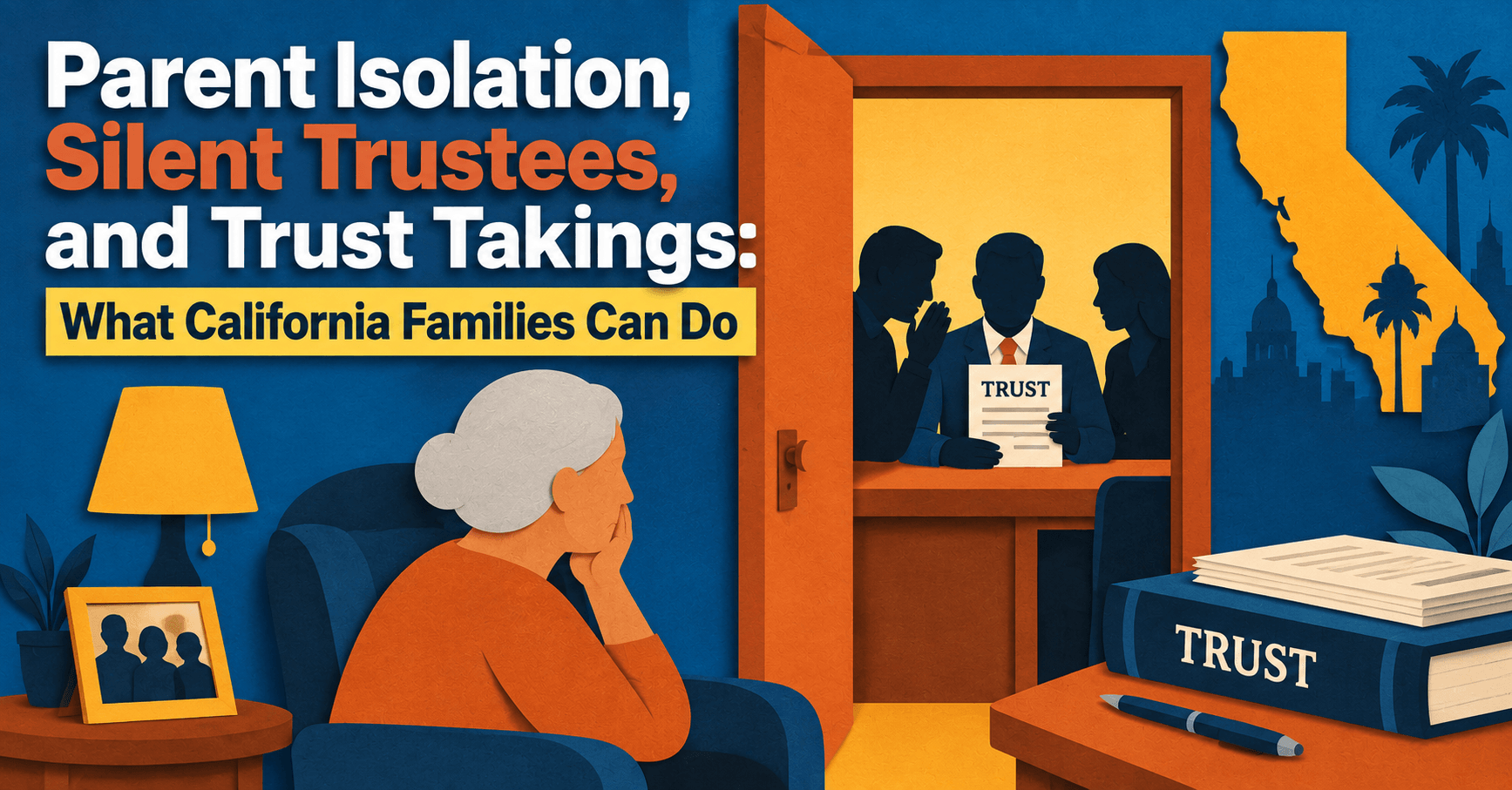
Parent Isolation, Silent Trustees, and Trust Takings: What California Families Can Do

When the Silence Becomes Deafening
I am Michael Hackard, founder of Hackard Law. Over five decades of practice, I have fought for heirs, beneficiaries, and elder abuse victims who found themselves locked out of estates they were promised and silenced by the very people entrusted to protect them. I have authored four published books on inheritance protection, and our firm has produced more than 1,000 educational videos that have reached over seven million viewers. I know what these situations look like, and I know how they feel to the families living through them.
Our work is concentrated in Sacramento, the San Francisco Bay Area, and Los Angeles – regions where we currently have cases pending in more than a dozen superior courts. If you are watching a sibling or caregiver take control of a trust while you receive no answers, no accounting, and no distributions, you are not alone. I have represented many families in exactly that position.
Hackard Law handles qualified cases on a contingency fee basis – no upfront costs to you. To speak with our team, call (916) 313-3030.
Quick Summary
When a parent is isolated from family and then dies, leaving a trust that suddenly benefits only one person, the pattern almost always points to elder financial abuse and undue influence. California law provides civil remedies that can reach the people who engineered that outcome.
- Parent isolation from family is often the first stage of a deliberate financial scheme
- A successor trustee who goes silent after taking control may be concealing misconduct
- Heirs and beneficiaries who have been cut out have legal standing to challenge the trust
- Civil court – not criminal court – is the primary venue for recovering stolen inheritance
- Acting quickly matters because evidence can disappear and statutes of limitations apply
The Pattern: Isolation, Control, Silence
This pattern happens again and again. As parents get older, they rely more on others. Sometimes a new friend, nanny, or sibling steps in and slowly cuts off contact with the rest of the family. Calls go unanswered. Holiday visits are stopped or discouraged. Eventually, one person is left in control of the parent’s world and begins to change the estate.
By the time the parent dies, the situation may look very different. Assets may have been moved, and the trust may no longer say what the family remembers. The person who isolated the parent may now be serving as successor trustee, with control over the trust and its records.
Then communication becomes difficult. Emails go unanswered, and phone calls go unreturned. In some cases, that lack of communication may be deliberate, making it harder for beneficiaries to understand what changed or what happened to the assets. The silence is intentional. It is a strategy.
Understanding elder financial exploitation means recognizing that this is not a family disagreement. It is a calculated taking, and California law treats it as such.
Case Pattern: An elderly widower’s adult children became concerned when their father stopped returning their calls after a live-in caregiver moved in. Eighteen months later, the trust was changed to make the caregiver the sole beneficiary. After their father’s death, the family filed a civil lawsuit. The case focused on signs of isolation, the father’s declining mental health, and records showing the caregiver controlled his communications and finances.
What the Law Gives You
California’s elder abuse statutes are among the strongest in the country. When financial abuse of an elder is proven, courts can award double damages and attorney fees against the person responsible. This is not a minor remedy – it is a significant financial deterrent, and it is designed to make full recovery possible for families who have been robbed of an inheritance.
The civil remedies available for elder financial abuse include the recovery of transferred assets, disgorgement of profits, and in appropriate cases, punitive damages. The goal is to restore what was taken and hold the responsible party financially accountable.
These cases are litigated in probate court and civil court – not criminal court. Law enforcement and district attorneys handle the criminal side. Hackard Law focuses on the civil path, which is where families recover assets and enforce their rights as beneficiaries.
Undue Influence: The Legal Theory Behind the Claim
Undue influence is the legal concept that captures what happens when someone exploits a position of trust or authority to override a vulnerable person’s free will. In the context of estate planning, it means convincing – or coercing – an elderly parent to change a trust, will, or beneficiary designation in ways that serve the influencer rather than the parent’s true wishes.
California courts consider several things: the relationship between people, the elder’s health and mental state, how and when documents were signed, and if an independent lawyer was involved. Being cut off from family is a strong warning sign. If a parent is isolated except for the person who benefits, that pattern is very important in court.
For families in Sacramento dealing with this, the Sacramento elder financial abuse lawyer practice at Hackard Law handles these claims from initial investigation through trial.
Case Pattern: A family in the Sacramento area learned that their mother had executed a trust amendment several weeks prior to her death, which excluded three adult children and designated her entire estate to a single daughter who had assumed the role of caregiver two years earlier. Medical documentation indicated progressive dementia. The sequence of events, cognitive decline, and evidence of social isolation constituted the primary basis for the undue influence allegation.
The Silent Trustee Problem
When a successor trustee takes over and goes silent, that silence is more than frustrating – it may be a breach of fiduciary duty. California law requires trustees to keep beneficiaries reasonably informed, provide accountings, and administer the trust in the interests of all beneficiaries, not just themselves.
A trustee who refuses to communicate, delays distributions without cause, or administers the trust for personal benefit is exposed to removal and surcharge. Hackard Law litigates these cases through the Sacramento County probate courts and has pursued trustee accountability across California.
If you have been cut out of a trust and the trustee will not respond, that is not a dead end. It is a starting point. The Sacramento contested will and trust lawyer practice at Hackard Law can help you understand your standing and your options.
Why Early Action Matters
For decades, I have worked with families who waited too long—not because they were careless, but because they did not know they had choices. By the time they reached out, assets were already transferred, accounts were empty, and important witnesses were difficult to find. The longer a case goes unchallenged, the greater the financial cost. Sometimes, the damage is so deep that no judgment can truly fix it.
Early intervention changes the outcome. When a family moves quickly – preserving documents, identifying witnesses, and filing the right motions – the chance of meaningful recovery increases substantially. Early legal intervention in elder financial abuse cases is not just a tactical advantage. It is often the difference between recovery and loss.
Discovery, forensic analysis, and the pursuit of justice – these are not just legal strategies, but safeguards for families threatened by undue influence and fraud. A steadfast commitment to truth restores what dishonesty tried to steal.
Key Definitions
- Undue influence: A legal doctrine that voids estate planning documents when a vulnerable person’s free will was overridden by someone in a position of trust or authority.
- Successor trustee: The person named to manage and distribute a trust after the original trustee (often the parent) dies or becomes incapacitated.
- Fiduciary duty: The legal obligation of a trustee to act in the best interests of all beneficiaries, not in their own self-interest.
- Elder financial abuse: The wrongful taking, concealment, or appropriation of an elderly person’s property or assets, including through manipulation of estate documents.
- Trust amendment: A change to the terms of an existing trust, which can be challenged if made under undue influence or when the settlor lacked mental capacity.
- Capacity: The legal standard for whether a person understood the nature and consequences of a legal document at the time they signed it.
- Surcharge: A court-ordered penalty against a trustee who has caused financial harm to the trust through misconduct or breach of duty.
- Probate court: The California court with jurisdiction over trust and estate disputes, including challenges to trustee conduct and trust validity.
- Contingency fee: A fee arrangement in which the attorney is paid only if the case results in a recovery – no upfront cost to the client.
- Standing: The legal right of an heir or beneficiary to bring a challenge in court based on their interest in the estate.
What to Do Next
- Look for any documents showing recent changes to your parent’s trust, will, or beneficiary designations – especially changes made after a caregiver or sibling moved in.
- Get copies of your parent’s medical records from the period when estate documents were signed, as they may reflect cognitive decline relevant to a capacity challenge.
- Write down a timeline of when contact with your parent became restricted and who was controlling access.
- Try to avoid confronting the trustee directly before speaking with an attorney, as early communications can affect your legal position.
- Look for financial records, bank statements, or property transfer documents that may show assets moving out of the estate.
- Reach out to other family members or friends who witnessed the isolation – their accounts may be critical to your case.
- Review the California inheritance theft guide to understand the legal framework for what you may be facing.
- Try to act promptly – statutes of limitations in elder abuse and trust contest cases can be short, and delay can cost you remedies.
- Call Hackard Law at (916) 313-3030 to discuss your situation with our team.
- You can also reach us through our contact page to request a consultation.
CALL THE SAGE | When Experience Matters, Families Listen
🏛️ We practice California trust & estate & elder financial abuse litigation
⚖️ We represent heirs, beneficiaries, and elder abuse victims
🎥 1,000+ educational videos | 7 million+ views | 4 published books
🎯 “After thousands of cases, I see the pattern others miss.”
CONTINGENCY REPRESENTATION – No Win, No Fee
Throughout California: Sacramento | Los Angeles | Bay Area
📞 CALL THE SAGE: (916) 313-3030
Subscribe for weekly insights on:
- Elder financial abuse warning signs and prevention
- Trust and estate litigation strategies
- Inheritance protection for California families
- Family protection strategies
When your inheritance is under attack, Call The Sage.
Hackard Law | 10640 Mather Blvd, Mather CA 95655
Attorney Advertisement | Michael Hackard, State Bar #71067
RELATED VIDEOS
Establishing Undue Influence & Elder Financial Abuse | CA Trust Litigation
Explains how California courts identify and prove undue influence in trust disputes.
Common Signs of Elder Financial Abuse | Estate & Trust Lawsuits
Walks through the warning signs that a loved one is being financially exploited.
Successor Trustee Disputes: When Siblings Battle for Control of the Family Trust
Covers what happens when a sibling takes over a family trust and cuts others out.
Elder Financial Abuse Law | Game-Changer in CA Trust Litigation
Discusses how California elder financial abuse law strengthens inheritance recovery cases.
How Families Stop Elder Financial Abuse | Communication & Trust
Shows how families can recognize and respond to elder financial abuse early.
Sometimes You’ve Got to Fight | Disinherited Trust Beneficiary Battles
Explores the legal options available to beneficiaries who have been wrongfully disinherited.
 Michael Hackard is the founder of Hackard Law, a California trust and estate litigation firm with more than five decades of experience protecting the inheritance rights of families across Sacramento, the San Francisco Bay Area, and Los Angeles. He is the author of six published books on inheritance protection and has produced more than 1,000 educational videos with over seven million views.