


 (916) 313-3030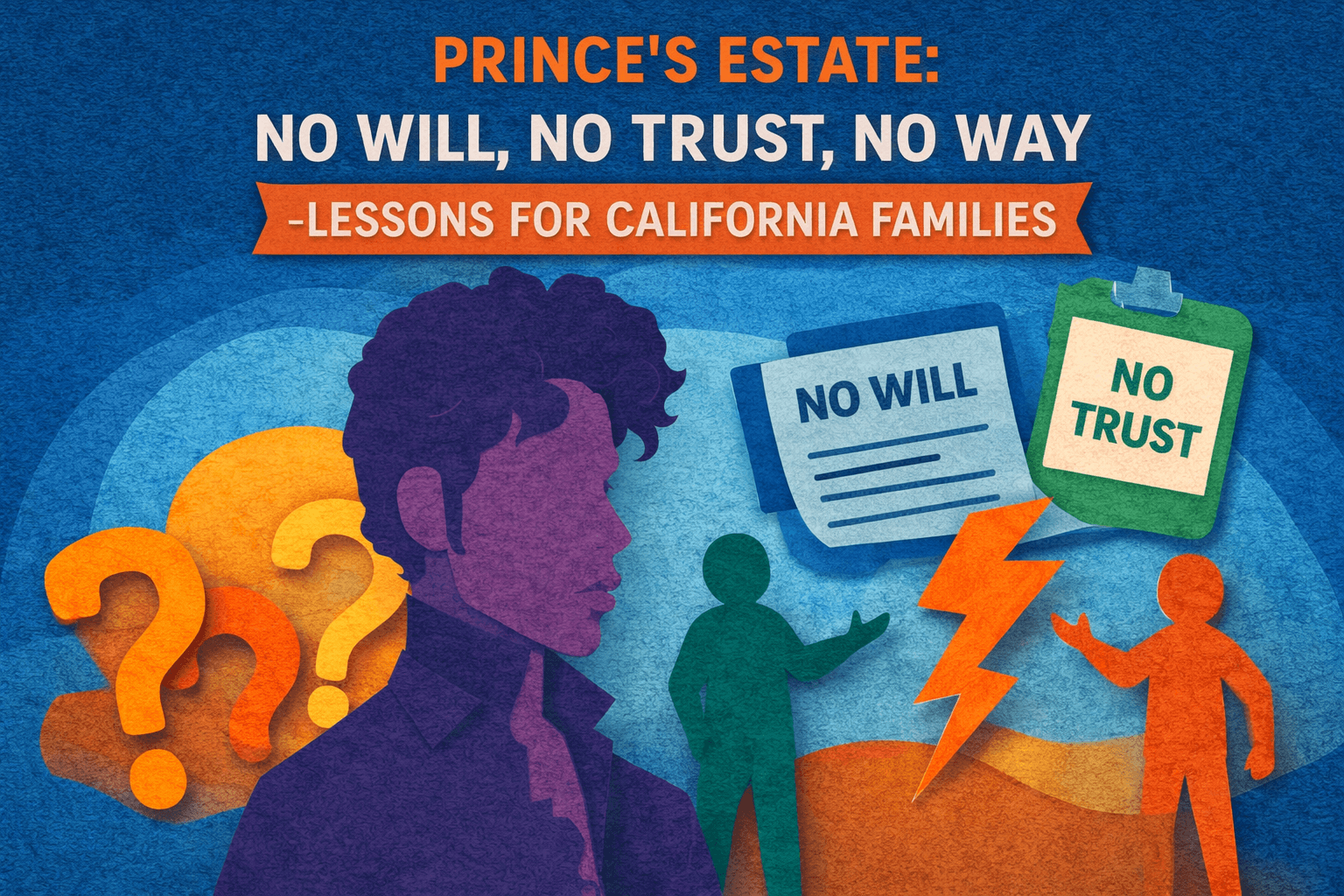
Prince’s Estate: No Will, No Trust, No Way — Lessons for California Families
When a Legend Dies Without a Known Will
I’m Michael Hackard, founder of Hackard Law and a California trust and estate litigation attorney with more than five decades of experience representing heirs, beneficiaries, and elder abuse victims. Over the course of my career, I have written four published books on inheritance protection and produced more than 1,000 educational videos that have now accumulated over 7 million views. My firm represents families across Sacramento, the San Francisco Bay Area, and Los Angeles — families who face real questions about what happens when a loved one’s will is missing, incomplete, or contested.
When Prince died in April 2016, the world lost an iconic musician. Within days, news outlets reported that Prince’s sister had filed a petition in court requesting to be appointed as the special administrator of her brother’s estate. The immediate question was obvious: did Prince really die without a will or a trust? That question carries enormous consequences — not just for celebrity estates, but for every California family that has delayed planning or failed to communicate their wishes.
Hackard Law provides contingency fee representation, meaning qualified cases move forward with no upfront costs to the client.
If your family faces uncertainty about a loved one’s estate, contact Hackard Law at (916) 313-3030 for a consultation.
Quick Summary: Prince’s Estate and What It Means for You
Prince’s death raised immediate questions about intestate succession, the role of trusts, and the long-term management of a massive estate. The lessons from this high-profile case apply directly to California families of every size.
- Prince’s sister filed to become the special administrator of his estate just six days after his death.
- Without a known will, Minnesota’s intestate succession laws would divide assets among surviving siblings.
- Prince likely maintained both revocable and irrevocable trusts, even though early reports focused on the absence of a will.
- Celebrity estates illustrate the stakes involved when planning gaps become public.
Intestate Succession: What is Done When There Is No Will
Intestacy is a condition where a person dies without a valid will. In that situation, the state’s laws dictate who inherits and in what proportions. In Prince’s case, Minnesota law controlled. Because he had no surviving children, spouse, or parents, the estate would pass to his surviving siblings.
California has its own intestate succession laws, governed by the Probate Code. State laws clearly describe a strict hierarchy of distributing assets: surviving spouses, children, parents, siblings, and then any other relatives. According to the state, there is no value to the deceased’s wishes because there are no written wishes. Families who believe in verbal promises or informal understandings discover too late that intestate succession follows rigid statutory rules, not conversations.
The absence of a will does not just create confusion about who inherits. It creates a vacuum of authority. So, a person must petition the court for appointment as the estate’s personal representative. But this is a complicated process that invites competing claims, delays, and legal fees that a simple plan could have prevented.
Case Pattern: The Unsigned Estate Plan
A California family patriarch worked with advisors for years but never finalized his trust documents. After his death, three adult children filed competing petitions. The court appointed a neutral administrator, and the family spent two years in litigation before reaching a settlement — a result the father never intended.
Revocable Living Trusts: Prince Likely Had One
News stories at the time focused on the absence of a will, but that headline missed the bigger picture. Prince had sophisticated legal and financial advisors throughout his career. It is extremely unlikely that a person of his wealth and business complexity failed to create a trust.
By using a revocable living trust, the trust maker can control assets during life, make changes at any time, and direct where assets go at death. Trust assets transfer without probate, which means faster distribution and greater privacy. For someone like Prince — whose assets included music catalogs, real estate, and intellectual property rights — a revocable living trust would have been a foundational planning tool.
California families benefit from the same structure. A properly funded revocable living trust keeps assets out of probate court, reduces administrative costs, and provides clear instructions for distribution. The keyword is “funded.” A trust that exists on paper but holds no assets creates the same gaps as having no trust at all.
Irrevocable Trusts and Tax Planning
Prince may have also maintained one or more irrevocable trusts. These trusts serve a different purpose. Once assets are added to an irrevocable trust, the maker cannot remove them or alter the trust terms. The trade-off is significant tax savings: the assets included in an irrevocable trust are excluded from the maker’s taxable estate.
For high-net-worth individuals, irrevocable trusts reduce exposure to federal estate taxes, protect assets from creditors, and create long-term structures for income distribution. Prince’s estate — valued at hundreds of millions of dollars — would have benefited enormously from this kind of planning.
California families with substantial assets face similar considerations. The federal estate tax exemption is generous, but it changes with legislation. Families who fail to plan for tax exposure risk losing a significant portion of their wealth to asset transfer taxes and administrative costs. Irrevocable trusts, when properly structured, provide a durable shield.
Case Pattern: The Hidden Irrevocable Trust
A family in Northern California thought their mother’s assets were limited to a small house and bank accounts. After her death, an irrevocable trust surfaced containing investment assets worth several times the value of the probate estate. The discovery changed the distribution entirely and required careful legal review to ensure the named beneficiaries received their proper shares.
The Forbes List: Why Celebrity Estates Keep Earning
Prince’s estate joined a distinctive group of celebrity estates that continue to generate enormous income after the celebrity’s death. The Forbes annual list of top-earning dead celebrities includes Elvis Presley, Michael Jackson, Bob Marley, Charles Schulz, Elizabeth Taylor, Marilyn Monroe, John Lennon, Albert Einstein, Paul Walker, Bettie Page, and Theodor Geisel (Dr. Seuss).
All his estates share a common feature: valuable intellectual property that requires active management. Music catalogs, image licensing rights, and brand partnerships generate revenue for decades. Without a clear estate plan and competent administration, those revenue streams can be lost, diluted, or diverted.
Families in California will learn a straightforward lesson. Even families without celebrity-level assets frequently own assets that need constant management, such as digital assets, family businesses, rental properties, or mineral rights. A comprehensive estate plan addresses not just who inherits, but how those assets will be managed over time. Communicating estate planning decisions to family members reduces conflict and protects the value of those assets.
The Story Is Not Over: Lessons for California Families
Prince’s estate dispute stretched on for years after his death. Competing claims, tax disputes, and valuation battles consumed time and resources. The full nature of his estate plan was not immediately known, and his advisors spent months protecting current assets and preventing harm to future assets.
In California, families face similar risks on a smaller scale. When a parent dies without leaving clear estate documentation, leaves behind confusion, competing expectations, and potential litigation. Also, even when a trust exists, ambiguous language or outdated provisions can trigger disputes that last for years.
The most effective protection is a complete, current, and clearly communicated estate plan. That means a funded revocable trust, a pour-over will, durable powers of attorney, healthcare directives, and regular reviews with a qualified probate attorney. Families who take these steps spare their heirs the uncertainty that the Prince’s family endured in public.
Key Definitions
- Intestate Succession: The legal process that determines how assets are distributed when a person dies without a valid will.
- Revocable Living Trust: A trust that can be changed or revoked by the maker during their lifetime. Assets in the trust avoid probate at death.
- Irrevocable Trust: A trust that cannot be altered or revoked once established. Provides tax benefits and asset protection.
- Special Administrator: A court-appointed individual who manages an estate during early stages of probate, often before a permanent personal representative is named.
- Probate: The court-supervised process of validating a will, inventorying assets, paying debts, and distributing property to heirs.
- Pour-Over Will: A will that directs any assets not already in a trust to “pour over” into the trust upon the maker’s death.
- Funded Trust: A trust that actually holds title to assets. An unfunded trust offers no probate avoidance.
- Personal Representative: The individual or entity appointed by the court to manage and distribute an estate during probate.
- Intellectual Property: Creations of the mind — music, art, inventions, brand names — that can be owned, licensed, and inherited.
What to Do Next
- Confirm that your revocable living trust is properly funded with all major assets titled in the trust’s name.
- Review your estate plan every three to five years or after any major life event.
- Discuss your estate plan openly with family members to reduce misunderstandings and conflict.
- Always verify that your beneficiary designations on retirement accounts, life insurance, and financial accounts match your trust and will.
- Consult a California estate litigation attorney if you suspect a loved one’s estate plan was altered, incomplete, or the result of undue influence.
- Keep original estate planning documents in a secure, known location and inform your successor trustee of their whereabouts.
- Consider irrevocable trust structures if your estate exceeds the federal estate tax exemption.
- Request a professional review of your estate plan to identify potential gaps before they become litigation.
If your family faces an inheritance dispute or questions about a loved one’s estate plan, call Hackard Law at (916) 313-3030 today.
CALL THE SAGE | When Experience Matters, Families Listen
THE EXPERTISE:
📚 50 years California trust, estate & elder financial abuse litigation
⚖️ We represent heirs, beneficiaries, and elder abuse victims
🎥 1,000+ educational videos | 7 million+ views | 4 published books
🎯 “After thousands of cases, I see the pattern others miss.”
CONTINGENCY REPRESENTATION — No Win, No Fee
Throughout California: Sacramento | Los Angeles | Bay Area
📞 CALL THE SAGE: (916) 313-3030
Subscribe for weekly insights on:
• Elder financial abuse warning signs and prevention
• Trust and estate litigation strategies
• Inheritance protection for California families
• Family protection strategies
When your inheritance is under attack, Call The Sage.
Hackard Law | 10640 Mather Blvd, Mather CA 95655
Attorney Advertisement | Michael Hackard, State Bar #71067
RELATED VIDEOS
California Estate and Trust Houses Draw Real Estate Agents’ Focus
Highest keyword relevance score (9 hits) among all candidates; directly addresses California estate and trust administration themes central to the blog’s lessons for California families.
Successor Trustee Disputes: When Siblings Battle for Control of the Family Trust
Directly mirrors the blog’s core narrative about Prince’s siblings competing for estate administration and the broader lesson about family disputes when no clear plan exists.
CA Estate & Trust Litigation Battles | A House Divided
Strong keyword match (7 hits); the ‘house divided’ theme closely parallels the blog’s case pattern of three adult children filing competing petitions after a father died without a finalized plan.
What Happened to Mom & Dad’s House? | CA Estate & Trust Litigation
High keyword match (7 hits); aligns with the blog’s theme of families discovering gaps in a loved one’s estate plan and facing court proceedings as a result.
Top 5 Mistakes to Avoid When Hiring a Trust Administration Lawyer
Relevant keyword match (5 hits); complements the blog’s call-to-action urging families to consult a qualified probate and estate litigation attorney before disputes arise.
Breach of Trust Triggers | Trust Accounting & Trustee Removal
Strong keyword match (7 hits); supports the blog’s discussion of trustee accountability and the risks that arise when trusts lack proper administration or oversight after the trust maker’s death.
 Michael Hackard is the founder of Hackard Law, a California trust and estate litigation firm with more than five decades of experience protecting the inheritance rights of families across Sacramento, the San Francisco Bay Area, and Los Angeles. He is the author of four published books on inheritance protection and has produced more than 1,000 educational videos with over seven million views.