


 (916) 313-3030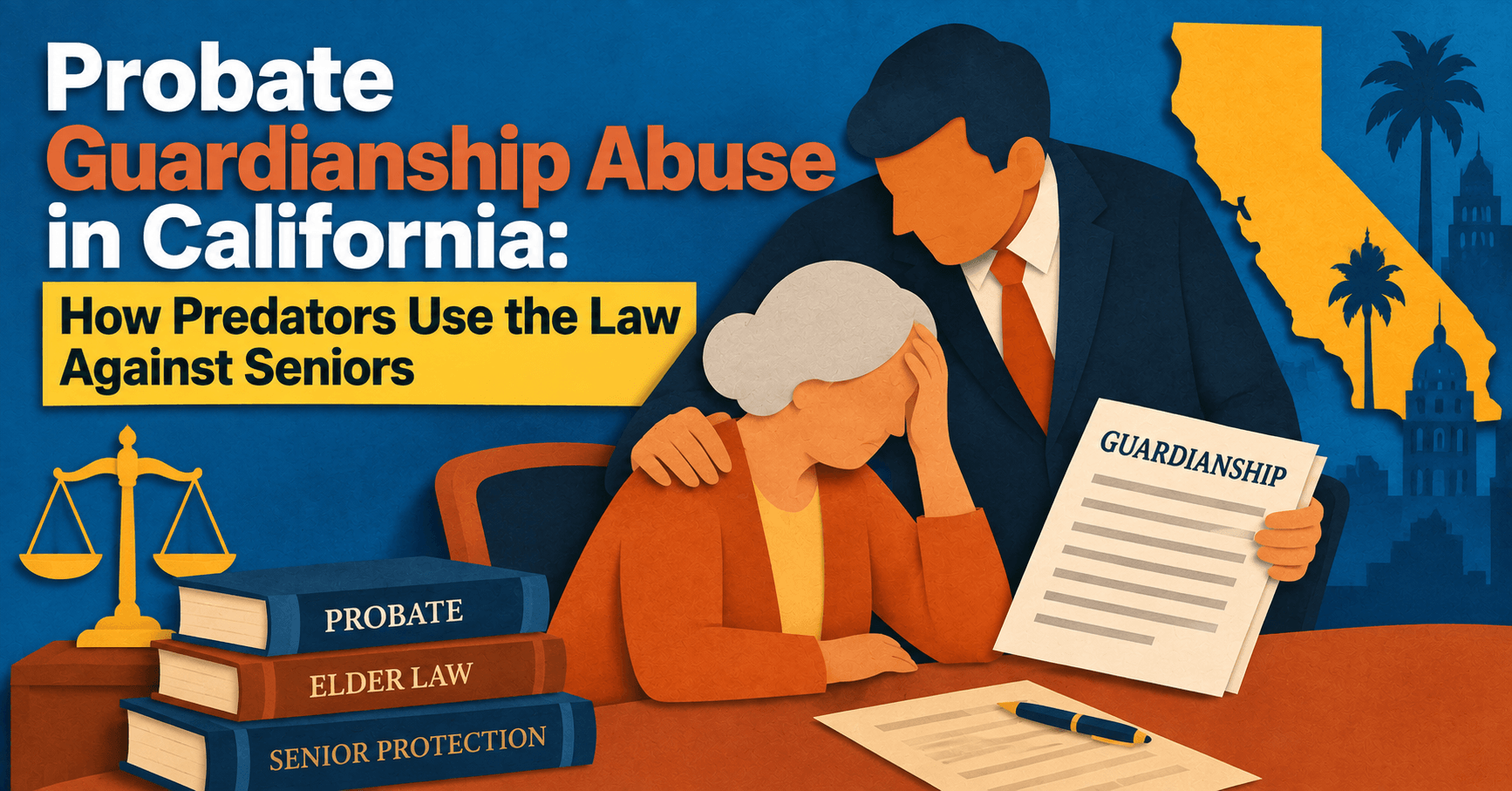
Probate Guardianship Abuse in California: How Predators Use the Law Against Seniors

When the System Meant to Protect Becomes a Weapon
I am Michael Hackard, founder of Hackard Law. Over five decades of practice, I have fought for heirs, beneficiaries, and elder abuse victims across California – from Sacramento and the San Francisco Bay Area to Los Angeles. I have written four books on inheritance protection and produced more than 1,000 educational videos that have reached over seven million viewers. In all that time, few issues have troubled me as deeply as probate guardianship abuse.
The scenario is almost unimaginable: an elderly parent or grandparent is removed from their home, cut off from family, and left at the mercy of a court-appointed guardian who systematically drains their estate. Yet this is not fiction. Rogue elements within the adult probate guardianship industry operate under color of law, using legal mechanisms to commit what amounts to elder financial abuse on a massive scale. Lives are shattered. Fortunes disappear. And families are left powerless – unless they know how to fight back.
Hackard Law provides contingency fee representation for qualified cases, meaning no upfront costs to pursue justice. If your family is facing guardianship abuse or elder financial exploitation, call us at (916) 313-3030.
Quick Summary
Probate guardianship abuse is a serious and growing threat to California seniors and their families. Predatory guardians exploit legal authority to isolate elders, control their assets, and loot their estates – often with minimal oversight.
- Guardianship abuse can strip seniors of their home, finances, and family contact
- Rogue guardians use court authority as cover for financial exploitation
- Advocacy organizations are pushing for systemic reform across California and the nation
- Families have legal options to challenge abusive guardianships and recover stolen assets
- Early legal intervention is critical to stopping the damage before it compounds
Understanding Probate Guardianship – and How It Goes Wrong
Probate guardianship is designed to protect adults who can no longer manage their own affairs. When it works as intended, a guardian steps in to ensure an elder’s health, safety, and financial well-being. When it fails – and in some cases, when bad actors deliberately exploit it – the result is devastating.
A guardian appointed by a probate court has extensive authority over the elder’s living arrangements, visitors, medical care, and financial outlays. When that power is in the hands of a predatory guardian, it becomes a tool for theft and seclusion. The elder may be moved to a facility far from family, their assets may be discreetly transferred or depleted, and they may have little to no contact with loved ones.
What makes this particularly insidious is that it happens under legal cover. The guardian has a court order. Objections from family members can be dismissed as interference. By the time the full picture becomes clear, the financial toll has grown, and the elder’s estate may be largely gone.
Case Pattern: After a professional guardian was appointed, a family in California discovered that their elderly mother had stopped returning calls. When they eventually gained legal standing to step in, they found that the mother had been relocated several times without informing the family and that substantial assets had been liquidated. The main goals of the litigation were restoring contact and pursuing an accounting of missing funds.
The Industry’s Rogue Elements and the Advocates Fighting Back
It would be unfair to characterize all professional guardians as predatory – many serve with genuine dedication. But the industry has serious structural problems that allow bad actors to thrive. Oversight can be inconsistent. Courts are often overwhelmed. Families may lack the resources or legal knowledge to challenge a guardian’s decisions effectively.
On the front lines of this battle are groups like Dr. Sam Sugar’s Americans Against Abusive Probate Guardianship (AAAPG). Advocates like Dr. Sugar, together with Rick Black of the Center for Estate Administration Reform and Teresa Kennedy of Elder Dignity, are advocating for more stringent protections, increased court supervision, and genuine accountability for guardians who misuse their power.
Their documentary, The Deception of Protection, is a compelling and sobering look at how deeply this problem runs. I recommend it to any family trying to understand what they may be up against. Knowing the landscape is the first step toward protecting your loved one. You can also review the top 10 most common probate, trust, and estate battles to understand how guardianship disputes fit into the broader picture of estate litigation.
How California Law Can Help Families Push Back
California provides legal tools for families who believe a guardianship has become abusive. Petitions to modify or terminate a guardianship, requests for a court-ordered accounting, and civil claims for elder financial abuse are all potential avenues. The challenge is that these proceedings require legal sophistication and persistence – the same probate court that appointed the guardian must now be persuaded that the arrangement is harmful.
Civil remedies for elder financial abuse in California can include double damages and attorney fee recovery, which makes litigation a viable path even when resources have been depleted by the guardian. The law recognizes that financial exploitation of elders is not merely a civil wrong – it carries enhanced consequences precisely because the victims are among the most vulnerable.
Michael Hackard and the team at Hackard Law understand how to navigate these proceedings. Litigation strategy in guardianship abuse cases must be methodical: document the elder’s condition and circumstances, challenge the guardian’s accounting, and build a record that supports judicial intervention. A steadfast commitment to truth restores what dishonesty tried to steal.
Case Pattern: In one pattern Hackard Law has encountered, a professional guardian was appointed after a distant relative filed a petition citing the elder’s cognitive decline. Family members who had been the primary caregivers were gradually excluded from visits. Legal action focused on challenging the guardian’s accounting and petitioning for restoration of family contact rights – ultimately resulting in court-ordered oversight and a transition to a family-selected fiduciary.
The Human Cost: What Families Actually Lose
The financial losses in guardianship abuse cases are staggering – homes sold, investment accounts drained, personal property disposed of without consent. But the financial toll is only part of the story. The fracture between elders and their families often runs too deep for any judgment to mend.
Seniors subjected to isolation suffer real psychological harm. The loss of familiar surroundings, trusted relationships, and personal autonomy accelerates cognitive and physical decline. For the families left outside, the grief of watching a loved one disappear behind a legal wall – while still alive – is a particular kind of anguish.
For decades, I have stood with families facing exactly this kind of loss. The legal system can be a weapon in the wrong hands, but it can also be the path to justice when wielded with skill and determination. Discovery, forensic accounting, and persistent advocacy – these are not just legal strategies, but safeguards for families threatened by those who have turned a duty of care into an instrument of exploitation.
Understanding your rights as a beneficiary or family member is essential. California beneficiaries facing trustee or guardian misconduct should know the five things every California trust beneficiary must understand before taking action.
Key Definitions
- Probate guardianship: A court-supervised legal arrangement giving a guardian authority over an incapacitated adult’s person, finances, or both.
- Guardian: A court-appointed individual or professional entity responsible for the care and decision-making of a protected person.
- Conservatorship: In California, the term often used interchangeably with guardianship for adults; covers personal care (conservator of the person) and finances (conservator of the estate).
- Elder financial abuse: The illegal or improper use of an elder’s funds, property, or assets, including through undue influence, fraud, or breach of fiduciary duty.
- Fiduciary duty: The legal obligation of a guardian or trustee to act in the best interests of the person they serve, not their own interests.
- Accounting: A formal financial report a guardian must provide to the court showing all income, expenses, and asset changes during a guardianship period.
- Isolation: The deliberate restriction of an elder’s contact with family, friends, or advisors – a common tactic in guardianship abuse cases.
- Petition to terminate guardianship: A legal filing asking the probate court to end a guardianship arrangement, typically because it is no longer necessary or has become harmful.
- Double damages: A civil remedy available under California elder abuse law allowing courts to award twice the actual damages in cases of financial exploitation.
- AAAPG: Americans Against Abusive Probate Guardianship, a national advocacy organization working to expose and reform abusive guardianship practices.
What to Do Next
- Look for warning signs early: sudden changes in an elder’s contact with family, unexplained asset transfers, or new legal filings involving a professional guardian.
- Get copies of any guardianship or conservatorship orders filed with the probate court – these are public records.
- Try to avoid confronting a guardian directly without legal counsel, as this can complicate future court proceedings.
- Document everything: dates of contact attempts, changes in the elder’s living situation, and any financial irregularities you observe.
- Look into organizations like AAAPG and Elder Dignity for advocacy resources and referrals.
- Review your options for choosing the right probate lawyer for your specific situation before taking legal action.
- Understand that California’s elder abuse statutes provide powerful remedies, including fee-shifting, that can make litigation accessible even when assets have been depleted.
- Learn about contingency fee representation so that cost is not a barrier to protecting your loved one.
- Call Hackard Law at (916) 313-3030 to discuss your family’s situation with an attorney who understands probate guardianship abuse.
- Visit our contact page to request a confidential consultation.
CALL THE SAGE | When Experience Matters, Families Listen
🏛️ We practice California trust & estate & elder financial abuse litigation
⚖️ We represent heirs, beneficiaries, and elder abuse victims
🎥 1,000+ educational videos | 7 million+ views | 4 published books
🎯 “After thousands of cases, I see the pattern others miss.”
CONTINGENCY REPRESENTATION – No Win, No Fee
Throughout California: Sacramento | Los Angeles | Bay Area
📞 CALL THE SAGE: (916) 313-3030
Subscribe for weekly insights on:
- Elder financial abuse warning signs and prevention
- Trust and estate litigation strategies
- Inheritance protection for California families
- Family protection strategies
When your inheritance is under attack, Call The Sage.
Hackard Law | 10640 Mather Blvd, Mather CA 95655
Attorney Advertisement | Michael Hackard, State Bar #71067
RELATED VIDEOS
Placer County Senior Exploitation | Homes and Estates & Trusts
Explores how seniors in Placer County face exploitation targeting their homes and estates.
Trust Traps Part 2 | Financial Entanglement: How Estate Predators Tighten Their Grip
Examines the tactics estate predators use to financially entangle and control vulnerable victims.
What Are Common Acts of Fraud in Trust or Probate? | California Estate Litigation Attorney
Breaks down the most common fraudulent acts that occur in California trust and probate cases.
Probate Petitions | Guarding CA Beneficiary Rights
Explains how probate petitions can be used to protect the rights of California beneficiaries.
Trustee Abuse | Health, Education, Maintenance & Support
Covers how trustees can abuse their authority over a beneficiary’s basic needs and finances.
CA Probate Litigation | Attorneys for the Blindsided & Left Behind
Addresses legal options for families who feel shut out or blindsided by probate proceedings.
 Michael Hackard is the founder of Hackard Law, a California trust and estate litigation firm with more than five decades of experience protecting the inheritance rights of families across Sacramento, the San Francisco Bay Area, and Los Angeles. He is the author of six published books on inheritance protection and has produced more than 1,000 educational videos with over seven million views.