


 (916) 313-3030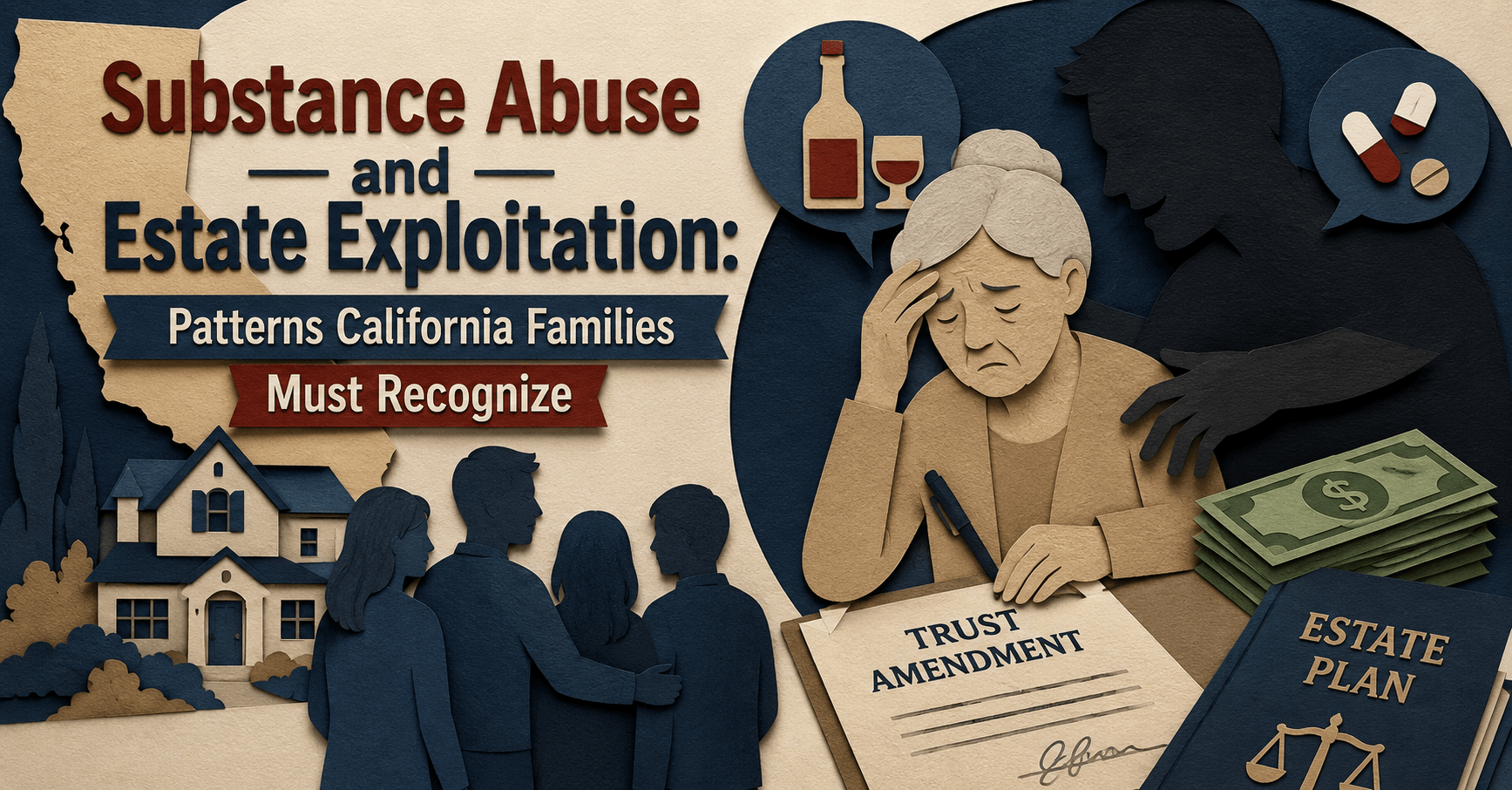
Substance Abuse and Estate Exploitation: Patterns California Families Must Recognize

When Addiction Meets Inheritance
I am Michael Hackard, founder of Hackard Law. Over five decades of practice, I have fought for heirs, beneficiaries, and elder abuse victims across California – from Sacramento and the San Francisco Bay Area to Los Angeles. I have written four books on inheritance protection and produced more than 1,000 educational videos that have reached over seven million viewers. In that time, one pattern surfaces with painful regularity: substance abuse and elder financial exploitation feeding off each other in ways that devastate families and drain estates.
Psychologists tell us that when we face unstructured messes, we instinctively search for patterns. Estate disputes often look like shapeless muddles. But long experience reveals recurring shapes – and one of the most damaging is the adult child or caregiver whose addiction quietly becomes a weapon against a vulnerable elder.
Hackard Law provides contingency fee representation for qualified cases – no upfront costs to you. If you believe a loved one’s estate was compromised by substance abuse and exploitation, call us today at (916) 313-3030.
Quick Summary
Substance abuse is a documented risk factor in elder financial exploitation, and California families often do not recognize the pattern until significant harm has already occurred.
- Studies indicate that 44% of male parent abusers had alcohol or drug dependency.
- Alcohol use disorder damages honesty and insight, making denial and deception habitual.
- Elders are often exploited by addicted adult children or caregivers who drain accounts or transfer property.
- Hackard Law litigates cases to overturn estate plans tainted by elder abuse, fraud, or undue influence.
- California law provides meaningful remedies for heirs and beneficiaries harmed by this pattern.
The Link Between Addiction and Elder Financial Exploitation
Substance abuse and elder financial exploitation are regularly linked in research. According to studies, 44% of male parents who abused their children had a drug or alcohol addiction. Families should be deterred by that number alone. Once you know what to look for, exploitation becomes nearly predictable due to the way addiction rewires behavior.
Honesty is typically the first casualty of alcohol use disorder. Denial deepens as the brain is affected, and lies become a reflexive part of daily life. The patterns are familiar: dismissals like “I’ve got it under control,” justifications like “I only have a drink or two,” and deflections like “You make me so upset I had to have a drink.” Hiding mouthwash to mask the smell. These are not random behaviors – they are symptoms of a disease that, left unaddressed, can consume an elder’s financial security along with the addict’s own.
For families watching from a distance, these signs can be easy to rationalize away. That rationalization is often the opening through which exploitation enters.
Case Pattern: Caregiver Isolation and Account Depletion
An elder living alone becomes dependent on an adult child with a long history of alcohol dependency. Over several years, the child gains sole access to bank accounts, citing the elder’s declining health. By the time other family members investigate, accounts have been drained and a home has been quietly transferred. The estate left behind bears little resemblance to what the elder had accumulated over a lifetime.
How Elders Enable – and Why That Does Not Erase the Harm
One of the hardest truths in these cases is that elders often cover for the person exploiting them. “They’re not feeling well.” “I don’t want to get them into trouble.” “It’s my fault – I failed them.” This enabling behavior is not weakness. It is love, loyalty, and often shame – the same forces that keep many families silent about addiction for years.
Alcoholism is a disease. It is tragic, damaging, and at times catastrophic. Its first victim is the person in its grip, and the damage radiates outward from there. I am not here to judge the addicted person. But the harm done to elders and their estates is real, and the law provides remedies for those who have been wronged.
California’s elder financial abuse statutes are among the strongest in the country. Understanding civil remedies including double damages and attorney fee recovery can make the difference between a family recovering what was stolen and walking away with nothing.
Case Pattern: Post-Death Discovery of Transferred Property
An elder passes away and family members begin reviewing the estate. They discover that a home – the family’s most valuable asset – was transferred to a substance-dependent sibling years earlier, apparently while the elder was in cognitive decline. The transfer was never discussed with other heirs. Litigation to void the transfer on grounds of undue influence and fraud becomes the only path forward.
Recognizing the Pattern Before It Is Too Late
Most families contact Hackard Law after the catastrophe has already unfolded. The elder’s bank accounts have been emptied while they were alive. The house has been transferred to the substance abuser. Or the changes to the estate plan were not discovered until after the elder’s death. By then, the financial toll has grown far beyond what anyone anticipated.
Early recognition matters. Families who spot the warning signs and act quickly have more legal options than those who wait. If an elder is becoming increasingly isolated from family, if a single person has taken over all financial decisions, or if the elder seems reluctant to discuss money – these are signals worth investigating. You can review what California beneficiaries can do when a trustee delays distributions without cause to understand how beneficiary rights can be enforced even before a dispute fully erupts.
Understanding the most common probate, trust, and estate battles in California can also help families identify whether what they are seeing fits a recognized pattern of exploitation.
How Hackard Law Litigates These Cases
Hackard Law is retained by heirs and beneficiaries to challenge estate plans that were the product of elder abuse, fraud, or undue influence. These are not simple cases. They require forensic review of financial records, medical history, and the circumstances surrounding any transfers or estate plan changes. The eight stages of trust and estate litigation reflect how methodical and thorough this process must be.
Discovery, forensic analysis, and the pursuit of justice – these are not just legal strategies, but safeguards for families threatened by undue influence and fraud. A steadfast commitment to truth restores what dishonesty tried to steal. For decades, I have stood with families who felt powerless in the face of exploitation, and I have seen time and again that the law, applied with precision and determination, can reach back and correct what was done in secret.
The fracture that addiction and exploitation leave in a family often runs too deep for any judgment to fully mend. But recovering what was wrongfully taken – a home, an inheritance, a lifetime of savings – is a form of justice that matters deeply to the people we represent. If you are navigating a dispute in Los Angeles, you can also learn about trust litigation contingency options in LA to understand how representation works in your area.
Key Definitions
- Elder financial abuse: The wrongful taking, concealment, or appropriation of an elder’s money or property, including by a person in a position of trust or confidence.
- Undue influence: Excessive persuasion that overcomes a person’s free will and causes them to act in a way they would not otherwise have chosen.
- Alcohol use disorder: A chronic brain disorder characterized by compulsive alcohol use, loss of control over drinking, and a negative emotional state when not drinking.
- Enabling: Actions by family members or caregivers that shield an addicted person from the consequences of their behavior, sometimes facilitating continued exploitation.
- Fraudulent transfer: A transfer of property made with intent to defraud, delay, or hinder a creditor or rightful heir.
- Contingency fee representation: A fee arrangement in which the attorney is paid only if the case results in a recovery – no upfront cost to the client.
- Estate plan contest: A legal challenge to the validity of a will, trust, or other estate planning document, typically on grounds of lack of capacity, undue influence, or fraud.
- Cognitive decline: A deterioration in memory, judgment, or reasoning that can make an elder more vulnerable to manipulation and exploitation.
- Isolation tactic: A pattern of behavior in which a caregiver or family member limits an elder’s contact with others to gain or maintain financial control.
What to Do Next
- Look for warning signs: sudden isolation of an elder, a single person controlling all finances, or unexplained changes to an estate plan.
- Get copies of any recent wills, trust amendments, or property transfer documents as soon as possible.
- Look for bank statements or financial records that might show unusual withdrawals or transfers.
- Talk to other family members and document what each person has observed, including dates and specific incidents.
- Try to avoid confronting the suspected abuser directly before speaking with an attorney – this can complicate the legal case.
- Look into whether the elder has a primary care physician who may have documented cognitive or behavioral changes.
- Try to avoid delay – California has statutes of limitations that can affect your ability to bring a claim.
- Consider consulting how to choose the right probate lawyer for your situation before your first call.
- Call Hackard Law at (916) 313-3030 to share your story and learn whether your case qualifies for contingency fee representation.
- Reach out through the Hackard Law contact page to schedule a confidential consultation.
CALL THE SAGE | When Experience Matters, Families Listen
🏛️ We practice California trust & estate & elder financial abuse litigation
⚖️ We represent heirs, beneficiaries, and elder abuse victims
🎥 1,000+ educational videos | 7 million+ views | 4 published books
🎯 “After thousands of cases, I see the pattern others miss.”
CONTINGENCY REPRESENTATION – No Win, No Fee
Throughout California: Sacramento | Los Angeles | Bay Area
📞 CALL THE SAGE: (916) 313-3030
Subscribe for weekly insights on:
- Elder financial abuse warning signs and prevention
- Trust and estate litigation strategies
- Inheritance protection for California families
- Family protection strategies
When your inheritance is under attack, Call The Sage.
Hackard Law | 10640 Mather Blvd, Mather CA 95655
Attorney Advertisement | Michael Hackard, State Bar #71067
RELATED VIDEOS
Substance Abuse & Estate Fights
Explores how addiction fuels estate disputes and harms families financially.
Gamblers & Addiction | Triggers for Trust & Estate Disputes
Examines how addictive behavior can trigger bitter trust and estate battles.
Opioid Overdoses | The Sad Truth in Estate & Trust Litigation
Looks at how opioid addiction intersects with estate and trust litigation outcomes.
Trust Traps Part 3: Manufacturing a Crisis to Seize Control of Estate Assets
Reveals tactics bad actors use to manufacture crises and grab estate assets.
The 3 Biggest Risks to Family Wealth | CA Estate & Trust Litigation
Identifies the three most common threats that put California family wealth at risk.
California’s High-Stakes Estate and Trust Litigators | Beneficiary Rights
Covers how California litigators fight to protect beneficiary rights in estate disputes.
 Michael Hackard is the founder of Hackard Law, a California trust and estate litigation firm with more than five decades of experience protecting the inheritance rights of families across Sacramento, the San Francisco Bay Area, and Los Angeles. He is the author of six published books on inheritance protection and has produced more than 1,000 educational videos with over seven million views.