


 (916) 313-3030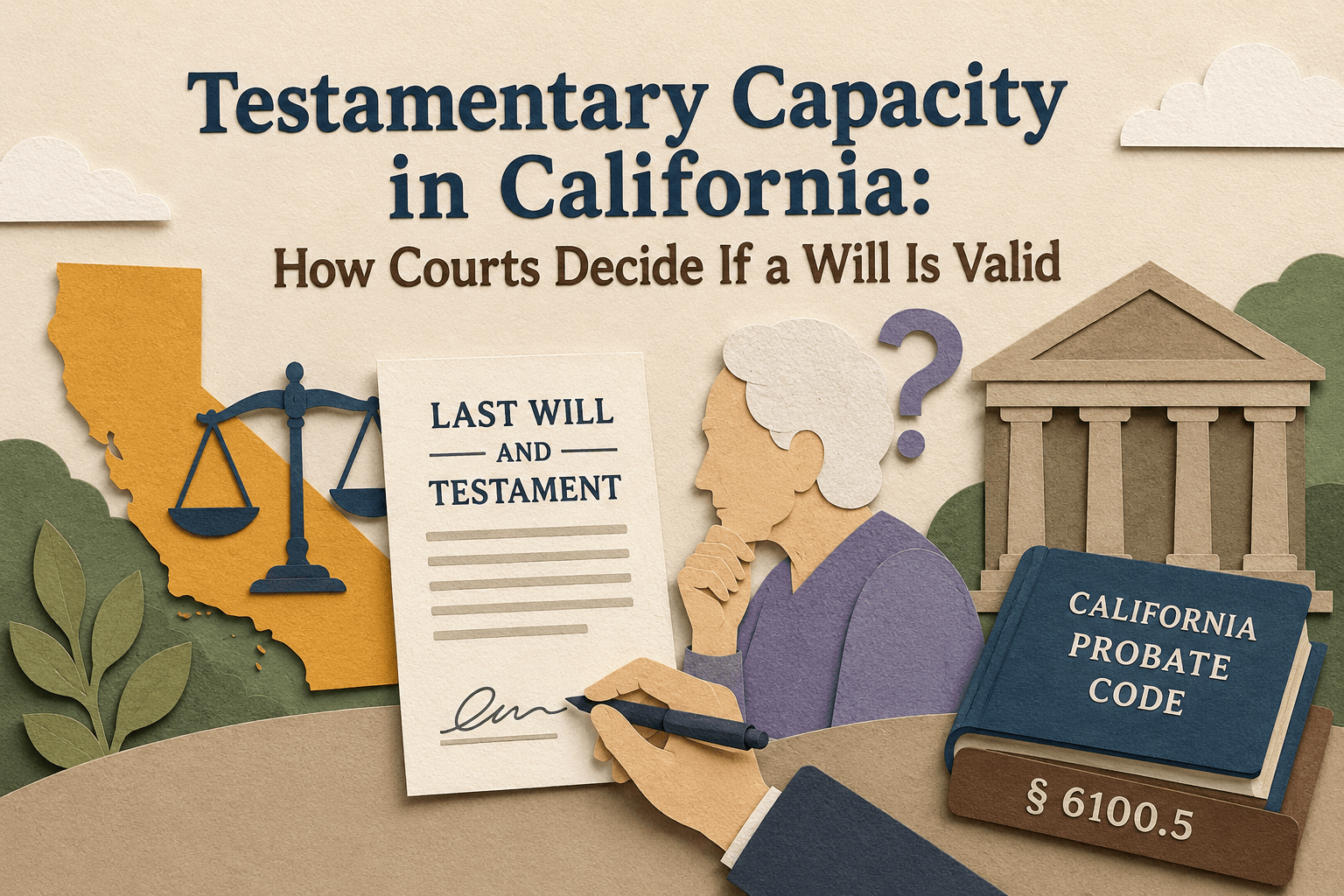
Testamentary Capacity in California: How Courts Decide If a Will Is Valid

Consider the scenario we see more often than most families expect. An elderly parent spends years telling everyone who will listen exactly how she wants her estate distributed. Her children, her grandchildren, the charities she cared about, all of it mapped out in a will she executed a decade ago. Then, in the final months of her life, while she is increasingly confused, increasingly isolated, and increasingly dependent on a caregiver who has become her primary point of contact with the world, a new will appears. The distribution is unrecognizable. A stranger benefits enormously. The family is largely cut out. And when the children ask how this happened, they are told the will is valid because their mother signed it.
Whether that will truly reflect her wishes depends on a single question that California law forces everyone to answer with precision: what did she understand in the moment she held the pen?
That question is the legal and human heart of testamentary capacity, and getting the answer right, either to protect a will or to challenge one, requires understanding exactly what the law demands, what the evidence must show, and why the stakes are so much higher than most families realize until it is too late.
What is Testamentary Capacity in California?
Testamentary capacity is the legal standard a person must meet to execute a valid will. California Probate Code Section 6100 states that any individual who is at least 18 years of age and of sound mind may make a will. That phrase, “sound mind,” carries enormous legal weight. It is not a general character assessment, nor a measure of whether someone was wise or foolish in how they chose to distribute their estate. It is a specific, defined legal threshold that courts apply to evaluate whether the person who signed the will had the cognitive ability to do so validly.
Perfection is something that the law does not demand. It is not necessary for a testator to be at the top of their game. They don’t have to be disease-free, medication-free, or cognitively impaired. Since at least 1926, California has purposefully upheld a relatively accessible capacity standard for wills, reflecting a policy judgment that an elderly or sick person’s right to manage their own estate should remain accessible even when they may no longer be able to handle routine business affairs. Legislators in California made that deliberate decision, and it influences every capacity dispute that is heard in court.
The Four-Part Test for a “Sound Mind” (CA Probate Code 6100.5)qxs
Under California Probate Code Section 6100.5, the legal definition of testamentary capacity is built on four specific elements that must all be present at the same time, at the moment of signing.
The testator must have understood the nature of the testamentary act itself, meaning they grasped what it means to make a will and that they were doing so. They must have understood the nature and situation of their property, a reasonable though not exhaustive grasp of what they owned. They must have remembered and understood their relationships with living descendants, spouses, and parents, who their family members are, and how those people connect to them. And they must have understood how the will would distribute their estate, meaning they could see the relationship between what they owned and what their instructions would accomplish.
All four of these elements must be satisfied simultaneously. A testator who could name her children but had no meaningful understanding of the scope of her estate fails the test. A testator who fully understood his property but did not recognize the family members most closely affected by his distribution choices fails the test. The four prongs are not a menu from which courts select whichever seems most relevant. They operate as a unit, at a single moment in time.
That “moment in time” principle is the most important thing to understand about testamentary capacity in California, and the place where most families first go wrong when they suspect something was amiss.
Medical Conditions and Lack of Testamentary Capacity
When families come to us after a loved one has died and a suspicious will has surfaced, the first thing most of them say is some version of: “She had dementia. She couldn’t have known what she was signing.” The instinct is understandable. The legal reality is more complicated.
A medical diagnosis of dementia, Alzheimer’s disease, schizophrenia, or any other cognitive or psychiatric condition does not automatically establish lack of testamentary capacity under California law. The diagnosis describes a condition that exists over time. The legal standard asks about a specific moment. Those are different questions, and courts treat them that way.
This does not mean a diagnosis is irrelevant, far from it. Medical records documenting progressive cognitive decline are among the most valuable tools available to a family contesting a will based on testamentary capacity. But the diagnosis is a starting point for the analysis, not the conclusion. The legal question remains: what was the testator’s actual cognitive function at the precise moment they executed the document?
Can Someone with Dementia or Alzheimer’s Sign a Valid Will?
The answer, under California law, is yes, sometimes. A person with a diagnosed neurodegenerative disease can execute a valid will if they do so during what the law calls a lucid interval, a period in which their cognitive function rises sufficiently to satisfy the four-prong test even within the broader trajectory of their decline. California courts do not void a will simply because the testator was ill. They examine whether capacity existed at the specific moment of execution.
This is reciprocal. This means that if there is proof that a person with moderate dementia was cognizant, oriented, and able to communicate clearly that day, their will may be completely valid. Additionally, a will signed by a person whose dementia was well-documented but whose execution took place during a window when they were severely sedated, extremely confused, or disoriented in space and time may not have the legal capacity.
We have seen both sides of this in our practice. The diagnosis is the beginning of the investigation, not the end of it.
The Critical Role of “Lucid Intervals”
The lucid interval doctrine is one of the most clinically and legally nuanced concepts in testamentary capacity law. Dementia and other neurocognitive disorders do not produce a uniform, constant state of incapacity. Many people with these conditions experience fluctuations in their cognitive function, periods of greater clarity within a broader pattern of decline. California law recognizes that a will executed during one of those intervals of sufficient capacity can be legally valid even if the testator was globally impaired at other times.
What this means practically is that the timing of a will execution matters enormously. In order to influence an elder’s estate plan, a caregiver or opportunistic family member has every reason to set up a will signing at a time when the elder seems competent enough to meet the legal requirements, as long as the circumstances surrounding that signing, such as who was present, who drafted the document, and what the elder was told, were completely within their control. It takes more than just academic study to comprehend lucid intervals. It serves as a lens through which we assess whether capacity was real or artificial, even if it was technically present.
Testamentary Capacity vs. Trust Capacity
One of the more consequential distinctions in California estate litigation is the difference between the capacity standard that governs wills and the standard that governs trusts and other instruments. Most families do not know this distinction exists. Many generic legal websites do not address it accurately. It can determine the entire trajectory of a will contest or trust challenge.
Will Capacity (Section 6100.5) vs. Trust Capacity (Section 812)
Wills are governed by California Probate Code Section 6100.5, which establishes the four-prong test described above. That standard was deliberately set at a relatively accessible level to preserve the right of aging and ill individuals to direct their own estates.
Trusts and other non-will instruments, however, are generally governed by California Probate Code Section 812, part of the Due Process in Competence Determinations Act. Section 812 sets a higher and more demanding standard. To execute a valid trust, a person must be able to understand and appreciate the rights, duties, and responsibilities created by the instrument, communicate decisions about it, and understand the consequences of decisions regarding the management of their property in a more comprehensive sense than the will standard requires.
Why is this important in real life? Because revocable living trusts, not straightforward wills, are the foundation of the vast majority of California estates for individuals of any considerable wealth. A stricter standard governs the capacity question when a trust is amended, restated, or established late in life under dubious circumstances. A person may not meet the trust capacity standard under Section 812 even though they may theoretically meet the will capacity threshold under Section 6100.5. That distinction can be dispositive in probate litigation, and conflating the two standards, as many challengers do early in the process, is a mistake that can undermine an otherwise strong case.
How to Prove Lack of Testamentary Capacity in Court
Here is the fact that surprises most families when they first consult with us: California law presumes every will offered to probate is valid.
The person contesting the will does not walk into court with the benefit of the doubt on their side. The burden of proof falls entirely on the challenger. The estate does not have to prove the will is valid, and the challenger must prove it is not.
That presumption of validity is not a technicality. It is a substantive hurdle that shapes how evidence must be gathered, organized, and presented. A family that assumes the dementia diagnosis will speak for itself, or that the court will see the obvious injustice of the new distribution, is almost always disappointed. California courts apply the legal standard with precision, and they require that the challenger reconstruct a deceased person’s mental state at a specific moment in the past, a moment that, by the time litigation begins, may be months or years behind them.
We have found that the most successful challenges are built not on a single piece of evidence but on a documented pattern: prior versions of the estate plan showing consistent, long-standing intentions, medical records charting a trajectory of decline, financial records revealing concurrent exploitation, and testimony from people who were present around the time of signing. Each piece of evidence strengthens the reconstruction of that frozen moment.
Documenting Capacity at the Will Signing
The clearest evidence in any testamentary capacity dispute is evidence created at the moment of signing. When a will execution is conducted properly and proactively, the attorney who oversees it can create a contemporaneous record of the testator’s capacity: notes of a capacity interview conducted on the day of signing, a video recording of the execution ceremony showing the testator responding to questions and demonstrating orientation to time, place, and the purpose of the document, and statements from the attesting witnesses about their observations of the testator’s condition.
This kind of documentation does two things. For a testator who wants to protect their will from future challenge, it creates powerful defensive evidence that directly answers the legal question at the moment it matters most. For a family challenging a suspicious will, the absence of this documentation, or the presence of a video showing a testator who appears confused, disoriented, or coached, becomes evidence of a different kind. We always look closely at what the execution ceremony did and did not preserve, because the record from that day tells us the most about what was really happening.
Forensic Neuropsychologists and Retroactive Assessments
When contemporaneous documentation is absent or inadequate, California courts and the attorneys who practice before them increasingly rely on forensic neuropsychologists, specialists in decisional capacity, geropsychology, and retroactive cognitive evaluation, to reconstruct a testator’s likely mental state at the time of signing.
A forensic neuropsychologist approaches this task by reviewing all available evidence bearing on the testator’s cognitive function around the date of execution: hospital and physician records, pharmacy records showing medication use, records of cognitive testing administered during clinical encounters, notes from caregivers or facility staff, and any behavioral observations recorded by family members or other witnesses. From this evidence, the expert constructs a retrospective assessment of whether the testator was likely to have satisfied the legal standard at the moment of signing.
This is specialized and demanding work, and not every psychologist or physician is qualified to perform it in a forensic context. We work with experts who understand both the clinical standards for assessing cognitive function and the specific legal threshold that California courts apply. That dual fluency, medical and legal, is what makes expert testimony in capacity cases genuinely useful rather than merely decorative.
The Intersection of Testamentary Capacity and Undue Influence
In our experience litigating trust and estate disputes across California, we rarely encounter a testamentary capacity claim that stands entirely alone. Almost always, the same circumstances that give rise to a capacity question also give rise to a claim of undue influence. These two theories are legally distinct, but they arise from the same underlying dynamics and feed off the same evidence.
Here is how it typically unfolds. An elder’s cognitive capacity begins to decline. A caregiver, a newly attentive relative, or a romantic partner recognizes the vulnerability that decline creates. They gradually assume control over the elder’s environment, restricting access to other family members, managing communications, accompanying the elder to attorney appointments, and controlling information about the estate plan. By the time a new will or trust amendment appears, the elder may have been sufficiently isolated and systematically influenced that their “decision” to change the estate plan reflects the influencer’s wishes rather than their own.
From an evidentiary standpoint, the cognitive decline that supports a capacity claim also supports the vulnerability element of an undue influence claim. An elder who did not fully understand the nature of their property or their relationships with family members was also an elder particularly susceptible to manipulation. Medical records that document confusion and disorientation do double duty: they speak to whether the legal standard for capacity was met, and they establish the conditions under which undue influence could operate.
Elder financial abuse also frequently occurs at this intersection. Financial exploitation and estate plan manipulation frequently coexist, with the same individual or group methodically rerouting testamentary distribution and current assets in their own favor. What sets seasoned probate litigators apart from generalist lawyers who handle will contests as an afterthought is their ability to recognize this pattern and craft a case that simultaneously addresses all of its dimensions.
We have seen results in cases where the capacity and undue influence evidence, assembled carefully and presented together, told a story that no single piece of evidence could tell alone. That is the kind of strategic, evidence-intensive litigation that gives families the best chance at justice when a loved one’s estate plan has been hijacked.
If you believe a loved one lacked capacity when they signed their will, contact Hackard Law for a case evaluation. The sooner you act, the stronger the evidence you can preserve. The window to reconstruct that frozen moment closes a little more each day, and the families who move quickly are the ones who give themselves a real chance at justice. We have spent decades fighting for families in exactly this situation, and we know what it takes to build a case that courts take seriously.
 Michael Hackard is the founder of Hackard Law, a California trust and estate litigation firm with more than five decades of experience protecting the inheritance rights of families across Sacramento, the San Francisco Bay Area, and Los Angeles. He is the author of six published books on inheritance protection and has produced more than 1,000 educational videos with over seven million views.