


 (916) 775-8542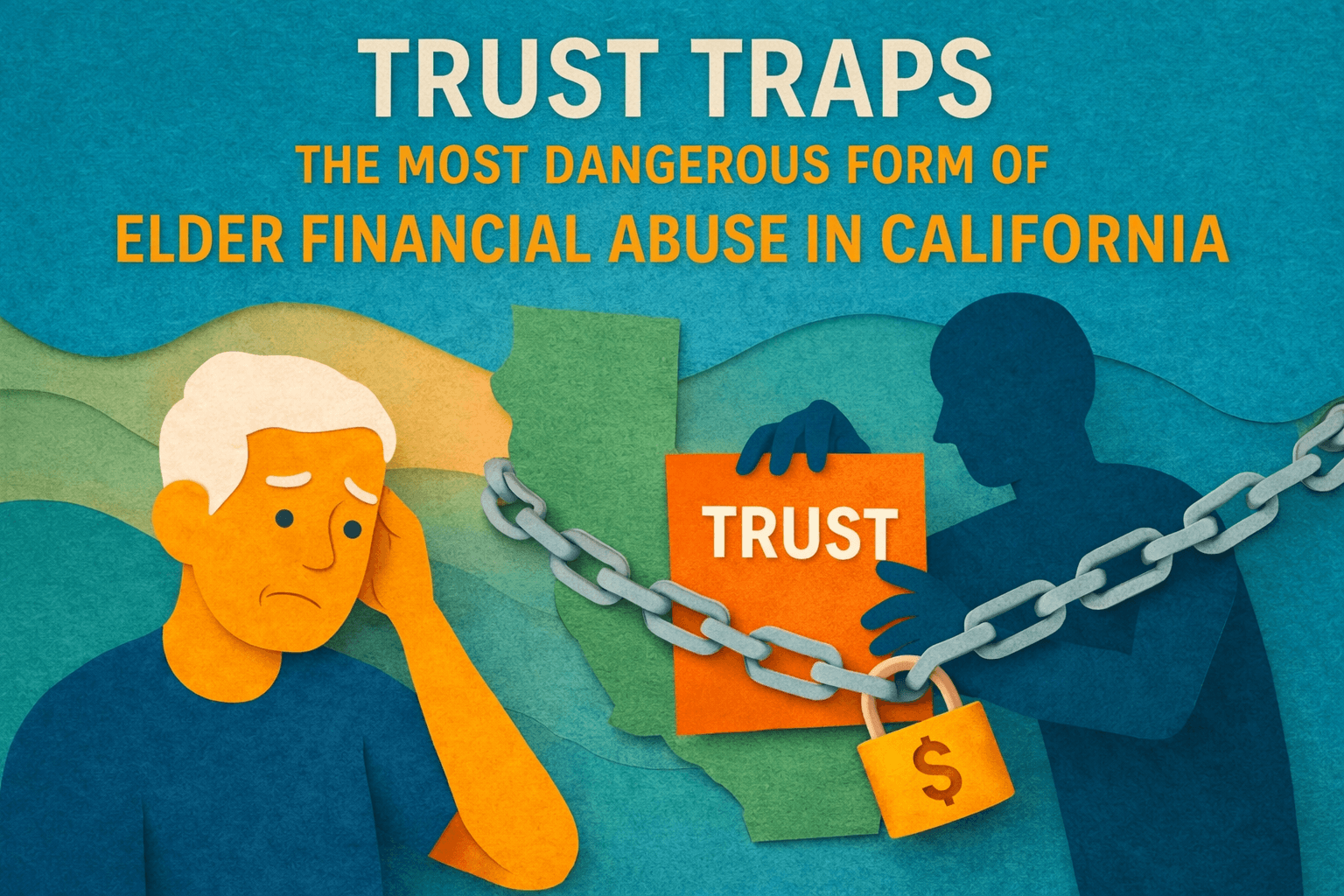
The Most Dangerous Form of Elder Financial Abuse in California

I’m Michael Hackard, and I have spent more than five decades litigating trust and estate disputes in California courts. Over that time, I have authored four published books on inheritance protection — including my book Inheritance Heists, which details how modern predators use trust authority to systematically steal entire family legacies. I have also produced more than 1,000 educational videos with over seven million views, all designed to help families recognize threats before it is too late.
Hackard Law represents heirs, beneficiaries, and elder abuse victims across Sacramento, the San Francisco Bay Area, and Los Angeles. The cases that concern me most are not the ones involving strangers breaking down doors. The most devastating losses come from people already trusted by the family — caregivers, new companions, and even licensed professionals who exploit their positions to redirect wealth away from the people who earned it. What I call “trust traps” represent the most dangerous category of elder financial exploitation because they weaponize the very relationships meant to protect our loved ones.
Hackard Law provides contingency fee representation for qualified cases — meaning families pay no upfront legal costs to pursue justice.
If you suspect a loved one is the target of a trust trap, contact Hackard Law immediately for a confidential consultation.
Quick Summary: What Are Trust Traps?
Trust traps are methodical elder financial abuse schemes that unfold over months. They exploit kindness, grief, and isolation to redirect family wealth. Here is what California families need to know.
- Trust traps begin with acts of helpfulness — not demands for money — making them nearly invisible in the early stages.
- Predators systematically isolate the victim from family members and longtime professional advisors before making major changes to estate documents.
- Six distinct red flags signal a trust trap in progress, and recognizing even one should prompt immediate action.
- California law provides powerful civil remedies, including double damages and asset recovery, for families who act quickly.
Red Flag One: The Helpful Takeover
The first phase of a trust trap looks nothing like abuse. It looks like generosity. A trusted insider gradually assumes control of daily financial activities. It begins with something as innocent as “Let me help you with those bills.” Within weeks, that person handles grocery shopping, bank deposits, and investment decisions.
Control expands systematically. The victim feels grateful, not suspicious. The person providing help positions themselves as indispensable, and the elderly individual begins to rely on them for every financial decision. This is not a coincidence — it is the foundation of a calculated scheme.
Families should pay close attention when one individual begins managing all aspects of a loved one’s financial life. A healthy arrangement involves honesty and multiple points of oversight. When a single person controls everything, the conditions for exploitation are already in place.
Case Pattern: The Grateful Widow. An elderly woman recovering from the loss of her husband accepted help from a longtime family friend who offered to manage household finances during her grief. Over the course of six months, the friend redirected automatic payments, changed account passwords, and told the widow that her adult children were too busy to help. By the time the family discovered the pattern, significant assets had been moved. The family deliberately inquired, pursued legal action early, and recovered the misappropriated funds.
Red Flag Two: New Best Friends and Professional Isolation
The second and third warning signs often appear together. A new relationship rapidly becomes central to the elderly person’s life. This is not a casual friendship. It is a well-planned relationship built specifically for financial access. The new companion becomes the primary social connection, and within months, other relationships are gradually discouraged or actively undermined.
At the same time, the victim becomes isolated from longtime professional advisors. The attorney they relied on for twenty years is suddenly deemed “too expensive.” The accountant “doesn’t understand the new situation.” Financial planners are replaced with unfamiliar professionals who have a prior relationship with the person orchestrating the scheme.
This combination — social isolation paired with professional isolation — creates a closed environment where the predator controls all information flowing to and from the victim. Michael Hackard identifies this pattern as one of the most dangerous phases of a trust trap because it eliminates the very safeguards designed to protect the elderly person.
Red Flag Three: The Introduction Game and Routine Updates
Pay attention when potential beneficiaries introduce unfamiliar legal or financial professionals into an elderly loved one’s life. This is not a coincidence — it is coordination. The new professionals often have a prior relationship with the person making the introduction. Longtime advisors who might raise concerns are systematically replaced.
Once the new professional team is in place, incremental changes to estate planning documents are presented as “routine updates.” Nothing about changing a will or trust should be treated as routine, especially when done repeatedly. Small changes accumulate into major shifts in beneficiaries. Each change is justified as necessary or beneficial, but the cumulative effect is a complete redirection of the estate away from the intended heirs.
California courts examine these patterns closely. When multiple document changes occur in a short period, particularly after the introduction of new advisors, it raises serious questions about undue influence and capacity.
Case Pattern: The Three Amended Wills. A caregiver slowly earned the elderly man’s trust after surgery. Within six months, she convinced him that his adult children were ungrateful and only interested in his money. She helped him change his will three times, with each version giving her greater control. By the time the family discovered the scheme, the caregiver had already transferred significant funds from his accounts. The man actually believed she was protecting him. The family filed suit, and the court examined the pattern of undue influence surrounding each amendment.
Red Flag Four: Grief Exploitation
No doubt that the cruelest tactic in the trust trap playbook involves using isolation or grief to justify excluding family members from an elderly person’s life. The manipulator uses language like “Your children don’t understand what you need right now.” Recent losses, health scares, or periods of loneliness turn into tools for driving wedges between the victim and the people who love them.
Emotional vulnerability becomes a weapon against family relationships. The predator positions themselves as the only person who truly understands and cares for the victim. Over time, the elderly person begins to believe that their own family members are adversaries rather than allies.
What makes these schemes so effective is that they exploit basic human needs — connection, security, and independence. Predators study their targets and learn their fears, values, and weaknesses. They do not attack those vulnerabilities. They offer to protect them. The victim feels rescued, not exploited. Unlike street criminals, these wolves at the door often carry professional credentials and present an image of respectability.
Why Trust Traps Succeed — and How California Law Fights Back
Trust traps succeed because they unfold slowly and exploit the appearance of legitimacy. The predator builds a foundation of trust before making any financial moves. By the time assets are transferred or documents are changed, the victim has been conditioned to view the predator as a defender.
California law provides robust tools for families who discover these schemes. The state’s elder financial abuse statutes allow courts to award double damages, attorney fees, and full asset recovery. Hackard Law pursues these remedies aggressively on behalf of heirs, beneficiaries, and elder abuse victims.
Timely action matters enormously. The longer a trust trap operates, the more difficult it becomes to trace assets and unwind fraudulent transfers. Families who recognize even one red flag should seek legal counsel immediately rather than waiting for more evidence. Courts take these patterns seriously and hold those who exploit positions of trust questionable; it is a cornerstone of California probate litigation.
Key Definitions
- Trust Trap: A systematic elder financial abuse scheme that exploits trusted relationships to redirect wealth away from intended beneficiaries.
- Undue Influence: Excessive persuasion that overcomes an elderly person’s free will, causing them to act in the influencer’s favor rather than their own.
- Professional Isolation: The deliberate removal of an elderly person’s longtime legal, financial, and medical advisors and their replacement with professionals aligned with the predator.
- Grief Exploitation: The manipulation of an elderly person’s emotional vulnerability following a loss or health crisis to justify major changes to estate documents.
- Helpful Takeover: The gradual assumption of control over an elderly person’s daily financial activities under the guise of assistance.
- Elder Financial Abuse: The illegal or improper use of an elder’s funds, property, or assets, as defined under California Welfare and Institutions Code Section 15610.30.
- Double Damages: A California statutory remedy that allows courts to award twice the actual damages in proven elder financial abuse cases.
- Contingency Fee Representation: A fee arrangement where the attorney collects fees only if the case results in a recovery, eliminating upfront costs for the client.
What to Do Next If You Suspect a Trust Trap
- Document every change you observe in your loved one’s behavior, relationships, and financial arrangements.
- Note when new individuals begin to control access to your loved one or manage their finances.
- Gather copies of prior estate planning documents if accessible — earlier versions of wills and trusts establish the baseline intent.
- Contact your loved one’s longtime attorney, accountant, or financial planner to determine whether they have been replaced or excluded.
- Request a formal trust accounting if a trustee refuses to provide financial transparency.
- Report suspected elder financial abuse to your county’s Adult Protective Services.
- Consult a California trust and estate litigation attorney who handles elder abuse cases on a contingency fee basis.
- Do not confront the suspected predator directly — this often causes them to accelerate asset transfers or destroy evidence.
- Preserve all communications, including texts, emails, and voice messages, that may reveal the predator’s influence.
- Act quickly — delay benefits the predator and makes asset recovery more difficult.
If your family faces a trust trap or any form of elder financial abuse, contact Hackard Law today to discuss your case.
Call the Sage
CALL THE SAGE | When Experience Matters, Families Listen
THE EXPERTISE:
📚 50 years California trust, estate & elder financial abuse litigation
⚖️ We represent heirs, beneficiaries, and elder abuse victims
🎥 1,000+ educational videos | 7 million+ views | 4 published books
🎯 “After thousands of cases, I see the pattern others miss.”
CONTINGENCY REPRESENTATION — No Win, No Fee
Throughout California: Sacramento | Los Angeles | Bay Area
📞 CALL THE SAGE: (916) 313-3030
Subscribe for weekly insights on:
- Elder financial abuse warning signs and prevention
- Trust and estate litigation strategies
- Inheritance protection for California families
- Family protection strategies
When your inheritance is under attack, call The Sage.
Hackard Law | 10640 Mather Blvd, Mather, CA 95655
Attorney Advertisement | Michael Hackard, State Bar #71067
RELATED VIDEOS
Trust Traps: Uncovering Elder Financial Abuse Schemes
Exact topic match to the blog post. This video covers the same trust trap concept, red flags, and legal remedies that form the core of the article.
5 Red Flags of Caregiver Exploitation: Protecting Your Loved Ones
Closely mirrors the blog’s red-flag structure (helpful takeover, isolation, grief exploitation) and the caregiver-as-predator pattern detailed throughout the article.
Dementia & Cognitive Decline: Protecting Seniors from Financial Exploitation
Addresses the cognitive and emotional vulnerability that trust trap predators exploit, complementing the blog’s discussion of grief exploitation and diminished capacity.
9 Signs It’s Time to Call an Elder Law Attorney
Aligns directly with the blog’s ‘What to Do Next’ action section, helping readers who have identified a trust trap understand when and why to seek legal counsel immediately.
Estate Fraud: Protect Generational Wealth from Deception
Complements the blog’s focus on fraudulent asset redirection and the systematic deception used in trust traps to strip intended heirs of their inheritance.
 Michael Hackard is the founder of Hackard Law, a California trust and estate litigation firm with more than five decades of experience protecting the inheritance rights of families across Sacramento, the San Francisco Bay Area, and Los Angeles. He is the author of four published books on inheritance protection and has produced more than 1,000 educational videos with over seven million views.