


 (916) 313-3030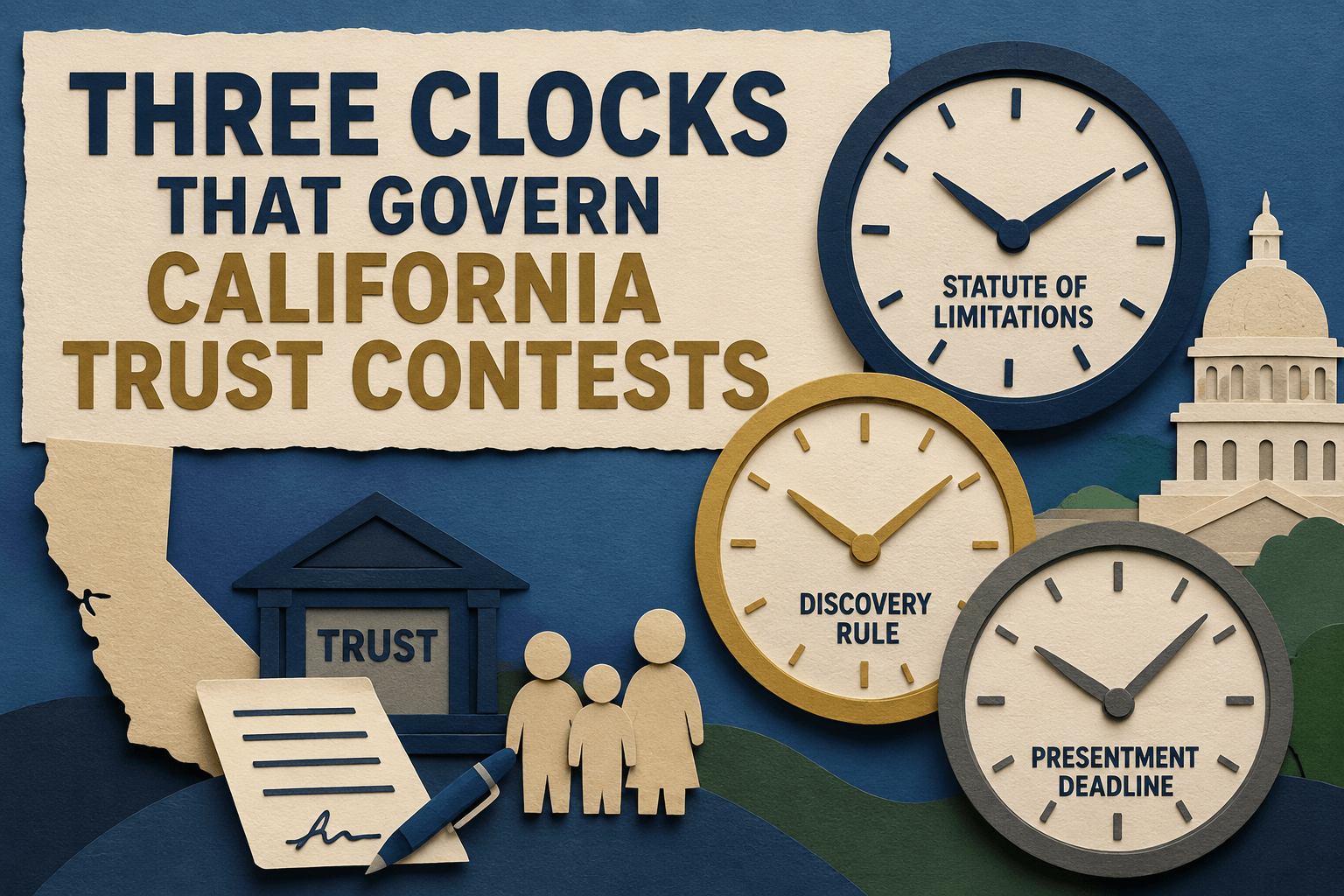
Three Clocks That Govern California Trust Contests: What Families Must Know

The Envelope That Starts the Clock
I am Michael Hackard, founder of Hackard Law. Over five decades of California trust and estate litigation, I have fought for heirs, beneficiaries, and elder abuse victims across Sacramento, the San Francisco Bay Area, and Los Angeles. I have written four books on inheritance protection and produced more than 1,000 educational videos with over seven million views combined. In all that time, one scenario repeats itself more than almost any other: a family receives a formal legal notice in the mail, sets it aside, and calls me months too late.
That envelope arrives three or four weeks after a parent dies. It comes on law firm letterhead. One page. It names the trust, identifies the trustee, and cites a California Probate Code section. The language is formal and unfamiliar. Most families read it once, do not understand what it is, and place it with the condolence cards. That is the most costly mistake a beneficiary can make. That envelope starts a clock – and in my experience, it is the most important piece of mail your family will ever receive.
Hackard Law provides contingency fee representation for qualified trust and estate cases – no upfront costs to you. To find out whether your case qualifies, call us at (916) 313-3030.
Quick Summary
California trust and estate law imposes three separate legal deadlines that govern different types of claims. Understanding which clock applies to your situation – and whether it is still running – can mean the difference between a viable case and a permanently closed door.
- The trust contest clock runs 120 days from proper service of the statutory notice under Probate Code section 16061.7.
- The elder financial exploitation clock runs four years from discovery of the harm, not from the date of the transfer or the date of death.
- The promise-and-reliance clock runs one year from death under Code of Civil Procedure section 366.3.
- A defective notice may mean the 120-day clock never started at all.
- Missing one deadline does not close the others – a family may still have strong claims even after the trust contest window has passed.
Clock One: The Trust Contest Window
Under California Probate Code section 16061.7, once a trustee properly serves a statutory notice, beneficiaries have 120 days to contest the trust. The grounds for contest include lack of capacity, undue influence, fraud, or the presumption under Probate Code section 21380 that applies to transfers made to drafters and caregivers. That window is fast, and it closes without announcement.
I have spoken with families who received that notice in March and called me in August – not because they were careless, but because a daughter was back at work, a son was finishing a trial, a brother was managing a lease dispute. The envelope looked like nothing. The trust contest window had closed in late June. The case that might have been filed never was.
For families navigating this process for the first time, understanding what California beneficiaries can do when a trustee delays distributions is a useful starting point – but the contest deadline is a separate and more urgent concern.
Case Pattern: The statutory notice was received by a family member who works out of state, but they assumed it was being handled by a sibling who lived closer. Within 120 days, neither filed. The window for contesting the trust had already closed when they eventually sought legal advice. But the exploitation clock had not.
What Most Families Don’t Know About the 120-Day Window
Two facts about the trust contest deadline regularly surprise the families I speak with. First, if the notice did not include a copy of the trust, you can request one. The trustee is required to provide it. The contest window then runs until the later of 120 days from the notice or 60 days from the date the trust was delivered. The clock may be running later than you think.
Second, a defective notice does not start the clock at all. Wrong address, wrong beneficiary list, missing the statutorily required warning language – any of these defects can render the notice legally ineffective. Families who assume they are too late are sometimes wrong about whether the clock ever started. A California trust litigation attorney can review the actual notice and tell you which clock governs your situation – and whether it is still running. The 8 stages of trust and estate litigation often begin with exactly this kind of threshold analysis.
Clock Two: The Elder Financial Exploitation Window
The second clock is the one most families never consider. It runs four years from discovery – not from the date of the transfer, not from the date of death, but from when you learned or reasonably should have learned what happened. A family that discovers in 2026 that a trust was amended in 2022 during a hospitalization they did not know about does not have a 2022 problem on the exploitation claim. They have a 2030 problem. The clock has barely started.
This clock reaches defendants the trust contest would never have reached. The attorney who drafted the amendment. The accounts were transferred by the financial advisor. According to Probate Code section 21380, the transfer is presumed to be void if the caregiver was present during the signing. The accountant saw a transaction that he knew was improper. A successful exploitation claim is subject to doubled damages upon a finding of bad faith and mandatory attorney’s fees upon recovery under California Welfare and Institutions Code section 15657.7.
Case Pattern: A family lost the trust contest window after a parent’s death. They later learned that a caregiver had been present at every estate planning meeting in the final year of the parent’s life. The exploitation claim, filed well within the four-year discovery window, reached the caregiver and the drafting attorney directly – parties the trust contest alone would never have named.
For a deeper look at how California law protects families in these situations, the civil remedies for elder financial abuse – including double damages and attorney’s fees – are worth understanding before concluding a case is over.
Clock Three: The Promise-and-Reliance Claim
The third clock is narrow but powerful in the right circumstances. Code of Civil Procedure section 366.3 gives claimants one year from death to pursue a claim based on a promise made and relied upon. A father tells his daughter for years that the ranch will come to her if she works it. She works it. The trust says otherwise. One year from death.
This clock does not apply broadly, but when the facts fit, it reaches conduct that neither the trust contest nor the exploitation claim would cover. It is a claim grounded in reliance – in what a person gave up or gave in because of what they were told. Families dealing with property disputes of this kind may also find the discussion of the top 10 most common probate, trust, and estate battles useful for understanding how courts treat these competing claims.
Three Clocks, Three Strategies
These three clocks do not all start at the same time. A family that has lost on the trust contest clock may still have everything on the exploitation clock. A family that missed the one-year promise claim may still have years remaining on the discovery-based exploitation window. The clocks run independently, and the analysis requires knowing which one governs your facts.
I have stood with families in Sacramento, across the Bay Area, and throughout Los Angeles for five decades. The financial toll grows when action is delayed. The fracture that runs through a family after an inheritance dispute often runs too deep for any judgment to mend – but a steadfast commitment to truth restores what dishonesty tried to steal. Discovery, forensic review, and the pursuit of accountability are not just legal strategies. They are safeguards for families who trusted that a parent’s wishes would be honored.
If you are unsure which clock governs your situation, or whether a notice you received was legally effective, the right step is a consultation – not an assumption. You can learn more about how to choose the right probate lawyer for your situation, or review Hackard Law’s contingency fee representation guide to understand your options before making a decision.
Key Definitions
- Probate Code section 16061.7: The California statute requiring trustees to serve a statutory notice on beneficiaries and heirs after a trust becomes irrevocable, triggering the 120-day contest window.
- Trust contest: A legal challenge to the validity of a trust or trust amendment, typically based on lack of capacity, undue influence, fraud, or statutory presumptions.
- Statutory notice: The formal written notice a trustee must serve under Probate Code section 16061.7, which must include specific warning language and a copy of the trust to be legally effective.
- Discovery rule: The legal principle that a statute of limitations begins to run when the claimant knew or reasonably should have known of the harm, not necessarily when the harm occurred.
- Probate Code section 21380: A California statute creating a presumption of undue influence when a donative transfer is made to a drafter, care custodian, or other person in a position of trust.
- Welfare and Institutions Code section 15657.7: The California elder financial abuse statute that provides for a four-year discovery-based limitations period, mandatory attorney’s fees, and double damages for bad-faith conduct.
- Code of Civil Procedure section 366.3: The statute governing claims based on a promise to make a distribution from an estate or trust, with a one-year limitations period running from the date of death.
- Defective notice: A statutory notice that fails to meet the requirements of Probate Code section 16061.7 – such as wrong address, missing beneficiaries, or absent warning language – and therefore does not start the 120-day clock.
- Donative transfer: A transfer of property made as a gift, including transfers made through a trust amendment, will, or beneficiary designation.
- Contingency fee representation: A fee arrangement in which the attorney is paid only upon a successful recovery, with no upfront costs to the client.
What to Do Next
- Look for any envelope from a law firm or trustee that arrived after a parent’s death – even if it was set aside weeks or months ago.
- Get copies of all trust documents referenced in any notice you received, including any amendments.
- Try to avoid assuming you have missed a deadline without having an attorney confirm whether the notice was legally effective.
- Look for signs that a caregiver, financial advisor, or attorney was present during estate planning changes in the final years of a parent’s life.
- Try to identify when your family first learned – or could reasonably have learned – about any suspicious transfer or amendment.
- Look for written communications, financial records, or witness accounts that document promises made about property or inheritance.
- Review the 5 things California trust beneficiaries must know before concluding you have no options.
- Get a copy of the statutory notice reviewed by a California trust litigation attorney to determine whether it was served correctly.
- Call Hackard Law at (916) 313-3030 to discuss which clock governs your situation and whether it is still running.
- Visit our contact page to schedule a consultation and learn whether your case qualifies for contingency fee representation.
CALL THE SAGE | When Experience Matters, Families Listen
🏛️ We practice California trust & estate & elder financial abuse litigation
⚖️ We represent heirs, beneficiaries, and elder abuse victims
🎥 1,000+ educational videos | 7 million+ views | 4 published books
🎯 “After thousands of cases, I see the pattern others miss.”
CONTINGENCY REPRESENTATION – No Win, No Fee
Throughout California: Sacramento | Los Angeles | Bay Area
📞 CALL THE SAGE: (916) 313-3030
Subscribe for weekly insights on:
- Elder financial abuse warning signs and prevention
- Trust and estate litigation strategies
- Inheritance protection for California families
- Family protection strategies
When your inheritance is under attack, Call The Sage.
Hackard Law | 10640 Mather Blvd, Mather CA 95655
Attorney Advertisement | Michael Hackard, State Bar #71067
RELATED VIDEOS
LA Trust & Estate Litigation Deadlines | Time’s Up?
Explains why missing litigation deadlines in trust disputes can end your case.
California Trust & Estate Litigation | Delay Is Not Your Friend
Warns beneficiaries about the serious consequences of waiting too long to act.
San Francisco Trust and Estate Litigation Timing Is Critical Hackard Law
Covers why acting quickly after a loved one’s death protects your legal rights.
Are You a Trust Beneficiary? Know Your Rights
Walks through the key legal rights beneficiaries hold under California trust law.
The 3 Biggest Risks to Family Wealth | CA Estate & Trust Litigation
Identifies the most common threats that put family inheritances in serious jeopardy.
Trust & Estate Litigation | From A to Z
Provides a broad overview of how California trust and estate litigation works.
 Michael Hackard is the founder of Hackard Law, a California trust and estate litigation firm with more than five decades of experience protecting the inheritance rights of families across Sacramento, the San Francisco Bay Area, and Los Angeles. He is the author of six published books on inheritance protection and has produced more than 1,000 educational videos with over seven million views.