


 (916) 313-3030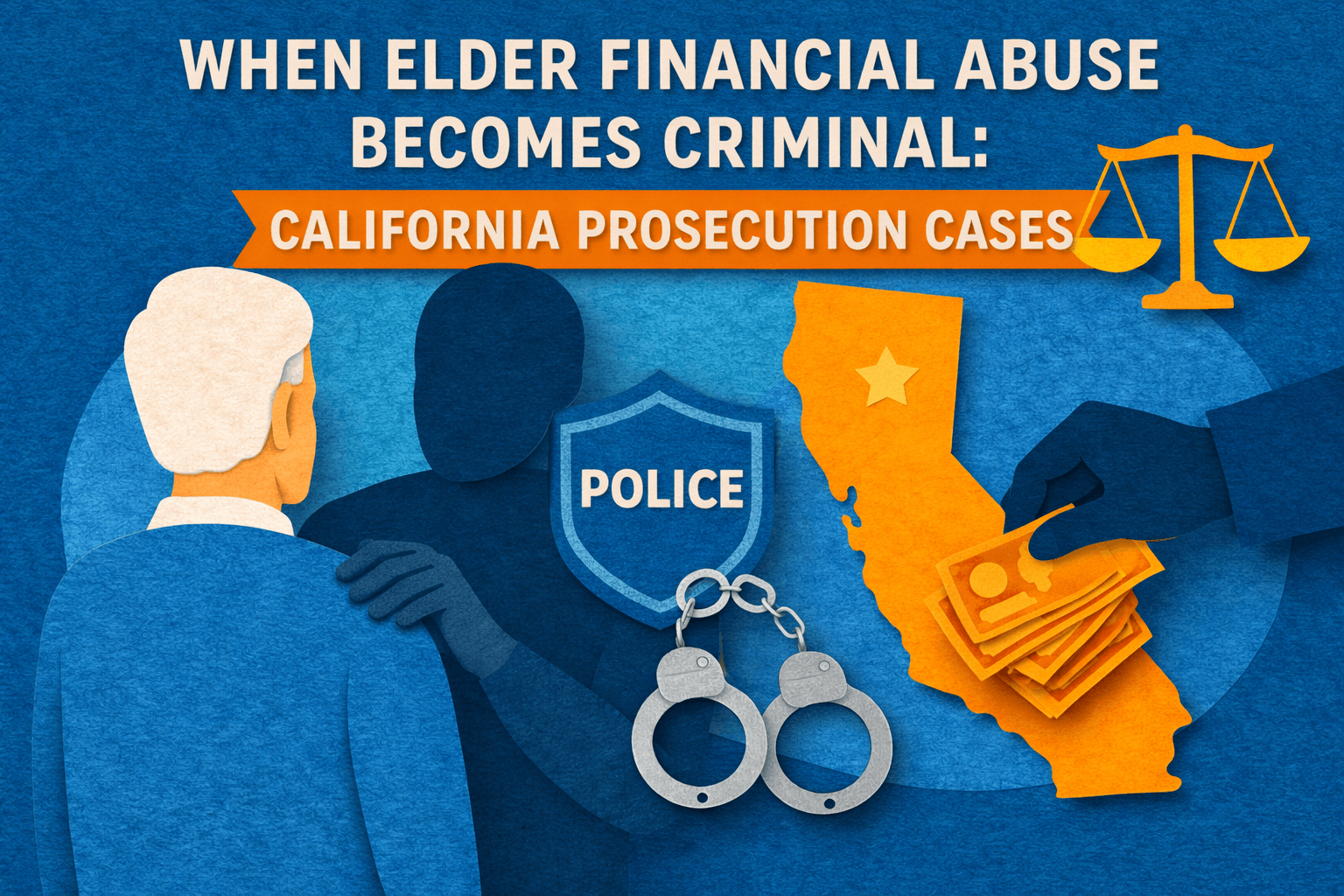
When Elder Financial Abuse Becomes Criminal: California Prosecution Cases

Understanding When Financial Elder Abuse Crosses the Criminal Line
I’m Michael Hackard, founder of Hackard Law. Over more than five decades of practicing trust, estate, and elder financial abuse litigation in California, I have seen the devastating toll that financial predators take on vulnerable adults and their families. I have written four published books on inheritance protection, each designed to arm families with the knowledge they need to fight back. I have also produced more than 1,000 educational videos — now with over seven million views — explaining the legal tools available to California families facing exploitation and inheritance theft. Hackard Law represents heirs, beneficiaries, and elder abuse victims across Sacramento, the San Francisco Bay Area, and Los Angeles in civil contingency fee trust, estate, and elder financial abuse actions. While our firm operates in the civil courts and does not prosecute criminal cases, the conduct that surfaces in our civil litigation often looks unmistakably criminal. In this post, I break down recent cases where law enforcement agencies stepped in to prosecute financial elder abusers, explain the difference between civil and criminal proceedings, and outline what families can do to protect their loved ones.
Hackard Law provides contingency fee representation for qualified cases, meaning families pay no upfront attorney fees to begin pursuing justice against those who exploit the elderly.
If you suspect elder financial abuse in your family, call Hackard Law at (916) 313-3030 for a free consultation.
Quick Summary
Financial elder abuse in California can lead to both civil lawsuits and criminal prosecution. While Hackard Law litigates civil cases on a contingency-fee basis, the conduct uncovered in those proceedings often triggers criminal investigations. Recent federal and state prosecutions illustrate the serious consequences for those who exploit vulnerable adults.
- A Fresno hairstylist and actress face federal charges for allegedly defrauding a physician out of more than $2.7 million and attempting to steal over $20 million more from his estate
- A Fresno man was sentenced to over five years in federal prison for bank fraud and identity theft targeting an elderly victim.
- A Tuolumne County woman received a 12-year state prison sentence for draining her disabled mother’s retirement account.
- A Wisconsin man was sentenced to three years in prison for stealing over $426,000 as the power of attorney for a vulnerable adult.
Civil vs. Criminal Elder Abuse: The Burden of Proof Difference
The burden of proof is where civil and criminal elder financial abuse proceedings diverge. In a civil case, the plaintiff must prove each element of liability by a preponderance of the evidence. This is often described as the “more likely than not” standard. If the evidence tips even slightly in the victim’s favor, the civil case can succeed.
Criminal prosecutors face a much higher bar. Federal and state prosecutors must prove guilt beyond a reasonable doubt. This is the highest standard of proof in the American legal system. It means that a jury must be firmly convinced of the defendant’s guilt before returning a guilty verdict.
Because the civil standard is lower, families can pursue financial recovery through civil litigation even when criminal prosecutors decline to file charges. Many families find that a civil remedy for elder financial abuse provides meaningful relief, including the potential for double damages and attorney fee recovery under California’s Elder Abuse Act.
Hackard Law does not have the authority to prosecute criminal cases. However, facts uncovered during civil trust and estate litigation often reveal conduct that law enforcement agencies choose to investigate and prosecute independently.
Federal Prosecution: The Fresno Physician Case
In February 2024, the U.S. Department of Justice announced charges against Anthony David Flores, a Fresno hairstylist, and Anna Renee Moore, an actress. Each defendant was charged with conspiracy to commit wire fraud and mail fraud, aggravated identity theft, wire fraud, mail fraud, conspiracy to engage in money laundering, money laundering, and engaging in monetary transactions with criminally derived property.
The indictment alleges that Flores and Moore defrauded a physician out of more than $2.7 million before his death and then attempted to defraud his estate out of an additional amount exceeding $20 million. The defendants allegedly concealed the victim’s financial information from his mother and sister, both of whom lived in Florida.
It was the victim’s family filing a civil lawsuit that ultimately uncovered the alleged fraud. This is a pattern Michael Hackard identifies repeatedly: families pursue civil litigation, and the discovery process exposes conduct so egregious that law enforcement takes notice. The defendants have pleaded not guilty. If convicted on all counts, they face statutory maximum sentences of 20 years in prison for each fraud count, 20 years for conspiracy and money laundering counts, ten years for transactional money laundering, and a mandatory two-year sentence for aggravated identity theft.
Case Pattern: The Concealed Relationship. A trusted individual — sometimes a caregiver, friend, or service provider — gains the confidence of a vulnerable adult. Over time, the individual isolates the elder from family, redirects finances, and conceals the exploitation until a family member files a civil action that exposes the scheme. This pattern appears in cases across California.
Identity Theft and Bank Fraud: Draining an Elder’s Savings
Also in February, the U.S. Attorney’s Office for the Eastern District of California announced the sentencing of Brian Stoffel, age 38, of Fresno. Stoffel received a sentence of five years and four months in federal prison for bank fraud and identity theft committed against an elderly victim.
According to court documents, between September 2020 and August 2021, Stoffel obtained the personally identifiable information of an elderly victim and used it to drain the victim’s savings. He also applied for loans in the victim’s name. Stoffel spent the stolen funds on a new motorcycle, an NFL playoff game, and retail shopping. This case demonstrates how quickly an elder’s life savings can disappear when a predator gains access to personal financial information.
Families who suspect that someone has exploited a vulnerable adult should act immediately. Early intervention can limit the financial damage and preserve evidence for both civil and criminal proceedings.
State Prosecution: A Daughter’s Betrayal
In Tuolumne County, California, the district attorney prosecuted Kayleen Chantel McMillan for systematically draining her disabled mother’s entire retirement account. McMillan forged checks, altered powers of attorney, and committed felony child abuse. Superior Court Judge Laura Creagh sentenced McMillan to 12 years in state prison, noting that taking all of a disabled mother’s money was terrible and that children should take care of their elderly parents, not steal from them.
This case highlights a disturbing reality: financial exploitation frequently comes from within the family. Adult children, grandchildren, and other relatives often have the closest access to an elder’s finances and the greatest opportunity to manipulate legal documents, such as powers of attorney.
When a power of attorney becomes a weapon rather than a protective tool, the consequences for the elder can be catastrophic. California law provides both civil and criminal remedies for this type of abuse.
Case Pattern: The Altered Power of Attorney. A family member who holds power of attorney begins withdrawing money from the elder’s accounts without authorization. The agent alters or forges financial documents to cover the trail. The exploitation continues until the elder’s account is empty or another family member notices irregularities. In many instances, the elder’s cognitive decline prevents them from identifying the theft.
Common Tools and Tactics of Financial Elder Abusers
Across these cases and many others like them, certain tools and tactics appear with alarming regularity. Abusers use money laundering to disguise stolen funds. They commit mail fraud and wire fraud to move money through financial institutions. They forge checks and alter legal documents, especially powers of attorney. They open bank accounts in the victim’s name. They commit aggravated identity theft to access credit and loans.
The stolen funds are used for a wide range of personal expenditures: casinos and gambling, home improvements, new vehicles and motorcycles, bar and restaurant expenses, drugs, vacations, retail purchases, and entertainment. The common thread is that the abuser treats the elder’s life savings as a personal bank account.
California’s inheritance theft protections apply when exploitation occurs before death, during estate administration, or both. Hackard Law litigates these cases in California’s largest urban areas, pursuing civil recovery for families who have lost assets to fraud and exploitation.
Key Definitions
- Preponderance of Evidence: The civil burden of proof requires that a claim is more likely true than not true
- Beyond a Reasonable Doubt: The criminal burden of proof, the highest standard in American law, requiring near certainty of guilt
- Aggravated Identity Theft: A federal crime involving the use of another person’s identity to commit certain felonies, carrying a mandatory two-year prison sentence
- Wire Fraud: A federal crime involving the use of electronic communications to carry out a scheme to defraud
- Money Laundering: The process of disguising illegally obtained money to make it appear legitimate
- Power of Attorney: A legal document granting one person authority to act on behalf of another in financial or legal matters
- Elder Financial Abuse: The illegal or improper use of an elder’s funds, property, or assets by a person in a position of trust or authority
- Contingency Fee Representation: A fee arrangement where the attorney receives payment only if the case results in a recovery for the client
- Double Damages: Under California’s Elder Abuse Act, courts may award twice the actual damages when abuse is proven by clear and convincing evidence
What to Do Next If You Suspect Elder Financial Abuse
- Record & track every suspicious transaction, withdrawal, or any change you observe in your loved one’s accounts
- Gather copies of any trust documents, wills, powers of attorney, and bank statements you can access
- Report suspected abuse to your local Adult Protective Services agency immediately
- Contact law enforcement if you believe criminal conduct has occurred
- Consult with a California trust and estate litigation attorney who handles elder financial abuse cases on a contingency fee basis
- Do not confront the suspected abuser directly, as this can lead to the destruction of evidence
- Request a formal accounting from any trustee or agent who controls your loved one’s finances
- Preserve all communications — emails, text messages, and letters — between the elder and the suspected abuser.
- Learn how to choose the right probate lawyer for your family’s situation
Call Hackard Law today at (916) 313-3030 to discuss your family’s case in a free and confidential consultation.
CALL THE SAGE | When Experience Matters, Families Listen
THE EXPERTISE:
📚 50 years California trust, estate & elder financial abuse litigation
⚖️ We represent heirs, beneficiaries, and elder abuse victims
🎥 1,000+ educational videos | 7 million+ views | 4 published books
🎯 “After thousands of cases, I see the pattern others miss.”
CONTINGENCY REPRESENTATION — No Win, No Fee
Throughout California: Sacramento | Los Angeles | Bay Area
📞 CALL THE SAGE: (916) 313-3030
Subscribe for weekly insights on:
- Elder financial abuse warning signs and prevention
- Trust and estate litigation strategies
- Inheritance protection for California families
- Family protection strategies
When your inheritance is under attack, Call The Sage.
Hackard Law | 10640 Mather Blvd, Mather CA 95655
Attorney Advertisement | Michael Hackard, State Bar #71067
RELATED VIDEOS
Trust Traps: Uncovering Elder Financial Abuse Schemes
Directly mirrors the blog’s core focus on how financial predators construct exploitation schemes, including the concealed-relationship and power-of-attorney-as-weapon patterns discussed in the Fresno and Tuolumne County cases.
Inheritance Heists Ch. 9: Caregivers & Elder Financial Exploitation
Strongly topical: the blog’s Fresno physician case centers on a trusted service provider (hairstylist) gaining an elder’s confidence and concealing the fraud—exactly the caregiver/trusted-person exploitation pattern this video addresses.
5 Red Flags of Caregiver Exploitation: Protecting Your Loved Ones
Complements the blog’s ‘What to Do Next’ and warning-signs sections, giving readers a practical checklist perspective on spotting the same patterns described in the prosecution cases.
Dementia & Cognitive Decline: Protecting Seniors from Financial Exploitation
The blog explicitly notes that cognitive decline often prevents elders from recognizing theft, as in the Tuolumne County case. This video addresses that vulnerability directly, adding important context for readers.
Estate Fraud: Protect Generational Wealth from Deception
Matches the Fresno physician case where defendants allegedly attempted to defraud the victim’s estate of over $20 million after his death—illustrating how financial abuse extends into estate administration.
9 Signs It’s Time to Call an Elder Law Attorney
Reinforces the blog’s call-to-action section by giving readers a clear decision framework for when to seek legal help—directly supporting the blog’s guidance on early intervention to preserve assets and evidence.
 Michael Hackard is the founder of Hackard Law, a California trust and estate litigation firm with more than five decades of experience protecting the inheritance rights of families across Sacramento, the San Francisco Bay Area, and Los Angeles. He is the author of four published books on inheritance protection and has produced more than 1,000 educational videos with over seven million views.