


 (916) 313-3030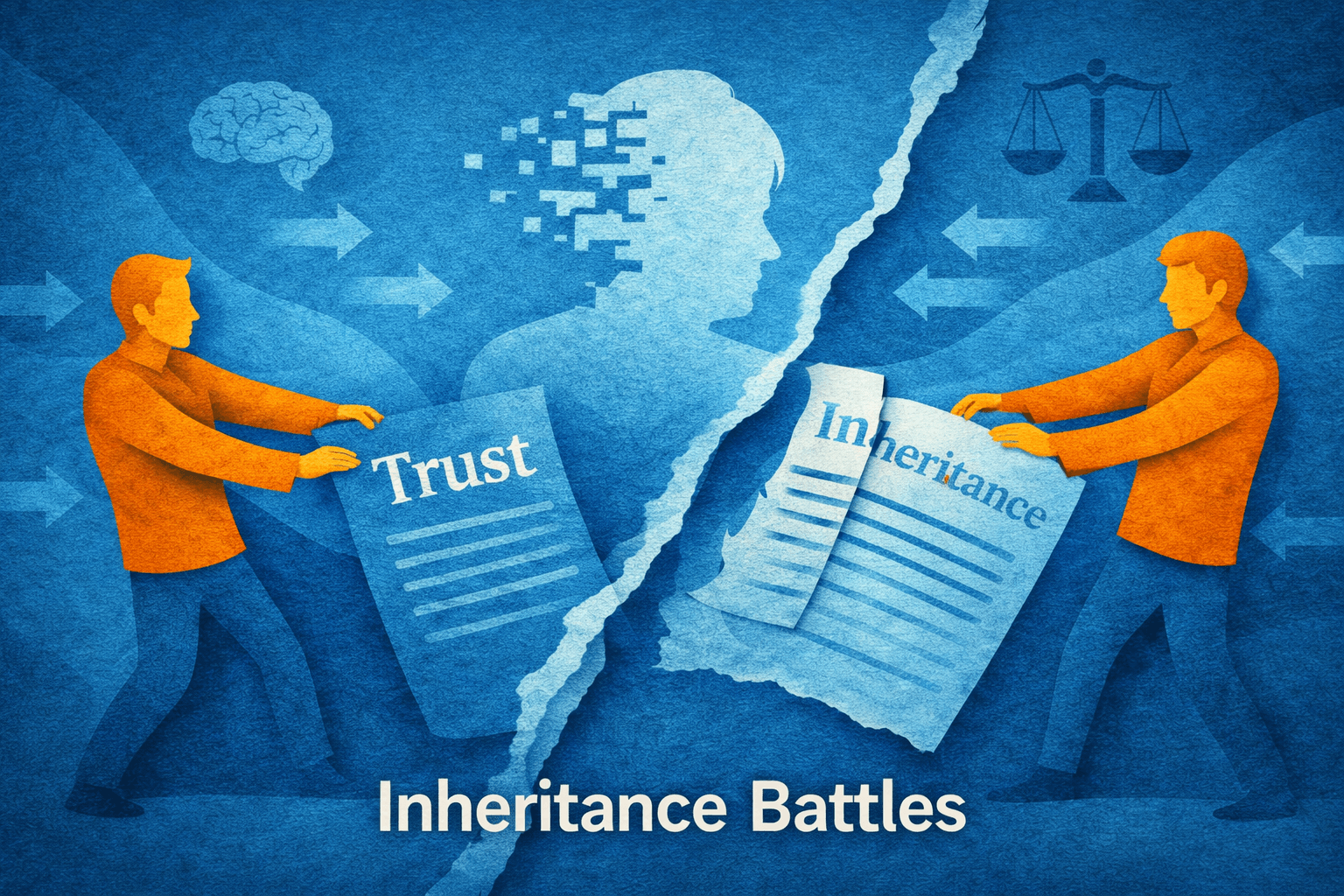
When Siblings Go to War: How Alzheimer’s Diagnoses Trigger Family Inheritance Battles

They were close their entire lives. Called each other every Sunday. Showed up for graduations, funerals, the ordinary Saturdays in between. Then their mother received an Alzheimer’s diagnosis, and one sibling moved in to help. Six months later, the trust had been rewritten. The other siblings found out at the funeral. What had been a family became a lawsuit.
This story is not unusual. Alzheimer’s inheritance disputes are among the most emotionally devastating and legally complex cases handled in California estate litigation. The disease doesn’t just rob a person of their memory — it creates a legal vulnerability that other people rush to fill, sometimes with the best of intentions, sometimes with something far darker. Either way, families fracture. Legacies disappear. And the courts are left sorting out what the parent actually wanted, often years after the documents were signed and the damage was done.
The Diagnosis That Splits Families Apart
Alzheimer’s disease is a progressive neurodegenerative condition that doesn’t announce its arrival with a clean timestamp. Symptoms emerge gradually, a missed appointment here, a repeated question there, and the legal implications accumulate just as quietly. The moment a diagnosis is confirmed, however, the family dynamic shifts in ways that are both predictable and catastrophic. Suddenly, someone has to be in charge. Someone has to make decisions about finances, about care, about where Mom will live, and who will manage her accounts. And when no legally binding documents exist to answer those questions, or when existing documents are vague, siblings answer them for themselves.
That is where the conflict begins. Not always with malice. Sometimes it begins with exhaustion — one sibling doing the physical labor of caregiving and gradually coming to believe, understandably if not legally, that this entitles them to financial authority. Sometimes it begins with old grievances, long-standing family hierarchies, or simply different interpretations of what a parent “would have wanted.” The sibling conflict over inheritance that arises from these circumstances is rarely simple and is almost never resolved quickly.
California courts see this pattern constantly. One child lives nearby and takes on the caregiving role. The other children live in different cities, trust that their sibling is handling things responsibly, and slowly lose visibility into what is actually happening. By the time they realize something has gone wrong, the estate documents have been changed, the financial accounts have been restructured, and the parent who might have explained everything is no longer able to do so.
Why Alzheimer’s Makes Estate Plans Collapse
Testamentary Capacity: The Question at the Heart of Every Dispute
Suppose a parent with an Alzheimer’s diagnosis signs a new trust amendment six months after the diagnosis is confirmed. The document is notarized. An attorney was present. Everything looks proper on its face. But the question that will drive the litigation is not whether the paperwork was completed correctly. The question is whether that parent, at the exact moment of signing, understood the nature of their assets, the identity of their natural heirs, and the legal consequences of what they were signing. That is testamentary capacity, and in Alzheimer’s cases, it is the issue at the center of nearly every court battle (California Probate Code Section 6100.5 , Testament).
California law sets a relatively low bar for testamentary capacity. Under Probate Code Section 6100.5, a person lacks testamentary capacity only if they cannot understand the nature of the testamentary act, the nature and situation of their property, or their relationship to living descendants, spouse, and parents. An Alzheimer’s diagnosis alone does not deny a person legal capacity. Capacity continues to fluctuate, especially in the early and middle stages of the disease. A person may have a lucid morning and a confused afternoon. They may answer direct questions coherently in a structured setting, yet be completely disoriented in ordinary life.
This is precisely why documents executed after a diagnosis are legally vulnerable, and why the timing, circumstances, and witnesses surrounding any estate document change become critical evidence in litigation. A California court evaluating a contested trust amendment will consider medical records from the period surrounding the signing, depositions from the attorney who drafted the document, testimony from witnesses who were present, and expert opinions from neurologists and geriatric psychiatrists who can reconstruct the parent’s cognitive state at that moment.
The Statute of Limitations Does Not Wait for Grief to Pass
One of the most consequential facts that families discover too late is that California imposes strict time limits on contesting estate documents. Under Probate Code Section 16061.7, a trustee is required to notify beneficiaries when a trust becomes irrevocable, and beneficiaries generally have 120 days from receipt of that notice to file a contest. I miss that window, and even a clearly manipulated trust amendment may be unreachable. The grief of losing a parent, the shock of discovering a rewritten estate, the weeks spent trying to understand what happened, none of that stops the clock.
Families who suspect something went wrong need to consult a California estate litigation attorney before doing anything else. Not after they have gathered all the evidence. Not after they have confronted the sibling who moved in. Before. Because the legal window for challenging a fraudulent or capacity-deficient estate document can close faster than most people realize, and once it closes, the options narrow dramatically.
The Caregiver-Influencer Pattern: The Most Common Fact Pattern in These Cases
How Proximity Becomes Power
Undue influence does not require a villain. California courts recognize that undue influence can arise from a combination of vulnerability, dependency, and opportunity, none of which requires conscious wrongdoing on the part of the influencer. The most common fact pattern in Alzheimer’s inheritance disputes involves a sibling who moved in to provide care, gradually took over the parent’s financial management, and over time became the gatekeeper who controlled access to the parent, to information, and to the parent’s professional advisors.
This pattern is worth understanding because it is genuinely easy to misread.
The caregiver sibling is often doing real work. Managing medications. Driving to appointments. Handling the finances. They may be running on empty while other siblings are nowhere to be found. That breeds resentment, and it’s not always unwarranted.
Over time, they may come to believe they deserve more. Not as a rationalization, but as a sincere conviction. They sacrificed. The others didn’t. So when the parent says, “I want to take care of you,” it doesn’t feel like manipulation. It feels like things are finally being made right.
That’s what makes it so hard to see clearly from the outside.
But California courts look at the totality of the circumstances. When a cognitively impaired parent suddenly changes an estate plan to dramatically benefit the caregiver sibling, when other family members have been isolated from the parent, when the caregiver controlled the parent’s access to legal counsel, and when the changes occurred without any independent advice, those facts, taken together, can establish undue influence regardless of whether the caregiver intended to do anything wrong. You can read more about how this dynamic operates in our analysis of when caregiving becomes financial control.
The Isolation Strategy
One of the most reliable warning signs in these cases is isolation. When a parent with Alzheimer’s stops returning phone calls, when visits become difficult to arrange, when the caregiver sibling always seems to be present during conversations, these are not coincidences. They are the conditions that allow influence to operate without witnesses. An isolated parent cannot receive independent advice. They cannot hear from other family members who might raise concerns. They cannot be observed by anyone who might later testify about their mental state.
Courts have seen this pattern so many times that isolation itself, when combined with cognitive decline and a changed estate plan, functions as circumstantial evidence of undue influence. If you are a sibling who has been cut off from your parent, document every attempt you make to visit or communicate. Keep records of phone calls, emails, and visits. That documentation may become important evidence if litigation becomes necessary.
What California Courts Actually Examine
When one of these cases reaches a courtroom, the court is essentially trying to reconstruct the past.
The central question is what the person actually understood, intended, and experienced at a specific moment in time, often years before anyone filed a lawsuit. That gap makes everything harder.
The evidence that carries the most weight:
- Medical records from around the time the documents were signed
- Physician testimony on how the disease was progressing
- Messages and communications between family members from that period
- Financial records showing changes in account ownership or beneficiary designations
- Testimony from anyone who had direct contact with the parent during that time
None of it is clean. It’s all reconstruction.
How probate judges examine credibility in high-conflict estate cases is a subject that deserves careful attention. Judges are experienced at evaluating conflicting accounts of the same events, and they are particularly attuned to inconsistencies in the testimony of parties who stand to benefit from a particular outcome. A sibling who claims the parent was completely lucid at the time of signing, but who also controlled all access to that parent, faces a credibility problem that no amount of notarized paperwork can fully resolve.
California also recognizes claims for elder financial abuse under Welfare and Institutions Code Section 15610.30, which provides for enhanced remedies including attorney’s fees and, in some cases, double damages. When an Alzheimer’s inheritance dispute involves not just a changed trust but also actual financial exploitation, transfers of money, changes to bank accounts, and real estate transactions that benefited the caregiver, those additional claims can significantly expand the legal remedies available to the excluded family members.
The Path Forward: What Families Can Actually Do
Act on Suspicion, Not Certainty
The most common mistake families make in these situations is waiting until they are certain something went wrong before consulting an attorney. By the time certainty arrives, usually at the funeral, when the new trust documents are revealed, critical deadlines may have already passed, evidence may have been lost, and the legal options may have narrowed. Suspicion is enough. If something feels wrong, if your parents’ estate documents changed after the diagnosis, if you have been cut off from contact, if financial accounts look different than they used to , those concerns are worth a conversation with an attorney who handles California estate litigation.
Gather What You Can, While You Can
If your parent is still living, there are steps you can take that may preserve your legal options. Requesting copies of existing trust documents, asking to be included in conversations with the parent’s attorney, documenting your observations about the parent’s cognitive state, and consulting with a physician about the parent’s capacity all create a record that can be valuable if litigation becomes necessary. If the parent is willing, an independent neuropsychological evaluation can establish a baseline of cognitive function that will later serve as important evidence.
After a parent’s passing, the focus shifts to obtaining financial records, identifying the attorney who drafted any changed documents, and locating witnesses who interacted with the parent during the relevant period. An experienced estate litigation attorney can assist with formal discovery processes that compel the production of records that the caregiver sibling may be reluctant to share.
Understand That Mediation Is Sometimes the Right Answer
Not every Alzheimer’s inheritance dispute needs to go to trial. California courts encourage mediation in estate disputes, and for families where the underlying relationships are worth preserving, a negotiated resolution can sometimes achieve more than years of litigation. That said, mediation only works when both sides negotiate in good faith and when the evidence of wrongdoing is clear enough to create real pressure on the party that benefited from the changed documents. An attorney who understands both the litigation and mediation landscape can help you assess which path makes sense for your specific situation.
Alzheimer’s inheritance battles are not inevitable. They are the predictable consequence of a legal vulnerability that most families don’t know exists until it has already been exploited. Understanding that vulnerability and knowing that California law provides real remedies for families who act in time is the first step toward protecting what your parent actually intended.
If you are facing a situation where a parent’s estate plan changed after an Alzheimer’s diagnosis, or where a sibling’s caregiving role has crossed into financial control, the attorneys at Hackard Law have handled hundreds of cases that began exactly where yours is beginning now. The diagnosis was the beginning of your parents’ crisis. Getting the right legal counsel is the beginning of your ending.
Past results do not guarantee future outcomes. Free consultation available.
 Michael Hackard is the founder of Hackard Law, a California trust and estate litigation firm with more than five decades of experience protecting the inheritance rights of families across Sacramento, the San Francisco Bay Area, and Los Angeles. He is the author of four published books on inheritance protection and has produced more than 1,000 educational videos with over seven million views.