


 (916) 313-3030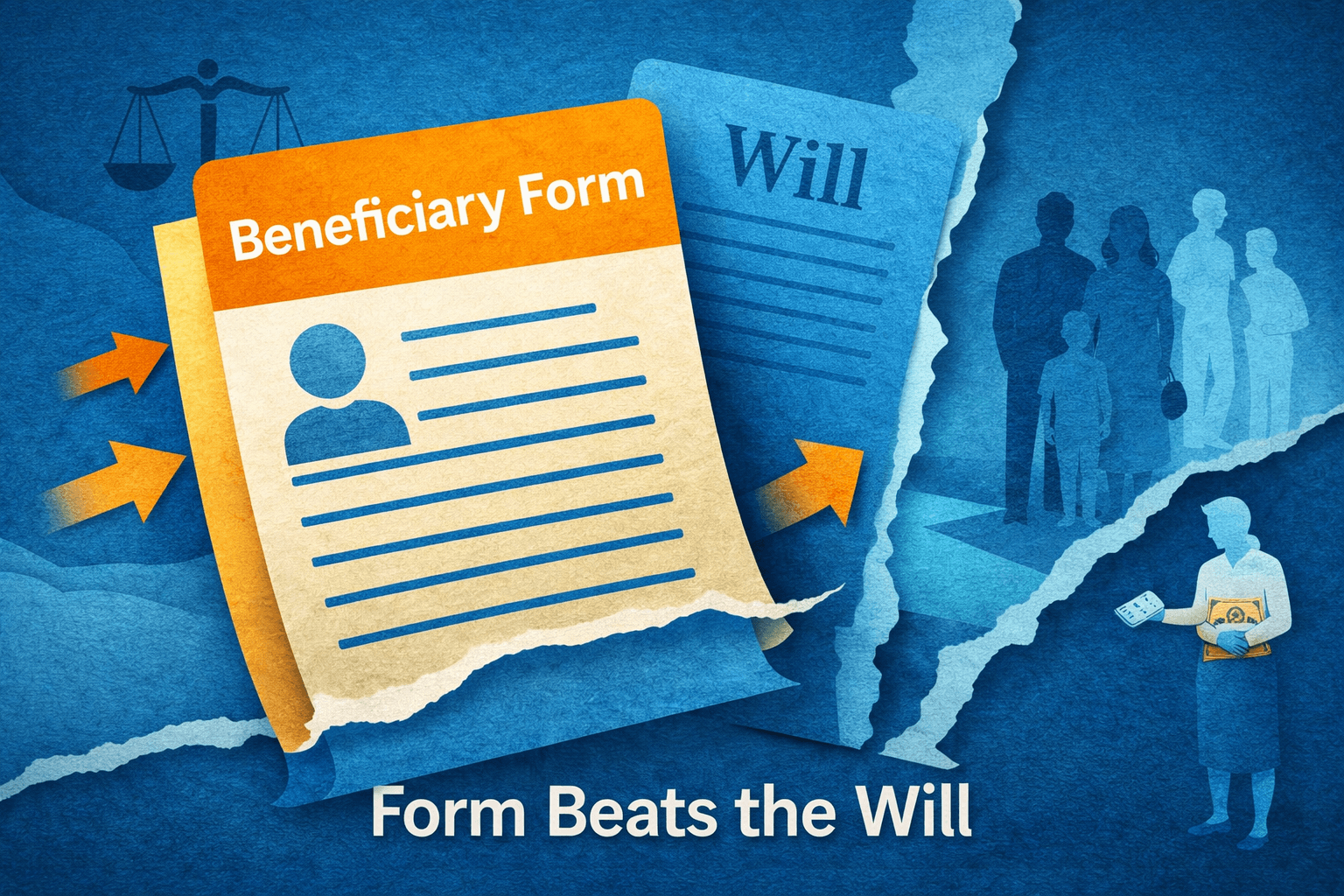
When the Form Beats the Will: Real Court Cases Where Beneficiary Designations Overrode a Deceased’s Wishes

A man spends thirty years building a careful estate plan. He drafts a will leaving everything to his children from his second marriage, works with an estate planning attorney, signs every document, and dies believing his estate is secure. Then his ex-wife collects his $400,000 life insurance policy. The will says one thing. The beneficiary designation form, completed during the first marriage and never updated, says another. The form wins. The children receive nothing from that policy. The ex-wife, who remarried years ago and has had no contact with the family in over a decade, walks away with the full payout.
This is not a legal abnormality or a warning story invented for effect. Beneficiary designations frequently override wills without exception for the accounts they govern, and the outcomes of neglecting them are evident in California families every year. It is important to know why the form beats the will, and how courts have consistently enforced that outcome, regardless of how unjust the result appears; it is the difference between a legacy delivered and a legacy destroyed.
The Illusion of Safety: Why Having a Will Is Not Having a Plan
The will-as-protection myth is one of the most dangerous misconceptions in American estate planning. Families spend real money on estate planning attorneys, sign carefully drafted documents, and leave the attorney’s office believing they have addressed everything that matters. What they often do not understand is that a will governs only the assets that flow through the probate estate. It has no authority whatsoever over assets that transfer by contract directly to a named beneficiary.
The legal architecture for this is clear, but its implications are meaningful. When you name a beneficiary on a financial account, an IRA, a 401(k), a life insurance policy, or a payable-on-death bank account, you are entering into a binding contractual obligation with that institution. The institution’s duty runs directly to the named beneficiary. Your will operates in an entirely different legal universe, one that courts have consistently refused to allow to override the contractual designation.
Think of it this way: a will is a letter to the probate court, and a beneficiary designation is a direct wire instruction to a financial institution. When you die, the institution does not call your executor, review your trust, or read your will. It looks at the form on file and pays. Courts have uniformly enforced this principle, even when the result contradicts everything else in the decedent’s estate plan, even when the decedent’s intent is obvious, and even when the outcome causes genuine hardship to people the decedent clearly intended to provide for.
This matters enormously in California, a community property state where the link between spousal rights, ERISA preemption, and designation forms creates some of the most legally complex inheritance disputes in the country. Estates above $184,500 are generally subject to full California probate — but assets with valid beneficiary designations bypass that threshold entirely, transferring directly to the named recipient, often within weeks of the death certificate being filed. The stakes attached to a single overlooked form are not abstract. They are measured in the hundreds of thousands of dollars, and the relationships are fractured as they fight over them.
The Case Files: Patterns Courts Have Enforced
The Ex-Spouse Who Collected Despite a Divorce Decree
No category of beneficiary-designation conflict involves more litigation and heartbreak than the ex-spouse who continues to be on the file. The pattern plays out with painful regularity across California probate courts. A couple of divorces. One party updates their will, perhaps even creates a new trust, leaving their assets explicitly to their children or new spouse. They never update the retirement account or life insurance designation. Years later, they remarry, build a new life, and die believing their affairs are in order.
California Probate Code Section 5600 revokes beneficiary designations in favor of a former spouse on divorce for certain non-ERISA accounts, but this protection has notable limitations that families often discover too late. Federal ERISA law, which governs most employer-sponsored retirement plans, preempts California’s automatic revocation statute. The United States Supreme Court addressed this directly in Egelhoff v. Egelhoff, holding that state laws purporting to automatically revoke beneficiary designations upon divorce are preempted by ERISA when the account is an employer-sponsored plan.
The result: a divorced spouse named on a 401(k) may collect the full account balance regardless of what any state-court divorce decree or subsequent will provides.
The practical consequence is that thousands of California employees who divorced, updated their wills, and assumed the law would protect their new families are wrong. The form they filled out during the first marriage, sitting in a filing cabinet at their employer’s HR department, controls. Courts enforce it. The new spouse has no legal recourse under ERISA. The children from the second marriage receive nothing from that account.
The Adult Child Who Was Cut Out, Then Reinstated, Then Cut Out Again
Families change. Relationships between parents and adult children go through periods of estrangement and reconciliation that rarely track with the dates on beneficiary designation forms. I have seen cases where a parent, during a period of conflict with one child, removed that child from a life insurance designation and named the other children. Years later, the relationship healed. The parents updated their will to ensure all children are treated equally. The designation form was never changed. The estranged child, now reconciled, received nothing from the policy. The other children, who knew the parents’ true wishes, were left to either honor them voluntarily or keep the money.
Courts will not intervene to correct this outcome based on what the will says or what witnesses testify the decedent intended. The designation controls. The only remedy available to the excluded child is to pursue a claim for undue influence or lack of capacity at the time the designation was made — a difficult standard to meet, and one that requires evidence far beyond “my parent meant to update the form.”
The Contingent Beneficiary Trap
The contingent beneficiary designation is the safety net that most people never think to install. When a primary beneficiary predeceases the account holder, and no contingent beneficiary has been named, the asset does not automatically flow to the next logical heir. It goes into the probate estate of the account holder, where it becomes subject to probate administration, creditor claims, and distribution according to the will or intestacy laws, not according to the account holder’s likely intent.
Consider the pattern I have seen in cases involving elderly couples: a husband names his wife as the sole beneficiary of his IRA. She predeceases him. He never names a contingent. When he dies, the IRA, which could have passed directly to their children within weeks, instead enters probate. The estate pays administration costs. The children wait months or years for distribution. The tax treatment of an inherited IRA that passes through an estate differs from one that passes directly to an individual beneficiary, and not always favorably. A form that took ten minutes to update would have prevented all of it.
The Minor Child Named Directly
Naming a minor child as a direct beneficiary of a life insurance policy or retirement account makes a legal crisis of its own. Minor children cannot legally receive large sums of money directly. When the account holder dies, and the named beneficiary is under 18, the institution cannot simply transfer the funds to the child. A court-supervised guardianship of the estate must be established, which requires legal proceedings, ongoing court oversight, and administrative costs that erode the inheritance. When the child reaches eighteen, the full remaining balance is distributed outright, regardless of whether an eighteen-year-old is capable of managing a $300,000 inheritance responsibly.
The solution is very simple: name a trust as the beneficiary, with the minor child as the trust beneficiary, and specify distribution terms that reflect the parent’s actual wishes. But this requires coordination between the estate plan and the designation form, coordination that too often fails to occur.
The Forgotten Small Account That Wasn’t Small
People track their large accounts. They remember the 401(k) with $800,000 in it. They forget the $150,000 IRA they rolled over from a job they left in 2003, sitting at a financial institution they barely think about anymore. The designation on that account names a sibling who has since died. With no named beneficiary alive, the account passes to the probate estate. The will, which was updated recently and reflects the decedent’s current wishes, now governs, but only after a probate administration that could have been entirely avoided. If the estate is large enough, the addition of this previously non-probate asset may push the estate into a higher administrative cost bracket or affect tax calculations.
Why Courts Cannot Help You After the Fact
Families who discover these designation conflicts after a death frequently ask whether a court can simply look at the totality of the evidence and give effect to what the decedent obviously intended. The answer, in most cases, is no. Courts applying contract law to beneficiary designations have very limited grounds for intervention. Fraud, forgery, and lack of capacity at the time the designation was made are viable theories. The argument that the decedent “meant to update the form” is not.
California courts have occasionally applied the constructive trust doctrine to redirect assets that would otherwise go to an unintended beneficiary, but this remedy is difficult to obtain and requires clear and convincing evidence of a specific promise or agreement, rather than mere intent. Families who pursue these claims face high legal costs, uncertain outcomes, and the emotional burden of protracted litigation against someone who may have a completely valid legal claim to the money.
The far better approach is prevention. Reviewing beneficiary designations at every major life event, marriage, divorce, birth of a child, death of a named beneficiary, significant change in family relationships, takes an hour and costs nothing compared to the litigation it prevents. For a deeper look at how poor estate planning coordination leads to courtroom battles, the pattern is consistent: documents drafted in isolation, without cross-referencing the full picture of how assets actually transfer, create conflicts that only courts can resolve.
The problem of outdated designations also intersects with elder financial abuse in ways that families may not anticipate. A caregiver or new companion who persuades an elderly person to update a beneficiary designation in their favor, while the person’s cognitive capacity is declining, may be committing financial exploitation under California law, even if the form itself looks valid on its face.
What a Coordinated Review Actually Looks Like
Fixing a beneficiary conflict starts with knowing what you’re working with.
That means building a full picture of every account that carries a designation. Life insurance policies, both term and permanent. IRAs and Roth IRAs. Employer-sponsored retirement plans. Annuities. Payable-on-death bank accounts. Transfer-on-death brokerage accounts.
Every single one needs to be tracked down and verified. Old paperwork is not enough. Each designation must be compared against the current estate plan to identify conflicts, gaps, and outdated names.
For beneficiary disputes in Sacramento and across California, the firms that handle the litigation consistently report the same finding: the conflict that produced the lawsuit was visible in the documents years before the death. No one ever checked. When accounts are spread across multiple institutions, which is the case for almost anyone who has changed jobs, rolled over accounts, or inherited assets, you can’t rely on the copy in the decedent’s files. It may not reflect the most recent change. You’ll need to contact each institution directly to find out what designation they actually have on file.
For families navigating an active dispute over a designation that has already produced an unintended outcome, the question is whether any of the recognized legal theories apply: undue influence, lack of capacity, fraud, or constructive trust. These are fact-intensive inquiries that require experienced estate litigation counsel who understands both the procedural requirements and the evidentiary standards California courts apply.
Beneficiary designations are not a footnote to your estate plan. For most California families, they control the transfer of the largest assets in the estate. The form you filled out decades ago, sitting in a filing cabinet at a financial institution you may have forgotten you use, has more legal authority over your legacy than the will you paid an attorney to draft. Courts enforce that outcome consistently, and families discover it too late, in the middle of grief, when the money has already been paid out, and the legal options have narrowed dramatically.
If you have questions about a beneficiary designation dispute or want to understand how these issues might affect your own estate plan, Hackard Law represents clients throughout California in trust and estate litigation matters. You can reach our office through the contact page to discuss your situation.
 Michael Hackard is the founder of Hackard Law, a California trust and estate litigation firm with more than five decades of experience protecting the inheritance rights of families across Sacramento, the San Francisco Bay Area, and Los Angeles. He is the author of four published books on inheritance protection and has produced more than 1,000 educational videos with over seven million views.