


 (916) 313-3030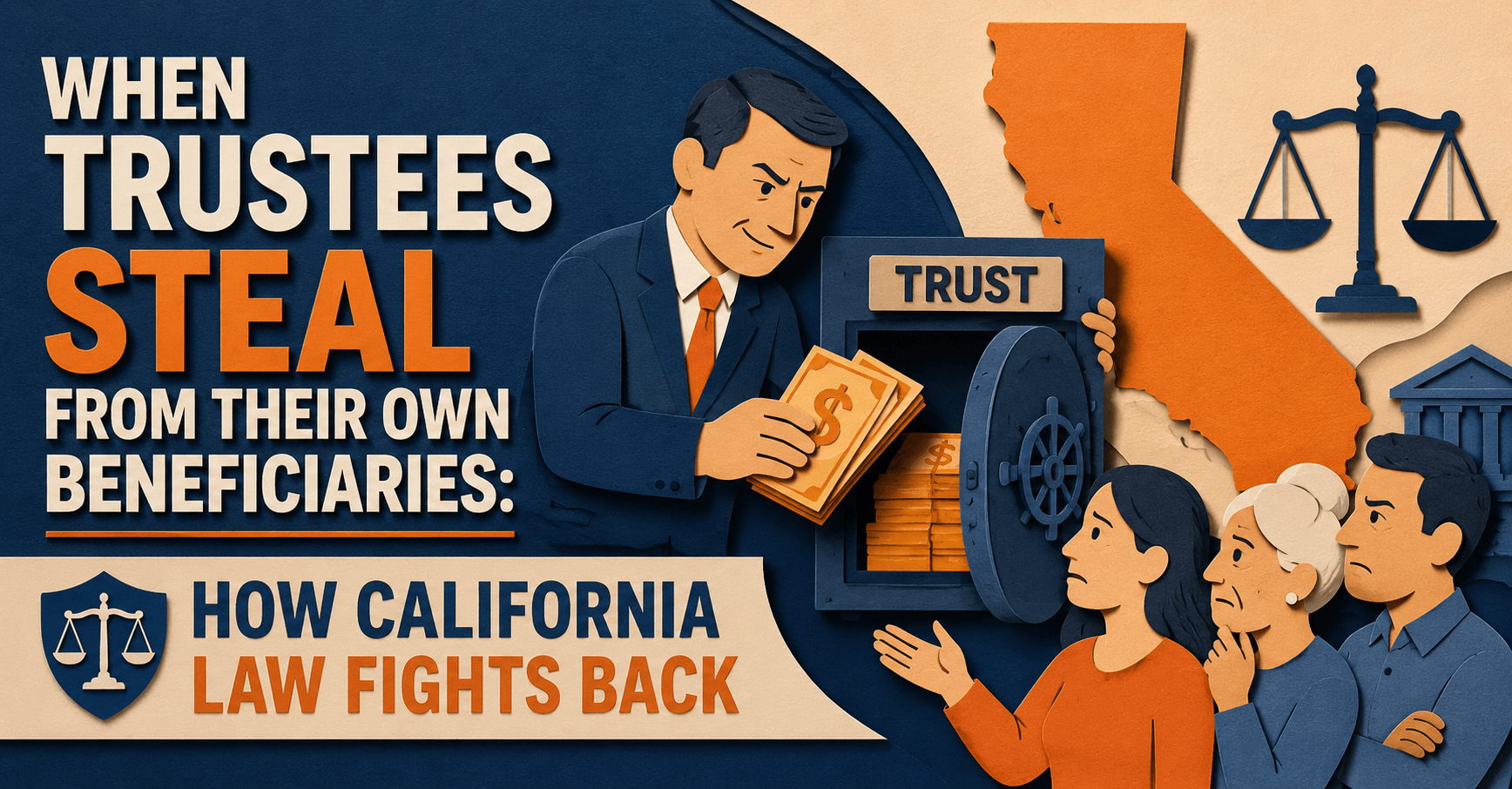
When Trustees Steal From Their Own Beneficiaries: How California Law Fights Back

The Problem No One Talks About Openly
I’m Michael Hackard, founder of Hackard Law. Over five decades of practice, I have fought for heirs, beneficiaries, and elder abuse victims across California – from Sacramento to the San Francisco Bay Area and Los Angeles. I have written four published books on inheritance protection and produced more than 1,000 educational videos that have reached over seven million viewers. In that time, I have seen one pattern repeat itself with troubling regularity: a trustee who misappropriates trust funds and then turns around and uses that same money to hire lawyers and fight the very beneficiaries they harmed.
It is a form of financial entrapment. The trustee holds the keys to the vault. When a beneficiary dares to object, the trustee reaches into that vault – money that does not belong to them – and funds a legal defense. The beneficiary, already denied their rightful distributions, must now find a way to fight back with their own resources. The imbalance is not accidental. That imbalance is why so many beneficiaries walk away from legitimate claims.
Hackard Law provides contingency fee representation for qualified trust and estate cases – no upfront costs required. If you believe a trustee has wronged you, call us today at (916) 313-3030.
Quick Summary
In California, trustees have a fiduciary duty to beneficiaries; if they violate this duty, the law offers significant remedies. The problem is that abusive trustees frequently use trust assets to pay for their own defense, which results in an imbalance of power that deters beneficiaries from standing up for their rights.
- Trustees who misuse trust funds can face removal, surcharge, and personal liability
- California courts have authority to freeze trust assets and order accountings
- Beneficiaries do not need to fund litigation out of pocket when contingency fee representation is available
- Early legal intervention is often the difference between recovering assets and losing them permanently
- Holding a trustee accountable protects not just one beneficiary but the entire trust estate
The Vault Analogy: Why It Matters
Consider a straightforward scenario. A trustee is appointed to manage a family trust. The settlor has passed away. The beneficiaries are waiting for distributions. Instead of distributing, the trustee delays, stonewalls, and begins transferring assets in ways that benefit themselves or their allies. A beneficiary objects and threatens legal action. The trustee responds by hiring a team of attorneys – paid for entirely from the trust.
This is not a hypothetical edge case. It is a pattern that plays out in probate courts across California with real frequency. The trustee’s logic mirrors that of the bank robber who says, at least I have money to defend myself. The stolen funds become the shield. For beneficiaries who want to understand what rights they actually hold, five essential things every California trust beneficiary should know is a valuable starting point.
Case Pattern: Trustee Defense Funded by the Trust
Citing ambiguous administrative delays, a sibling appointed as sole trustee repeatedly refused distributions to co-beneficiaries. After the beneficiaries hired legal counsel, the trustee hired a well-known litigation firm and charged the trust by the hour. By the time the court stepped in, the trustee’s legal fees had consumed a significant portion of the trust’s liquid assets. In the end, the court removed the trustee and imposed a surcharge, but the estate suffered greatly financially.
What California Law Actually Allows
California courts have considerable power to address trustee misconduct under the Probate Code. A court can freeze trust assets, remove a trustee, require an accounting, and order the trustee to personally reimburse misappropriated funds. A court may require that fees a trustee incurs using trust funds for an inappropriate legal defense be returned to the trustee rather than the trust.
The key is getting into court quickly and with the right legal theory. Delay benefits the trustee. Every month that passes is another month of potential asset dissipation, another billing cycle of trust-funded attorney fees, and another opportunity for the trustee to restructure accounts or transfer property. Hackard Law litigates these cases throughout California, including in Los Angeles, Oakland, Glendale, and Sacramento County.
California courts also recognize the doctrine of surcharge, which allows a court to hold a trustee personally liable for losses caused by their breach of fiduciary duty. If a trustee improperly paid their own legal fees from the trust, those payments can become part of the surcharge calculation. The trustee does not get to profit from their own wrongdoing – and they do not get to make the trust pay for defending that wrongdoing.
The Contingency Fee Difference
The perceived expense of litigation is one of the most frequent reasons beneficiaries choose not to pursue valid claims. They believe it takes large sums of money to oppose a well-funded trustee. Although it makes sense, that assumption isn’t always true.
Hackard Law handles qualified trust and estate litigation on a contingency fee basis. That means the firm’s compensation comes from the recovery – not from the client’s savings account. For a beneficiary who has already been denied distributions, this model changes everything. It levels the playing field. The trustee may have access to trust funds for their defense, but the beneficiary has access to experienced litigation counsel without paying upfront. Our contingency fee guide for California trust and estate cases explains how this works in practical terms.
Case Pattern: Beneficiary Who Almost Walked Away
A beneficiary of a substantial trust was told by the trustee that the estate had been depleted by market losses. Unable to afford a retainer, the beneficiary nearly accepted the explanation. After consulting with Hackard Law on a contingency basis, forensic review revealed that the trustee had made a series of self-dealing transfers. The case resolved with a significant recovery for the beneficiary – one that would never have happened if cost had been the deciding factor.
How Trustees Get Away With It – and How Courts Stop Them
Abusive trustees often operate in the shadows of complexity. Trust documents are long. Accounting statements are dense. Beneficiaries may not understand what they are entitled to receive or when. The trustee counts on this confusion. They delay responses, provide incomplete accountings, and use legal jargon to obscure what is actually happening.
Courts stop this through a combination of tools: mandatory accountings, discovery, depositions, and forensic financial analysis. When a beneficiary’s attorney demands a full accounting and the trustee cannot produce one – or produces one that does not add up – that itself becomes evidence. Michael Hackard and the Hackard Law team know how to read trust accountings, identify discrepancies, and build a case that a probate judge can act on. For those navigating a Sacramento-area dispute, the Sacramento estate lawyer page provides additional context on how these cases proceed locally.
Beyond legal tactics, discovery, forensic analysis, and the pursuit of accountability protect families threatened by trustees who have forgotten whose funds they oversee. For decades, I have supported families in these battles. The longer action is postponed, the greater the financial cost. A steadfast dedication to the truth can restore what dishonesty attempted to steal, but the rift that develops between family members when a trustee betrays their duty is frequently too deep for any judgment to completely heal.
Key Definitions
- Fiduciary duty: The legal obligation of a trustee to act in the best interests of the trust beneficiaries, not in their own interest.
- Surcharge: A court-ordered remedy requiring a trustee to personally repay the trust for losses caused by their breach of duty.
- Self-dealing: When a trustee uses trust assets for their own benefit, in violation of their fiduciary obligations.
- Trust accounting: A formal financial statement that a trustee must provide to beneficiaries showing all income, expenses, and distributions.
- Removal of trustee: A court order ending a trustee’s authority over the trust, typically following a finding of misconduct or incapacity.
- Contingency fee: A fee arrangement where the attorney is paid only if the case results in a recovery, with no upfront cost to the client.
- Beneficiary: A person named in a trust to receive distributions of income or principal.
- Breach of fiduciary duty: A trustee’s failure to fulfill their legal obligations to the trust and its beneficiaries.
- Asset dissipation: The reduction or disappearance of trust assets, often through improper transfers, excessive fees, or mismanagement.
- Probate court: The California court with jurisdiction over trust and estate disputes, including trustee misconduct cases. Learn more about how to choose the right probate lawyer for your situation.
What to Do Next
- Look for signs that your trustee is delaying distributions without a clear explanation.
- Get copies of any trust accountings you have received and note any gaps or inconsistencies.
- Try to avoid confronting the trustee directly before speaking with an attorney, as this can complicate your legal position.
- Look for a pattern of self-dealing, such as the trustee paying personal expenses from trust funds.
- Get a copy of the trust document itself – you are entitled to it as a beneficiary.
- Look into whether the trustee has hired attorneys and whether those fees are being charged to the trust.
- Try to avoid signing any releases or settlement agreements without independent legal review.
- Document all communications with the trustee, including emails, letters, and voicemails.
- Explore contingency fee representation so that cost is not a barrier to pursuing your rights – see our LA trust litigation contingency options for more detail.
- Call Hackard Law at (916) 313-3030 to tell us your story, and visit our contact page to reach us online.
CALL THE SAGE | When Experience Matters, Families Listen
🏛️ We practice California trust & estate & elder financial abuse litigation
⚖️ We represent heirs, beneficiaries, and elder abuse victims
🎥 1,000+ educational videos | 7 million+ views | 4 published books
🎯 “After thousands of cases, I see the pattern others miss.”
CONTINGENCY REPRESENTATION – No Win, No Fee
Throughout California: Sacramento | Los Angeles | Bay Area
📞 CALL THE SAGE: (916) 313-3030
Subscribe for weekly insights on:
- Elder financial abuse warning signs and prevention
- Trust and estate litigation strategies
- Inheritance protection for California families
- Family protection strategies
When your inheritance is under attack, Call The Sage.
Hackard Law | 10640 Mather Blvd, Mather CA 95655
Attorney Advertisement | Michael Hackard, State Bar #71067
RELATED VIDEOS
Bad Trustees | You Can Remove Them
Explains the legal process for removing a trustee who has breached their duties.
Gravy Train Trustees | California Trust Litigation
Looks at trustees who exploit their position to enrich themselves at beneficiaries’ expense.
LA Trust Beneficiaries | Lawsuits Against Bad Trustees
Walks through how beneficiaries can take legal action against trustees who mismanage assets.
Trust Traps Part 2 | Financial Entanglement: How Estate Predators Tighten Their Grip
Examines how predatory trustees use financial control to trap and harm beneficiaries.
Anatomy of Trust Litigation | Protecting Beneficiaries
Breaks down how trust litigation works and what beneficiaries can expect in court.
San Mateo County Trust Administration When Trustees Breach Fiduciary Duties Hackard Law
Covers what happens when a trustee violates their fiduciary duties during trust administration.
 Michael Hackard is the founder of Hackard Law, a California trust and estate litigation firm with more than five decades of experience protecting the inheritance rights of families across Sacramento, the San Francisco Bay Area, and Los Angeles. He is the author of six published books on inheritance protection and has produced more than 1,000 educational videos with over seven million views.