


 (916) 775-8542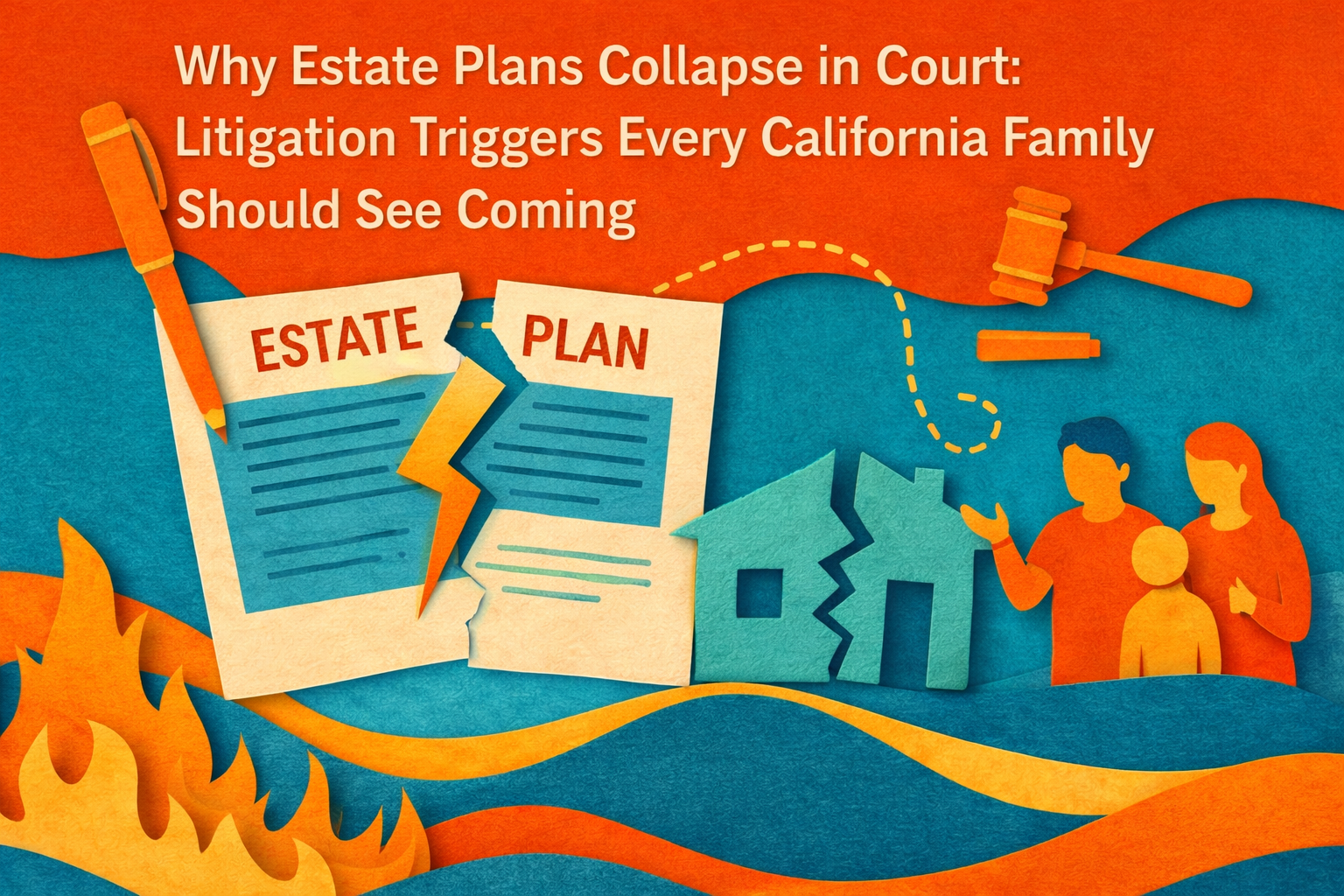
Why Estate Plans Collapse in Court: Litigation Triggers Every California Family Should See Coming

They did everything they were supposed to do.
They hired an estate planning attorney. They created a living trust. They funded it with their assets. They updated it when circumstances changed. They believed their family would be protected.
And yet, within months of the funeral, their children were in court. The trust they created to prevent conflict had become the battlefield for it.
In my 50 years of practicing trust and estate litigation across California, from Sacramento’s tree-lined historic neighborhoods to communities throughout the state, I’ve watched hundreds of carefully crafted estate plans collapse into bitter courtroom battles. The families never saw it coming. The warning signs were there, but no one recognized them until it was too late.
Understanding why estate plans fail can help you prevent failure in your own family. If you’re already facing a dispute, understanding the triggers can help you recognize the strengths and weaknesses of your position and make informed decisions about how to proceed.
Estate litigation rarely erupts from a single cause. More often, multiple triggers converge, each amplifying the others until conflict becomes inevitable. Here are the triggers I see most frequently, and the warning signs that should alert every California family.
Trigger One: Undue Influence and Capacity Questions
The most common trigger for estate litigation is doubt about whether the estate plan truly reflects the decedent’s wishes.
Undue influence occurs when someone uses a position of trust or confidence to substitute their own wishes for those of the person creating the estate plan. The influencer doesn’t need to hold a gun to the elder’s head; subtle manipulation, isolation, and emotional pressure can be just as effective at overcoming free will.
Capacity questions arise when the person creating or amending estate documents may not have had the mental ability to understand what they were doing. Dementia, Alzheimer’s disease, the effects of medication, or acute illness can all impair the cognitive functions necessary for valid estate planning.
These triggers often appear together. A vulnerable elder with declining capacity is exactly the person most susceptible to undue influence. The predator recognizes the vulnerability and exploits it.
Warning Signs
Watch for these indicators that undue influence or incapacity may become litigation triggers:
Estate planning changes during periods of cognitive decline, illness, or hospitalization. Documents executed when the person was medicated, confused, or dependent on others invite challenge.
A new person, whether a caregiver, romantic interest, or newly attentive family member, who becomes heavily involved in the elder’s life and then benefits from estate plan changes. The timing correlation itself raises questions.
Isolation of the elder from family members and longtime friends. Influencers need privacy to work. When an elder becomes unavailable, when visits are discouraged, when phone calls go unanswered, someone may be creating conditions favorable to manipulation.
Estate plan changes that contradict decades of expressed intentions. A parent who always said they’d treat children equally but suddenly leaves everything to one child or to a new spouse has either genuinely changed their mind or been influenced to do so.
The elder can’t explain their own estate plan. If your parent can’t articulate why they made recent changes, or seems confused about what their documents say, the documents may not reflect genuine intent.
A Sierra Oaks Vignette
The following vignettes are based on actual matters our firm has handled. Names, locations, and certain facts have been changed to protect the privacy and confidentiality of the parties involved while preserving the essential legal issues and outcomes.
Margaret had lived in her Sierra Oaks home for thirty-five years. After her husband’s death, she managed well on her own until a series of small strokes left her confused and dependent on daily assistance.
Her daughter Laura, who lived nearby, arranged for a caregiver named Diana to help with daily tasks. Over the course of 18 months, Diana became indispensable. She managed Margaret’s medications, drove her to appointments, handled her mail, and eventually moved into the guest room to provide round-the-clock care.
What Laura didn’t know was that Diana had also arranged for Margaret to meet with an attorney Diana had selected, not the family’s longtime estate planning lawyer. At that meeting, Margaret signed a new trust leaving her $2.4 million estate to Diana, with only token amounts to her children.
Margaret’s family discovered the new trust only after Margaret’s death. They challenged it on the grounds of undue influence and lack of capacity. Medical records showed Margaret had significant cognitive impairment during the period the trust was signed. The attorney Diana had selected testified that Diana had been present throughout the estate planning meetings, something a careful attorney would never have permitted.
The case settled with the Diana trust being voided and the prior family trust reinstated. But the family had spent eighteen months and substantial resources to undo what should never have happened.
The warning signs were there: a vulnerable elder, a new person becoming indispensable, estate planning changes made without family knowledge, and documents prepared by an unfamiliar attorney. Any of these should have prompted intervention.
Trigger Two: Trustee Misconduct
Even when the estate plan itself is valid, the conduct of the person administering it can trigger litigation.
Trustees are fiduciaries; they have legal obligations to manage trust assets prudently, to act solely in beneficiaries’ best interests, to keep accurate records, to provide accountings, and to distribute assets according to the trust’s terms. When trustees violate these duties, beneficiaries have grounds to sue them.
Common forms of trustee misconduct include self-dealing (using trust assets for the trustee’s personal benefit), failure to account (refusing to provide information about trust administration), delayed distributions (holding assets longer than necessary, often while collecting trustee fees), favoritism (treating some beneficiaries better than others without trust authorization), and mismanagement (making imprudent investment decisions or failing to maintain trust property).
Warning Signs
Watch for these indicators that trustee misconduct may become a litigation trigger:
The trustee won’t provide information. Beneficiaries have a right to know what assets the trust holds, what income it receives, and what expenses are paid. A trustee who stonewalls, delays, or provides only vague responses may be hiding something.
Trust administration drags on indefinitely. Most trusts can be administered and distributed within a year or two. When administration stretches to three, four, five years or more without clear justification, the trustee may be benefiting from the delay.
The trustee’s lifestyle doesn’t match their known income. When the person controlling trust assets suddenly has a new car, an expensive vacation, or home improvements they couldn’t otherwise afford, trust funds may be the explanation.
The trustee is also a beneficiary, and the trustee has conflicts of interest. A trustee who stands to benefit from certain decisions faces inherent conflicts of interest. While this arrangement is common and can work well, it creates opportunities for abuse that don’t exist with neutral trustees.
Beneficiaries are treated differently without explanation. If one beneficiary receives distributions while others wait, or if the trustee seems to favor certain family members, the duty of impartiality may be violated.
A Fair Oaks Vignette
Robert’s father had appointed Robert as successor trustee, a role Robert took seriously at first. After their father’s death, Robert provided regular updates to his two sisters about the trust administration. He sold their father’s Fair Oaks home, liquidated investment accounts, and paid final expenses.
Then the updates stopped.
Months passed. Robert’s sisters asked when they would receive their distributions. Robert always had reasons for the delay: tax issues, account complications, paperwork that needed sorting. A year went by, then two.
When the sisters finally hired an attorney and demanded an accounting, the truth emerged. Robert had been paying himself an excessive trustee fee, far above the reasonable compensation their father’s modest trust justified. He had “borrowed” trust funds to cover personal business expenses, planning to repay them eventually. He had used trust accounts to pay his own credit card bills. And he had made “investments” in his friend’s failing business venture.
Of the $1.8 million trust, less than $900,000 remained.
The sisters filed suit for breach of fiduciary duty, removed Robert as trustee, and ultimately obtained a judgment against him for the missing funds plus attorney’s fees. The collection proved difficult; Robert had spent much of what he took, but a lien on his home and garnishment of his income will eventually recover much of it.
The warning signs were clear in hindsight: a trustee who stopped communicating, unexplained delays, and a family member whose personal finances seemed inconsistent with his means. Earlier intervention might have limited the damage.
Trigger Three: Blended Family Dynamics
Second marriages pose estate-planning challenges that even careful attorneys struggle to address. The competing interests of a surviving spouse and children from a prior marriage are often irreconcilable, and what feels fair to one side feels like betrayal to the other.
The classic scenario: A widowed parent remarries later in life. They want to provide for their new spouse while also preserving assets for their children from the first marriage. Estate plans attempt to balance these interests, perhaps giving the spouse a lifetime income with the remainder going to the children, or dividing assets between the spouse and children in some proportion.
But these arrangements often break down. The surviving spouse may feel entitled to more than the plan provides. The children may resent the spouse receiving anything from their parents’ estate. And when the surviving spouse controls assets during their lifetime, children worry that nothing will be left when the spouse eventually dies.
Warning Signs
Watch for these indicators that blended family dynamics may trigger litigation:
Late-in-life marriage or relationship where the new spouse is significantly younger or has different financial circumstances than the parent. These situations create inherent tensions about inheritance.
Estate plan changes after the new marriage that reduce what children from the first marriage will receive. Even if these changes are legitimate, they breed resentment that can fuel litigation.
The new spouse becomes the primary caregiver or financial manager for the aging parent. This position of control creates both opportunity for exploitation and suspicion among the parents’ children, whether or not exploitation actually occurs.
Children from the first marriage are increasingly excluded from the parents’ lives after the new marriage. Whether due to the spouse’s influence or simple geographic and lifestyle changes, this exclusion fuels distrust.
The parents’ stated intentions change after the new marriage. If your parent always said they wanted to leave their estate to their children, but after remarriage, they begin talking about “taking care of” the new spouse, conflicts are brewing.
A Fab 40s Vignette
William had raised three children in his gracious Fab 40s home with his first wife, Catherine. After Catherine’s death, William lived alone for several years before meeting Sandra at a community event. They married when William was 78, and Sandra was 62.
William’s children were wary but wanted their father to be happy. They noticed, however, that Sandra quickly became involved in William’s finances. She accompanied him to meetings with his financial advisor. She added her name to his bank accounts “for convenience.” She suggested they meet with an estate planning attorney, not the attorney who had prepared William’s original trust.
Over five years, William’s estate plan changed three times. The first amendment gave Sandra the family home outright rather than a life estate with a remainder to the children. The second amendment increased Sandra’s share of the investment accounts. The third amendment, signed when William was 86 and experiencing documented memory problems, gave Sandra 80% of the estate with only 20% to his three children.
When William died, his children received copies of the final trust and were devastated. The home where they’d grown up, worth over $3 million, would go to a woman their father had known for only seven years. The investments their parents had accumulated over decades would largely bypass the children entirely.
They contested the trust amendments, focusing particularly on the final amendment signed during William’s cognitive decline. Discovery revealed that Sandra had been present at all estate planning meetings, had communicated directly with the attorney without William’s involvement, and had provided the attorney with “information” about the family that was misleading.
The case settled with a restoration of the Second Amendment terms, giving Sandra a meaningful inheritance while preserving a larger share for the children than the final amendment provided. Neither side was fully satisfied, but both avoided the risk and cost of a trial.
The warning signs accumulated over the years: a new spouse taking control of finances, estate plan changes reducing children’s inheritances, the children’s gradual exclusion from their father’s life, and final changes made during documented cognitive decline. Any of these should have prompted the children to seek legal counsel.
Trigger Four: Unequal Treatment Without Explanation
Parents can legally leave their estates however they choose, including giving everything to one child and nothing to the others. But when they do so without explanation, litigation often follows.
The excluded or disfavored children don’t simply accept the result. They wonder why. They question whether the parent was manipulated. They search for grounds to challenge documents that produce results they find inexplicable.
Sometimes the unequal treatment is exactly what the parent intended. Perhaps one child provided years of caregiving while others were absent. Perhaps one child received substantial gifts during the parents’ lifetime, while others did not. Perhaps relationships were fractured in ways that caused the parent to change their intentions.
But often, unequal treatment is the product of manipulation by the favored child. They isolated the parent. They poisoned relationships with siblings. They convinced the parents that they alone deserved the inheritance.
Warning Signs
Watch for these indicators that unequal treatment may trigger litigation:
A parent who previously expressed an intent for equal treatment creates documents that provide unequal distribution. The change itself warrants examination.
The favored beneficiary had significant access to and influence over the parent, particularly during the parent’s decline. Position and opportunity matter.
The disfavored beneficiaries were excluded from the parents’ lives during the period when estate plan changes occurred. Isolation of the parent from children who might otherwise inherit suggests manipulation.
The unequal treatment benefits whoever was closest to the parent at the end, regardless of the quality of that relationship during earlier years. A child who was absent for decades but appeared during the parents’ final illness may have been opportunistic rather than devoted.
The parent left no explanation for their decision. When parents knowingly treat children unequally, thoughtful estate planners encourage them to explain their reasoning, either in the trust itself or in a separate letter. Absence of explanation leaves disfavored children to construct their own theories, often involving exploitation.
A Sierra Oaks Vignette
The Peterson family had always been close, or so they thought. Richard and Ellen had raised their children, Steven, Karen, and Michelle, in their Sierra Oaks home. All three children attended local schools, stayed in the Sacramento area, and remained involved in their parents’ lives.
Ellen died first, and Richard’s trust provided for equal distribution among the three children upon his death. This was what Richard had always said he wanted: “You’re all my children, and I love you all the same.”
After Ellen’s death, Michelle, who lived closest, became Richard’s primary companion. She visited daily, helped manage his household, and eventually took over his financial affairs when his memory began to fail.
When Richard died three years later, Steven and Karen received copies of an amended trust they’d never seen. Michelle would receive the family home and 60% of the remaining assets. Steven and Karen would split the remaining 40%.
Michelle insisted this was what their father wanted, recognition for her years of daily involvement while her siblings “couldn’t be bothered.” Steven and Karen believed Michelle had manipulated their father during his decline, taking advantage of her access and his diminished capacity.
The truth, as it usually does, lies somewhere in between. Richard had genuinely appreciated Michelle’s help and wanted to recognize it. But the extent of the disparity, and the fact that the amendment was signed during a period of documented cognitive decline, at a meeting Michelle arranged with an attorney Michelle selected, created grounds for challenge.
The case settled with a compromise that gave Michelle a larger share than equal distribution but less than the amended trust provided. The family relationships, strained by the litigation, never fully recovered.
The warning signs included unequal treatment from a parent who had always emphasized equality, an amendment benefiting the child with the most access during the parent’s decline, and changes made during documented cognitive impairment. Even if Michelle’s intentions were pure, the circumstances invited challenge.
Trigger Five: Beneficiary Designation Conflicts
One of the most overlooked triggers for estate litigation is conflict between beneficiary designations and estate planning documents.
Beneficiary designations on life insurance, retirement accounts, bank accounts, and brokerage accounts transfer assets directly to named beneficiaries, regardless of what the will or trust says. A parent’s trust can specify that everything should be divided equally, but if the beneficiary designations on their accounts name only one child, that child receives those assets, and the trust provision is meaningless.
Sometimes these conflicts result from oversight: the parent simply never updated beneficiary designations to match their estate plan. Other times, they result from manipulation: an exploiter convinces a vulnerable elder to change designations, quietly redirecting assets while the estate plan remains unchanged.
Warning Signs
Watch for these indicators that beneficiary designation conflicts may trigger litigation:
Beneficiary designations that were changed during periods of vulnerability, illness, cognitive decline, or dependence on the person who benefits from the change.
Beneficiary designation changes that contradict longstanding estate plan provisions. If the trust has said “equal shares” for twenty years but beneficiary designations suddenly name one child, something changed, and the reason matters.
The person who benefits from beneficiary designation changes was also involved in managing the elder’s finances or accounts. Access creates opportunity.
Beneficiary designations that were changed using forms faxed or mailed from someone other than the account holder. Financial institutions keep records of where documents originated, and if designation changes came from the beneficiary’s address rather than the elder’s, that’s suspicious.
Multiple designation changes across multiple accounts, all benefiting the same person, all occurring within a concentrated time period. A pattern of changes suggests systematic exploitation rather than coincidental updates.
A Fair Oaks Vignette
Thomas and his sister, Jennifer, had always expected to split their mother, Dorothy’s, estate equally. Dorothy’s trust said so explicitly, and she had confirmed her intentions many times over the years.
What Thomas and Jennifer didn’t know was that their brother Michael, who had moved back to their mother’s Fair Oaks home after his divorce, had been quietly redirecting Dorothy’s assets for years.
Michael had helped Dorothy “simplify” her finances by consolidating accounts. In the process, he’d changed beneficiary designations on her IRA accounts, worth over $700,000, to name himself. He’d converted her brokerage accounts to transfer-on-death registration with himself as sole beneficiary. He’d added himself as a joint owner to her bank accounts.
By the time Dorothy died, her trust held almost nothing. The assets that should have funded equal distributions to three children had all been structured to pass directly to Michael outside the trust.
Thomas and Jennifer challenged the beneficiary designation changes, presenting evidence that Dorothy had experienced a significant cognitive decline during the period when the changes were made and that Michael had orchestrated them while Dorothy was unaware of their significance.
The case went to trial. Michael claimed Dorothy had wanted to reward him for caring for her during her final years, and that she’d understood exactly what she was signing. But the evidence showed Dorothy couldn’t explain her own financial affairs during the relevant period, and a forensic document examiner testified that some of the signatures on designation forms showed characteristics consistent with guided hand signing, someone physically directing Dorothy’s hand.
The jury found that Michael had procured the beneficiary designation changes through undue influence and fraud. The designations were voided, the assets were ordered returned to Dorothy’s estate, and Michael was further ordered to pay his siblings’ attorney’s fees.
The warning signs were present: beneficiary designation changes made during cognitive decline, changes that benefited the child with the most access and control, and changes that contradicted decades of expressed intentions.
Trigger Six: Secrecy and Lack of Communication
Secrecy breeds litigation. When family members are kept in the dark about estate plans, changes being made, the parent’s circumstances, or trust administration, they fill the information vacuum with suspicion. And suspicion, justified or not, often leads to court.
Secrecy can operate at multiple levels: a parent who refuses to discuss their estate plan, a caregiver who controls information flow about the parent’s condition, a sibling who manages finances without transparency, or a trustee who won’t communicate with beneficiaries.
Sometimes, secrecy is innocent; people are simply private about money matters. Other times, secrecy facilitates exploitation by preventing detection until it’s too late.
Warning Signs
Watch for these indicators that secrecy may trigger litigation:
A parent who once discussed their estate plan openly becomes secretive about it, or claims not to remember what it says.
Information about the parents’ health, finances, or daily life is filtered through a single person who controls all communications.
Family members are discouraged from visiting, or visits are supervised by someone who might be benefiting from the parent’s estate.
A trustee refuses to provide information to beneficiaries, delays providing accountings, or responds to questions with vague or evasive answers.
Estate planning documents or financial records are kept inaccessible to family members who previously had access.
Trigger Seven: Last-Minute Changes
Changes to estate plans made shortly before death warrant heightened scrutiny. While people certainly have the right to change their minds at any time, last-minute changes, particularly those made during illness, hospitalization, or obvious decline, raise questions about capacity and influence.
The timing itself is suspicious. Why the urgency? What changed in the final weeks or months of life that required redoing decades of estate planning? Was the dying person truly driving these changes, or was someone else taking advantage of a final window of opportunity?
Warning Signs
Watch for these indicators that last-minute changes may trigger litigation:
Estate planning changes are made within the final months of life, particularly during hospitalizations or periods of acute illness.
Changes that dramatically depart from prior estate plans, shifting distributions, adding new beneficiaries, and removing longstanding beneficiaries.
Changes that benefit whoever had the most access to the decedent during their final period.
New estate planning attorneys who had no prior relationship with the decedent, particularly if introduced by someone who benefits from the changes.
Documents signed during periods of heavy medication, documented confusion, or medical distress.
A Fab 40s Vignette
Eleanor’s family knew her wishes. She had created her trust thirty years earlier, updated it periodically, and always maintained the same basic structure: her Fab 40s home and other assets would pass equally to her four children.
In her final year, Eleanor’s health declined rapidly. Cancer required hospitalization, surgery, and eventually hospice care. Her daughter Patricia, who lived locally, coordinated her care and was present daily during the final months.
Three weeks before Eleanor died, while in hospice and receiving substantial pain medication, Eleanor signed a trust amendment leaving her home, worth over $2 million, to Patricia alone. The remaining assets would be divided among all four children, but the home represented more than half the estate’s value.
Patricia claimed Eleanor wanted to reward her for the years of caregiving she’d provided. Eleanor’s other children believed Patricia had taken advantage of their mother’s final vulnerability to redirect the family home.
The circumstances were troubling. The attorney who prepared the amendment had been recommended by Patricia. Patricia had transported Eleanor to the attorney’s office, despite Eleanor being in hospice. Medical records from that week showed Eleanor was intermittently confused and heavily medicated.
The case settled with Patricia receiving a larger share than strict equality but less than the amendment provided. All four children agreed that their mother had probably wanted to recognize Patricia’s caregiving, but disputed whether the hospice-signed amendment truly reflected Eleanor’s wishes or her medicated confusion.
The warning signs were unmistakable: estate planning changes made during terminal illness, while on hospice, with a new attorney introduced by the beneficiary, and during documented mental status changes. These facts virtually guaranteed litigation.
When Multiple Triggers Converge
The most contentious estate cases involve multiple triggers that reinforce one another. A blended family creates inherent tensions. A new spouse gains influence over a vulnerable elder. Estate plan changes favor the spouse and exclude children from the first marriage. The changes occur during documented cognitive decline. Beneficiary designations are altered to redirect assets outside the estate plan. And everything happens in secrecy, without family members’ knowledge, who will later feel betrayed.
Each trigger alone might be manageable. Combined, they create litigation that’s nearly impossible to avoid and difficult to resolve.
Preventing Estate Plan Collapse
If you’re concerned about preventing litigation in your own family, consider these approaches:
Communicate openly. Secrets breed conflict. Even if you don’t share every detail of your estate plan, ensure your family understands your general intentions and the reasoning behind them.
Explain unequal treatment. If you’re treating children or beneficiaries differently, explain why. A letter expressing your reasoning can prevent years of speculation and litigation.
Coordinate beneficiary designations. Ensure that designations on your accounts align with your estate plan, and review them whenever you update your trust or will.
Choose fiduciaries carefully. Select trustees and agents who can manage family dynamics as well as finances. Consider professional fiduciaries when family conflicts are likely to arise.
Document capacity. If you’re making significant estate planning changes later in life, consider a capacity evaluation to establish that you understand what you are doing.
Involve the right professionals. Work with estate planning attorneys who understand litigation risks and can build in protections. Consider involving a family meeting facilitator when dynamics are complex.
Review plans regularly. Estate plans that worked when created may not work when circumstances change. Regular review prevents outdated documents from triggering disputes.
What to Do If You’re Already Facing a Dispute
If you’re involved in estate litigation or see it coming, take these steps:
Preserve evidence. Gather documents, communications, and records before they disappear. Evidence often becomes unavailable once litigation begins.
Understand your position. Honestly assess your situation’s strengths and weaknesses. Which triggers are present? How would a judge view the facts?
Know your deadlines. California imposes strict time limits on trust and estate disputes. Missing deadlines can forfeit your rights entirely.
Consider your goals. Do you want to maximize financial recovery? Preserve family relationships? Establish what really happened? Different goals require different strategies.
Get experienced counsel. Estate litigation requires attorneys who understand both the legal technicalities and the family dynamics that drive these disputes.
Get Help Now
If you recognize warning signs in your own family, or if you’re already facing an estate dispute, don’t wait to seek guidance. Early intervention can prevent litigation; prompt action can preserve claims when litigation is necessary.
At Hackard Law, we’ve spent 50 years helping California families navigate estate conflicts. We serve clients in Sacramento, including East Sacramento’s Fab 40s, Sierra Oaks, Fair Oaks, Carmichael, and Granite Bay, as well as throughout California.
We understand the triggers that cause estate plans to collapse. We know how to investigate when something has gone wrong. And we know how to resolve disputes through negotiation when possible and litigation when necessary.
Call us for a free consultation. Let us help you evaluate your situation and determine the best path forward.
Because estate plans are supposed to protect families, not tear them apart.
Contact Hackard Law
- Phone: (916) 313-3030
- Website: hackardlaw.com
- Office: 10640 Mather Boulevard, #100, Mather, CA 95655
- Serving all California counties, including Sacramento, Placer, El Dorado, San Francisco, Los Angeles, San Diego, Orange County, and all California communities
 Michael Hackard is the founder of Hackard Law, a California trust and estate litigation firm with more than five decades of experience protecting the inheritance rights of families across Sacramento, the San Francisco Bay Area, and Los Angeles. He is the author of four published books on inheritance protection and has produced more than 1,000 educational videos with over seven million views.