


In brief: Hackard Law represents beneficiaries and families in Marin County trust contests, trustee disputes, and elder financial abuse cases. These cases are heard in the probate department of Marin County Superior Court in San Rafael. Michael Hackard has practiced California trust and estate litigation for fifty years, and the firm works on contingency: no fee and no costs if there is no recovery, unless your written agreement provides otherwise.

By Michael Hackard, California trust and estate litigation attorney. Last reviewed October 26, 2026. Published November 2, 2026.
A trust is amended in the last months of a life. A caregiver’s name appears on a deed. A trustee stops returning calls. In Marin County these disputes are heard at the Civic Center in San Rafael. Very often they are about a house worth more than everything else the family owns.
Michael Hackard has litigated California trust, estate, and elder financial abuse cases for fifty years. Hackard Law represents beneficiaries and families on a contingency basis. If there is no recovery, you owe no fee and no costs, unless your written agreement provides otherwise.
Call the Sage: (916) 313-3030
Most cases begin with one detail that does not fit. A daughter finds an amendment dated three weeks before her mother died. A son learns the house was quietly deeded during a hospital stay. A trustee who used to send statements sends nothing.
These are patterns, and they repeat:
Noticing the pattern early matters. California deadlines in this area are short, and some of them run from the day a notice arrives in the mail.
Trust and probate matters are heard in the probate department of the Marin County Superior Court, Hall of Justice, Marin County Civic Center, 3501 Civic Center Drive, San Rafael, California 94903. The court’s local probate rules, effective July 1, 2026, shape every step.
Venue is not automatic. A trust dispute belongs in the county where the trust is principally administered (Probate Code § 17005), which is not always the county where the parent lived. That question is answered first.
Trust contests. Challenges to trusts and amendments for lack of capacity (Probate Code §§ 810–812), undue influence, fraud, or duress. Gifts to a care custodian or to the person who drafted the document may be presumed invalid (Probate Code § 21380).
Trustee removal and surcharge. A trustee may be removed for breach of trust, unfitness, failure or refusal to act, excessive compensation, or other good cause (Probate Code § 15642). If trust property is at risk while removal is pending, the court can suspend the trustee’s powers. A trustee who breaches the trust can be ordered to restore what was lost (Probate Code § 16420).
Accountings. Trustees must keep beneficiaries reasonably informed and account (Probate Code §§ 16060–16062). When they do not, the court can compel it (Probate Code § 17200(b)(7)).
Recovering property. A petition under Probate Code § 850 reaches property wrongfully held by another, including real estate. A person who took property in bad faith is liable for twice its value (Probate Code § 859).
Elder financial abuse. Taking, hiding, or keeping the property of a person 65 or older for a wrongful use, or by undue influence, is financial abuse (Welfare & Institutions Code §§ 15610.27, 15610.30). When it is proven, the court awards attorney’s fees and costs (Welfare & Institutions Code § 15657.5).
In Marin County, a long-time financial advisor or accountant may personally serve as trustee of a family’s trust. That individual takes on the duties of a trustee, including loyalty, impartiality, and accounting. Beneficiaries can challenge self-dealing, seek accountings, and ask the court to remove a trustee who breaches those duties.
Hackard Law handles disputes involving individual advisors or accountants who personally serve as trustees. The firm does not handle claims against banks, brokerages, or corporate trustees.
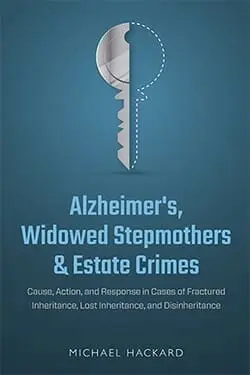
Michael Hackard is the author of six books on elder vulnerability and family protection, including Stolen Inheritance and Alzheimer’s, Widowed Stepmothers & Estate Crimes. He has testified before the U.S. House of Representatives, Committee on Ways and Means. He has been AV Preeminent rated by Martindale-Hubbell for more than forty years and has received Super Lawyers recognition.
The patterns on this page come from those books, and from fifty years of files.
“After thousands of cases, I see the patterns others miss.”
Hackard Law represents families on a contingency basis. The fee is a percentage of the recovery, stated in a written agreement before any work begins.
The firm advances the costs of the case: filing fees, experts, depositions, and records. Those costs are repaid from the recovery before the fee is calculated. If there is no recovery, you owe no fee and no costs, unless your written agreement provides otherwise.
In elder financial abuse cases, the law may also require the wrongdoer to pay attorney’s fees.
A trust contest is filed as a petition under California Probate Code § 17200. It belongs in Marin County Superior Court when the trust is principally administered in Marin (Probate Code § 17005). Common grounds are lack of capacity, undue influence, fraud, and duress. Trust petitions in Marin require thirty days’ notice to interested persons.
After a trustee serves the notification required by Probate Code § 16061.7, you have 120 days from service to contest the trust. If a copy of the trust terms is delivered to you during that 120-day period, the deadline is the later of 120 days after service of the notice or 60 days after delivery of the terms (Probate Code § 16061.8). Other claims, such as breach of trust, have separate deadlines.
A will is contested in the probate case. An objection may be filed before the will is admitted (Probate Code § 8250), or a petition to revoke probate may be filed within 120 days after it is admitted (Probate Code § 8270). A trust is contested by a separate petition under Probate Code § 17200.
Under Probate Code § 15642, a court may remove a trustee who has committed a breach of trust, is insolvent or otherwise unfit to administer the trust, fails or declines to act, or takes excessive compensation, or for other good cause. If trust property may suffer loss while removal is pending, the court can suspend the trustee’s powers and appoint a temporary trustee or receiver.
Elder financial abuse is taking, hiding, appropriating, or keeping the property of a person 65 or older for a wrongful use, with intent to defraud, or by undue influence (Welfare & Institutions Code §§ 15610.27, 15610.30). When financial abuse is proven, the court awards reasonable attorney’s fees and costs (Welfare & Institutions Code § 15657.5).
Marin’s probate tentative rulings are available online after 2:00 p.m. the court day before the hearing. A party who wants to argue must request argument by 4:00 p.m. that day and notify the other parties. If no one requests argument, the tentative ruling becomes the court’s order (Marin Local Rule 6.2(D)).
Yes. Hackard Law represents beneficiaries and families in Marin County trust, estate, and elder financial abuse cases on a contingency basis. The firm advances case costs, which are repaid from any recovery. If there is no recovery, the client owes no fee and no costs, unless your written agreement provides otherwise. Hackard Law’s office is in Sacramento County.

The first conversation is about what happened and when.
Call the Sage: (916) 313-3030
Hackard Law’s office is in Sacramento County. The firm handles matters in Marin County Superior Court and throughout California.
Hackard Law represents families throughout California. hackardlaw.com
Please do not send documents until we ask for them.
Hackard Law handles trust and estate disputes throughout Marin County, including:
 (916) 313-3030