I’m Michael Hackard, founder of Hackard Law. Over five decades of practice, I have fought for heirs, beneficiaries, and elder abuse victims across California – from Sacramento and the San Francisco Bay Area to Los Angeles. I have authored four books on inheritance protection, and our firm has produced more than 1,000 educational videos that have reached over seven million viewers. In that time, I have watched estate fraud grow more sophisticated, and I have watched the tools available to expose it grow more powerful in equal measure.
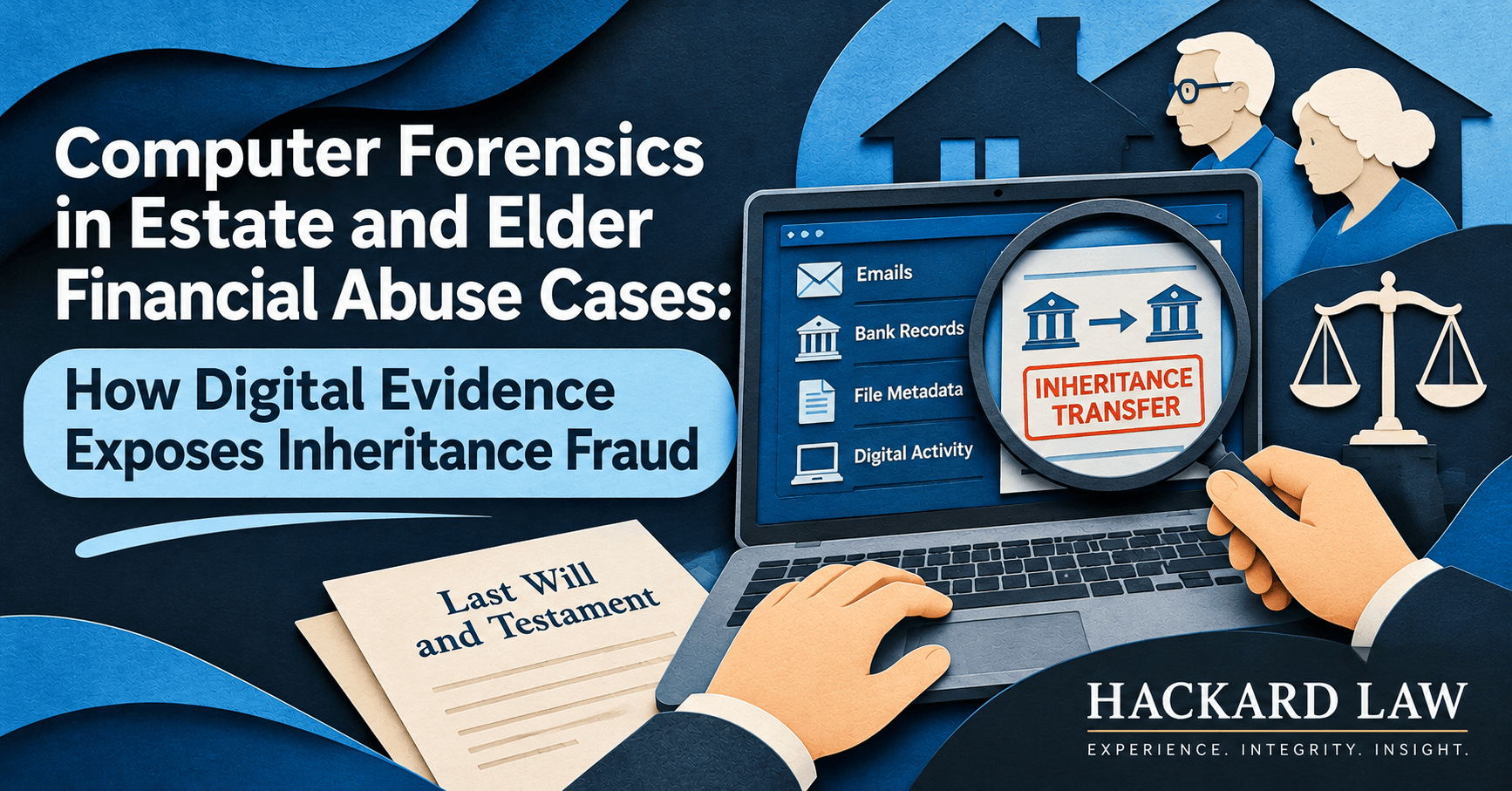
One of the most powerful tools we rely on today is computer forensics. Digital evidence – timestamps, file metadata, browsing history, email records – can tell a story that no witness and no document alone can tell. When a will appears out of nowhere, when a trust amendment surfaces after a loved one dies, when an elder’s finances are quietly drained through online transactions, the computer often holds the truth. In this post, I want to share what computer forensics looks like in real estate and elder financial abuse cases, and why it matters deeply to the families we represent.
Hackard Law provides contingency fee representation – no upfront costs for qualified cases. If you believe a loved one’s estate has been compromised, call us at (916) 313-3030.
Quick Summary
Computer forensics is a disciplined, court-recognized method of recovering and analyzing digital evidence from computers, phones, and storage devices. In estate and elder financial abuse litigation, it can expose forged documents, fraudulent will amendments, and financial exploitation that would otherwise go undetected.
Digital timestamps and file metadata can prove when a document was created or altered – even after the fact.
Computer forensic analysis can establish whether a deceased person was alive and active on a device at the time a disputed document was supposedly signed.
Evidence recovered from computers has turned single-victim cases into multi-count prosecutions involving dozens of victims.
Early engagement of a forensic investigator preserves evidence before it can be deleted or overwritten.
California law provides strong civil remedies, including double damages, for elder financial abuse supported by digital evidence.
The Science Behind Computer Forensics
Computer forensics is not simply pulling files off a hard drive. It is a methodical process governed by strict legal standards for how digital evidence must be collected, preserved, and analyzed. Investigators use court-accepted tools and documented chain-of-custody procedures that allow their findings to survive challenge in litigation.
Jim Carden, a forensic investigator with backgrounds in the Air Force Office of Special Investigations and law enforcement financial crimes units, has explained the discipline clearly. When he first began seizing computers as a financial crimes detective, his department lacked trained personnel to examine them. Suspects repeatedly pleaded guilty the moment computers were seized – they knew what was on those devices. Once Carden obtained formal computer forensics training through the Department of Justice, single-victim cases routinely expanded into prosecutions with dozens of counts. The computers contained everything.
For estate and elder financial abuse litigation, that same principle applies. A disputed will amendment, a suspicious trust modification, an unexplained transfer of cryptocurrency or real property – the computer tied to the decedent or the alleged perpetrator may hold timestamps, drafts, deleted files, and access logs that answer the central questions in dispute.
A Bitcoin Estate and a Suspicious Will
One of the most striking case patterns Carden described involves a reclusive elderly man who lived alone in a remote area and had developed an early interest in Bitcoin. When he passed away, his body was not discovered for approximately thirty days. Shortly after his death was reported, his self-described best friend – the person who found him – produced a newly updated will leaving the entire estate to himself.
The deceased’s family retained forensic investigators to examine his computer. What they found was straightforward and devastating to the friend’s claim: there was no computer activity from the date the coroner established as the date of death through the date the body was discovered. The will had been updated and changed after the friend located the body. The deceased had not touched his computer after he died – because he could not.
Case Pattern: A reclusive elder with significant cryptocurrency holdings dies alone. A person who claims to be his closest friend produces a new will shortly after discovering the body. Computer forensic analysis, combined with coroner records, establishes that the will was modified after the date of death. The family challenges the will, armed with digital evidence that directly contradicts the friend’s account.
This is the kind of case where California inheritance theft law intersects with forensic science. The computer does not lie. It records what happened and when.
Elder Financial Abuse and the Digital Trail
Elder financial abuse is one of the most prevalent and underreported crimes in California. It takes many forms – fraudulent real estate schemes, manipulation of estate documents, exploitation through caregiving relationships, and increasingly, digital financial crimes. For heirs, beneficiaries, and elder abuse victims, the challenge is often proving what happened when the elder can no longer speak for themselves.
Carden’s early career in financial crimes detective work illustrates how often the digital trail is the only reliable trail. In one case, an elderly woman was defrauded by a charismatic real estate operator who promised to move her family from a small condominium into a home. He collected thousands of dollars in down payments and delivered nothing. The patrol officer who took her initial report did not know what crime to charge – but he knew something was wrong and filed an information report rather than turning the woman away. That instinct preserved the case.
For families navigating elder financial exploitation in Sacramento and across Northern California, the lesson is the same: report early, preserve everything, and get legal and forensic help before evidence disappears. California’s elder abuse statutes provide meaningful remedies, including double damages and attorney fee recovery, when financial exploitation is proven.
Case Pattern: Real estate operator targets elder woman in fraudulent home-purchase scheme. She loses thousands of dollars before she calls the police. A detective who specializes in financial crimes will see many felony infractions that a patrol officer would not. Computer forensic evidence and confession during interrogation lead to a criminal conviction and imprisonment.
How Forensic Evidence Supports Civil Litigation
In estate and trust litigation in California, the standard is civil: a preponderance of the evidence. This is a lower hurdle than criminal prosecution, but the quality of evidence still matters immensely. Forensic digital evidence properly collected and certified bears great weight with probate judges and juries.
Hackard Law works with forensic investigators to build cases around digital evidence when the facts call for it. A trust amendment that appears to have been drafted after a settlor lost capacity, a power of attorney signed under suspicious circumstances, financial transfers made through online accounts in the final months of an elder’s life – these are areas where undue influence in California estate law and digital forensics intersect directly.
For families pursuing claims through Sacramento County probate litigation, understanding what forensic evidence can and cannot prove is essential to building a credible case. Metadata alone does not demonstrate purpose, but it can be used to support witness testimony, cast doubt on a perpetrator’s timeline, and provide a court with a factual basis to act.
Why Early Action Protects the Evidence
Digital evidence is fragile. Hard drives can be wiped. Devices can be discarded. Cloud accounts can be closed. In estate disputes, the period immediately following a death is often when the most critical evidence is most at risk – and when families are least equipped to think about preservation.
For heirs, beneficiaries, and elder abuse victims working with a Sacramento estate lawyer, the first priority after identifying a potential dispute should be preserving the digital record. That means not deleting emails, not returning or resetting devices, and not allowing a suspected perpetrator unsupervised access to the decedent’s home or electronics. It means contacting an attorney who understands both the legal and forensic dimensions of the case.
Early legal intervention in estate transfers involving elder financial abuse can mean the difference between a recoverable case and one where the evidence is gone before litigation begins. I have seen this trend happen countless times. Moving swiftly gives families something to work with for their lawyers and forensic experts. Families in those situations often find that the trail has gone cold.
Discovery, forensic analysis, and the pursuit of justice – they are not only legal techniques, but protective measures for families threatened by undue influence and deception. For decades, I’ve stood with families who have been informed that what happened to their loved one was a civil matter, that nothing could be done, that the forms were signed and the money was gone. The computer often told a different story. An unshakable loyalty to truth recovers what dishonesty sought to steal.
Key Definitions
Computer forensics: The disciplined collection, preservation, and analysis of digital evidence from electronic devices using court-accepted tools and documented procedures.
Metadata: Data embedded in digital files that records when a file was created, modified, or accessed – often invisible to casual users but recoverable by forensic investigators.
Chain of custody: The documented record showing who handled evidence, when, and how – required to authenticate digital evidence in court.
Undue influence: Pressure or manipulation that overcomes a person’s free will, often used to obtain changes to wills, trusts, or beneficiary designations.
Elder financial abuse: The wrongful taking, concealment, or appropriation of an elder’s property or funds, including through fraud, forgery, or manipulation.
Will contest: A legal challenge to the validity of a will, often based on lack of capacity, undue influence, or fraud.
Probate litigation: Court proceedings to resolve disputes over a deceased person’s estate, including will contests, trustee misconduct, and beneficiary claims.
Digital timestamp: A computer-generated record of when a file or action occurred, which forensic investigators can use to establish or challenge a timeline.
Contingency fee: A fee arrangement in which the attorney is paid only if the case is successful, with no upfront cost to the client.
Forensic investigator: A trained professional who applies scientific methods to recover and analyze evidence, including digital evidence, for use in legal proceedings.
What to Do Next
Look for any computers, phones, tablets, or external drives that belonged to the deceased or the elder – do not reset or discard them.
Get copies of any estate documents, including wills, trust amendments, and powers of attorney, as soon as possible.
Try to avoid allowing anyone with a financial interest in the estate unsupervised access to the decedent’s home or devices.
Look for unusual financial transactions, new beneficiary designations, or recently signed documents that do not match the elder’s known wishes.
Get copies of bank and financial account statements covering the last two to three years of the elder’s life.
Try to avoid confronting a suspected perpetrator directly before speaking with an attorney – this can compromise both civil and criminal investigations.
Document your concerns in writing, including dates, names, and specific incidents you observed.
Learn about your rights as a beneficiary – understanding what you are entitled to is the first step toward protecting it.
Call Hackard Law at (916) 313-3030 to discuss your situation with an attorney who handles estate fraud and elder financial abuse cases across California. You can also reach us through our contact page.
CALL THE SAGE | When Experience Matters, Families Listen
🏛️ We practice California trust & estate & elder financial abuse litigation
⚖️ We represent heirs, beneficiaries, and elder abuse victims
Explores how elder financial abuse cases have transformed modern estate litigation practice.
Frequently Asked Questions
Yes. Digital evidence that is properly collected and authenticated can be introduced in California probate and civil proceedings. Forensic investigators follow documented chain-of-custody procedures that allow their findings to withstand legal challenge, and courts have accepted digital evidence in will contests, trust disputes, and elder financial abuse claims.
Access does not necessarily mean the evidence is gone. Forensic investigators can often recover deleted files, access logs, and metadata even after a device has been used or partially wiped. The sooner you engage a forensic professional, the better the chances of recovering meaningful evidence.
Forensic analysis can establish when documents were created or altered, whether a decedent was actively using their devices near the time a disputed document was signed, and whether communications show pressure or manipulation. This timeline evidence can directly support or undermine a claim of undue influence.
Yes. Hackard Law serves clients throughout California’s major urban areas, including Sacramento, the San Francisco Bay Area, and Los Angeles. Cases involving elder financial abuse and estate fraud are handled on a contingency fee basis for qualified matters, meaning no upfront legal costs.
California’s Elder Abuse and Dependent Adult Civil Protection Act provides civil remedies including double damages, attorney fee recovery, and enhanced protections for victims of financial exploitation. These remedies apply when financial abuse is proven, and they can be pursued alongside trust or probate litigation.
About the Author
Michael Hackard is the founder of Hackard Law, a California trust and estate litigation firm with more than five decades of experience protecting the inheritance rights of families across Sacramento, the San Francisco Bay Area, and Los Angeles. He is the author of six published books and has produced more than 1,000 educational videos with over seven million views.


 (916) 313-3030

 Michael Hackard is the founder of Hackard Law, a California trust and estate litigation firm with more than five decades of experience protecting the inheritance rights of families across Sacramento, the San Francisco Bay Area, and Los Angeles. He is the author of six published books and has produced more than 1,000 educational videos with over seven million views.