


 (916) 313-3030
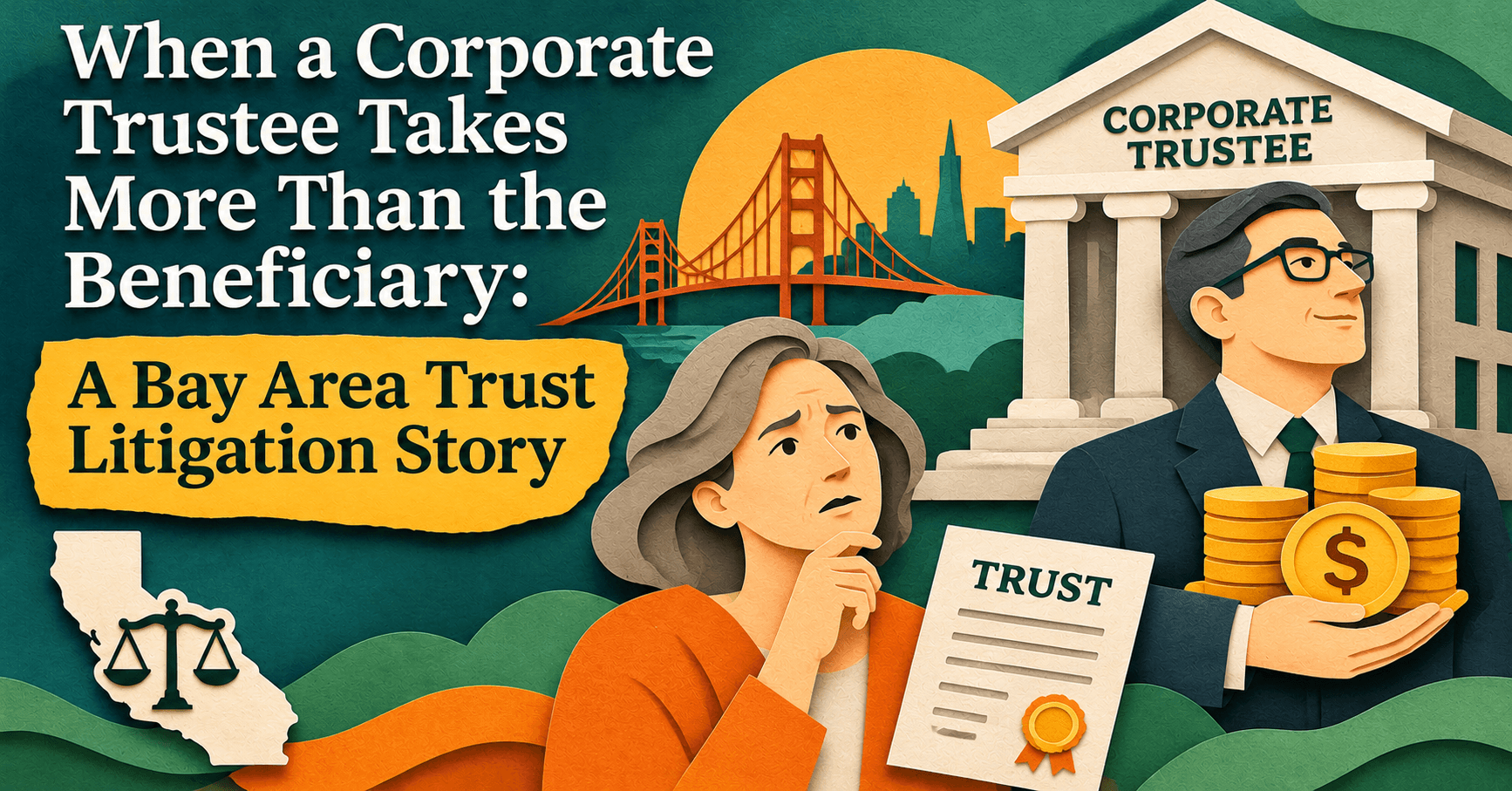
When a Corporate Trustee Takes More Than the Beneficiary: A Bay Area Trust Litigation Story

A Trustee Who Served Itself First
I’m Michael Hackard, founder of Hackard Law. Over fifty years of practice, I have stood beside heirs, beneficiaries, and elder abuse victims whose inheritances were quietly drained by the very people appointed to protect them. I have written seven books on inheritance protection and produced more than 1,000 educational videos that have drawn over seven million views – because families deserve to understand what is happening inside their trusts before it is too late. Hackard Law serves clients throughout the San Francisco Bay Area, Sacramento, and Los Angeles, with a focus on California’s largest urban counties where trust assets are most concentrated and trustee misconduct can go unchallenged for years.
The story I want to share today is drawn from real-life patterns in Bay Area trust litigation. The names and identifying details have been changed to protect confidentiality. But the dynamic – a corporate trustee collecting more in fees than it distributes to the rightful beneficiary – is one I have encountered far too often.
Hackard Law handles qualified trust and estate cases on a contingency fee basis, meaning there are no upfront costs for clients who qualify. To find out whether your situation qualifies, call us at (916) 313-3030.
Quick Summary
This post walks through a real-life pattern of corporate trustee misconduct in which a Bay Area beneficiary received a fraction of what the trust was designed to provide – while the trustee collected more in fees than it paid out to her.
- A mother created a trust to ensure her daughter would always be financially supported
- After the mother’s death, a corporate trustee took control of roughly $3 million in trust assets
- The trustee paid itself $42,000 in fees while distributing only $24,000 to the beneficiary in the same period
- The beneficiary received 0.8% of trust assets; the trustee collected 1.4% for itself
- Hackard Law evaluates these cases and, where warranted, pursues litigation to restore what was taken
How the Trust Was Designed
Mama Bear – a long-time San Francisco resident – lost her husband in 2010. She had one daughter, Cinderella, who lived in a modest Daly City apartment and worked a modest-paying job. Mama Bear’s deepest concern was making sure her daughter would never have to struggle financially after she was gone.
She worked with a trust drafting attorney who prepared a revocable trust with standard HEMS language: the trustee was authorized to distribute income and principal for the beneficiary’s health, education, maintenance, and support, taking into account any other resources available to her. The trust also named a corporate trustee – a professional fiduciary company – as successor trustee after Mama Bear’s death. Any remaining principal at Cinderella’s death would pass to a university foundation.
The structure was reasonable. The intent was clear. What happened next was not what Mama Bear had in mind.
What the Corporate Trustee Actually Did
After Mama Bear passed away, the corporate trustee – call it Flanno – took control of the trust. Following the sale of real estate, the trust held approximately $3 million. Cinderella reached out repeatedly, asking about distributions to help cover her rent, medical insurance, and basic living costs.
Flanno never asked Cinderella a single question about her health, her financial needs, or her circumstances. Instead, a committee decided – without any individualized inquiry – to pay her $36,000 per year in income and nothing from principal. That decision was made annually, with no guarantee of continuity.
When Cinderella shared the trust’s market reconciliation statement with us, the numbers told the story plainly. Year to date, Flanno had collected $42,000 in trustee fees and expenses. Cinderella had received $24,000. The trustee was taking more from the trust than the beneficiary it was legally obligated to serve. For more on how these distribution disputes unfold, see what California beneficiaries can do when a trustee delays distributions without cause.
Case Pattern: Corporate Trustee Fee Extraction
A Bay Area beneficiary contacted Hackard Law after discovering that the corporate trustee managing her late mother’s trust had collected nearly double in fees what it had distributed to her over the same period. The trustee had never conducted any needs assessment, never reviewed the beneficiary’s financial circumstances, and never considered principal distributions despite the trust’s clear HEMS authorization. Litigation to compel proper distributions and recover excess fees was pursued on a contingency basis.
The HEMS Standard and Why It Matters
HEMS stands for health, education, maintenance, and support. It is one of the most common distribution standards in California trusts, and it carries real legal weight. A trustee administering a HEMS trust is not free to simply set an arbitrary annual payment and move on. The trustee has a duty to actually inquire into the beneficiary’s circumstances – their income, their health costs, their housing situation – before making a distribution decision.
Flanno did none of that. It made a committee decision, set a number, and moved forward without ever speaking meaningfully with Cinderella about her needs. That is not trust administration. That is self-serving inaction dressed up as process. The top 10 most common probate, trust, and estate battles in California frequently include exactly this pattern: a trustee hiding behind procedure while the beneficiary goes underserved.
California Probate Code imposes a duty of loyalty on trustees. A trustee must administer the trust solely in the interest of the beneficiaries – not in the interest of its own fee revenue. When a corporate trustee structures distributions in a way that maximizes its own compensation relative to beneficiary payouts, that duty is in serious jeopardy.
Case Pattern: HEMS Duty Ignored
In a pattern Hackard Law has seen across Bay Area and Alameda County cases, a corporate trustee administering a HEMS trust failed to document any inquiry into the beneficiary’s actual needs before setting an annual distribution. When litigation commenced, discovery revealed that the trustee’s internal records contained no financial assessment of the beneficiary whatsoever – only committee meeting minutes approving a flat payment. The court found the trustee’s process deeply deficient.
What Cinderella’s Story Reveals About Corporate Trustees
Cinderella asked me directly: did her mother really want the trust company to receive more from the trust than she did? The answer, of course, is no. Mama Bear told her attorney she wanted her daughter to always be taken care of, that Cinderella would never have to worry about money. What Flanno was providing barely covered rent and medical insurance.
Corporate trustees are not necessarily evil actors. Most do their tasks faithfully. But the framework of corporate trust management – committees, annual reviews, fee schedules – can subtly shift the incentives of the trustee away from the beneficiary and toward institutional efficiency. That shift might become something worse when there’s no one around. Families dealing with Oakland estate litigation or disputes in Alameda County often discover this dynamic only after years of underpayment.
I have seen the financial toll grow year after year in cases like this. Each year the trustee collects its fee. Each year the beneficiary scrapes by. And each year the trust principal sits largely untouched – available to the trustee’s fee calculations, unavailable to the person the trust was built to protect. The fracture between what a parent intended and what a corporate trustee delivers can run too deep for any single distribution to mend.
For beneficiaries in Santa Clara and the broader Bay Area, understanding your rights before engaging a trustee in litigation is critical. Our colleagues at Santa Clara estate litigation handle these disputes with the same commitment to accountability.
How Hackard Law Evaluates These Cases
When Cinderella came to us, we reviewed the trust documents, the market reconciliation statements, the history of communications with Flanno, and the legal framework governing HEMS distributions. We evaluated the likely venue for a trust petition, the options for attorney fees, and the strength of the evidence.
Hackard Law takes significant cases where we believe we can make a meaningful difference and where the responsible party can be held financially accountable. We litigate trust disputes across California’s major urban counties – including San Mateo, Santa Clara, Alameda, Contra Costa, and Sacramento. For clients who cannot afford hourly rates, contingency fee representation makes it possible to pursue justice without paying out of pocket.
For decades, I have stood with families who discovered too late that the trustee they trusted was serving itself first. Discovery, forensic analysis, and the pursuit of accountability – these are not just legal strategies, but safeguards for families whose loved ones placed their trust in the wrong hands. A steadfast commitment to truth restores what institutional indifference tried to steal.
Key Definitions
- HEMS standard: A trust distribution standard authorizing the trustee to pay income or principal for the beneficiary’s health, education, maintenance, and support.
- Successor trustee: The individual or institution that takes over trust administration after the original trustee (often the grantor) dies or becomes incapacitated.
- Revocable trust: A trust the grantor can amend or revoke during their lifetime; it becomes irrevocable at death.
- Corporate trustee: A professional fiduciary institution – such as a bank or trust company – appointed to administer a trust, typically for a fee.
- Duty of loyalty: A trustee’s legal obligation to administer the trust solely in the interest of the beneficiaries, not in the trustee’s own interest.
- Trustee fees: Compensation paid to the trustee from trust assets for administration services, subject to a reasonableness standard under California law.
- Trust petition: A court filing used to challenge trustee conduct, compel distributions, or seek removal of a trustee in California probate court.
- Principal: The core assets held in a trust, as distinct from income generated by those assets.
- Accumulation clause: A trust provision directing that undistributed income be added to the trust’s principal rather than carried forward as distributable income.
- Breach of fiduciary duty: A legal claim arising when a trustee fails to meet its legal obligations to the beneficiaries it serves.
What to Do Next
- Look for the trust document and any amendments – the distribution standard (HEMS or otherwise) is the foundation of your claim.
- Get copies of all trustee accountings and fee statements so you can compare what the trustee collected against what was distributed to you.
- Write down every communication you have had with the trustee about distributions, including dates and what was said.
- Look for any documentation showing the trustee’s process for deciding distributions – or the absence of one.
- Try to avoid signing any releases or agreements with the trustee before speaking with an attorney.
- Review the five things every California trust beneficiary should know before your first legal consultation.
- Learn about your options through Michael Hackard’s attorney bio and the firm’s track record in trust litigation.
- Try to avoid waiting too long – California trust contests and surcharge claims have strict deadlines.
- Call Hackard Law at (916) 313-3030 to discuss your situation with our team.
- Visit our contact page to schedule a confidential consultation at no upfront cost for qualified cases.
CALL THE SAGE | When Experience Matters, Families Listen
🏛️ We practice California trust & estate & elder financial abuse litigation
⚖️ We represent heirs, beneficiaries, and elder abuse victims
🎥 1,000+ educational videos | 7 million+ views | 7 published books
🎯 “After thousands of cases, I see the pattern others miss.”
CONTINGENCY REPRESENTATION – No Win, No Fee
Throughout California: Sacramento | Los Angeles | Bay Area
📞 CALL THE SAGE: (916) 313-3030
Subscribe for weekly insights on:
- Elder financial abuse warning signs and prevention
- Trust and estate litigation strategies
- Inheritance protection for California families
- Family protection strategies
When your inheritance is under attack, Call The Sage.
Hackard Law | 10640 Mather Blvd, Mather CA 95655
Attorney Advertisement | Michael Hackard, State Bar #71067
RELATED VIDEOS
Abused Trust Beneficiary Litigation Lawyers | Alameda County
Explores how Bay Area beneficiaries can fight back against trustee misconduct and abuse.
Trust Beneficiary Distributions | Trustee Judgment Required?
Examines how trustees are supposed to exercise judgment when making distributions to beneficiaries.
Unfair Trust Distributions | California Trust Litigation
Looks at what beneficiaries can do when trust distributions feel unfair or inadequate.
San Francisco Bay Area Trust Litigation Making Contingency Cases Economically Viable
Explains how contingency fee arrangements make Bay Area trust litigation accessible to beneficiaries.
What Makes Hackard Law’s Bay Area Practice Successful | Contingency Trust Litigation Attorney
Describes the approach Hackard Law uses to win high-stakes Bay Area trust cases.
Beneficiary of a California Trust? | What You Need to Know
Covers the essential rights and protections California law gives to trust beneficiaries.
 Michael Hackard has practiced law since 1976 and is the founder of Hackard Law, a California trust and estate litigation firm protecting the inheritance rights of families across Sacramento, the San Francisco Bay Area, and Los Angeles. He is the author of seven published books and has produced more than 1,000 educational videos with over seven million views.